
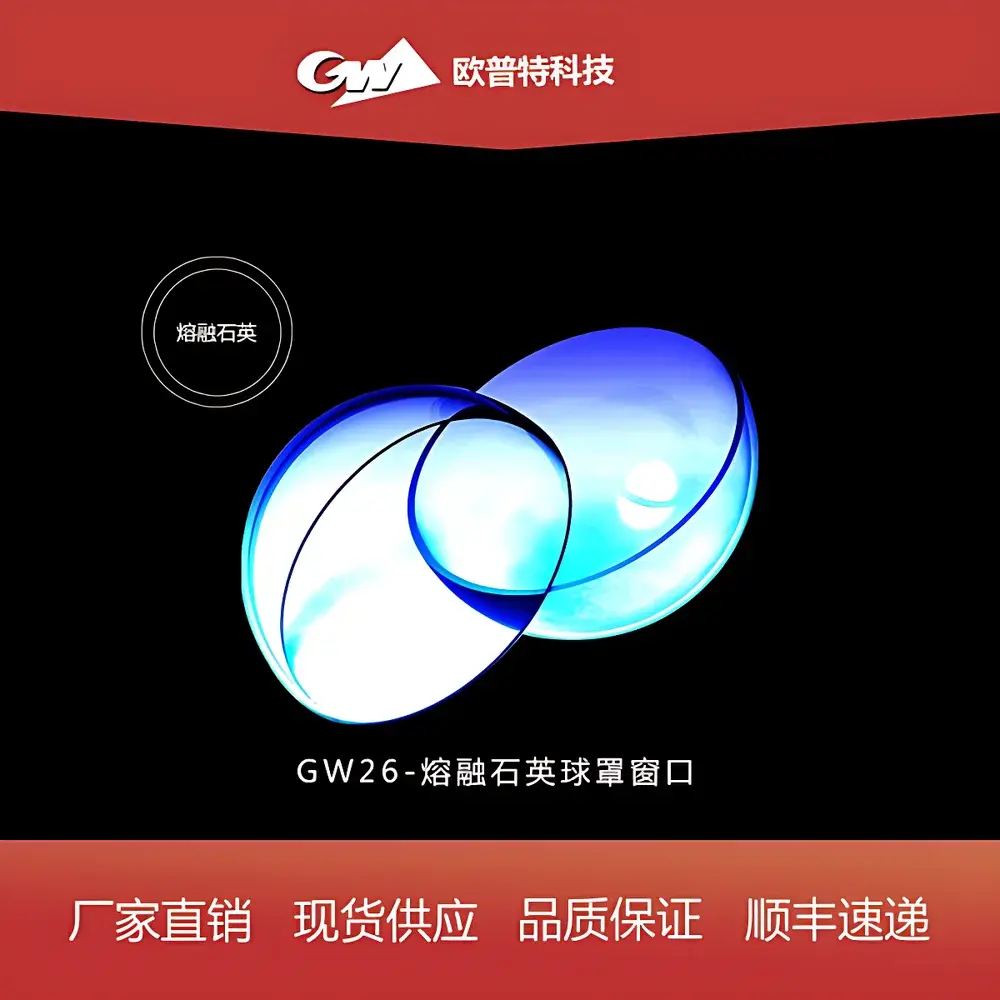
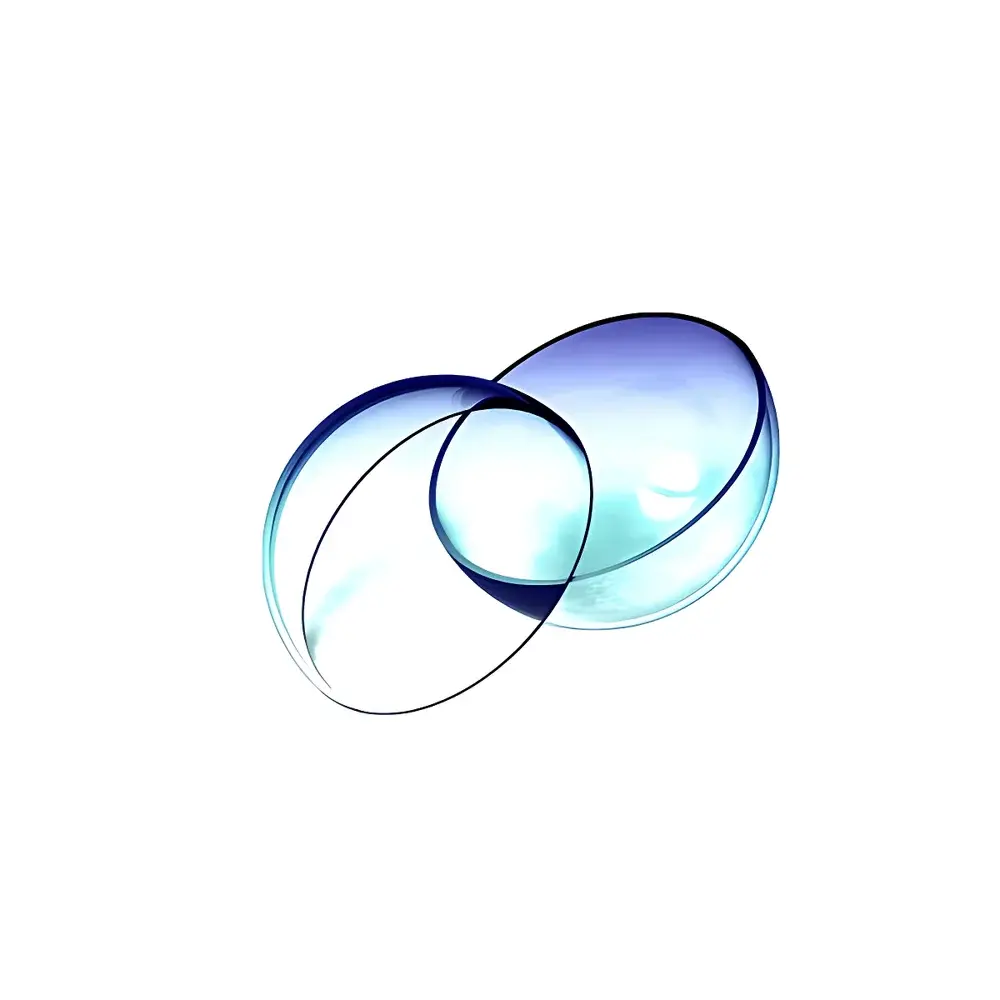
GW26 Fused Silica Spherical Dome Window
| Material | Fused Silica |
|---|---|
| Surface Figure | Local ΔN < 10 @ 633 nm |
| Surface Quality | 40-20 (MIL-PRF-13830B) |
| Diameter Tolerance | +0.0 / −0.1 mm |
| Thickness Tolerance | ±0.2 mm |
| Edge Treatment | Protective 45° chamfer, 0.2–0.5 mm |
| Coating | Optional AR or custom broadband coating per specification |
| Diameter Options | 3 mm, 25 mm, 50 mm, 75 mm, 100 mm |
| Dome Height | 11.5–49.0 mm (model-dependent) |
| Center Thickness | 1.0–4.0 mm (model-dependent) |
Overview
The GW26 Fused Silica Spherical Dome Window is a precision optical component engineered for demanding applications requiring wide-angle transmission, minimal wavefront distortion, and high environmental stability. Constructed from synthetic fused silica (SiO₂), this dome window leverages the material’s exceptional UV-to-NIR transmission (180 nm – 2.1 µm), near-zero thermal expansion coefficient (~0.55 × 10⁻⁶ /°C), and high laser-induced damage threshold (LIDT > 10 J/cm² at 1064 nm, 10 ns pulse). Its spherical geometry provides uniform optical path length across incident angles up to ±60°, making it ideal for non-normal incidence scenarios where planar windows introduce significant aberrations or beam deviation. Unlike flat windows, the dome design eliminates focus shift and minimizes reflection-induced ghosting—critical in imaging spectrometers, infrared sensor housings, and aerospace-grade optical front ends.
Key Features
- Fused silica substrate with certified homogeneity and bubble/inclusion grade ≤ ISO 10110-3 Class 1
- Surface figure accuracy: Local irregularity ΔN < 10 waves @ 633 nm (λ/10 PV), verified via phase-shifting interferometry
- Surface quality rated to 40–20 scratch-dig per MIL-PRF-13830B, ensuring low scatter performance in high-sensitivity detection systems
- Precision-ground and polished spherical dome profile with controlled radius of curvature tolerance ±0.3%
- Consistent center thickness control within ±0.2 mm, enabling predictable optical power and thermal lensing behavior
- Protective 45° edge chamfer (0.2–0.5 mm) mitigates chipping during handling and mounting while preserving effective clear aperture
- Optional anti-reflection coatings available: single-layer MgF₂ (for UV-VIS), V-coat (1064 nm), or broadband AR (400–1100 nm, R<0.5% avg)
Sample Compatibility & Compliance
The GW26 series is compatible with standard kinematic and flexure-based optical mounts (e.g., Thorlabs KM100, Newport UMB12) and integrates seamlessly into vacuum-compatible enclosures (10⁻⁶ Torr capable with proper bake-out). All units undergo 100% inspection per ISO 10110-7 for surface defects and are traceable to NIST-calibrated interferometric standards. The fused silica raw material complies with ASTM F796 for optical quartz and meets RoHS Directive 2011/65/EU. No hazardous substances are introduced during polishing or cleaning; final cleaning follows ISO 10110-7 Class 5 particulate limits (<5 particles ≥5 µm per cm²).
Software & Data Management
While the GW26 is a passive optical element, its geometric and metrological data—including measured surface figure maps, spectral transmittance curves (200–2500 nm), and coating reflectance spectra—are delivered in standardized formats (CSV, Zemax .ZBF, and STEP AP214) for integration into optical design workflows (Zemax OpticStudio, CODE V, FRED). Each unit ships with a Certificate of Conformance (CoC) containing serial-numbered test reports compliant with ISO 9001:2015 documentation requirements. Traceability records support GLP/GMP validation protocols and FDA 21 CFR Part 11–aligned audit trails when paired with enterprise lab management systems.
Applications
- Front-end protective windows for uncooled microbolometer arrays and InSb/MCT detectors in thermal imaging systems
- Hermetic encapsulation domes for fiber-coupled photodiodes and quadrant detectors operating under pressure differential or corrosive atmospheres
- UV spectroscopy probe heads requiring high transmission below 200 nm and resistance to solarization
- Aerospace payload optics, including star tracker baffles and LIDAR receiver apertures exposed to atomic oxygen and thermal cycling
- High-power laser diagnostics where thermal lensing must be minimized across broad spectral bands
FAQ
What is the maximum operating temperature for the GW26 dome window?
Fused silica maintains structural integrity up to 1050°C in air; continuous operation is recommended below 800°C to prevent devitrification over extended periods.
Can the GW26 be custom-coated for specific laser lines?
Yes—custom dielectric coatings (e.g., HR @ 1550 nm, dual-band AR for 532/1064 nm) are available upon request with typical lead time of 3–4 weeks.
Is the dome geometry optimized for immersion applications?
The standard GW26 dome assumes air-to-glass interface; for liquid-immersion use (e.g., water, silicone oil), radius-of-curvature and thickness can be recalculated to maintain telecentricity—contact engineering support for ray-trace validation.
Do you provide mounting fixtures or flanges?
Standard configurations include bare optics only; however, custom O-ring grooves, threaded retaining rings (M25×0.75, M50×0.75), and CF-35/CF-63 flange adapters are offered as optional accessories.
How is wavefront error characterized for each unit?
Each dome undergoes full-aperture interferometric testing using a Zygo Verifire™ MST with a calibrated reference sphere; results include PV, RMS, and Zernike decomposition up to 37 terms, supplied digitally with the CoC.




