
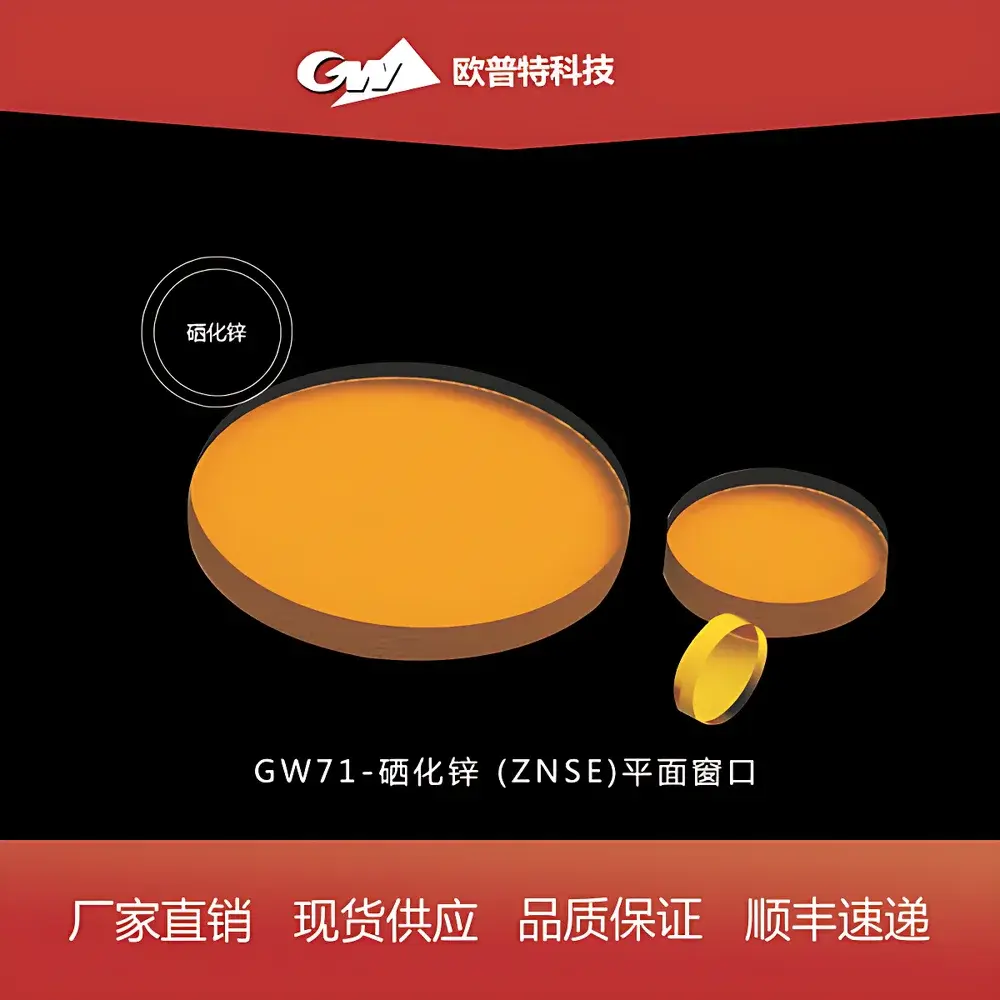
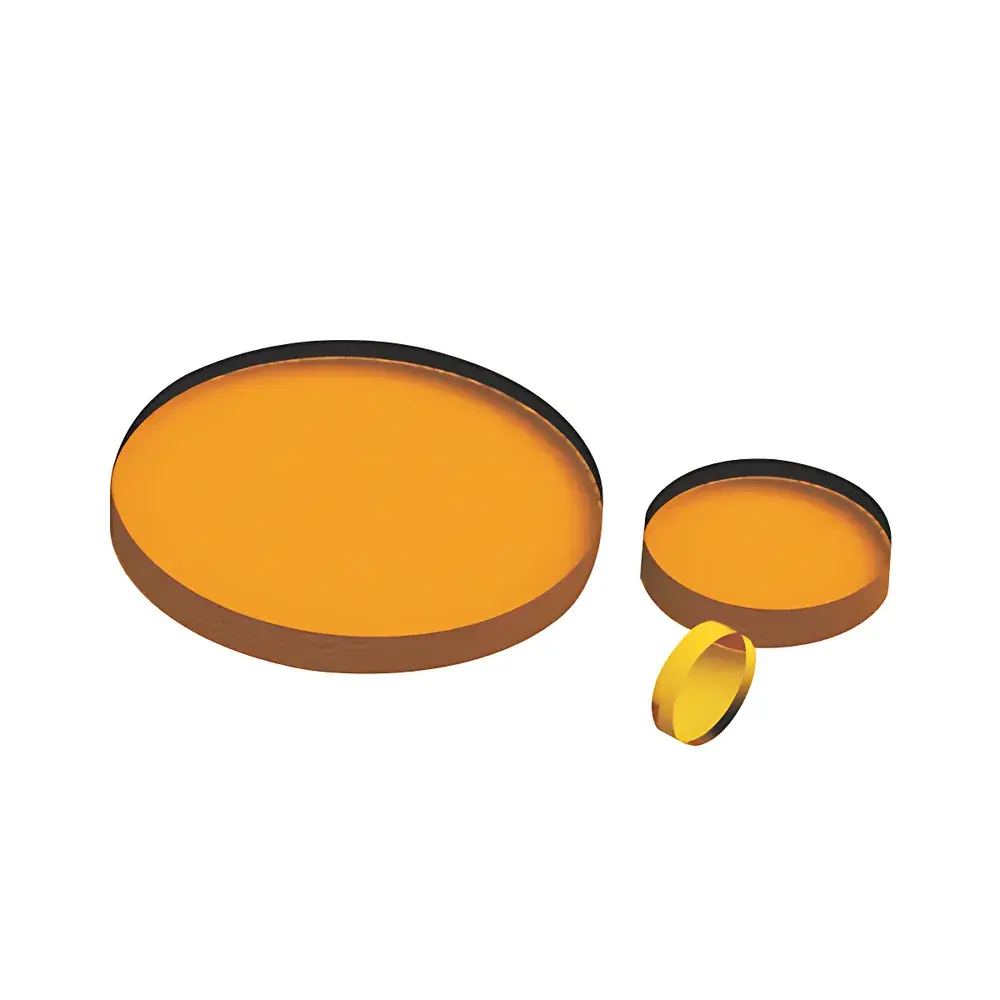
GW71 ZnSe (Zinc Selenide) Optical Window
| Origin | Beijing, China |
|---|---|
| Manufacturer Type | Distributor |
| Origin Category | Domestic |
| Model | GW71 |
| Price Range | USD 70–140 |
| Component Category | Optical Element |
| Diameter Options | 3, 12.5, 12.7, 25.0, 25.4, 40.0, 50.0 mm |
| Thickness Options | 3.0 or 5.0 mm |
| Coating Options | Uncoated or Broadband Anti-Reflection (AR) with R<sub>avg</sub> < 1% @ 8–12 µm |
Overview
The GW71 ZnSe (Zinc Selenide) Optical Window is a precision-transmission component engineered for mid-infrared (MIR) optical systems operating in the 0.5–20 µm spectral range. Zinc selenide exhibits exceptionally high transmittance (>70%) across the 8–12 µm atmospheric window—the critical band for thermal imaging, CO₂ laser delivery (10.6 µm), FTIR spectroscopy, and gas sensing applications. Unlike fused silica or BK7, ZnSe offers negligible absorption and low dispersion in this region, making it the material of choice for demanding IR instrumentation where thermal stability, low birefringence, and consistent wavefront transmission are essential. The GW71 series features optically polished plano surfaces with surface quality rated at 60–40 scratch-dig (per MIL-PRF-13830B), parallelism ≤3 arcmin, and surface flatness λ/4 @ 633 nm—ensuring minimal beam deviation and phase distortion in collimated or focused IR paths.
Key Features
- High-purity polycrystalline ZnSe substrate with certified bulk transmission data traceable to NIST-referenced reference spectra
- Multiple standard diameters (3 mm to 50 mm) and thicknesses (3.0 mm and 5.0 mm) to accommodate compact sensor housings, laser cavities, and spectrometer fore-optics
- Two coating configurations: uncoated for maximum broadband utility or AR-coated with ion-assisted e-beam deposition for Ravg < 1% over 8–12 µm—optimized for CO₂ laser systems and thermal camera windows
- Chemically stable under ambient laboratory conditions; resistant to moisture-induced degradation when handled per ISO 9022-2 cleanroom protocols
- Thermal expansion coefficient of 7.6 × 10⁻⁶ K−1, enabling reliable performance in temperature-cycled environments up to +150 °C (short-term)
- Compliant with RoHS Directive 2011/65/EU; no cadmium or lead-based dopants in raw material synthesis
Sample Compatibility & Compliance
The GW71 window is compatible with standard kinematic mounts (e.g., Thorlabs SM1-threaded housings), vacuum flanges (CF-35/CF-63), and custom O-ring sealed enclosures. Its low intrinsic fluorescence and absence of hydroxyl (OH) absorption peaks make it suitable for quantum cascade laser (QCL) spectroscopy and heterodyne detection setups requiring signal-to-noise ratios >60 dB. All coated variants undergo environmental durability testing per MIL-C-48497A (adhesion, humidity, abrasion). Documentation includes material certificate (ASTM F2692-21 compliant), spectral transmittance report (measured on PerkinElmer Lambda 950 with MCT detector), and dimensional inspection report (CMM verified).
Software & Data Management
While the GW71 is a passive optical component, its specifications integrate seamlessly into optical design workflows via Zemax OpticStudio (.ZAR) and CODE V-compatible material files (Schott Glass Code: ZNSE). Transmittance curves (uncoated and AR-coated) are provided in ASCII format for import into MATLAB, Python (NumPy), or LabVIEW-based system modeling tools. Each shipped unit carries a unique serial number linked to a digital QC dossier—including interferometric surface map, spectral scan metadata, and coating uniformity validation—accessible through secure customer portal login (2FA enabled, GDPR-compliant data handling).
Applications
- Laser system output couplers and cavity end windows for CO₂, QCL, and OPO sources
- FTIR spectrometer beam splitters and detector protection windows
- Thermal imaging lens assemblies (uncooled microbolometer and cooled InSb/MCT systems)
- Gas analyzers targeting CH₄, CO, NO₂, and SF₆ using tunable diode laser absorption spectroscopy (TDLAS)
- Environmental monitoring sensors deployed in industrial stack emissions monitoring (EPA Method 30B compliance support)
- Research-grade cryogenic optics where ZnSe’s low thermal conductivity (18 W/m·K) minimizes conductive heat load
FAQ
What is the damage threshold for GW71 ZnSe windows under continuous-wave CO₂ laser irradiation?
For uncoated GW71 windows at 10.6 µm, the nominal CW laser-induced damage threshold (LIDT) is ≥500 W/cm² (tested per ISO 21254-2 with 10.6 µm, 10 s exposure). AR-coated variants maintain ≥450 W/cm² due to reduced surface absorption.
Can GW71 windows be used in vacuum environments?
Yes—GW71 windows are vacuum-compatible up to 10⁻⁶ Torr when mounted with metal gaskets (e.g., copper or indium). Outgassing rates meet ASTM E595 requirements (<1.0% TML, <0.1% CVCM).
Is custom diameter or thickness available?
Custom dimensions (e.g., 18.0 mm Ø × 4.0 mm thick) and substrate doping (e.g., Fe-doped for enhanced 10.6 µm transmission) are available under NRE agreement with 8-week lead time.
How should ZnSe windows be cleaned to avoid surface damage?
Use spectroscopic-grade methanol followed by dry nitrogen purge; avoid acetone or ultrasonic cleaning. Refer to ISO 10110-7 handling guidelines for ZnSe-specific protocols.
Do you provide ISO/IEC 17025-accredited calibration reports?
Spectral transmittance verification is performed in-house per ISO/IEC 17025:2017 accredited procedures (Scope ID: CNAS LXXXXX); third-party certification available upon request.





