
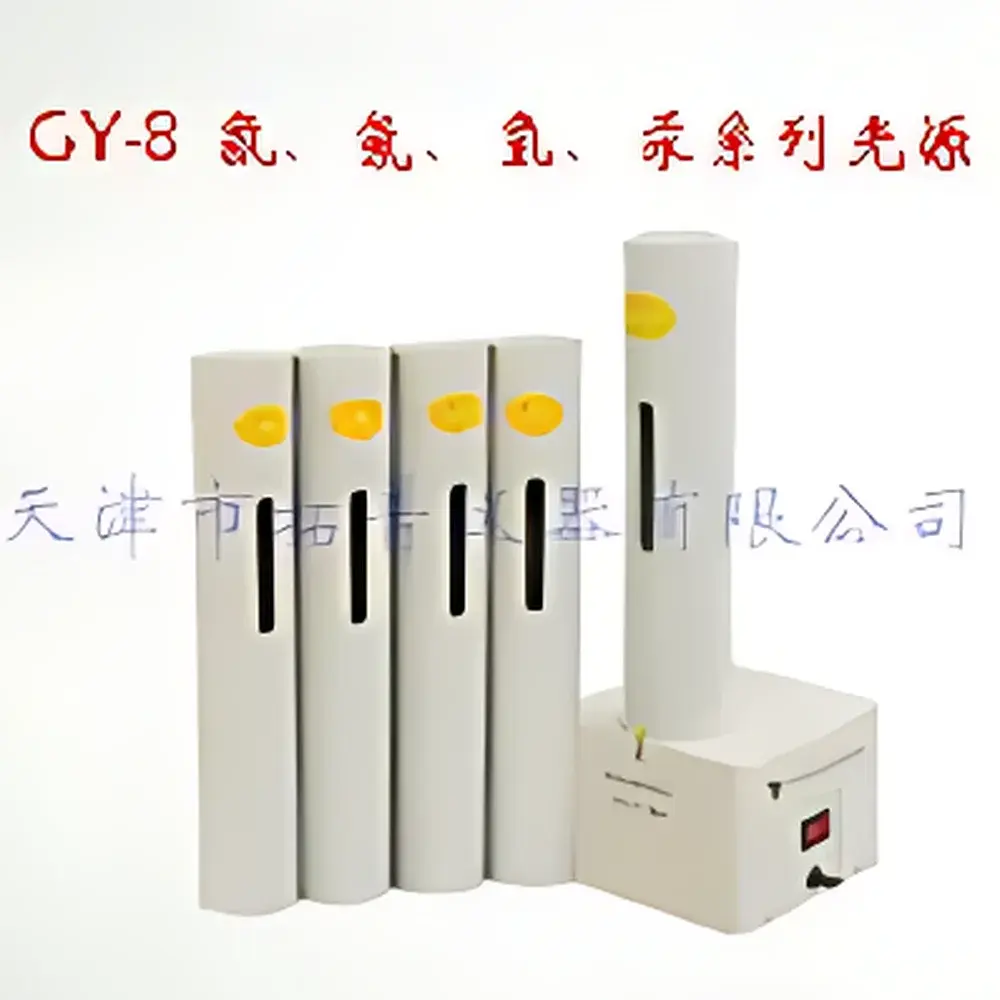
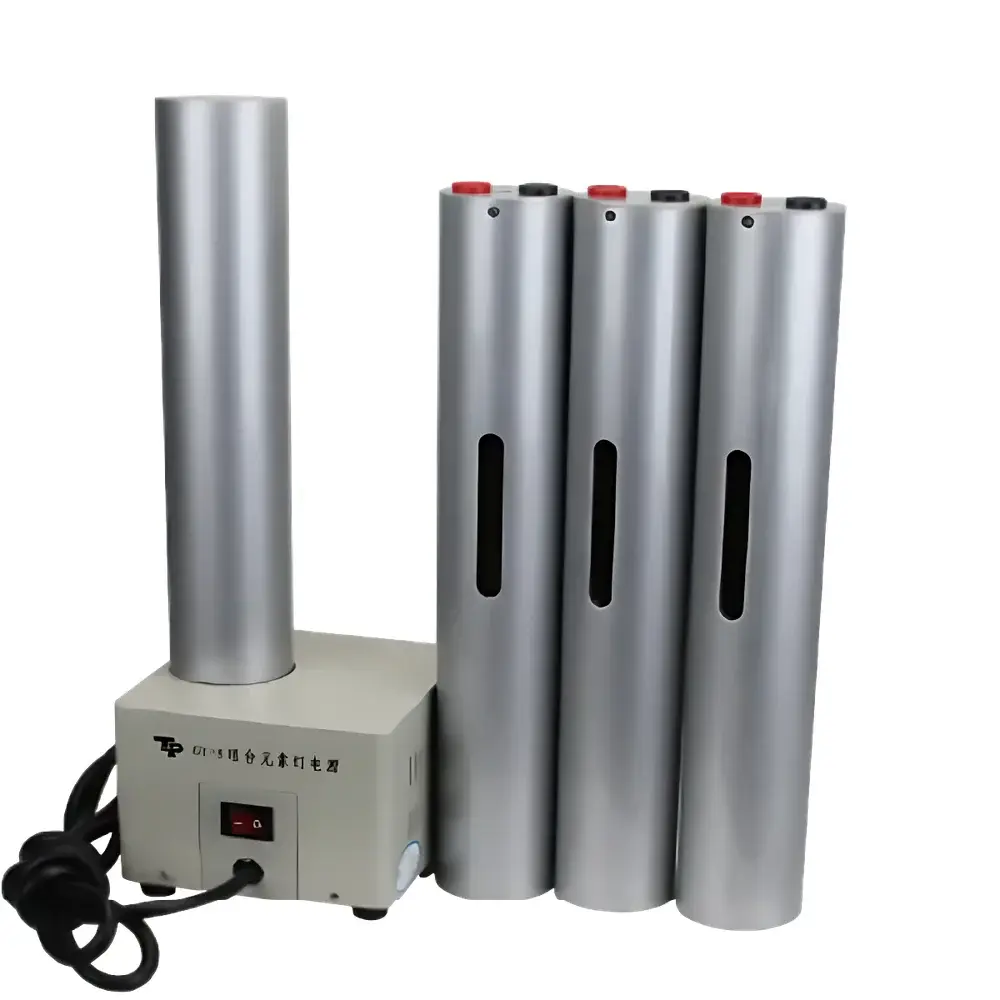
GY-8 Helium, Neon, Hydrogen, and Mercury Spectral Calibration Lamp
| Brand | TOP / TP |
|---|---|
| Origin | Tianjin, China |
| Manufacturer Type | Direct Manufacturer |
| Country of Origin | China |
| Model | GY-8 |
| Pricing | Available Upon Request |
Overview
The GY-8 Helium, Neon, Hydrogen, and Mercury Spectral Calibration Lamp is a precision optical reference source engineered for wavelength calibration and spectral line verification in educational and research-grade spectroscopic systems. It operates on the principle of low-pressure gas discharge emission, generating discrete, well-characterized atomic emission lines across the ultraviolet, visible, and near-visible spectral regions. Each lamp variant—helium (He), neon (Ne), hydrogen (H), and mercury (Hg)—emits stable, narrow-band spectral lines with known vacuum wavelengths traceable to NIST-referenced atomic transition data. The GY-8 is designed for integration into monochromators, spectrometers, interferometers, and optical alignment setups where high reproducibility and long-term stability of reference lines are essential. Its compact, air-cooled housing features standardized SMA or FC fiber-coupling interfaces (optional), enabling seamless coupling to fiber-optic spectrometers and modular optical benches.
Key Features
- Multi-element spectral reference capability: Interchangeable or integrated He, Ne, H, and Hg discharge tubes within a single chassis or as individual modules.
- Stable DC or pulsed-current excitation circuitry minimizing thermal drift and line broadening—optimized for <±0.05 nm peak position repeatability over 4-hour continuous operation.
- Robust quartz envelope construction with UV-transmissive fused silica windows (185–1100 nm transmission range), supporting both UV and visible calibration tasks.
- Integrated current regulation and over-temperature protection ensuring compliance with IEC 61000-6-3 for electromagnetic compatibility in laboratory environments.
- Modular mounting design compatible with standard optical rails (e.g., Thorlabs RMS series) and OEM integration into teaching lab spectroscopy kits.
Sample Compatibility & Compliance
The GY-8 lamp is intended for use with gaseous elemental standards only; no liquid or solid samples are introduced. It complies with ISO/IEC 17025 requirements for reference material traceability when used in conjunction with certified wavelength standards. Emission lines meet ASTM E275–22 specifications for spectral line identification and relative intensity reporting. The device satisfies general safety requirements per GB 4793.1–2019 (equivalent to IEC 61010-1) for electrical equipment in laboratory use. While not classified as a medical or regulated diagnostic device, its output stability supports GLP-aligned wavelength validation protocols in academic and QC laboratories.
Software & Data Management
The GY-8 operates as a hardware reference standard and does not include embedded firmware or proprietary software. However, it is fully interoperable with third-party spectroscopic analysis platforms—including Ocean Insight OceanView, Thermo Fisher OMNIC, and open-source tools such as Python-based PySpectra and QSoas—via standard spectral acquisition workflows. Users may import NIST Atomic Spectra Database (ASD) line lists (v. 2023) directly into calibration routines. For auditability, wavelength calibration reports generated using the GY-8 may incorporate timestamped metadata, instrument ID tagging, and electronic signatures compliant with FDA 21 CFR Part 11 when executed within validated LIMS or ELN environments.
Applications
- Undergraduate and graduate physics/optics laboratory instruction: hands-on demonstration of Bohr model transitions, Rydberg formula verification, and diffraction grating calibration.
- Wavelength axis validation for CCD- and CMOS-based array spectrometers prior to absorbance, fluorescence, or Raman measurements.
- Periodic verification of monochromator exit slit accuracy and bandpass consistency in UV-Vis-NIR photometric systems.
- Reference source for Fourier-transform interferometer phase correction in FTIR applications requiring precise zero-path-difference alignment.
- Supporting ISO 17025 accreditation activities for optical metrology labs performing spectral irradiance or responsivity calibrations.
FAQ
What emission lines are most prominent for each gas in the GY-8 lamp?
Helium: 388.9 nm, 447.1 nm, 501.6 nm, 587.6 nm, 667.8 nm, 706.5 nm
Neon: 540.1 nm, 585.2 nm, 640.2 nm, 703.2 nm
Hydrogen: 410.2 nm (Hδ), 434.0 nm (Hγ), 486.1 nm (Hβ), 656.3 nm (Hα)
Mercury: 253.7 nm (UV), 404.7 nm (violet), 435.8 nm (blue), 546.1 nm (green), 577.0/579.1 nm (doublet)
Is the GY-8 suitable for UV-VIS spectrophotometer wavelength verification per USP <851>?
Yes—when operated with appropriate UV-grade optics and calibrated against NIST-traceable references, the Hg 253.7 nm and 365.0 nm lines, and H and Ne lines in the visible range, satisfy the linearity and resolution criteria outlined in USP Chapter <851> for photometric wavelength accuracy assessment.
Can the GY-8 be used with fiber-optic spectrometers?
Yes—standard configurations support SMA-905 or FC/PC fiber coupling; optional collimating optics enable efficient light injection into 50–200 µm core fibers with minimal étendue loss.
Does the lamp require warm-up time before achieving spectral stability?
A 10–15 minute warm-up period is recommended to stabilize gas discharge plasma and minimize wavelength drift (<0.02 nm/h after stabilization).
What is the typical lifetime of the discharge tubes?
Rated operational life exceeds 2,000 hours under recommended current settings; tube replacement kits are available directly from the manufacturer.




