
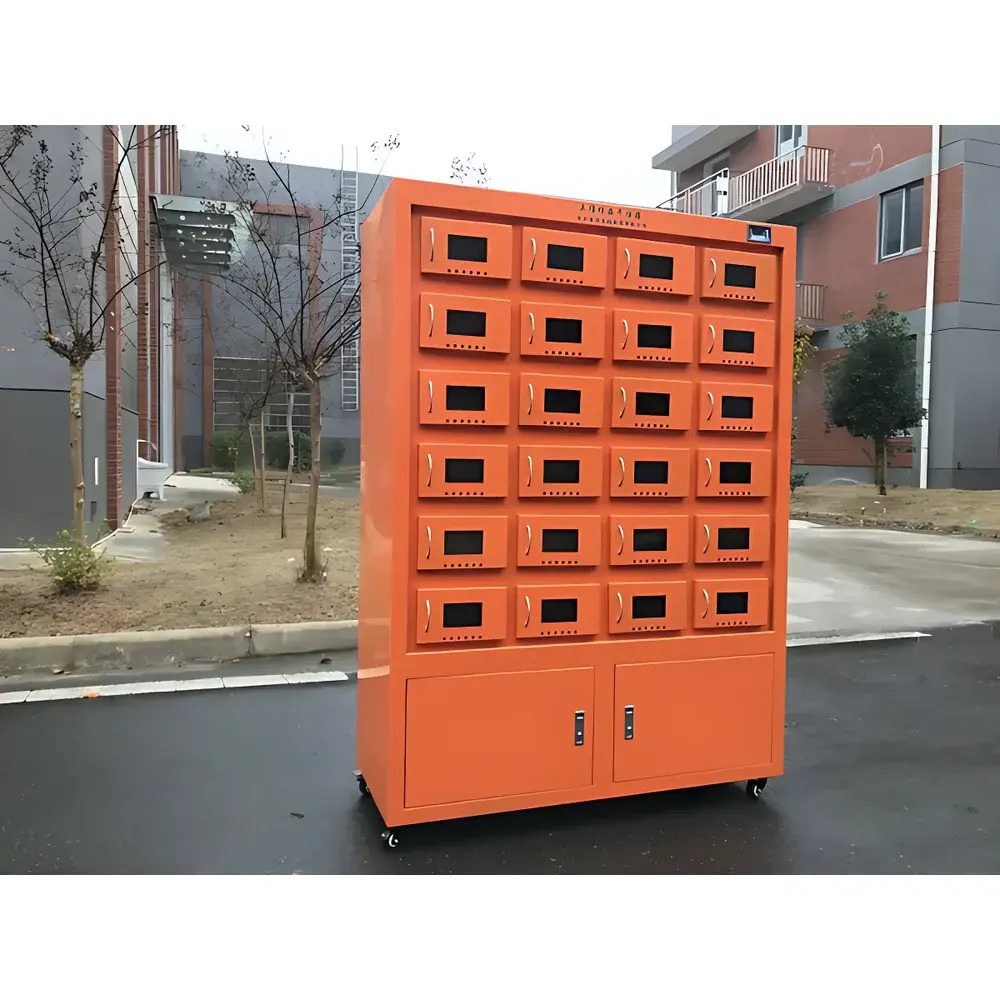
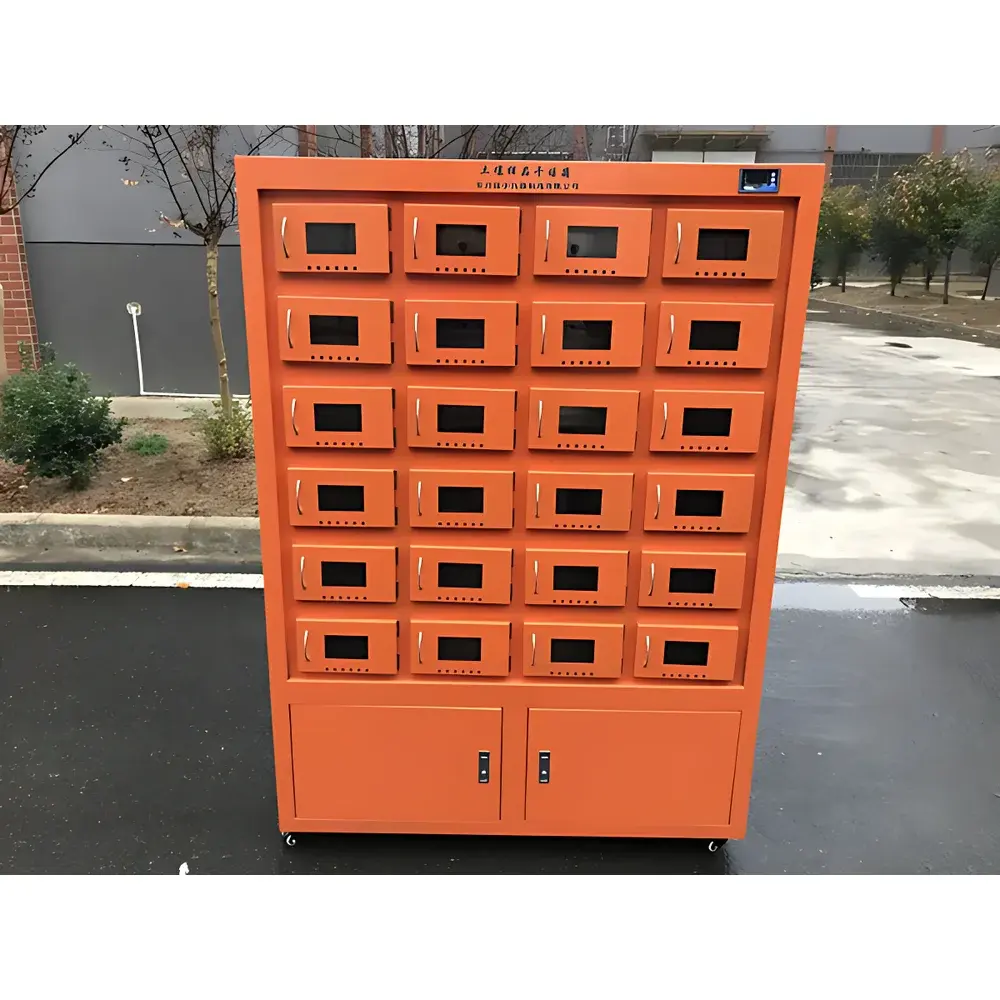
GY-TGX1 Soil Drying Oven by CZGY
| Brand | CZGY |
|---|---|
| Origin | Jiangsu, China |
| Manufacturer Type | Direct Manufacturer |
| Model | GY-TGX1 |
| Temperature Range | 35 ± 5 °C |
| Temperature Uniformity | ±1 °C |
| External Dimensions | 1140 × 450 × 1620 mm |
| Internal Chamber Configuration | 24 independent stainless-steel sample compartments (each 200 × 300 × 120 mm) |
| Chamber Material | 304 Stainless Steel |
| Heating Method | Electric resistive heating |
| Airflow System | Dual-stage purified & dehumidified forced convection |
| Power Supply | 220 V, 50 Hz |
| Rated Power | 300 W |
| Airflow Capacity | 240 L/min |
| Max Sample Load per Compartment | 1 kg |
| Relative Humidity Limit for Operation | ≤60% RH |
Overview
The CZGY GY-TGX1 Soil Drying Oven is a purpose-engineered laboratory instrument designed for the controlled, contamination-free air-drying of soil, sediment, and solid waste samples prior to elemental analysis—particularly for heavy metal quantification (e.g., Pb, Cd, As, Hg, Cr) in compliance with EPA Method 3050B, ISO 11464, and GB/T 22105–2008. Unlike conventional convection ovens, the GY-TGX1 employs a dual-mode drying principle: regulated low-temperature heating (35 ± 5 °C) combined with continuous, laminar flow of purified, dehumidified air across each sample surface. This simulates natural indoor air-drying kinetics while eliminating thermal degradation, volatile loss, and cross-contamination risks associated with high-temperature oven drying or open-air exposure. The system operates on a constant-flow air circuit: ambient air is drawn through an integrated desiccant dryer (removing H2O), then passed through a multi-layer high-efficiency particulate and chemical adsorption filter (capable of capturing PM2.5, VOCs, and acidic gases), and finally distributed uniformly via a precision gas manifold to 24 thermally isolated stainless-steel compartments. This architecture ensures trace-level integrity of analytes and supports GLP-aligned sample preparation workflows.
Key Features
- 24 independent sample compartments: Each chamber (200 × 300 × 120 mm) is constructed from electropolished 304 stainless steel—resistant to acid leaching, organic adsorption, and corrosion from high-moisture sediments or saline soils.
- Contamination-controlled airflow path: Single-point inlet feeds a 4-channel primary distributor, branching into 24 dedicated air conduits—ensuring zero inter-compartment mixing and eliminating cross-contamination during parallel processing.
- Integrated purification subsystem: Comprises replaceable silica-gel desiccant cartridges (visual inspection via front-access镂空 window) and certified HEPA + activated carbon filtration—validated for ≥99.97% removal of particles ≥0.3 µm and broad-spectrum gaseous impurities.
- Precision low-temperature control: Digital PID-regulated heating maintains setpoint stability within ±1 °C across all compartments; nominal operating temperature is 35 °C (adjustable up to 60 °C for accelerated drying under validated protocols).
- Ergonomic and service-oriented design: Front-loading doors with tempered glass observation windows; castor-mounted base for lab mobility; modular tray system (24 included) supporting both loose soil and high-water-content river sediments (max 1 kg per tray).
- Acoustic and thermal optimization: Sound-dampened air pump enclosure; insulated air delivery ducts minimize thermal drift; energy-efficient 300 W total power draw aligns with ISO 50001 lab sustainability benchmarks.
Sample Compatibility & Compliance
The GY-TGX1 is validated for drying heterogeneous environmental matrices including agricultural topsoil, estuarine sediments, municipal sludge, mining tailings, and industrial solid wastes. Its gentle, oxidative-drying regime preserves redox-sensitive species (e.g., Cr(III)/Cr(VI), As(III)/As(V)) and minimizes volatilization of methylmercury or organotin compounds—critical for speciation-aware regulatory reporting. The instrument meets structural and operational requirements referenced in US EPA SW-846 Chapter Three (Sample Preparation), ISO/IEC 17025:2017 Clause 7.2.2 (Method Validation), and China’s HJ 494–2009 standard for soil sampling and pretreatment. All stainless-steel wetted surfaces comply with FDA 21 CFR 178.3570 (indirect food contact), and the unit’s electrical safety conforms to IEC 61010-1:2010 (Laboratory Equipment Safety).
Software & Data Management
The GY-TGX1 operates as a standalone hardware platform with no embedded software or network interface—intentionally designed to eliminate cybersecurity vulnerabilities and ensure deterministic, audit-trail-free operation suitable for regulated environments where electronic records are not required. Temperature setpoint and real-time chamber display are managed via a front-panel digital LED controller with non-volatile memory retention. For labs requiring full 21 CFR Part 11 compliance, optional external data loggers (e.g., Omega OM-DAQPRO-5300) may be connected via analog 4–20 mA output (available on request). All calibration certificates, maintenance logs, and filter replacement records are maintained manually per GLP Annex 13 documentation practices.
Applications
- Preparation of soil/sediment samples for ICP-MS, AAS, and XRF elemental analysis
- Drying of moisture-rich dredged materials without crust formation or analyte stratification
- Stabilization of field-collected samples prior to transport and long-term storage
- Parallel processing of QA/QC duplicates, blanks, and matrix spikes under identical environmental conditions
- Compliance-driven drying per Chinese Standard GB 15618–2018 (Soil Environmental Quality Risk Control Standard)
- Research-scale studies on drying kinetics, moisture migration, and analyte redistribution in porous media
FAQ
What is the maximum recommended sample mass per chamber?
Each compartment accommodates up to 1 kg of wet soil or sediment when using the supplied stainless-steel tray—optimized for uniform airflow and minimal settling-induced heterogeneity.
How often must the desiccant and filter modules be replaced?
Under typical lab use (8 hrs/day, 5 days/week), silica gel desiccant requires replacement every 3–4 months; the HEPA/carbon filter assembly is rated for 12 months and includes visual saturation indicators.
Can the GY-TGX1 be used for drying biological or organic-rich samples?
Yes—its low-temperature, oxidation-limited drying mode prevents charring or lipid oxidation; however, volatile organic compound (VOC) analysis requires separate cold-chain handling per EPA Method 8260.
Is the unit compatible with nitrogen-purged drying protocols?
No—the system is engineered exclusively for ambient-air purification; retrofitting for inert gas supply would void CE/IEC certification and compromise airflow calibration.
Does the instrument include validation documentation for ISO/IEC 17025 accreditation?
Factory calibration reports (temperature uniformity mapping, airflow verification) are provided with shipment; users must perform initial qualification (IQ/OQ) per their site-specific SOPs using NIST-traceable reference standards.



