
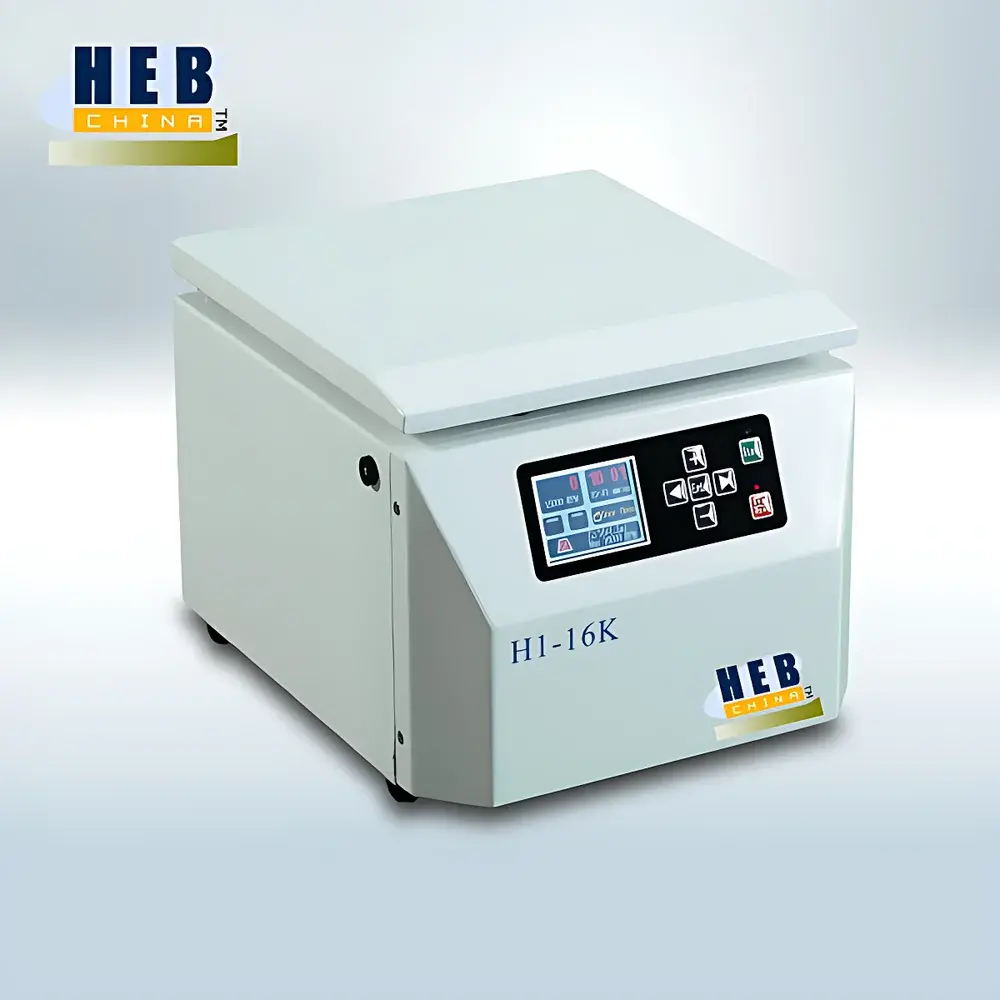
H1-16K Desktop High-Speed Centrifuge
| Brand | Jihepu (Jinan Hepu) |
|---|---|
| Origin | Shandong, China |
| Model | H1-16K |
| Type | Benchtop Centrifuge |
| Max Speed | 16500 rpm |
| Max RCF | 18757 ×g |
| Max Capacity | 12 × 5 mL |
| Dimensions (W×D×H) | 315 × 270 × 240 mm |
| Noise Level | ≤65 dB(A) |
| Power Supply | AC 220 V ±10%, 50/60 Hz, 10 A |
| Total Power | 420 W |
| Net Weight | 11 kg |
| Rotor Compatibility | Fixed-angle rotors (e.g., 12 × 5 mL, 24 × 1.5/2.2 mL, 16 × 1.5/2.2 mL) |
| Acceleration/Deceleration | 10-step programmable control |
| RCF Auto-Calculation | Yes |
| Door Lock | Electronic interlock |
| Timer Range | 1–99 min |
| Speed Accuracy | ±20 rpm |
| Centrifuge Chamber Diameter | Φ200 mm |
Overview
The H1-16K Desktop High-Speed Centrifuge is an engineered solution for routine and advanced separation tasks in life science laboratories, clinical diagnostics, and quality control environments. Designed around a high-efficiency brushless AC frequency-controlled motor, it delivers precise rotational control across its operational range—up to 16,500 rpm and 18,757 ×g—enabling effective pelleting of subcellular organelles, nucleic acids, proteins, and viral particles. Its compact footprint (315 × 270 × 240 mm) and robust stainless-steel centrifuge chamber ensure compatibility with standard biosafety cabinets and limited bench space, while maintaining structural integrity under sustained high-speed operation. The device adheres to IEC 61010-1 safety standards for laboratory electrical equipment and incorporates mechanical and electronic safeguards—including automatic rotor imbalance detection, over-speed protection, and real-time thermal monitoring—to support GLP-compliant workflows.
Key Features
- Benchtop form factor with full steel housing and electropolished stainless-steel rotor chamber for corrosion resistance and ease of decontamination.
- Brushless AC frequency-controlled motor delivering smooth acceleration/deceleration profiles across 10 programmable steps—reducing sample shear stress and improving reproducibility.
- High-resolution color LCD display showing real-time rpm, RCF, remaining time, and error codes; supports on-the-fly parameter adjustment without rotor stoppage.
- Integrated RCF calculator that dynamically updates centrifugal force values as speed or radius changes—eliminating manual lookup errors per ISO 21501-4 and ASTM E2456 conventions.
- Electromechanical door lock system with automatic engagement/disengagement and status feedback—meeting EN 61010-2-020 requirements for access control during operation.
- Low-noise design (≤65 dB[A] at maximum speed) achieved via precision-balanced rotor assembly and vibration-dampening base construction—suitable for shared lab environments.
Sample Compatibility & Compliance
The H1-16K supports fixed-angle rotor configurations optimized for microcentrifuge tubes (1.5–5 mL), including 12 × 5 mL, 16 × 1.5/2.2 mL, and 24 × 1.5/2.2 mL variants—each validated for maximum rated speed and RCF. Rotors are manufactured from high-strength aluminum alloy (6061-T6) and undergo static/dynamic balancing per ISO 1940-1 G2.5 grade specifications. The system complies with CE marking directives (2014/30/EU EMC, 2014/35/EU LVD), RoHS 2011/65/EU, and meets essential requirements of ISO 13485 for in vitro diagnostic support equipment. While not certified for BSL-3 applications, its sealed chamber and autoclavable rotor lids facilitate decontamination between runs per CDC/NIH biosafety guidelines.
Software & Data Management
The H1-16K operates as a standalone instrument with embedded firmware—no external PC or proprietary software required. All operational parameters (speed, time, acceleration profile, RCF) are stored in non-volatile memory with timestamped event logging (last 100 cycles). Though lacking network connectivity or FDA 21 CFR Part 11-compliant audit trails out-of-the-box, the device supports manual documentation protocols aligned with ISO/IEC 17025 clause 7.7 (result reporting) and GLP Principle 5 (record retention). Optional third-party LIMS integration is feasible via RS-232 serial interface (standard) for basic command-and-status polling.
Applications
- Isolation of plasmid DNA, genomic DNA, and RNA from bacterial lysates and mammalian cell suspensions.
- Clarification of crude protein extracts prior to chromatography or electrophoresis.
- Concentration of viruses, exosomes, and extracellular vesicles from cell culture supernatants.
- Routine phase separation in solvent extraction protocols (e.g., phenol-chloroform).
- Preparative sedimentation of mitochondria, nuclei, and membrane fractions in subcellular fractionation workflows.
- Quality assurance testing of colloidal suspensions, nanoparticles, and emulsions in pharmaceutical development.
FAQ
What rotor configurations are included with the H1-16K by default?
The base configuration includes one fixed-angle rotor (part number: Rotor-2, 12 × 5 mL capacity, max 15,000 rpm / 15,940 ×g). Additional rotors are available as optional accessories.
Does the H1-16K support refrigerated operation?
No—the H1-16K is a non-refrigerated centrifuge. For temperature-sensitive samples, users should pre-chill samples and rotors, and limit run duration to minimize thermal drift.
Can this centrifuge be used for blood separation protocols?
Yes—within its capacity and speed limits, it effectively separates whole blood into serum/plasma and cellular components using standard 5 mL collection tubes.
Is rotor lifetime tracking supported?
No built-in rotor hour meter is present; however, each rotor bears a laser-engraved serial number and maximum cycle rating per manufacturer documentation—manual logbook tracking is recommended.
What safety certifications does the H1-16K hold?
It carries CE marking compliant with IEC 61010-1 (safety) and IEC 61326-1 (EMC), verified through third-party testing per EN 61010-2-020 for centrifuges.



