
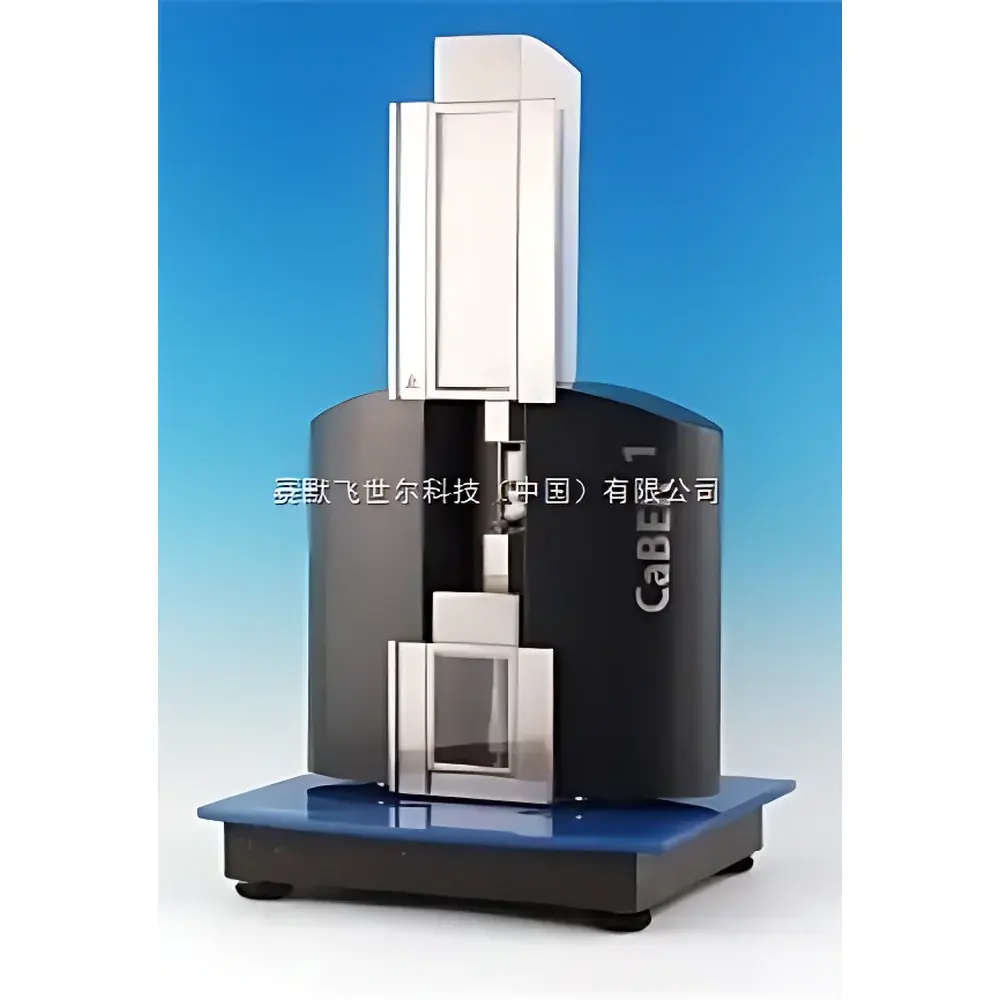
HAAKE CaBER 1 Capillary Breakup Extensional Rheometer
| Brand | HAAKE |
|---|---|
| Origin | Germany |
| Model | CaBER 1 |
| Motor Type | Linear Motor |
| Hencky Strain (ε₀) | 10 |
| Applied Strain Rate Range | 0.01–300 s⁻¹ |
| Fluid Strain Rate Range | 10⁻⁵–10 s⁻¹ |
| Shear Viscosity Range | 10–10⁶ mPa·s |
| Plate Diameter | 4–8 mm (standard: 6 mm) |
| Temperature Range | 0–80 °C |
| Filament Diameter Resolution | 10 µm |
| System Response Time | 10 ms |
| Dimensions | 40 × 34 × 60 cm |
Overview
The HAAKE CaBER 1 Capillary Breakup Extensional Rheometer is a purpose-built instrument for quantitative characterization of uniaxial extensional rheology in complex fluids. Unlike rotational rheometers—which primarily probe shear response—the CaBER 1 applies controlled, rapid step-strain separation between parallel circular plates to generate a transient fluid filament under capillary-driven thinning. This configuration enables direct measurement of extensional stress growth, filament thinning dynamics, and rupture behavior governed by the interplay of surface tension, viscoelasticity, and solvent relaxation. The device operates on the principle of capillary breakup rheometry (CaBER), where the time-dependent mid-filament diameter D(t) is tracked via high-speed laser micrometry, and constitutive parameters—including extensional viscosity, relaxation time, surface tension, and strain-hardening coefficient—are extracted through model-based fitting (e.g., Oldroyd-B, Giesekus, or FENE-P frameworks). Designed for laboratory-scale fundamental research and industrial formulation development, the CaBER 1 delivers reproducible extensional data critical for predicting processing behavior in fiber spinning, inkjet printing, coating, extrusion, and spray atomization.
Key Features
- First commercially available capillary breakup extensional rheometer—engineered specifically to quantify extensional deformation inaccessible to conventional rotational systems.
- Linear motor-driven upper plate with programmable separation velocity and precise displacement control, enabling user-defined Hencky strain (ε₀ = 10) and applied strain rates from 0.01 to 300 s⁻¹.
- High-resolution laser micrometer (10 µm diameter resolution) synchronized with 10 ms system response time for accurate real-time tracking of filament thinning kinetics.
- Modular plate geometry: interchangeable parallel-plate sets (4–8 mm diameter; standard 6 mm) accommodate varied sample volumes (< 1 mL) and rheological regimes.
- Integrated temperature-controlled environment (0–80 °C) supports studies under physiologically or industrially relevant thermal conditions.
- Fully automated test execution, including filament initiation, diameter monitoring, rupture detection, and parameter extraction—minimizing operator variability and enhancing throughput.
Sample Compatibility & Compliance
The CaBER 1 accommodates low-to-medium viscosity polymeric solutions, entangled polymer melts, surfactant-laden liquids, biological fluids (e.g., mucus, synovial fluid), food colloids (e.g., whey protein dispersions), and pharmaceutical suspensions. Its minimal sample requirement (< 1 mL) reduces material consumption and enables high-value or scarce-sample testing. All hardware and firmware comply with CE marking requirements. Data acquisition and analysis workflows support audit-ready documentation aligned with GLP and GMP practices. While not inherently 21 CFR Part 11-compliant out-of-the-box, the system architecture permits integration with validated software environments that provide electronic signatures, change control logs, and secure user access management—facilitating regulatory submissions under FDA, EMA, or PMDA guidelines.
Software & Data Management
The proprietary CaBER Control & Analysis Suite provides intuitive graphical interface for experiment setup, real-time visualization of D(t) curves, and automated model fitting using built-in linear and nonlinear viscoelastic models. Raw diameter vs. time datasets are stored in ASCII-compatible format for third-party post-processing (e.g., MATLAB, Python SciPy). The software implements standardized reporting templates compliant with ASTM D7905 (Standard Test Method for Extensional Viscosity of Polymer Melts Using a Capillary Breakup Extensional Rheometer) and ISO/CD 19208 (Plastics — Determination of Extensional Viscosity Using Capillary Breakup Techniques). Audit trails record operator ID, timestamp, instrument configuration, calibration status, and version-controlled analysis algorithms—ensuring traceability across multi-user lab environments.
Applications
- Quantifying strain hardening in polyethylene and polypropylene melts during fiber spinning simulations.
- Evaluating extensional stability of inkjet inks to prevent satellite droplet formation and nozzle clogging.
- Characterizing mucin network elasticity and relaxation times in respiratory mucus analogues for inhalation drug delivery optimization.
- Assessing yield-stress contributions in structured food gels under startup extensional flow.
- Validating constitutive model predictions for crosslinked hydrogels used in soft robotics and tissue engineering scaffolds.
- Screening surfactant efficacy in oilfield drilling fluids by correlating filament lifetime with interfacial rheology.
FAQ
What physical quantities does the CaBER 1 directly measure?
It measures the time evolution of mid-filament diameter D(t) during capillary-driven thinning, from which extensional viscosity, relaxation time, surface tension, and rupture time are derived via model inversion.
Can the CaBER 1 operate under controlled humidity or inert atmosphere?
The base configuration operates in ambient air; optional environmental enclosures (N₂-purged or RH-controlled) are available as add-on modules for sensitive samples.
Is calibration traceable to national standards?
Laser micrometer calibration is traceable to NIST-traceable length standards; plate gap calibration uses certified gauge blocks; temperature sensors are calibrated per ISO/IEC 17025-accredited procedures.
How does the CaBER 1 differ from the CaBER 2 or CaBER XT?
The CaBER 1 features fixed-geometry plates and single-range strain rate capability; later generations introduce variable-gap actuators, enhanced temperature control (−20 to 150 °C), and higher-speed imaging (≥1 kHz) for broader transient response capture.
Does the system support custom scripting or API access?
Yes—via COM/ActiveX interface and documented DLL libraries, enabling integration into LabVIEW, Python, or MATLAB automation pipelines for high-throughput screening.



