
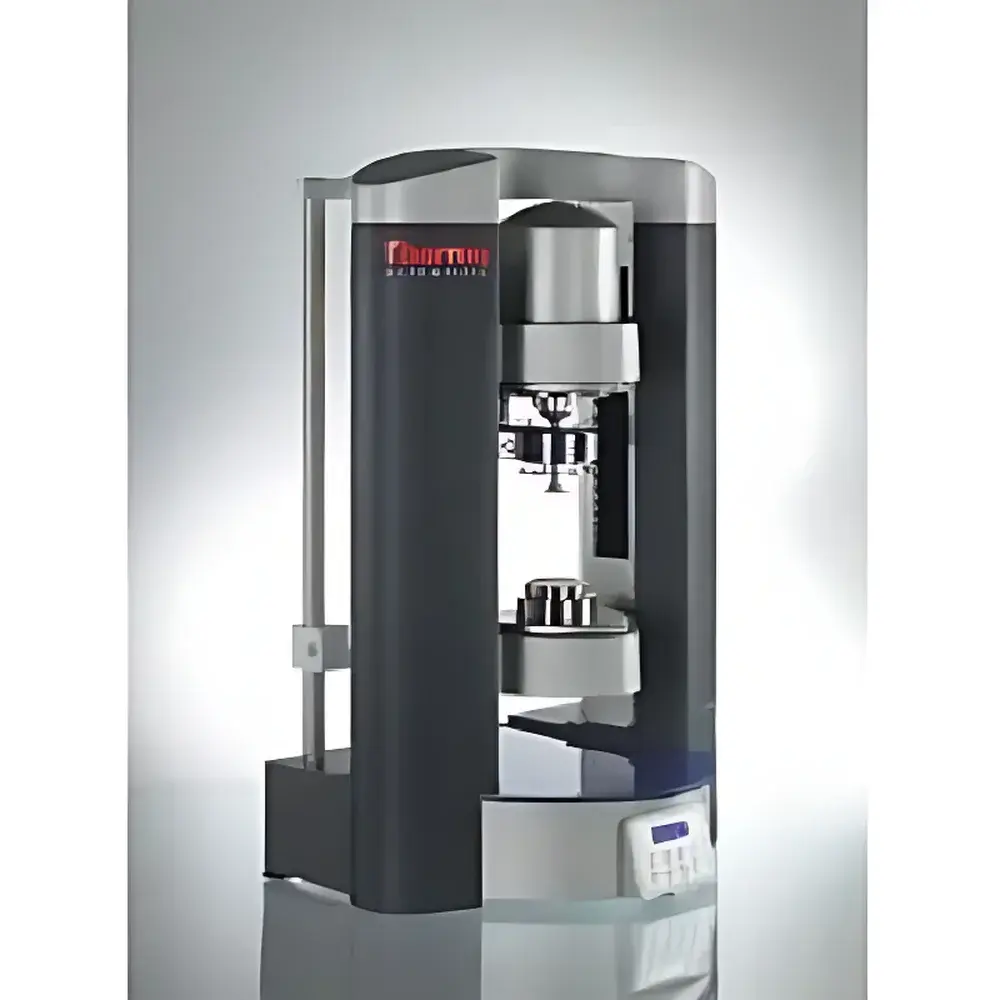
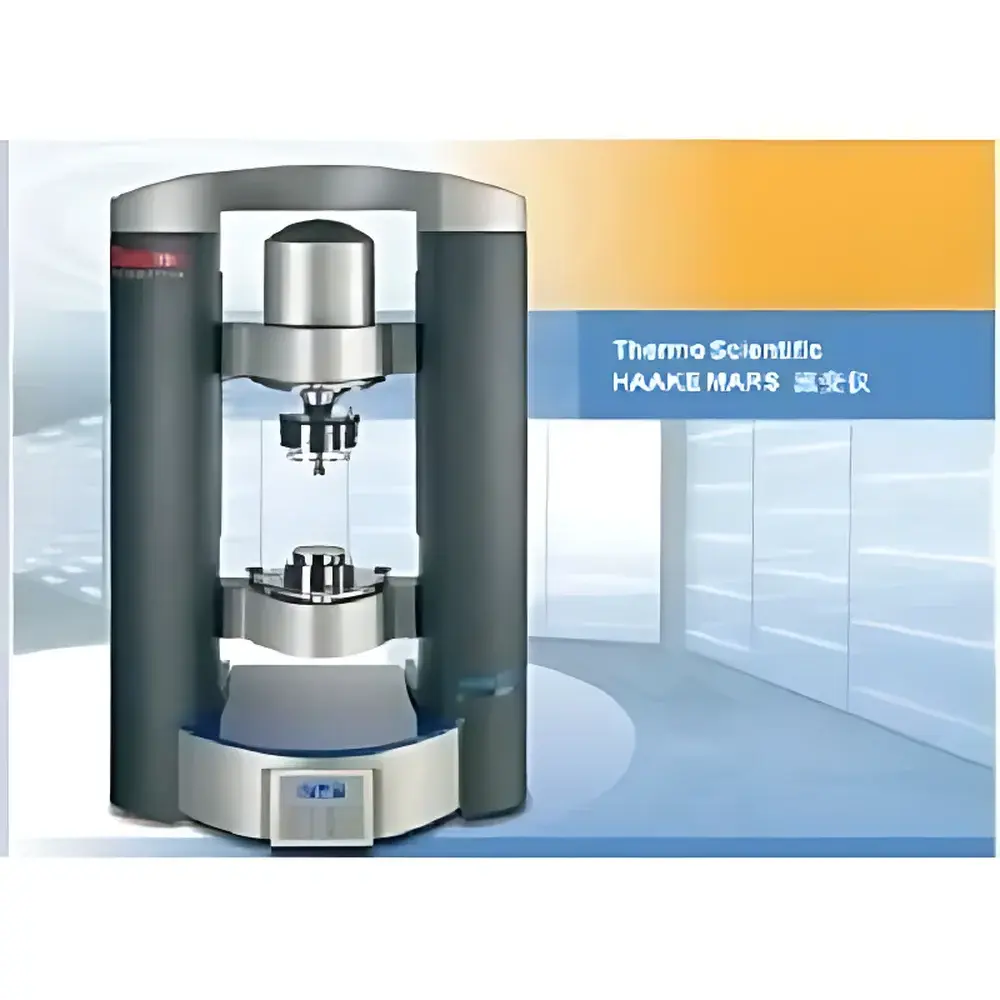
HAAKE Mars 40 Advanced Rotational Rheometer
| Brand | HAAKE |
|---|---|
| Origin | Germany |
| Model | Mars 40 |
| Instrument Type | Rotational Rheometer |
| Motor Bearing | Air-bearing (2 radial + 1 axial) |
| Minimum Rotational Speed | 1×10⁻⁷ rpm |
| Maximum Rotational Speed | 4500 rpm |
| Frequency Range | 1×10⁻⁶ – 100 rad/s |
| Maximum Torque | 200 mNm |
| Torque Resolution | 0.1 nNm |
| Angular Displacement Resolution | 12 nrad |
| Motor Inertia | 1×10⁻⁵ kg·m² |
Overview
The HAAKE Mars 40 Advanced Rotational Rheometer is a high-precision, modular rotational rheometer engineered for demanding research and quality control applications in academic, pharmaceutical, polymer, food, cosmetics, and petrochemical laboratories. Based on Couette and cone-plate rheological principles, it measures shear stress, shear rate, complex viscosity, storage/loss moduli (G′/G″), and viscoelastic relaxation behavior under controlled temperature and deformation conditions. Its fourth-generation low-inertia air-bearing drive system—comprising two radial and one axial air bearings—enables ultra-low torque detection down to 0.1 nNm and exceptional angular resolution (12 nrad), supporting both steady-state and dynamic oscillatory measurements across an exceptionally broad frequency range (10⁻⁶–100 rad/s). Designed for long-term scientific rigor, the dual-column mechanical architecture ensures structural stability, thermal homogeneity, and future-ready expandability—making it compatible with advanced add-ons including RheoScope (microscopy-integrated rheology), Rheonaut (FTIR-coupled rheology), and SER (Sentmanat Extensional Rheometer) modules.
Key Features
- Patented low-inertia air-bearing motor system delivering <0.1 nNm torque resolution and <1×10⁻⁷ rpm minimum rotational speed
- Dual-column mechanical design ensuring high rigidity, minimal thermal drift, and optimal alignment repeatability
- “Quick-Connect Assistant” technology enabling automatic transducer recognition, self-alignment of measuring geometries, and seamless integration of Peltier, electric furnace, and solvent trap temperature modules
- Modular platform architecture supporting up to 12 functional expansion interfaces—including real-time spectroscopic, microscopic, and extensional rheology couplings
- Comprehensive geometry library: cone-plate, parallel-plate, concentric cylinder, vane, and serrated fixtures compliant with ISO 6721, ASTM D4440, and DIN 53019 standards
Sample Compatibility & Compliance
The Mars 40 accommodates a wide range of sample rheologies—from low-viscosity solvents (<1 mPa·s) to highly filled suspensions (>10⁶ mPa·s) and thermosetting melts. Its temperature-controlled environment (−40°C to 600°C, depending on module configuration) supports ISO 11443, ASTM D3835, and USP <911> compliant melt flow index and viscosity profiling. All firmware and data acquisition protocols are designed to meet GLP/GMP requirements, with full audit trail support, electronic signature capability, and 21 CFR Part 11–ready software architecture. Traceable calibration certificates per ISO/IEC 17025 are available for torque, angle, temperature, and time domains.
Software & Data Management
Operated via Thermo Scientific™ RheoWin software (v4.5+), the Mars 40 provides intuitive workflow-driven test sequencing, real-time parameter optimization, and automated compliance reporting. The software includes built-in models for Carreau-Yasuda, Cross, and Maxwell fitting; time–temperature superposition (TTS) analysis; and linear viscoelastic region (LVR) determination. Raw data is stored in HDF5 format with embedded metadata (user, timestamp, geometry ID, calibration history), ensuring FAIR (Findable, Accessible, Interoperable, Reusable) data principles. Export options include CSV, XML, and universal rheological data exchange (RheoML) schema for LIMS and ELN integration.
Applications
- Polymer science: Melt elasticity quantification, crosslinking kinetics, and processing window mapping for extrusion and injection molding
- Pharmaceutical development: Gelation onset temperature, injectability assessment of hydrogels, and suspension stability prediction
- Food & cosmetics: Yield stress determination in sauces and creams, thixotropic recovery analysis, and emulsion breakdown monitoring
- Coatings & inks: Pigment dispersion stability, leveling behavior modeling, and rheological response to shear during spray or roll application
- Building materials: Fresh concrete workability, cement paste setting kinetics, and fiber-reinforced composite viscoelastic performance
FAQ
What temperature ranges are supported with standard Peltier modules?
Standard Peltier-based temperature control covers −40°C to 200°C with ±0.1°C accuracy and ±0.05°C stability over 30 minutes.
Is the Mars 40 compatible with third-party rheological software?
Yes—via TCP/IP API and documented DLL interface, allowing integration with MATLAB, Python (via PyRhéo), and LabVIEW environments for custom protocol development.
How is torque calibration traceability maintained?
Each instrument ships with NIST-traceable calibration certificates for static and dynamic torque, verified annually using primary-standard torsion calibrators accredited to ISO/IEC 17025.
Can the air-bearing system operate continuously at maximum speed?
Yes—the dual radial + axial air-bearing configuration is rated for indefinite operation at 4500 rpm under load, with active pressure regulation and redundant bearing gap monitoring.
Does the system support oscillatory time sweeps for aging studies?
Yes—time-resolved small-amplitude oscillatory shear (SAOS) is fully supported, including automated amplitude sweeps before/after each time point to confirm LVR integrity throughout multi-hour experiments.



