
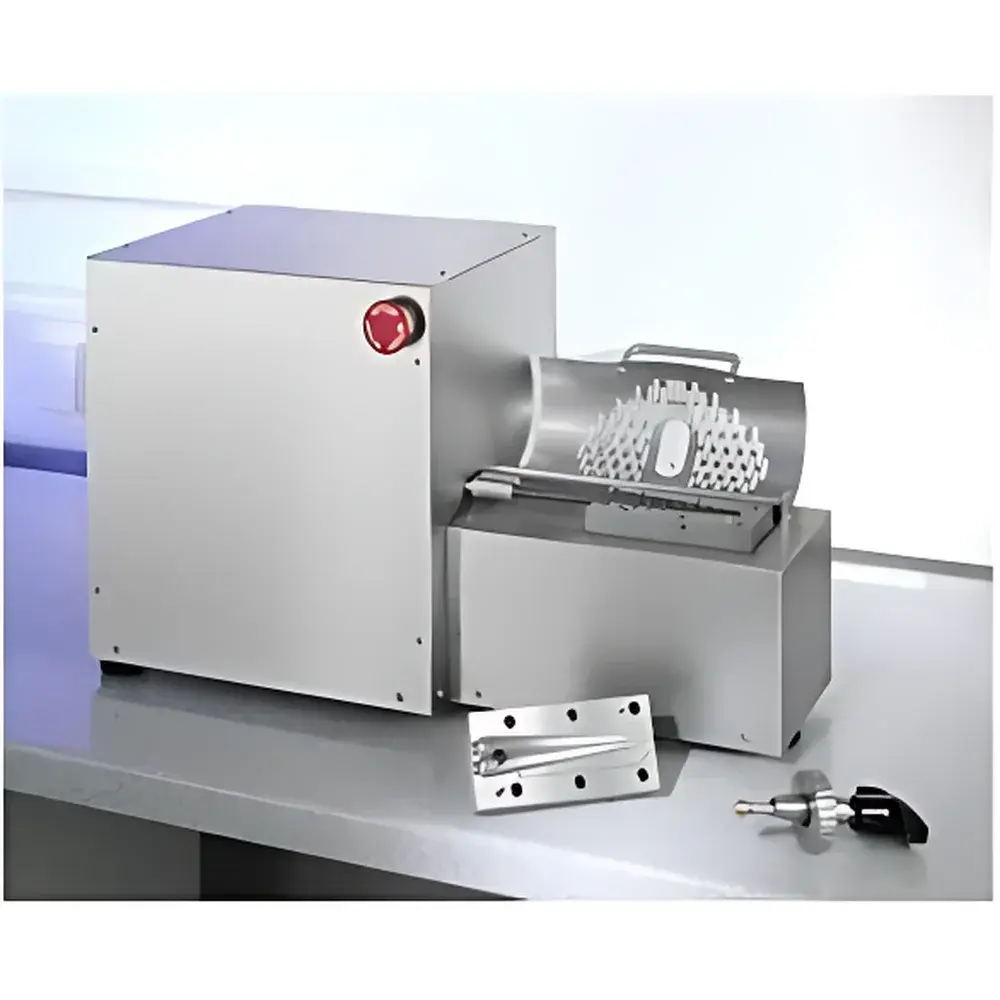
HAAKE MiniCTW Micro Twin-Screw Extruder by Thermo Fisher Scientific
| Brand | Thermo Fisher Scientific |
|---|---|
| Origin | Germany |
| Manufacturer | Thermo Fisher Scientific |
| Type | Imported Instrument |
| Model | MiniCTW |
| Pricing | Upon Request |
Overview
The HAAKE MiniCTW is a benchtop micro twin-screw extruder engineered for precision processing and rheological characterization of thermoplastic polymers, pharmaceutical actives, and high-value functional materials. Designed as the successor to the widely adopted MiniLab II platform, the MiniCTW integrates co-rotating or counter-rotating conical twin-screw architecture with real-time torque and pressure monitoring—enabling simultaneous melt compounding, reactive extrusion, and in-line rheological assessment under controlled thermal and shear conditions. Its core operating principle relies on volumetric feeding, screw-driven conveying, and shear-induced melting within a precisely temperature-regulated barrel system (up to 420 °C), allowing reproducible residence time control via programmable recirculation loops and automated bypass valve sequencing. This architecture supports fundamental studies of polymer melt viscoelasticity, degradation kinetics, additive dispersion efficiency, and hot-melt extrusion (HME) formulation development—particularly critical for low-dose drug delivery systems, biodegradable implants, and nanocomposite masterbatches where material economy and process fidelity are paramount.
Key Features
- Conical twin-screw configuration with interchangeable co-rotating or counter-rotating geometries, fabricated from high-hardness M340 tool steel (HRC 55) for wear resistance and thermal stability
- Stainless steel barrel (7 cm³ free volume, equivalent to ~5 g PE) featuring horizontal split design for rapid cleaning, in-process visual inspection, and modular sensor integration
- Integrated rheometry capability: real-time torque measurement enables calculation of apparent shear viscosity (η) vs. shear rate (γ̇) profiles per ASTM D3835 and ISO 11443
- Automated bypass valve system enabling seamless transition between closed-loop recirculation (for residence time control) and open extrusion (for strand or pellet output)
- Dual cooling options: air-cooling standard; water-cooling available for 350 °C configurations; air-only cooling for extended 420 °C operation
- Modular auxiliary interfaces: liquid dosing ports, nitrogen purge lines, and standardized mounting flanges for inline FTIR, Raman, or die-pressure transducers
- 400 W high-torque drive motor with speed control range of 1–360 rpm and maximum system pressure rating of 200 bar
Sample Compatibility & Compliance
The MiniCTW accommodates thermoplastics (e.g., PLA, PCL, Eudragit®, HPMC-AS), API-polymer blends, nanofillers (CNTs, cellulose nanocrystals), plasticizers, surfactants, and reactive monomers. Its compact scale (3–5 g typical batch size) minimizes raw material consumption while maintaining representative shear history and thermal profiles relevant to industrial-scale extrusion. The system complies with GLP documentation requirements through audit-trail-enabled software logging (21 CFR Part 11 optional), supports validation protocols aligned with USP for pharmaceutical extrusion, and meets mechanical safety standards per EN 61000-6-2/6-4 and CE marking directives.
Software & Data Management
Control and data acquisition are managed via Thermo Fisher’s proprietary HAAKE RheoWin software, offering synchronized recording of temperature (±0.5 °C), screw speed, torque (±0.2 N·cm), pressure (±1 bar), and motor current at up to 10 Hz sampling rate. All datasets are timestamped, user-annotated, and exportable in CSV or HDF5 formats. Optional modules include predictive residence time distribution (RTD) modeling, viscosity curve fitting using Cross-WLF or Carreau-Yasuda models, and comparative batch analysis dashboards for DOE-based formulation screening.
Applications
- Hot-melt extrusion (HME) process development for amorphous solid dispersions (ASDs) and controlled-release dosage forms
- Thermal and oxidative stability assessment of polymer melts under shear stress (e.g., melt index decay, gel formation onset)
- Reactive extrusion of functionalized polyolefins, graft copolymers, and crosslinked networks
- Dispersion quality evaluation of nanofillers and pigment concentrates via in-line rheology and post-extrusion microscopy correlation
- Accelerated aging studies of biodegradable polymers under simulated processing conditions
- Screening of plasticizer efficiency, compatibilizer performance, and stabilizer efficacy in constrained-volume trials
FAQ
Can the MiniCTW operate under inert atmosphere?
Yes—integrated nitrogen purge ports allow continuous blanketing during processing to prevent oxidation of sensitive APIs or thermally labile polymers.
Is it possible to monitor melt temperature directly inside the barrel?
Yes—the system includes multiple calibrated Pt100 sensors embedded along the barrel length (zones 1–4), with optional in-barrel melt probe extension for direct interstitial temperature measurement.
What sample throughput can be expected per experiment?
Typical single-run material consumption ranges from 3 to 5 g; full extrusion output yields 1–3 g of usable strand or pelletized product depending on die geometry and residence time.
Does the system support GMP-compliant data handling?
With optional 21 CFR Part 11-compliant software license, the MiniCTW provides electronic signatures, role-based access control, and immutable audit trails required for regulated pharmaceutical development.
Are custom screw configurations available?
Yes—Thermo Fisher offers application-specific screw designs (e.g., kneading blocks, reverse elements, mixing paddles) and barrel inserts for enhanced distributive or dispersive mixing, subject to engineering review and lead-time confirmation.




