
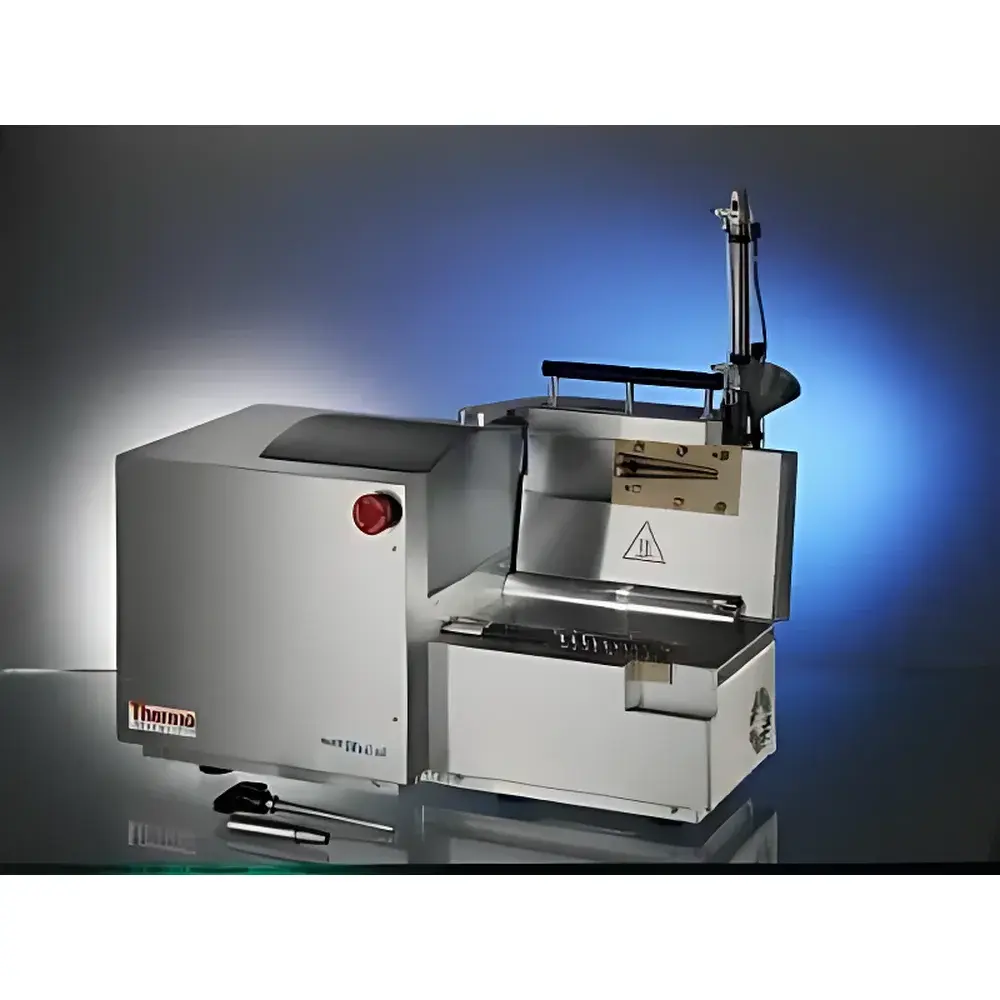
HAAKE MiniLab II Micro Compounder and Capillary Rheometer
| Brand | HAAKE |
|---|---|
| Origin | Germany |
| Model | MiniLab II |
| Instrument Type | Torque Rheometer |
| Screw Configuration | Co-rotating and Counter-rotating Conical Twin-Screw |
| Minimum Speed | 1 rpm |
| Maximum Speed | 360 rpm |
| Frequency Range | 0.1–37.7 rad/s |
| Maximum Torque | 300 N·m |
| Torque Resolution | 0.1 N·m |
| Motor Power | 400 W |
| Barrel Volume | 7 cm³ (≈5 g PE) |
| Max Temperature | 350 °C (optional 420 °C) |
| Max Pressure | 200 bar |
| Barrel Material | Stainless Steel (HRC55) |
| Screw Material | Stainless Steel 1.4122 |
| Cooling | Air/Water (350 °C version), Air-only (420 °C version) |
| Flow Path | Integrated Recirculation Channel with Automated Bypass Valve |
Overview
The HAAKE MiniLab II is a benchtop micro compounder and in-line capillary rheometer engineered for precise thermomechanical processing and real-time rheological characterization of polymer melts using only 3–5 g of material. Unlike conventional torque rheometers or standalone extruders, the MiniLab II integrates three core functions—mixing, extrusion, and dynamic/oscillatory rheometry—within a single, compact architecture. Its operation is based on controlled rotational shear in a conical twin-screw system, where torque, temperature, pressure, and residence time are independently monitored and regulated. The device employs Couette-type flow geometry during recirculation mode and transitions seamlessly to capillary flow during extrusion mode via an automated bypass valve. This dual-mode capability enables direct correlation between processing history (e.g., shear history, thermal exposure) and resulting melt rheology—critical for structure–property–process relationships in polymer development.
Key Features
- Conical twin-screw configuration with selectable co-rotating or counter-rotating operation, enabling tailored shear profiles for dispersion, distributive mixing, or reactive extrusion.
- Integrated recirculation channel and pneumatically actuated bypass valve for precise control of melt residence time (down to seconds), supporting kinetic studies and thermal degradation assessment.
- Patented in-line rheological measurement system compliant with ISO 6721-10 and ASTM D3835, delivering shear viscosity vs. shear rate curves under actual processing conditions—not post-extrusion measurements.
- Horizontally split barrel design with quick-release clamping mechanism, allowing full visual access during operation and rapid cleaning without disassembly.
- Dedicated ports for liquid additive injection, inert gas purging (N₂), and integration of auxiliary sensors—including inline NIR, die pressure transducers, and melt temperature probes.
- Thermal management system supporting operation up to 350 °C (air/water-cooled) or 420 °C (air-cooled), with ±0.5 °C temperature stability across the 7 cm³ barrel volume.
Sample Compatibility & Compliance
The MiniLab II accommodates thermoplastics (e.g., PP, PE, PC, PA), thermoplastic elastomers, biopolymers (PLA, PHA), nanocomposites, medical-grade polymers (PEEK, PTFE), and reactive systems (e.g., epoxy-anhydride blends). Its small-scale format minimizes material consumption while maintaining representative shear rates (1–1,000 s⁻¹) and apparent shear stresses comparable to industrial extruders. All mechanical and thermal subsystems comply with CE machinery directive 2006/42/EC and electromagnetic compatibility (EMC) directive 2014/30/EU. Data acquisition meets GLP and GMP requirements when used with Thermo Scientific RheoWin software configured for 21 CFR Part 11 compliance (audit trail, electronic signatures, user role management).
Software & Data Management
RheoWin 4.x provides synchronized acquisition of torque, speed, temperature, pressure, and motor current at 100 Hz sampling rate. Real-time visualization includes torque–time, viscosity–shear rate, storage/loss modulus (G′/G″) vs. frequency, and melt temperature–residence time overlays. Experimental protocols are fully scriptable and repeatable; method templates support DOE-based formulation screening. Export formats include CSV, HDF5, and universal rheology data format (URDF) for third-party analysis (e.g., MATLAB, Python SciPy). Raw sensor data is stored with metadata (user ID, timestamp, calibration IDs), ensuring traceability for regulatory submissions.
Applications
- Development and optimization of high-value polymer formulations (nanocomposites, bioresorbables, conductive blends)
- Accelerated thermal stability testing and melt degradation kinetics under shear
- Reaction extrusion studies (grafting, crosslinking, transesterification)
- Dispersion quality assessment of fillers, pigments, and masterbatches
- Correlation of lab-scale processing parameters with pilot- or production-scale extrusion behavior
- Preparation of micro-specimens for DSC, TGA, SEM, or mechanical testing
- Validation of constitutive models (e.g., Carreau-Yasuda, Giesekus) using in-process rheological data
FAQ
Can the MiniLab II perform both steady-state and dynamic oscillatory rheology?
Yes—during recirculation mode, it supports controlled-strain and controlled-stress oscillatory tests per ISO 6721-10, delivering G′, G″, complex viscosity, and loss tangent across 0.1–37.7 rad/s.
Is the screw geometry interchangeable between co- and counter-rotating configurations?
Yes—the conical twin-screw assembly is modular and field-replaceable; both configurations use identical screw elements but differ in drive coupling orientation and timing gear setup.
What sample throughput can be expected during extrusion mode?
Extrusion output ranges from 0.5–15 g/min depending on material viscosity, screw speed, and die geometry; typical pelletizing yields 3–8 g of shaped specimens per run.
Does the system support automated dosing of liquid additives?
Yes—via optional HAAKE forced feeder or syringe pump interface, with programmable addition profiles synchronized to torque and temperature events.
How is calibration traceability maintained for torque and temperature measurements?
Torque sensors are factory-calibrated against NIST-traceable deadweight standards; temperature sensors are certified per DIN EN 60751 Class A, with annual recalibration supported through Thermo Fisher service centers.



