
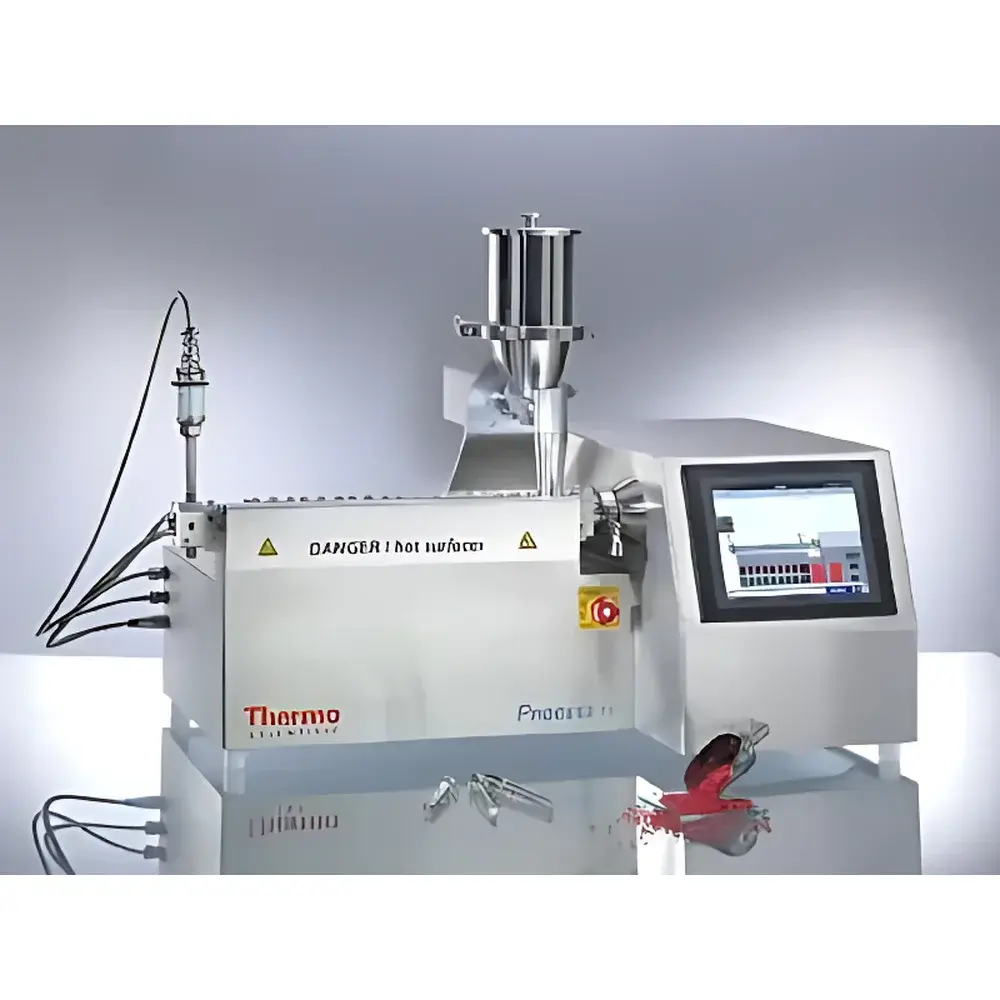
HAAKE PROCESS 11 Mini Twin-Screw Extruder
| Brand | Thermo Fisher Scientific |
|---|---|
| Origin | Germany |
| Manufacturer | Thermo Fisher Scientific |
| Type | Laboratory-Scale Co-Rotating Twin-Screw Extruder |
| Screw Diameter | 11 mm |
| L/D Ratio | 40:1 |
| Drive Power | 1.25 kW |
| Speed Range | 10–1000 rpm (infinitely variable) |
| Max Operating Pressure | 100 bar (with integrated safety monitoring) |
| Temperature Range | Ambient to 350 °C (optional up to 450 °C) |
| Barrel Zones | 8 (1 cooling feed zone + 7 independently heated zones) |
| Footprint | 82 × 48 × 34 cm (L × W × H) |
| Throughput | Up to 2.5 kg/h |
| Minimum Sample Requirement | ~20 g |
| Screw Design | Modular, segmentable for customizable configuration |
| Barrel Configuration | Horizontally split, top barrel section removable |
| Control Interface | Integrated color touchscreen |
Overview
The HAAKE PROCESS 11 Mini Twin-Screw Extruder is a compact, benchtop-scale co-rotating twin-screw extrusion system engineered for high-fidelity formulation development and process simulation of thermoplastic polymers, polymer blends, composites, and reactive systems. Designed with direct scalability in mind, its 11 mm screw diameter and 40:1 length-to-diameter (L/D) ratio replicate the fundamental shear history, residence time distribution, and thermal-mechanical processing conditions found in production-scale extruders. Unlike conventional torque rheometers or batch mixers, the PROCESS 11 operates under continuous flow dynamics governed by positive displacement and controlled melt conveying—enabling quantitative assessment of mixing efficiency, dispersion quality, thermal stability, and rheological response under realistic processing shear rates (10–1000 rpm corresponding to shear rates from ~10 to >10⁴ s⁻¹ in typical polymer melts). Its modular architecture supports both exploratory screening and GLP-compliant method development, serving as a critical bridge between molecular design and industrial manufacturing.
Key Features
- Modular screw design: Fully segmentable co-rotating screws allow precise configuration of conveying, kneading, reverse, and mixing elements to match specific material behavior and process objectives.
- Horizontally split barrel: Eight-zone barrel assembly features a removable upper half for rapid cleaning, screw changeover, and in-process visual inspection—minimizing downtime and contamination risk.
- Independent thermal control: Seven actively heated zones (plus one water-cooled feed zone) enable precise axial temperature profiling, supporting studies of thermal degradation, crystallization kinetics, and reactive extrusion.
- Integrated safety architecture: Real-time pressure monitoring at multiple locations with automatic shutdown at 100 bar threshold; overtemperature, overload, and emergency stop compliance per IEC 61800-5-2 and CE machinery directives.
- Benchtop footprint and mobility: Compact dimensions (82 × 48 × 34 cm) and integrated leveling feet support flexible lab placement—including integration into fume hoods or gloveboxes for handling sensitive or volatile formulations.
- Intuitive human-machine interface: 7-inch full-color touchscreen provides synchronized control of speed, temperature profiles, pressure, and torque—with on-screen trend logging and parameter recall for method reproducibility.
Sample Compatibility & Compliance
The PROCESS 11 accommodates a broad range of polymeric and composite feedstocks including but not limited to polyolefins (PP, PE), engineering thermoplastics (PA6, PC, PBT), biopolymers (PLA, PHA), filled systems (glass/carbon fiber, CaCO₃, nanoclays), and reactive monomers (e.g., ring-opening polymerization of ε-caprolactone). Its corrosion-resistant barrel and screw materials (hardened tool steel with optional nitrided or plasma-sprayed coatings) ensure compatibility with abrasive fillers and mildly aggressive chemistries. The system meets ISO 11443 for capillary rheometry alignment and supports ASTM D3835 (standard test method for extrusion plastometer) methodology adaptation. Data acquisition and audit trails comply with FDA 21 CFR Part 11 requirements when operated with Thermo Fisher’s HAAKE RheoWin software in validated mode, facilitating regulatory submissions in pharmaceutical excipient or medical-grade polymer development.
Software & Data Management
Control and data acquisition are managed via HAAKE RheoWin 4.x software, which provides synchronized acquisition of torque, pressure, temperature, and rotational speed at ≥10 Hz sampling rate. Raw data is stored in vendor-neutral HDF5 format with embedded metadata (user ID, timestamp, method ID, instrument calibration status). Software modules include real-time PID tuning assistance, comparative overlay of multiple runs, automatic calculation of specific mechanical energy (SME), mean residence time (MRT), and melt temperature deviation. Export options include CSV, Excel, and XML for integration into LIMS or statistical process control platforms (e.g., JMP, Minitab). All method files and raw datasets support version-controlled archiving aligned with ALCOA+ principles (Attributable, Legible, Contemporaneous, Original, Accurate, Complete, Consistent, Enduring, Available).
Applications
- Formulation optimization: Screening of compatibilizers, plasticizers, stabilizers, and flame retardants under representative shear and thermal histories.
- Dispersion evaluation: Quantitative assessment of nanoparticle or pigment distribution using inline rheological signatures and post-extrusion microscopy correlation.
- Process window definition: Mapping of operational boundaries for melt fracture, gel formation, or thermal degradation across temperature–speed–throughput space.
- Scale-up validation: Direct correlation of lab-scale SME, pressure drop, and melt viscosity with pilot- and production-line extrusion data using geometric similarity principles.
- Reactive extrusion development: In situ monitoring of viscosity build-up during grafting, crosslinking, or transesterification reactions.
- Educational use: Hands-on training in polymer processing fundamentals, including solid conveying, melting, mixing, and devolatilization mechanisms.
FAQ
Is the PROCESS 11 suitable for food-grade or pharmaceutical-grade polymer processing?
Yes—when equipped with FDA-compliant wetted materials (e.g., AISI 316L barrel liners) and operated under documented SOPs, it supports development work aligned with USP and ISO 10993 biocompatibility pathways.
Can the system be integrated with inline analytics such as FTIR or Raman?
Yes—the modular die head includes standardized flange interfaces (CF35 or DIN 28178) for coupling with commercial inline spectroscopic probes and rheo-optical cells.
What maintenance intervals are recommended for the gearbox and drive system?
Thermo Fisher specifies 500 operating hours or 12 months (whichever occurs first) for gear oil replacement; screw element wear inspection is recommended after every 200 kg of processed material.
Does the system support automated recipe execution and reporting?
Yes—RheoWin’s Method Editor enables creation of multi-step protocols with conditional logic (e.g., ramp to target temperature only after stable torque is achieved), and auto-generates PDF reports compliant with ISO/IEC 17025 documentation requirements.



