
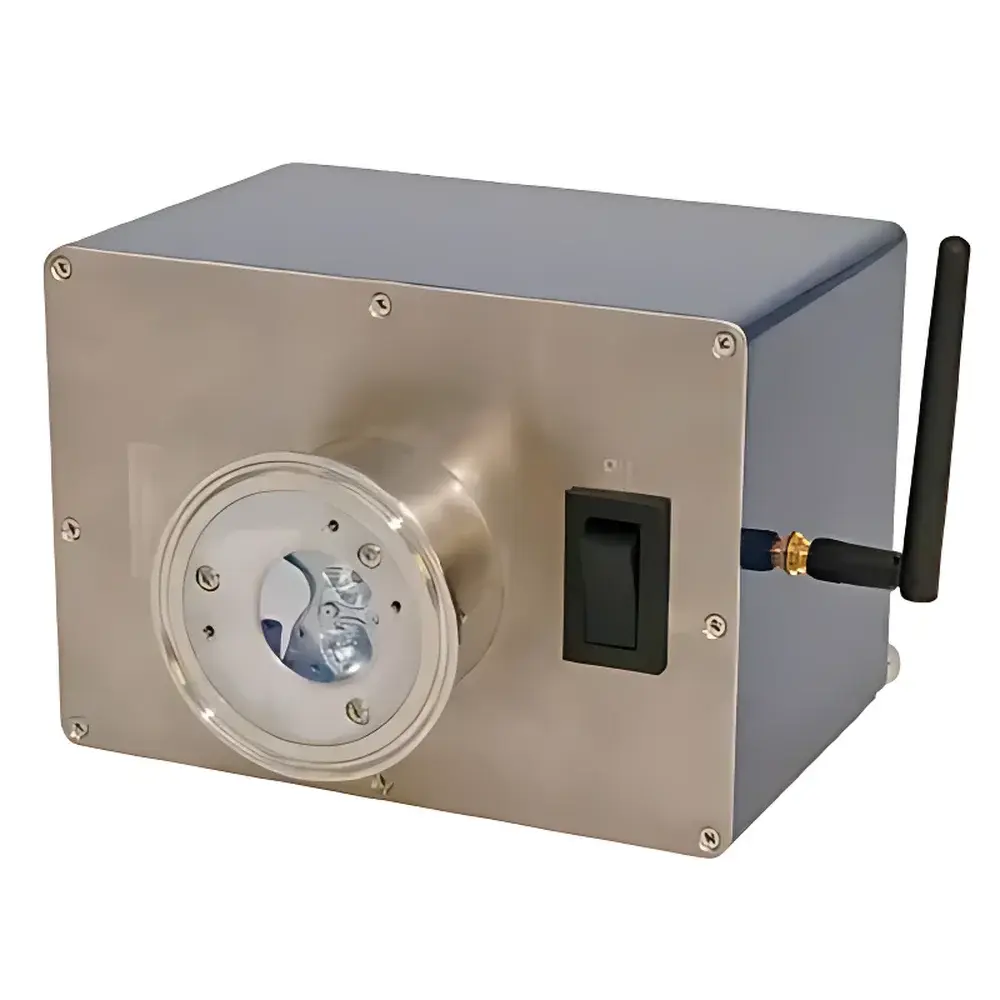
HAAKE TruProcess Near Infrared Spectrometer
| Brand | HAAKE |
|---|---|
| Origin | Germany |
| Type | Online & Portable NIR Spectrometer |
| Model | TruProcess |
| Measurement Principle | Diffuse Reflectance NIR Spectroscopy (900–2500 nm) |
| Optical Architecture | MEMS-based Scanning Grating |
| Scan Speed | ≤5 µs per spectrum |
| Sampling Interface | Non-contact, Programmable Triggered Acquisition |
| Process Integration | DIN-rail mountable, 4–20 mA / Modbus TCP / OPC UA ready |
| Compliance | Designed for GMP/GLP environments |
Overview
The HAAKE TruProcess Near Infrared Spectrometer is an industrial-grade, online and portable process analytical technology (PAT) instrument engineered for real-time, non-invasive chemical and physical property monitoring in continuous manufacturing environments. Leveraging diffuse reflectance near-infrared spectroscopy across the 900–2500 nm spectral range, the TruProcess system captures molecular vibrational overtones and combination bands—primarily from C–H, O–H, and N–H functional groups—to deliver quantitative and qualitative insights into composition, moisture content, blend uniformity, crystallinity, and drying endpoints. Unlike benchtop laboratory spectrometers, the TruProcess is purpose-built for integration directly into production lines—from pilot-scale mixers and fluid-bed dryers to full-scale continuous manufacturing trains—without requiring sample extraction or preparation. Its compact, ruggedized housing (IP65-rated) and low thermal drift architecture ensure stable performance under variable ambient conditions, making it suitable for deployment in regulated pharmaceutical, food, chemical, and polymer processing facilities where PAT-driven quality assurance is mandated.
Key Features
- MEMS-Based Optical Engine: Replaces conventional moving grating or filter wheel mechanisms with a solid-state micro-electromechanical systems (MEMS) scanning mirror, enabling ultra-fast spectral acquisition (≤5 µs per scan) and exceptional long-term wavelength stability.
- Non-Contact, Trigger-Synchronized Measurement: Supports programmable acquisition triggers synchronized with process events (e.g., mixer rotation phase, conveyor position, valve actuation), eliminating timing artifacts and ensuring representative sampling during dynamic operations.
- Modular Process Interface: Equipped with industrial I/O options including 4–20 mA analog outputs, Modbus TCP, and OPC UA connectivity for seamless integration with DCS, SCADA, and MES platforms—enabling closed-loop control and automated batch release decisions.
- Field-Deployable Form Factor: Weighing under 3.2 kg and measuring less than 200 × 150 × 100 mm, the unit mounts directly to equipment frames or DIN rails without vibration isolation, reducing installation complexity and footprint.
- Robust Optical Path Design: Features sapphire window optics and temperature-compensated detector electronics to maintain photometric accuracy across ambient temperatures from 5 °C to 45 °C and relative humidity up to 85% non-condensing.
Sample Compatibility & Compliance
The TruProcess spectrometer is compatible with heterogeneous, opaque, and granular materials—including powder blends, wet granules, extrudates, tablets, and slurries—without requiring dilution, pelletization, or transmission cells. Its diffuse reflectance geometry accommodates surface roughness variations typical of industrial process streams. The system conforms to key regulatory expectations for process analytical instrumentation: spectral data files include embedded metadata (timestamp, instrument ID, calibration version, operator ID), and when used with Thermo Scientific™ Method Development Software under a validated configuration, it supports audit trails, electronic signatures, and data integrity controls aligned with FDA 21 CFR Part 11, EU Annex 11, and ICH Q5A/Q5C guidelines. It is routinely deployed in facilities operating under cGMP and GLP frameworks for Stage 2 (Process Design) and Stage 3 (Process Performance Qualification) of the ICH Q8–Q10 lifecycle model.
Software & Data Management
The TruProcess operates natively with Thermo Scientific™ OMNIC™ Spectra and Method Development Software, enabling end-to-end method creation—from spectral preprocessing (baseline correction, multiplicative scatter correction, derivative transformation) to PLS and PCR multivariate calibration. Calibration models are exportable in PMML format for deployment on third-party analytics platforms. All raw spectra, processed results, and alarm logs are stored in HDF5-compliant binary files with SHA-256 checksums for data integrity verification. Optional cloud synchronization (via secure TLS 1.3) enables centralized model management across global manufacturing sites while preserving local data sovereignty per regional data residency requirements.
Applications
- Real-time monitoring of powder blend homogeneity in high-shear mixers and V-blenders (ASTM E2872–18 compliant endpoint detection)
- In-line moisture quantification during fluid-bed drying and tray drying (correlated to Karl Fischer titration reference methods)
- Endpoint determination for wet granulation and melt extrusion processes
- Polymorph screening and crystallinity assessment in API manufacturing
- Raw material identity verification (Raman/NIR fusion optional) at receiving docks
- Continuous tablet coating thickness and film uniformity analysis via probe-coupled fiber optics
FAQ
Is the TruProcess spectrometer suitable for hazardous area installations?
Yes—ATEX/IECEx-certified variants (Zone 2 / Class I Div 2) are available upon request, featuring intrinsically safe optical heads and explosion-proof junction boxes.
Can existing laboratory NIR calibrations be transferred to the TruProcess platform?
Yes—calibration transfer protocols (e.g., piecewise direct standardization, slope/bias correction) are supported within OMNIC software to minimize revalidation effort.
What maintenance is required for long-term field operation?
No routine optical alignment or lamp replacement is needed; the MEMS engine and thermoelectrically cooled InGaAs detector are rated for >50,000 hours MTBF. Annual verification using NIST-traceable ceramic standards is recommended.
Does the system support multi-stream measurement?
Yes—up to eight process points can be monitored sequentially using motorized fiber-optic multiplexers (optional accessory), each with independent trigger logic and calibration models.
How is cybersecurity addressed in network-connected deployments?
The device implements role-based access control (RBAC), encrypted firmware updates (signed with ECDSA-256), and configurable firewall rules via embedded Linux OS—fully auditable against IEC 62443-3-3 SL2 requirements.





