
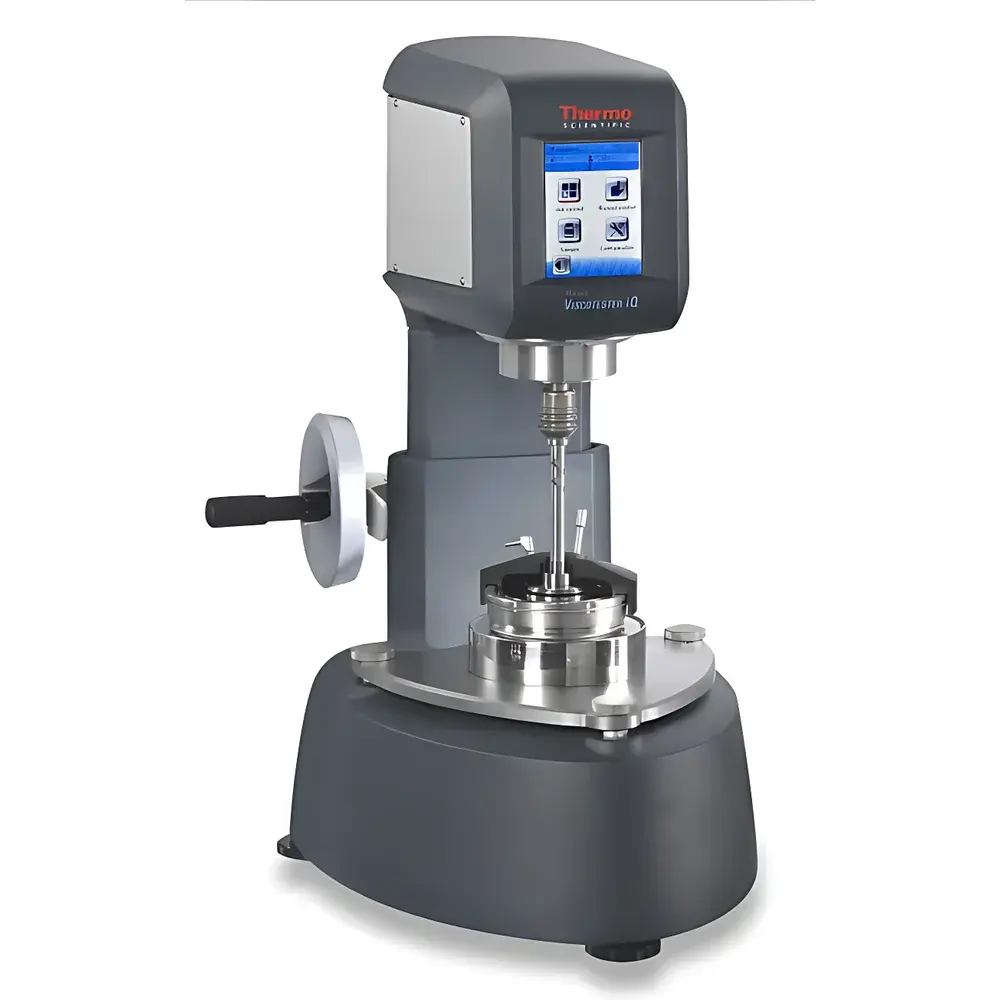
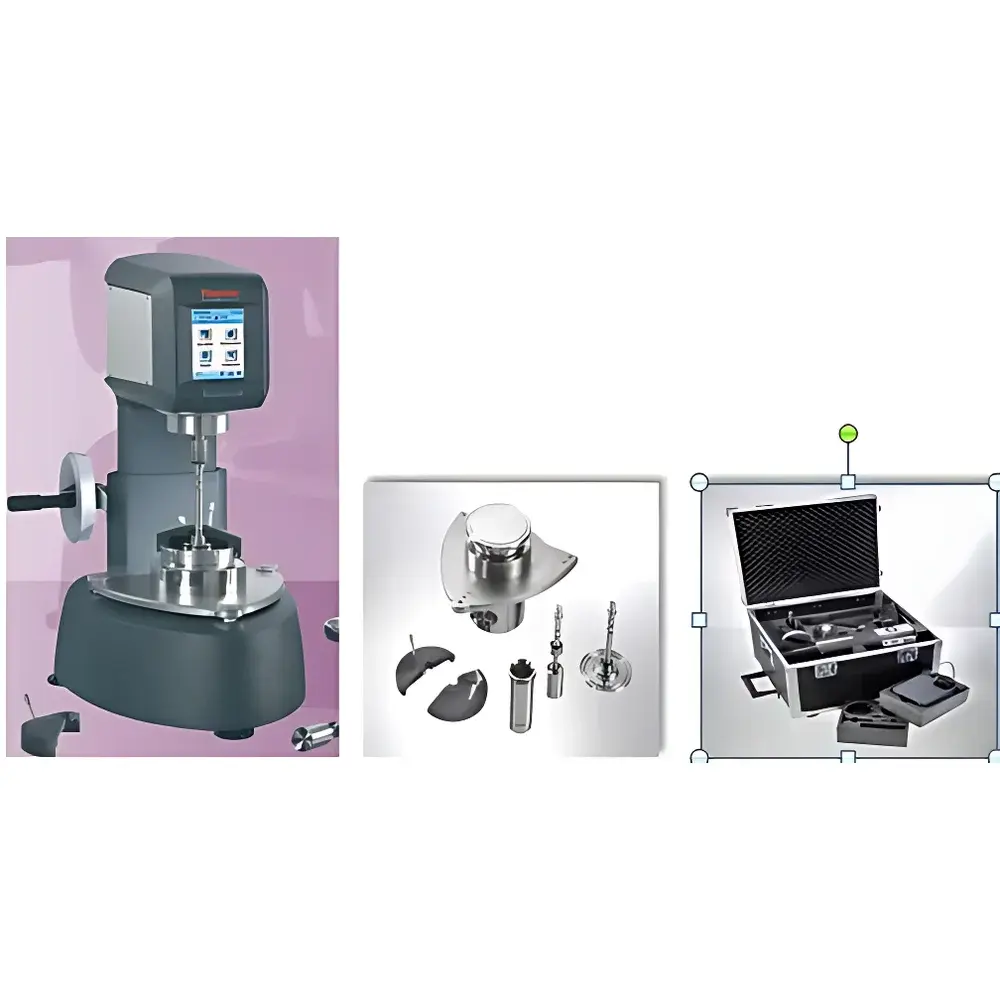
HAAKE VT iQ Intelligent Rotational Viscometer & Compact Rheometer
| Brand | HAAKE |
|---|---|
| Origin | Germany |
| Instrument Type | Rotational Viscometer / Compact Rheometer |
| Model | VT iQ |
| Viscosity Range | 0.001 – 600,000 Pa·s |
| Angular Velocity Range | 0.001 – 157 rad/s |
| Torque Range | 0.2 – 100 mN·m |
| Shear Stress Range | 0.7 – 63,660 Pa |
| Shear Rate Range | 0.004 – 11,415 s⁻¹ |
| Temperature Control | Peltier (–5 °C to 160 °C, depending on geometry) and Liquid Circulator (–20 °C to 180 °C) |
| Connectivity | USB, TCP/IP, USB flash drive interface for RheoApp, keyboard & barcode scanner ports |
| Dimensions (W × L × H) | 270 × 500 × 500 mm |
| Weight | 18 kg |
| Power Supply | 100–240 VAC, 50/60 Hz |
Overview
The HAAKE VT iQ is a modular, intelligent rotational viscometer engineered for precision viscosity and controlled-stress/controlled-rate rheological characterization in laboratory and field environments. Based on Couette flow principles, it employs high-resolution torque and angular displacement sensing to deliver traceable, reproducible measurements across six decades of dynamic viscosity (0.001–600,000 Pa·s). Its dual-capability architecture integrates standalone viscometry with optional oscillatory rheometry—enabling small-strain dynamic testing (G′, G″, tan δ) without external air compressors or recirculating chillers. Designed and manufactured in Germany, the VT iQ complies with ISO 2555, ASTM D2196, and ISO 6721-10 for shear-dependent viscosity profiling, and supports GLP/GMP-aligned workflows via audit-trail-enabled software operation.
Key Features
- Modular hardware platform with auto-recognized geometries: coaxial cylinder, cone-and-plate, and parallel-plate systems—all equipped with integrated Peltier or liquid-circulated temperature control.
- Full touchscreen interface enabling stand-alone operation; no PC required for routine viscosity screening or single-point yield stress determination.
- Temperature Assist algorithm synchronizes real-time thermal feedback from embedded Pt100 sensors with Peltier power modulation, reducing thermal equilibration time by up to 40% versus conventional systems.
- Controlled Rate (CR) and Controlled Stress (CS) modes support both Newtonian validation and non-Newtonian analysis—including flow curves, thixotropy loops, and creep recovery protocols.
- Optional oscillatory module enables frequency sweeps (0.01–100 Hz), amplitude sweeps, and time sweeps—fully compliant with ISO 6721-5 for linear viscoelastic property determination.
- Portable configuration includes ruggedized carry case, battery-compatible power management (via external DC input), and USB-flash-based RheoApp deployment for offline method transfer and result export.
Sample Compatibility & Compliance
The VT iQ accommodates diverse sample classes—from low-viscosity solvents and polymer melts to highly filled pastes and thermosetting resins—across temperature ranges spanning –20 °C to +180 °C (dependent on geometry and temperature unit selected). Its geometry-specific calibration certificates are traceable to PTB (Physikalisch-Technische Bundesanstalt) standards. The system meets requirements for regulatory documentation under FDA 21 CFR Part 11 when operated with Thermo Scientific RheoWin software (v4.0+), including electronic signatures, user access levels, and immutable audit trails. It supports ISO/IEC 17025-compliant uncertainty budgets through built-in repeatability diagnostics and automatic zero-torque compensation.
Software & Data Management
Instrument control and data acquisition are managed via three interoperable layers: (1) onboard touch interface for rapid method execution; (2) RheoApp—a lightweight, USB-deployable application supporting method templates, real-time graphing, and CSV/PDF export; and (3) full-featured RheoWin software (Windows-based) for advanced protocol sequencing, multi-step test design, statistical batch reporting, and integration into LIMS environments via ODBC or OPC UA. All software modules enforce role-based permissions and support automated report generation compliant with USP , ISO 1628, and ASTM D1238 (for melt flow index correlation).
Applications
- Food & Beverage: Texture profiling of sauces, dairy emulsions, and plant-based alternatives; shelf-life stability assessment via time-sweep thixotropy.
- Pharmaceuticals & Cosmetics: Gel strength quantification, suspension stability evaluation, and viscosity-pH dependency mapping for topical formulations.
- Polymer Processing: Melt viscosity monitoring during extrusion feedstock qualification; crosslinking kinetics via time-resolved oscillatory testing.
- Paints, Inks & Coatings: Shear-thinning behavior analysis for spray application modeling; yield stress determination for sag resistance.
- Oilfield & Mining: Drilling fluid rheology at elevated temperatures; cuttings transport simulation using Herschel-Bulkley parameter extraction.
- Academic Research: Teaching rheological fundamentals with intuitive hardware-software coupling; publication-grade data export compatible with MATLAB, Python (via .csv/.xlsx), and OriginLab.
FAQ
Does the VT iQ require external cooling units for sub-ambient measurements?
Yes—when operating below 0 °C with coaxial cylinder geometry, a certified liquid circulator (e.g., Huber Unistat) is required. The integrated Peltier module supports minimum temperatures of –5 °C (coaxial) and 0 °C (cone/plate).
Can the VT iQ perform yield stress measurements?
Yes—using Controlled Stress mode with ramped stress profiles and flow curve extrapolation (e.g., Casson or Bingham models), or via vane geometry add-ons (sold separately) for undisturbed yield point detection.
Is calibration traceable to national metrology institutes?
All factory calibrations are performed using NIST-traceable standard oils and PTB-certified torque transducers, with certificate-of-conformance provided per ISO/IEC 17025 Annex A.
What data security features support regulated environments?
RheoWin software implements 21 CFR Part 11 compliance through encrypted user authentication, electronic signatures, and immutable audit logs covering all method edits, run executions, and data exports.
How does the VT iQ handle non-Newtonian samples with strong time-dependent effects?
Its programmable rest periods, multi-interval shear history protocols, and integrated thixotropy index calculation (per ISO 10457) enable robust quantification of structural recovery and breakdown kinetics.



