
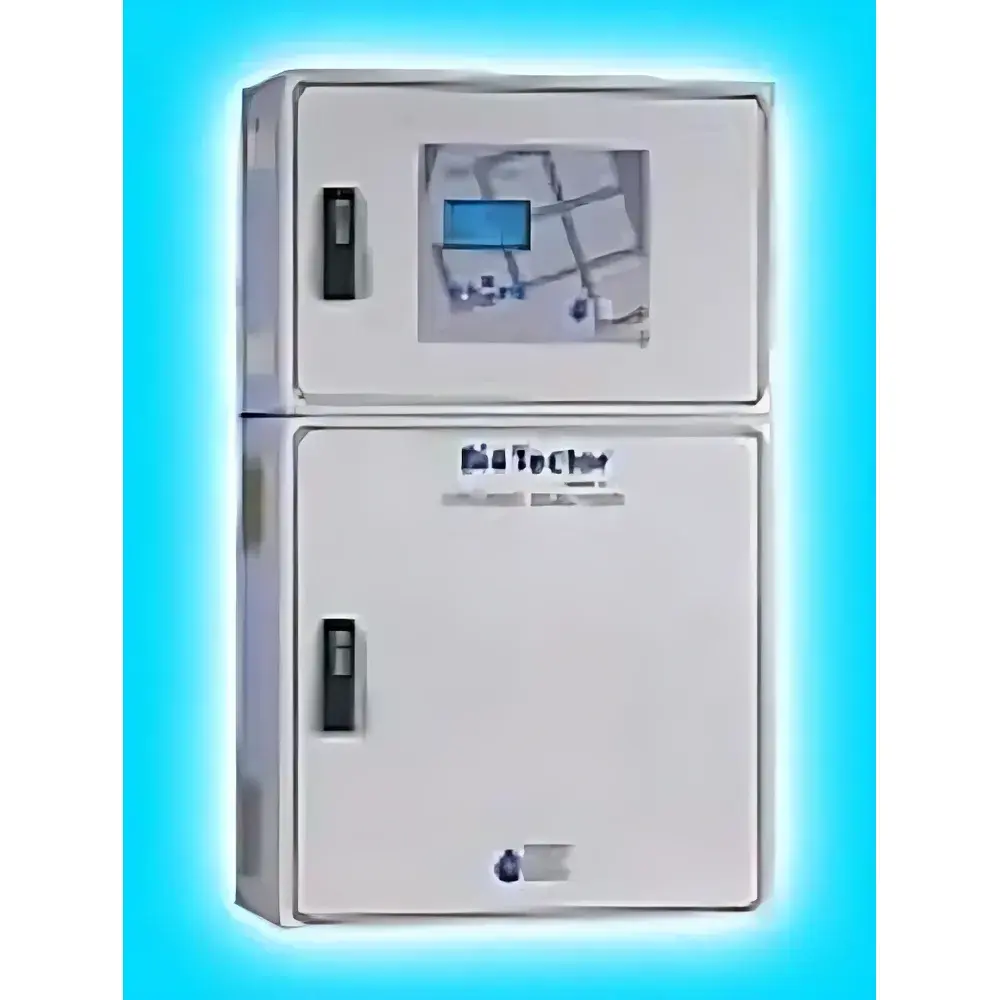
Hach Online Total Organic Carbon Analyzer
| Origin | USA |
|---|---|
| Manufacturer Type | Authorized Distributor |
| Origin Category | Imported |
| Model | Online TOC Analyzer |
| Price Range | USD 42,000 – 70,000 |
| Instrument Type | Online TOC Monitoring System |
| Detection Principle | Non-Dispersive Infrared (NDIR) Absorption |
| Oxidation Methods | UV/Persulfate, High-Temperature Combustion (680–900 °C), Ozone-Promoted Oxidation, Ultra-Pure UV Oxidation |
| Measurement Range | 0–50,000 ppm C |
| Accuracy | ±1% of reading |
| Resolution | 0.05 ppm C |
| Detection Limit | 0.05 ppm C |
| Repeatability | ±1% RSD |
| Sample Throughput | As low as 3 minutes per analysis (configuration-dependent) |
| Dimensions (H×W×D) | 575 × 556 × 612 mm |
| Weight | 60 kg |
| Power Supply | 220 VAC, 10 A |
Overview
The Hach Online Total Organic Carbon Analyzer is an industrial-grade, continuous-monitoring instrument engineered for real-time quantification of total organic carbon in aqueous matrices across municipal, pharmaceutical, power generation, and semiconductor process water systems. It operates on the fundamental principle of complete oxidation of organic carbon to carbon dioxide, followed by highly selective, non-dispersive infrared (NDIR) detection. The system supports four orthogonal oxidation pathways—UV/persulfate, high-temperature catalytic combustion (680–900 °C), ozone-promoted oxidation, and ultra-pure UV oxidation—enabling method-selective adaptation to sample complexity, matrix interference, and regulatory compliance requirements. Each oxidation route is integrated with acidification (pH ≤ 2.0) to purge inorganic carbon as dissolved CO₂ prior to organic carbon measurement, ensuring strict adherence to ASTM D5903, ISO 8245, and USP methodologies.
Key Features
- Dual NDIR detectors with temperature- and pressure-compensated optical cells for enhanced signal stability and long-term baseline integrity
- Modular oxidation architecture allowing field-selectable configuration between UV/persulfate, high-temperature combustion, ozone, or ultra-pure UV oxidation
- Integrated acidification and sparging module for precise inorganic carbon removal prior to TOC determination
- Automated calibration verification using certified potassium hydrogen phthalate (KHP) and sodium bicarbonate standards
- 103-position autosampler (optional) with programmable rinse cycles, temperature-controlled sample tray, and leak-detection circuitry
- Configurable high-temperature module (up to 900 °C) for refractory compound oxidation in wastewater and industrial effluents
- Optional TN/TOC dual-module capability: post-oxidation nitrogen gas stream directed to a segmented flow photometer for total nitrogen quantification per ISO 11908
Sample Compatibility & Compliance
The analyzer demonstrates robust performance across diverse water types, including drinking water, surface water, groundwater, wastewater (primary to tertiary), cooling tower water, seawater, ultrapure water (UPW), high-salinity brines, and leachates from solid waste and soil extracts. Its oxidation flexibility ensures reliable recovery of recalcitrant organics (e.g., humic substances, pyridines, chlorinated hydrocarbons) without matrix-induced suppression. The system meets GLP and GMP data integrity requirements through built-in audit trail logging, electronic signature support, and full 21 CFR Part 11 compliance when paired with Hach DataStream™ software. All oxidation methods are validated against EPA Method 415.3 and ISO 20674 for trace-level TOC quantification in regulated environments.
Software & Data Management
Hach DataStream™ v5.2 provides browser-based instrument control, method scheduling, real-time trend visualization, and automated report generation (PDF/CSV). The software implements secure user-role management (admin/operator/auditor), time-stamped event logs, and configurable alarm thresholds with SNMP/email notification. Raw NDIR absorbance signals, oxidation efficiency diagnostics, and carryover metrics are stored with metadata (sample ID, operator, method version, ambient conditions). Data export supports LIMS integration via ASTM E1384-compliant HL7 messaging or OPC UA protocol. All raw spectra and calibration history are retained for retrospective reprocessing and regulatory inspection readiness.
Applications
- Continuous monitoring of TOC at drinking water treatment plant intake and distribution points
- Pharmaceutical water system validation (PW, WFI, pure steam condensate) per EU Annex 1 and FDA guidance
- Real-time TOC surveillance in semiconductor UPW loops to prevent particle nucleation and wafer defect escalation
- Effluent compliance reporting for industrial dischargers subject to NPDES permits
- Process optimization in membrane bioreactors (MBRs) and advanced oxidation processes (AOPs)
- Leachate characterization from landfill and contaminated site remediation projects
FAQ
What oxidation method is recommended for ultrapure water applications?
Ultra-pure UV oxidation is the default method for UPW analysis, minimizing reagent introduction and eliminating combustion-related particulate carryover. It achieves sub-ppb sensitivity with negligible blank contribution.
Can the system quantify both TOC and TN in a single run?
No—TOC and TN analyses are sequential but fully automated. After TOC oxidation, the same sample stream is routed to the TN photometric module for nitrate/nitrite detection following persulfate digestion and reduction.
Is carrier gas required for all oxidation modes?
Yes—high-purity oxygen or synthetic air is used for sparging (IC removal) and as a transport medium for CO₂ to the NDIR cell. An integrated oxygen generator or gas purifier is available as an option.
How does the system handle high-chloride or high-sulfide samples?
The acidification/sparging step removes volatile inorganic species (e.g., H₂S, Cl⁻ interference minimized via optimized pH control and ceramic sparger design). For extreme matrices, optional chloride-tolerant catalysts and sulfide-scavenging pre-filters are available.
What maintenance intervals are specified for routine operation?
Daily: auto-zero and span verification; Weekly: acid reagent replacement and sparger cleaning; Quarterly: NDIR optical window inspection and combustion tube conditioning; Annually: full system performance qualification per IQ/OQ protocols.
Related Products







