
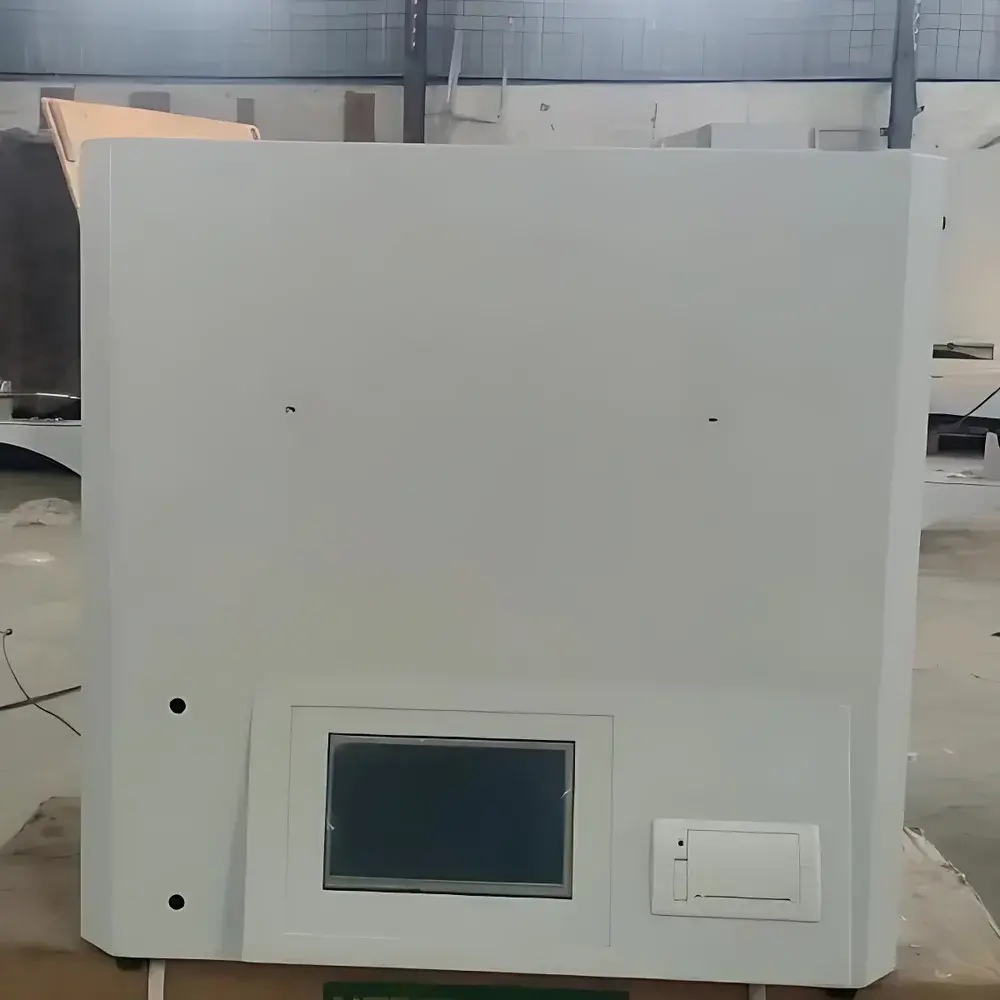
HAG-Type Halogen Acid Gas Evolution Tester
| Brand | Aerospace Vertical |
|---|---|
| Origin | Beijing, China |
| Manufacturer Type | Authorized Distributor |
| Country of Origin | China |
| Model | HAG-Type |
| Price Range | USD 6,000 – 10,000 (FOB) |
| Application | Halogen acid gas quantification in flame-retardant cables |
| Sample Form | Solid wire & cable specimens |
| pH Repeatability | ±0.02 pH units |
| Combustion Boat | Fused quartz tube, 100 mm × 25 mm × 10 mm (L × W × D) |
| Air Filtration | Activated carbon + silica gel dual-stage drying & purification |
| Thermocouple | K-type, 0–1300 °C, stainless-steel sheathed |
| Heating Furnace | 600 mm effective length × Ø42 mm ID, 10 kW electric heating, PID-controlled |
| Gas Collection | Dual 500 mL absorption flasks |
| Air Flow Control | 20–200 mL/min adjustable rotameter |
| Power Supply | 220 V AC, 30 A |
| Conductivity Range | 0–1×10⁵ µS/cm |
| pH Measurement Range | 0–14, resolution 0.01 pH |
Overview
The HAG-Type Halogen Acid Gas Evolution Tester is a precision-engineered combustion analysis system designed to quantify total halogen acid gas (e.g., HCl, HBr, HF) evolution from electric cables and wires during thermal decomposition under controlled pyrolysis conditions. It operates in strict compliance with the gravimetric and absorptiometric principles defined in IEC 60754-1:1994 (determination of halogen acid gas content) and IEC 60754-2:1991 (determination of acidity via pH and conductivity of aqueous absorption solution). The instrument implements the standardized test methodology specified in GB/T 17650.1–1998 and GB/T 17650.2–1998 — China’s national equivalents of the IEC standards — and further satisfies requirements outlined in GB/T 19666–2005 (General Specification for Flame Retardant and Fire Resistant Cables), GA 306.1–2007 and GA 306.2–2007 (Public Security Industry Standards for Flame Retardant Cables), and UL 2556–2007 Sections 9.10 and 9.11. Its core measurement principle relies on complete combustion of a precisely weighed sample (500–1000 mg) in a fused quartz combustion boat within a high-temperature furnace (up to 1300 °C), followed by quantitative absorption of evolved acidic gases into standardized sodium hydroxide solution. Subsequent analysis of the absorption medium yields both total halogen acid mass (via titration or ion chromatography, per user protocol) and acid strength metrics — pH and specific conductivity — enabling full assessment of corrosivity potential in fire scenarios.
Key Features
- Fused quartz combustion boat (100 × 25 × 10 mm) ensuring chemical inertness and thermal stability up to 1300 °C, minimizing background interference during halogen release.
- Integrated dual-stage air purification system: activated carbon filter removes organic vapors and hydrocarbons; silica gel column ensures consistent dew point control for dry, contaminant-free carrier gas.
- PID-controlled high-power furnace (10 kW) with K-type thermocouple feedback, delivering stable, reproducible temperature profiles across the 600 mm heated zone (Ø42 mm internal diameter).
- Automated combustion boat positioning mechanism utilizing platinum wire linkage and external bar magnet actuation — eliminating mechanical contact and thermal leakage at furnace ports.
- Dual-flask gas collection system: one flask contains 220 mL of 0.1 mol/L NaOH solution and integrates a submersible magnetic stirrer for uniform gas dissolution and rapid equilibration.
- Dedicated high-precision pH meter (±0.02 pH accuracy) and conductivity meter (0–1×10⁵ µS/cm range) calibrated per ISO/IEC 17025 traceable procedures.
- Full compliance-ready hardware configuration: includes all reagents, volumetric glassware, and consumables required for GB/T 17650.1 and GB/T 17650.2 execution — excluding analytical balances and standalone pH/conductivity meters as specified in standard protocols.
Sample Compatibility & Compliance
The HAG-Type tester is validated for solid polymeric cable insulation and jacketing materials, including cross-linked polyolefins (XLPE), ethylene propylene rubber (EPR), and halogen-free flame retardant (HFFR) compounds. It accommodates specimen dimensions conforming to IEC 60754-1:1994 Clause 6.2 — typically 10–20 cm lengths of finished cable, stripped to expose homogeneous polymer layers. All operational parameters align with GLP-compliant laboratory practice: temperature calibration records, gas flow verification logs, and reagent lot traceability are fully supported. The system meets essential requirements for regulatory submissions under EU CPR (Construction Products Regulation) Annex ZA, RoHS Directive Annex II (halogen content screening), and NFPA 70E arc-flash hazard assessments where material corrosivity data informs enclosure material selection.
Software & Data Management
While the base HAG-Type configuration is hardware-centric and analog-output oriented (pH and conductivity signals routed to dedicated digital displays), optional RS-232/USB interfaces enable direct acquisition into LIMS or custom Excel-based reporting templates. All measured values — furnace temperature profile, airflow rate, final pH, and conductivity — are manually logged in accordance with ASTM E2500-17 guidelines for equipment qualification documentation. For laboratories operating under FDA 21 CFR Part 11 or ISO 17025, the instrument supports audit-trail-capable data entry when integrated with compliant electronic lab notebooks (ELN). Calibration certificates for included pH and conductivity sensors are supplied with NIST-traceable references, and furnace temperature uniformity mapping reports can be generated upon installation commissioning.
Applications
- Quantitative halogen acid gas emission testing of low-smoke zero-halogen (LSZH) cables for transit infrastructure, data centers, and healthcare facilities.
- Verification of halogen-free declarations per IEC 61249-2-21 and IPC-4101D specifications in printed circuit board laminate qualification.
- Comparative evaluation of flame retardant additives (e.g., aluminum trihydrate vs. magnesium hydroxide) on acid gas generation kinetics.
- Root cause analysis of conductor corrosion in fire-damaged electrical systems through post-test absorption solution anion profiling (Cl⁻, Br⁻, F⁻ via IC).
- Supporting UL 1685 vertical tray flame spread and smoke density testing by correlating halogen acid output with smoke optical density trends.
FAQ
What standards does the HAG-Type tester fully support out-of-the-box?
It is pre-configured to meet IEC 60754-1:1994, IEC 60754-2:1991, GB/T 17650.1–1998, GB/T 17650.2–1998, GB/T 19666–2005 Table 6, GA 306.1–2007 Section 6.3.4, GA 306.2–2007 Section 6.3.4, and UL 2556–2007 Sections 9.10 and 9.11.
Is the instrument supplied with certified reference materials or calibration standards?
No certified reference materials are included; however, the system ships with batch-certified reagents (NaOH, HCl, buffer solutions) meeting GB/T 601–2016 purity requirements and full CoA documentation.
Can the HAG-Type be used for non-cable polymeric materials such as connectors or enclosures?
Yes — provided specimens are homogenous, weigh 500–1000 mg, and contain no metallic fillers or flame retardants that volatilize below 800 °C without acid gas formation.
What safety infrastructure is mandatory for operation?
Mandatory infrastructure includes a certified fume hood with ≥0.5 m/s face velocity, grounded 220 V / 30 A circuit with residual current device (RCD), Class ABC fire extinguisher mounted within 3 m of the instrument, and PPE ensemble comprising acid-resistant gloves, chemical splash goggles, and respirator with multi-gas cartridge (organic vapor + acid gas).
How often must the fused quartz combustion boat be replaced?
Boats are rated for ≥200 cycles under standard test conditions; replacement is recommended after visible etching, warping, or inconsistent pH recovery between replicate runs — typically every 6–12 months in high-throughput labs.



