
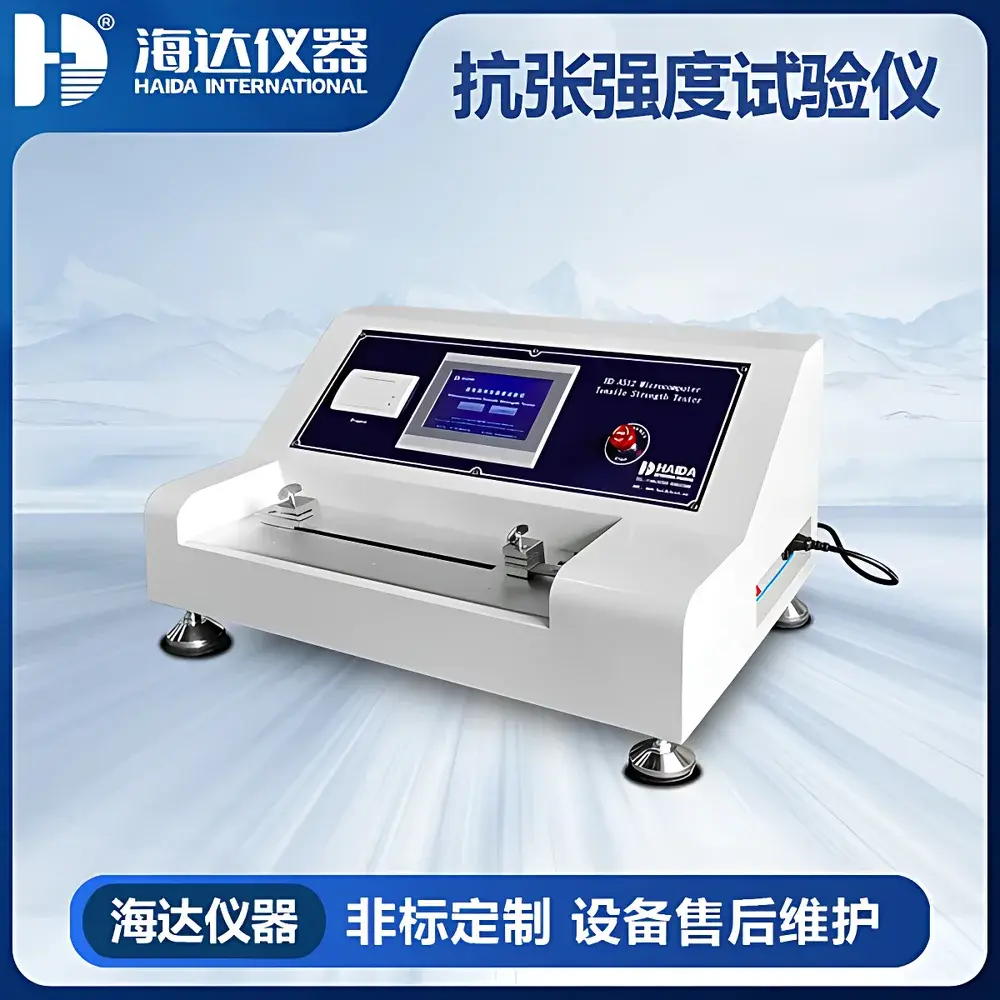
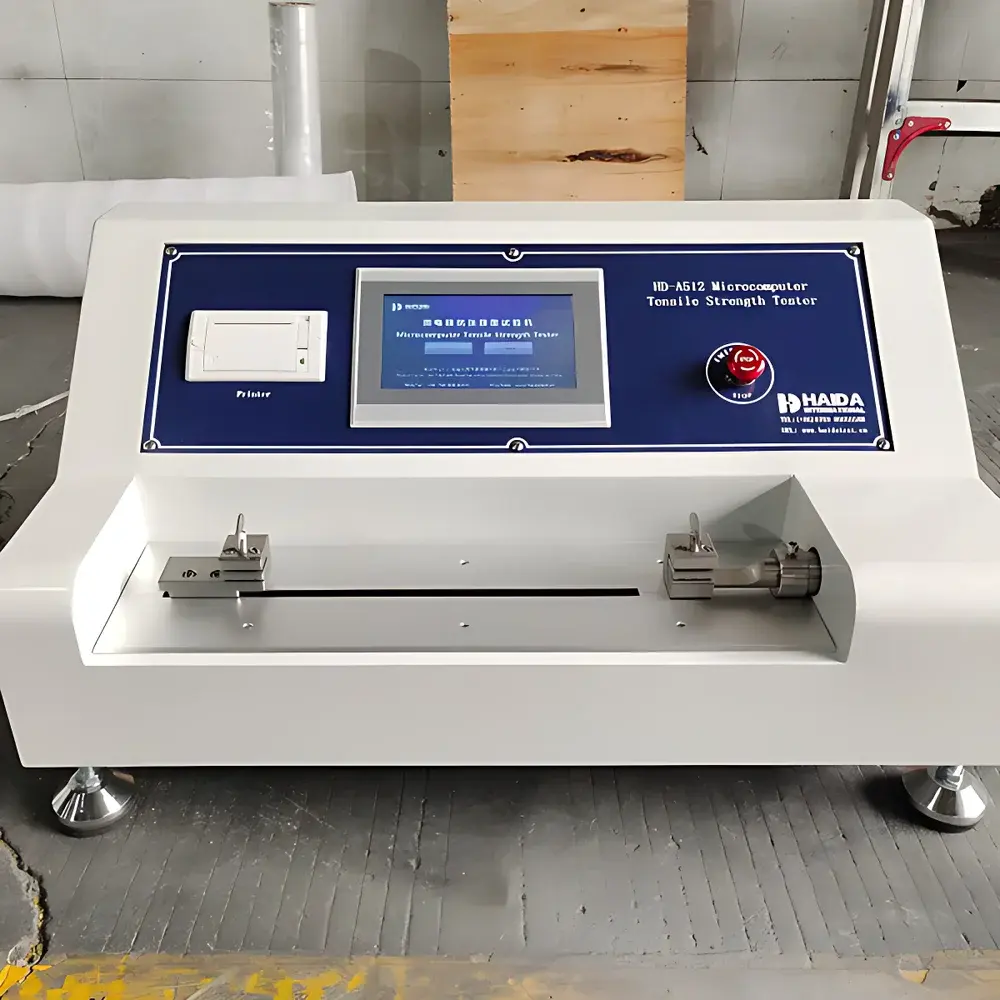
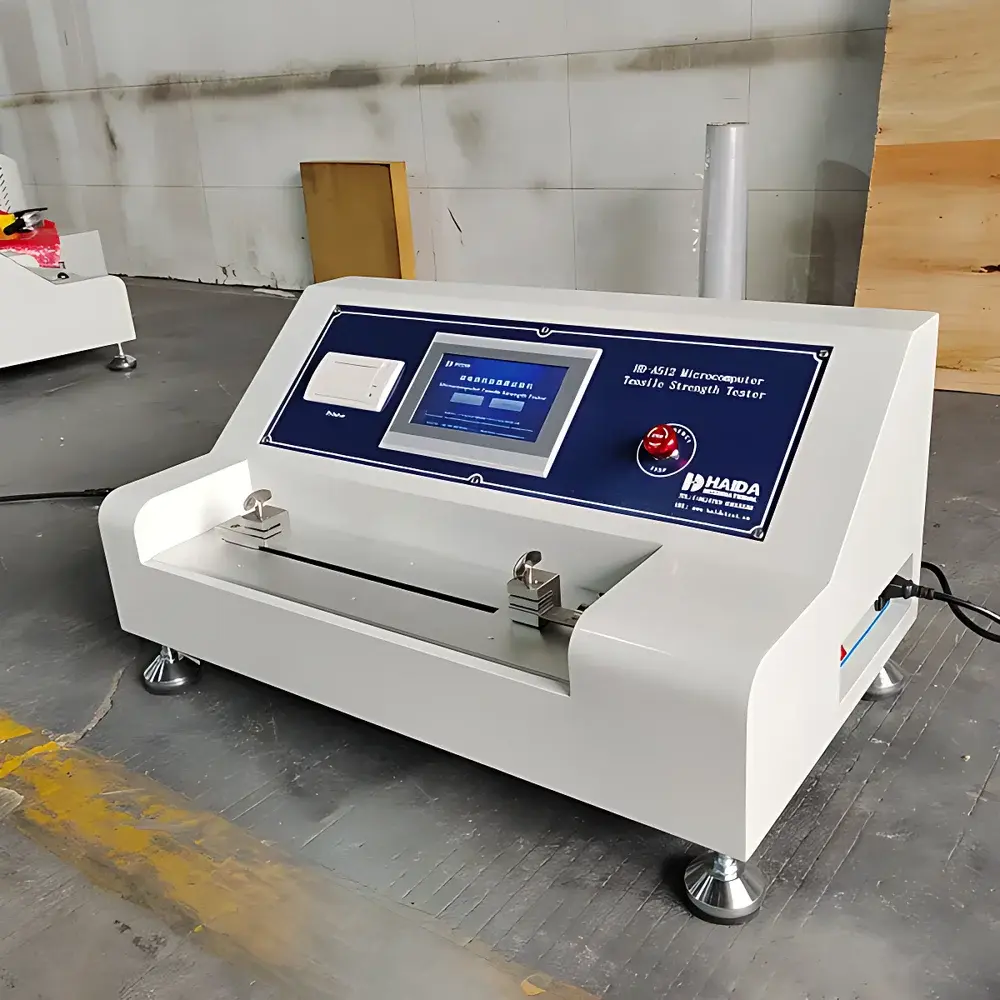
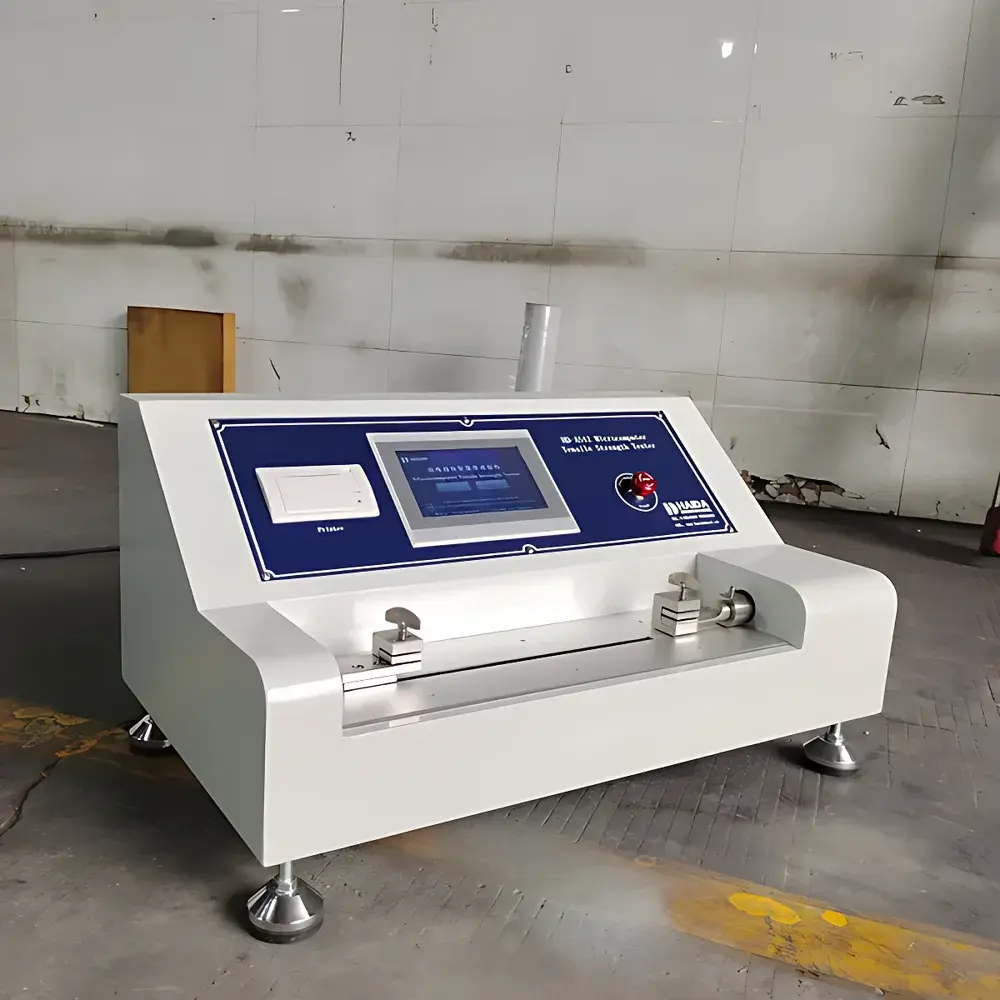
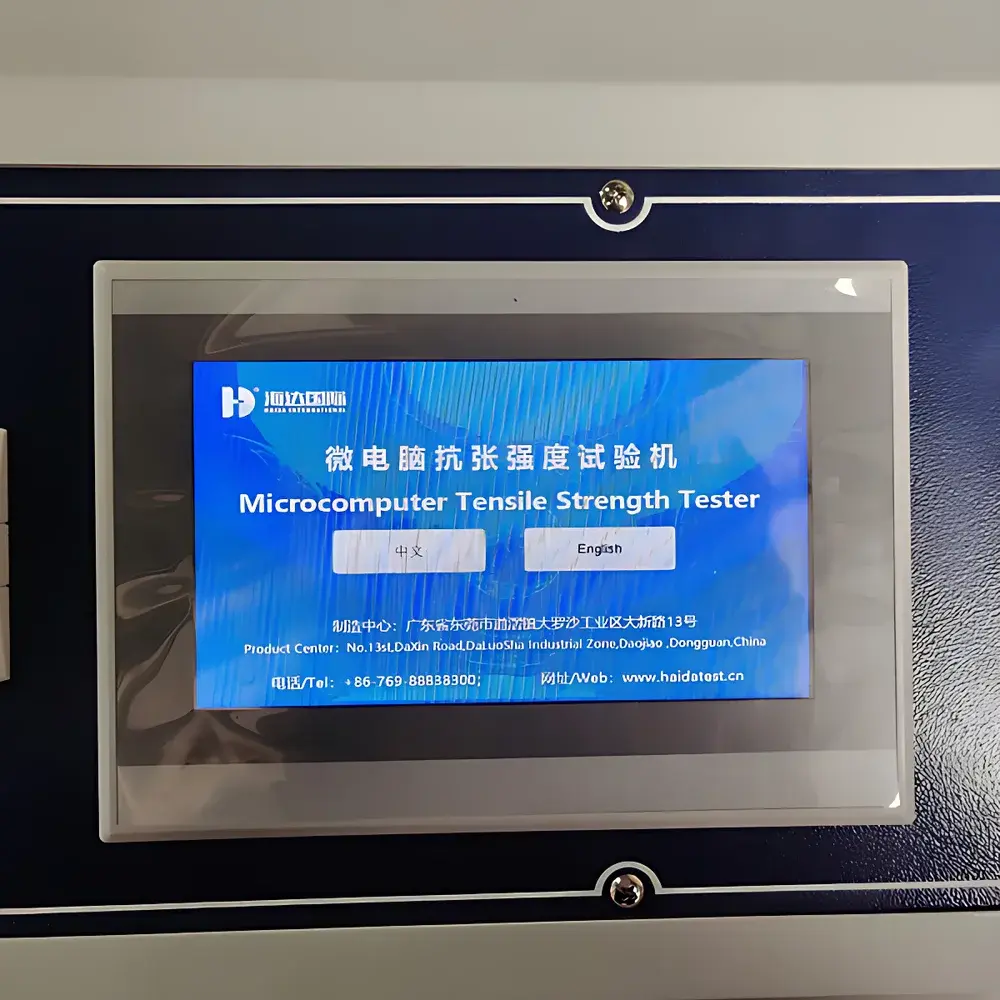
HAIDA HD-A512 Microcomputer-Controlled Tensile Strength Tester
| Brand | HAIDA INTERNATIONAL |
|---|---|
| Origin | Guangdong, China |
| Manufacturer Type | Direct Manufacturer |
| Product Origin | Domestic (China) |
| Model | HD-A512 |
| Capacity | 300 N |
| Motor | Stepper Motor |
| Driver | Stepper Motor Driver |
| Control Interface | Touchscreen |
| Display | Touchscreen LCD |
| Transmission | Precision Ball Screw |
| Speed Range | 0.1–200 mm/min |
| Maximum Travel | 300 mm |
| Load Resolution | 1/250,000 FS |
| Load Accuracy | ≤0.5% FS |
| Effective Force Range | 5 g–30 kg (49 mN–294 N) |
| Unit Options | gf, kgf, N, kN, lbf, tonf |
| Dimensions (L×W×H) | 700 × 420 × 325 mm |
| Weight | ~50 kg |
| Power Supply | 1∮ AC 220 V, 50/60 Hz |
| Power Consumption | ~500 W |
| Compliance Standards | GB/T 12914–2018, GB/T 1040, GB 13022–1991, ISO 1924-2:2008 |
Overview
The HAIDA HD-A512 Microcomputer-Controlled Tensile Strength Tester is a precision electromechanical instrument engineered for quantitative mechanical characterization of flexible sheet materials—primarily paper, board, corrugated fiberboard, plastic films, and nonwovens. It operates on the principle of uniaxial tensile loading under controlled displacement rate, measuring force response and dimensional change in real time to derive standardized mechanical parameters including tensile force, tensile strength (kN/m), elongation at break (%), breaking length (km), tensile energy absorption (J/m²), and tensile index (N·m/g). Designed to meet international test methodology requirements, the HD-A512 implements closed-loop motion control via a stepper motor coupled to a high-precision ball screw transmission system, ensuring repeatable strain-rate application and minimal mechanical hysteresis. Its dual-guide-rod structural architecture enhances lateral rigidity and axial alignment stability during high-speed or low-force testing, directly contributing to measurement reproducibility across multi-batch validation protocols.
Key Features
- High-resolution load sensing system with ≤0.5% full-scale accuracy and 1/250,000 internal resolution, compliant with ISO 7500-1 Class 1 requirements for force measurement instruments.
- Adjustable crosshead speed from 0.1 to 200 mm/min, enabling precise adherence to standard-defined test rates (e.g., 20 mm/min per ISO 1924-2:2008 or 100 mm/min per GB/T 12914–2018).
- Integrated touchscreen interface with intuitive menu navigation, real-time curve plotting (force vs. extension), and automatic parameter calculation per ASTM D828 and TAPPI T494 guidelines.
- Multi-mode control architecture supporting constant-rate-of-extension (CRE), constant-rate-of-load (CRL), constant-strain-rate, and stress/strain-rate targeting—configurable without firmware modification.
- Comprehensive safety architecture including hardware-based travel limit switches, software-enforced overload cutoff (adjustable threshold), and emergency stop circuitry meeting IEC 61800-5-2 functional safety criteria.
- Modular test program library preloaded with standardized routines for tensile, tear, puncture, and peel testing—each conforming to method-specific calibration traceability paths.
Sample Compatibility & Compliance
The HD-A512 accommodates specimens up to 300 mm in gauge length and 50 mm in width, compatible with standard specimen geometries defined in ISO 1924-2, GB/T 12914–2018, and TAPPI T494. Clamping systems utilize pneumatic or mechanical parallel-jaw configurations (optional) to minimize slippage and stress concentration. All mechanical and electronic subsystems are validated against national metrological verification procedures (JJG 475–2018) and support GLP/GMP-compliant audit trails when paired with optional data export modules. The instrument satisfies essential requirements of ISO/IEC 17025:2017 for testing laboratories, particularly clause 6.4 (equipment) and 6.5 (traceability of measurements), and is routinely deployed in QC labs undergoing CNAS or ILAC-MRA accreditation audits.
Software & Data Management
Firmware supports USB and RS-232 interfaces for bidirectional communication with external PCs. Optional HAIDA TestSuite v3.2 software provides FDA 21 CFR Part 11-compliant user access control, electronic signature logging, and immutable audit trail generation for all test events—including parameter changes, calibration updates, and result exports. Raw data (force/time, displacement/time) is stored in CSV and XML formats with embedded metadata (operator ID, timestamp, environmental conditions, standard reference). Batch analysis tools enable statistical comparison across up to 99 specimens per group, with automated calculation of mean, standard deviation, coefficient of variation, and confidence intervals at 95% level—aligned with ISO 5725-2 repeatability requirements.
Applications
This tester serves as a core platform for quality assurance in packaging material production, pulp & paper mills, and contract testing laboratories. Typical use cases include incoming raw material verification (e.g., linerboard tensile strength per ISO 1924-2), process control monitoring during converting operations (e.g., adhesive bond integrity in laminated films), regulatory submission testing for medical device packaging (per ISO 11607-1), and R&D evaluation of biodegradable substrates. Its capacity range (49 mN–294 N) and sub-gram force resolution make it suitable for both heavy-duty corrugated board and ultra-thin specialty papers (<30 g/m²), while its modular design allows integration into automated line sampling stations via digital I/O signals.
FAQ
Does the HD-A512 comply with ISO/IEC 17025 requirements for accredited testing laboratories?
Yes—its force transducer calibration path traces to NIM (National Institute of Metrology, China) standards, and mechanical verification follows JJG 475–2018. Full documentation packages—including as-found/as-left reports and uncertainty budgets—are available upon request.
Can test data be exported in formats compatible with LIMS systems?
Yes—CSV, XML, and PDF reports include structured fields for sample ID, test standard, operator, date/time, and all calculated metrics. Optional API integration supports direct push to common LIMS platforms.
Is third-party calibration certification available?
HAIDA offers ISO/IEC 17025-accredited calibration services through partner labs in Shenzhen and Shanghai, with certificates issued per ISO 17025:2017 Annex A.3.
What maintenance intervals are recommended for long-term accuracy retention?
Ball screw lubrication and guide rail cleaning every 6 months; annual verification of load cell linearity and zero drift; biannual verification of speed accuracy using calibrated encoder-based reference standards.
Are custom夹具 (grips) available for non-standard specimen geometries?
Yes—HAIDA provides CAD-supported custom grip design and manufacturing for specialized applications, including pneumatic clamps, serrated jaws for high-friction substrates, and micro-specimen holders down to 5 mm width.





