
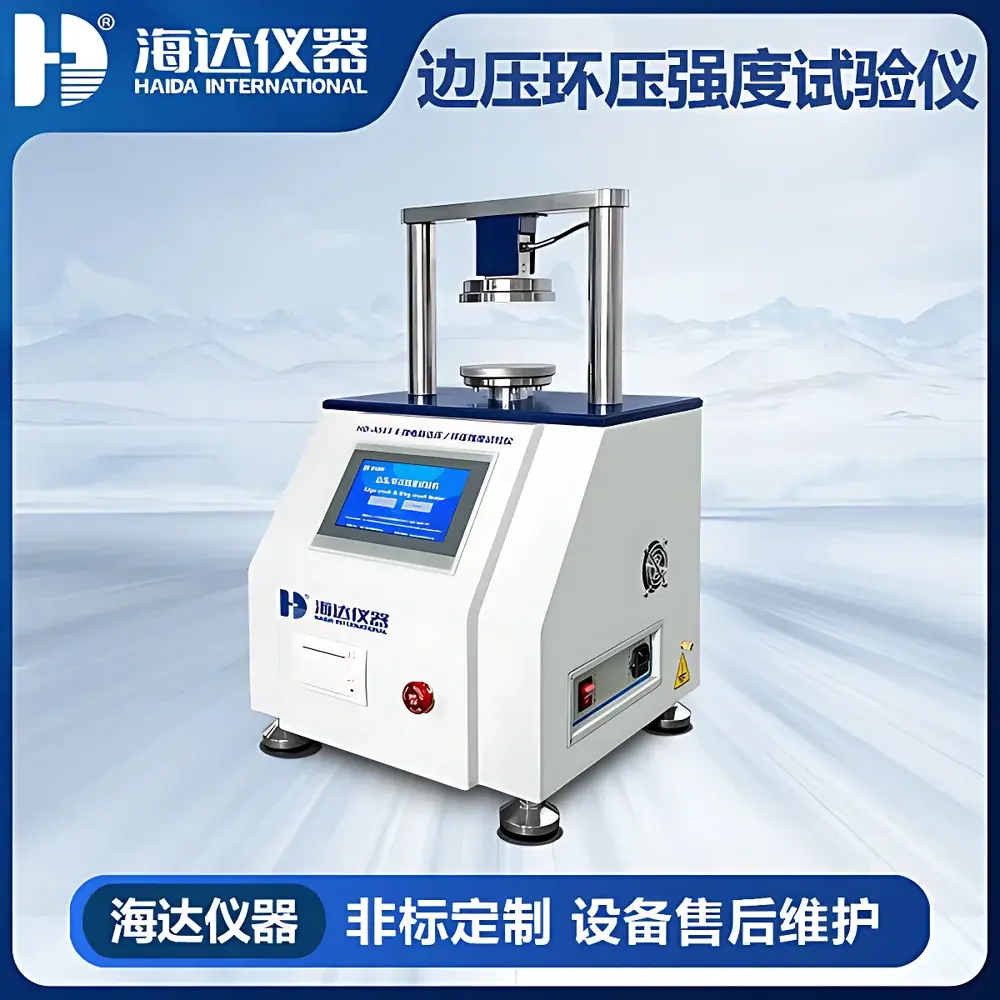
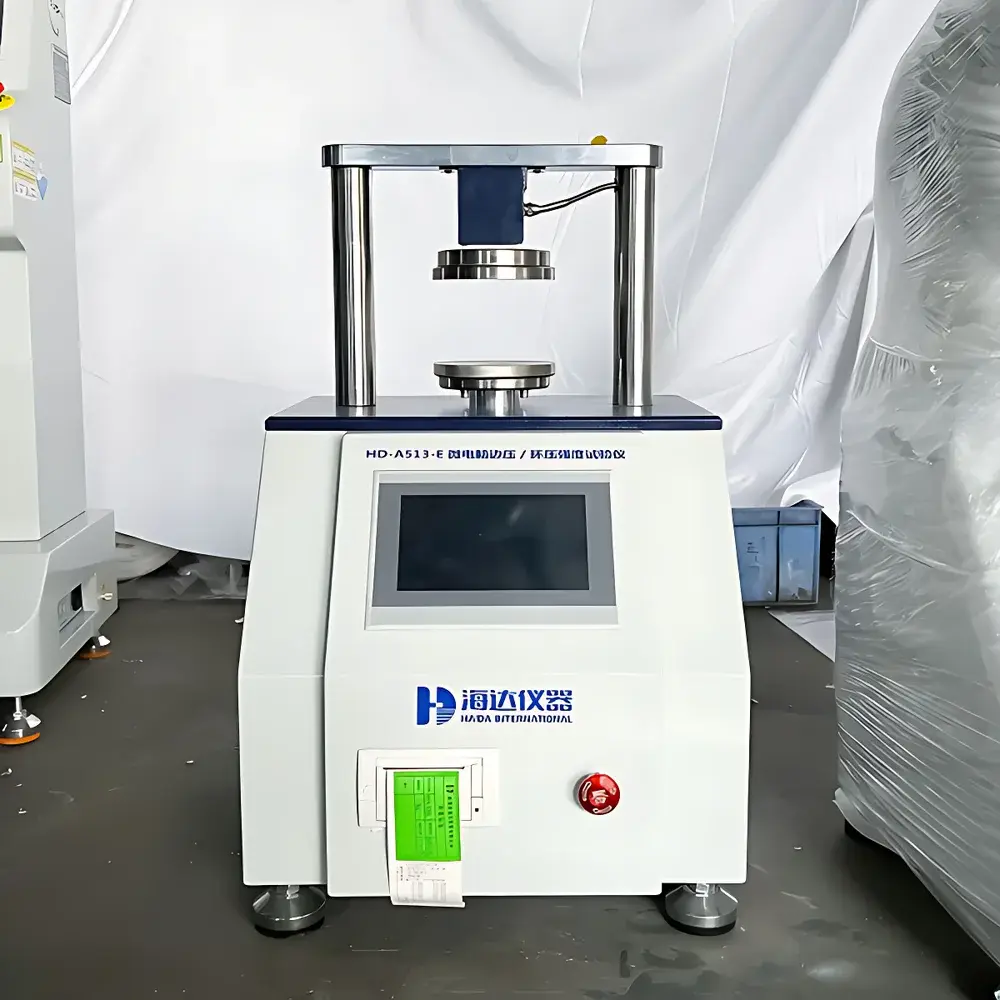
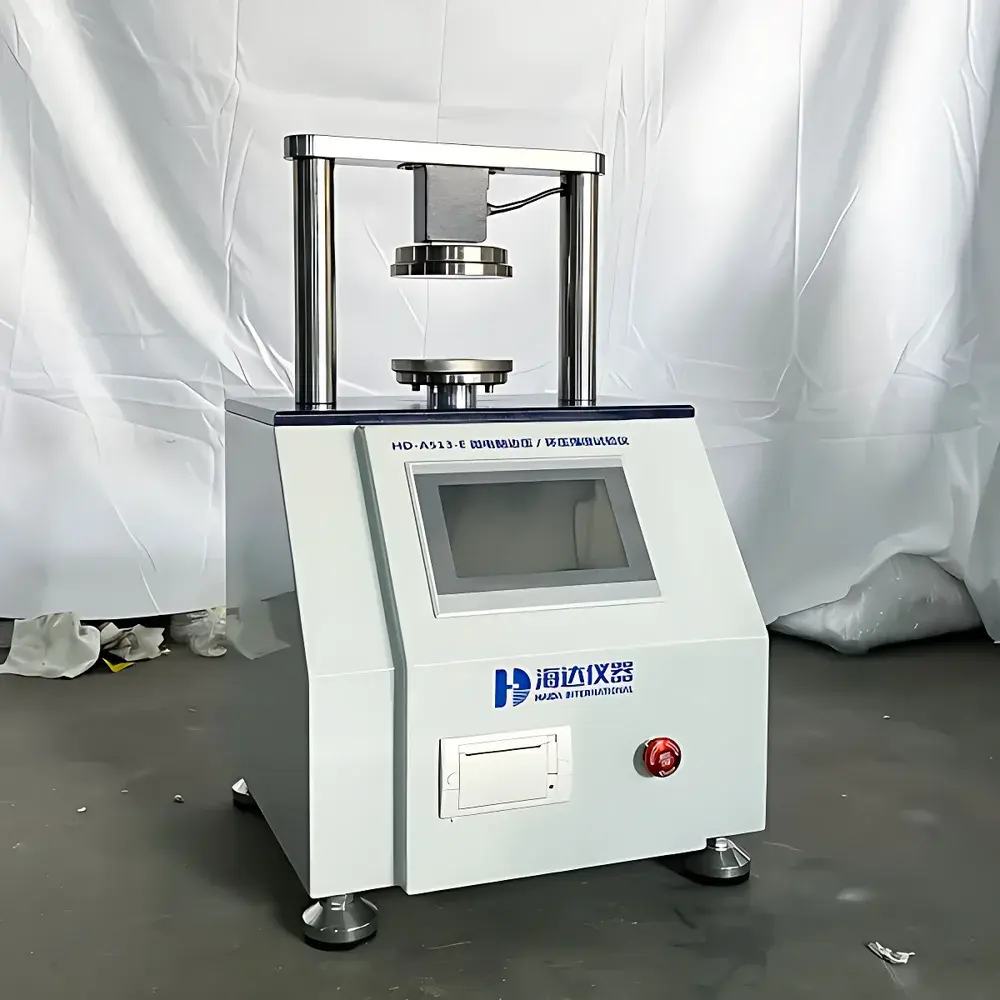
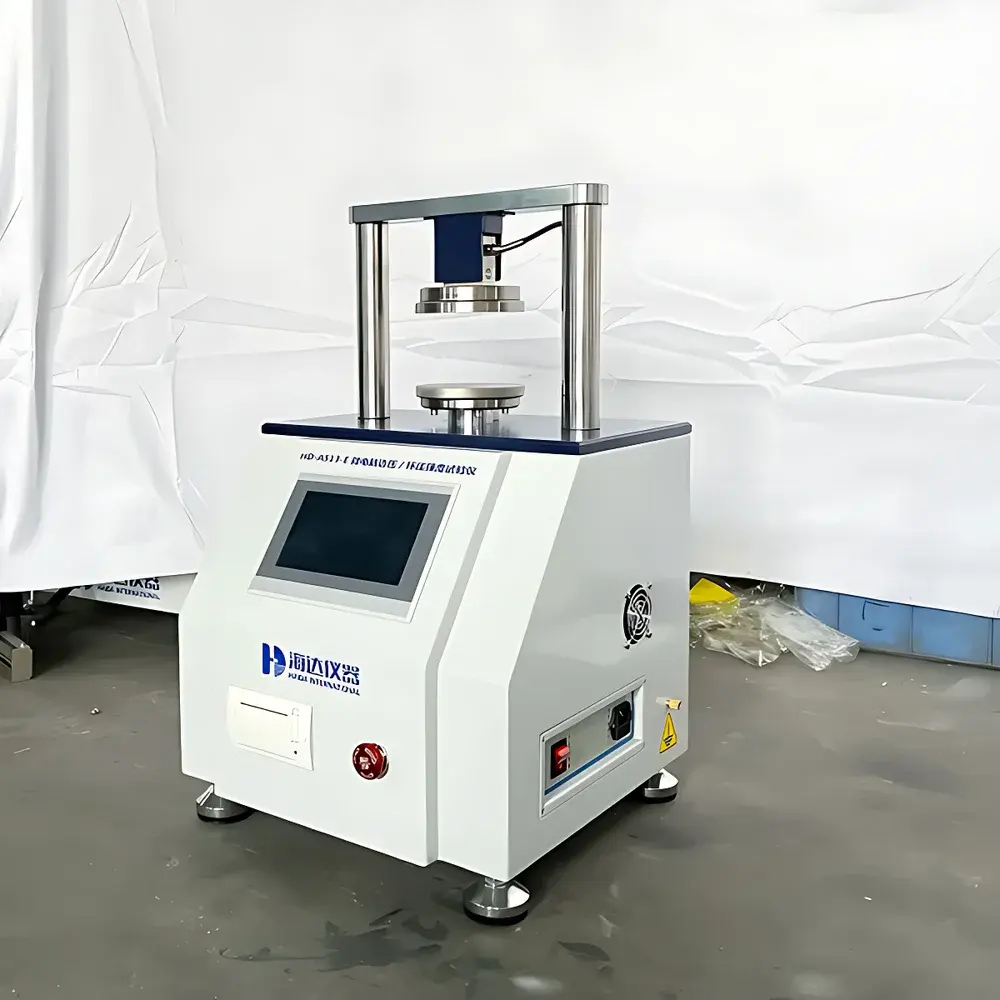
HAIDA HD-A513-E Microcomputer-Controlled Edge Crush Test (ECT) / Ring Crush Test (RCT) Tester
| Brand | HAIDA INTERNATIONAL |
|---|---|
| Origin | Guangdong, China |
| Manufacturer Type | Direct Manufacturer |
| Model | HD-A513-E |
| Display | 7-inch TFT Touchscreen (Dual-language UI: English/Chinese) |
| Load Capacity | 2 kN |
| Force Resolution | 0.02 N |
| Force Accuracy | ≤ ±0.5% FS |
| Load Cell Resolution | 1/250,000 |
| Test Speed | (12.5 ± 2.5) mm/min |
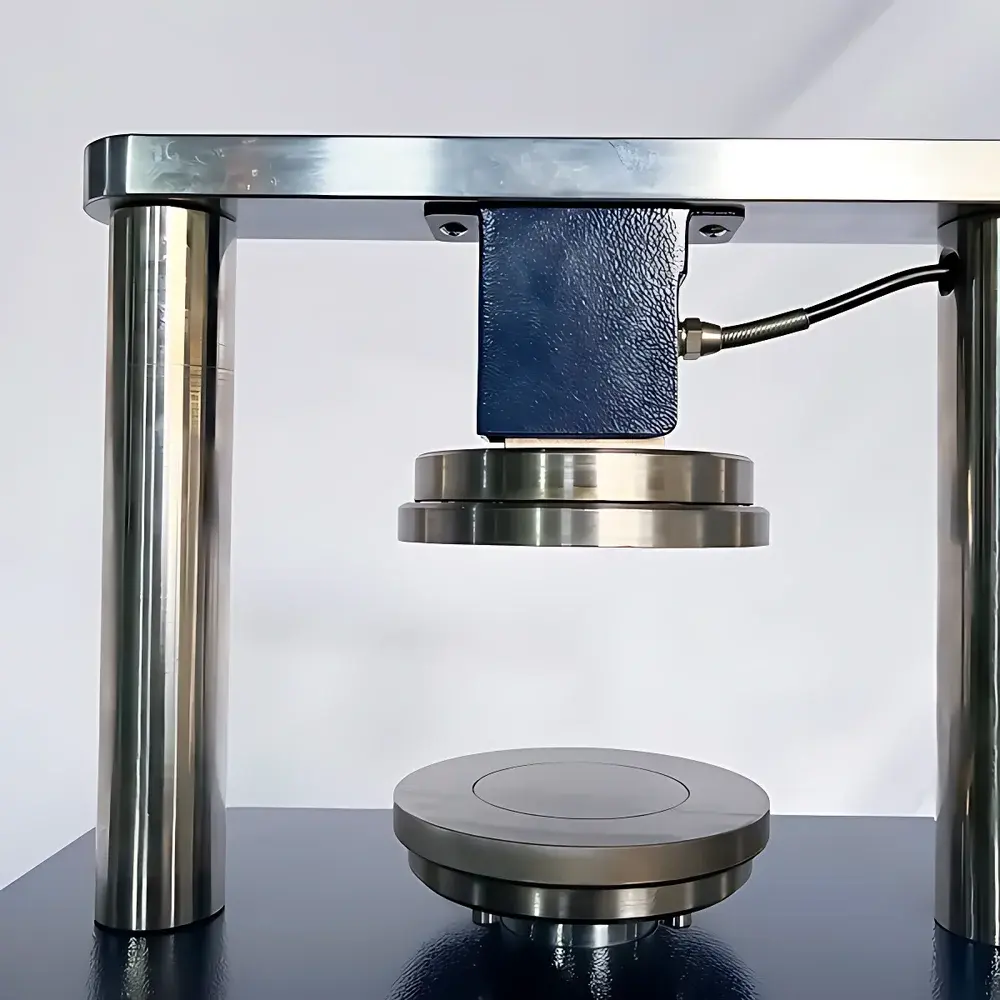
| Platen Diameter | φ120 mm |
| Parallelism of Platens | ≤ 0.06 mm |
| Travel Range | 0.1–80 mm |
| RCT Specimen Size | 152 × 12.7 mm (L × W) |
| ECT Specimen Size | 100 × 25 mm (L × W) |
| Flat Crush Fixture | 12 mm thick, φ120 mm |
| Dimensions (L×W×H) | 400 × 400 × 650 mm |
| Weight | ~40 kg |
| Power Supply | 1∮ AC 220 V, 50/60 Hz |
| Power Consumption | ~220 W |
| Force Units | N, kgf, lbf |
| Compliance Standards | GB/T 2679.8-2016, GB/T 2679.17-1997, GB/T 6546-1998, ISO 3035:2011, TAPPI T804-2011, TAPPI T811-2007, TAPPI T809-2011, JIS P8126 |
Overview
The HAIDA HD-A513-E Microcomputer-Controlled Edge Crush Test (ECT) / Ring Crush Test (RCT) Tester is a precision mechanical compression testing instrument engineered for quantitative evaluation of compressive resistance in corrugated fiberboard and paper-based packaging materials. It operates on the fundamental principle of uniaxial quasi-static compression, where a standardized specimen is subjected to controlled, monotonic loading between parallel platens until structural failure (i.e., buckling or crushing) occurs. The system measures peak compressive force—expressed in newtons (N)—and calculates derived strength indices including Edge Crush Strength (ECT in N/m), Ring Crush Strength (RCT in kN/m), Flat Crush Resistance (FCT), and Adhesive Peel Strength (PAT). Designed specifically for QC laboratories, packaging R&D facilities, and third-party certification bodies, the HD-A513-E meets the geometric, kinematic, and metrological requirements stipulated in international standards such as ISO 3035, TAPPI T804, and GB/T 2679 series. Its rigid frame, high-resolution load cell, and closed-loop speed control ensure repeatable force application across variable specimen geometries and material anisotropies.
Key Features
- 7-inch high-contrast TFT touchscreen interface with dual-language (English/Chinese) firmware and real-time load-displacement curve visualization
- High-stability 2 kN load cell calibrated to ≤ ±0.5% full-scale accuracy, with 0.02 N minimum resolution and 1/250,000 internal A/D resolution
- Precision ground ball-screw actuation system ensuring smooth, backlash-free motion and long-term mechanical integrity
- Integrated upper/lower mechanical limit switches and programmable overload protection to prevent sensor damage during operator error or specimen anomaly
- Automated test termination upon crush detection, followed by automatic crosshead return and digital storage of peak force, displacement at failure, and time-to-failure
- On-board data processing: automatic calculation of mean, max, min force values; statistical summary across up to 50 sequential tests; direct export of raw force-time datasets via USB port
Sample Compatibility & Compliance
The HD-A513-E supports standardized specimen configurations per major global packaging test protocols. For Ring Crush Testing (RCT), it accommodates 152 mm × 12.7 mm specimens mounted on a concentric annular mandrel (included). Edge Crush Testing (ECT) utilizes 100 mm × 25 mm specimens oriented with flutes perpendicular to the direction of loading. Flat Crush Testing (FCT) employs a dedicated 12 mm-thick, φ120 mm cylindrical platen to apply uniform pressure over the flute top surface. Adhesive peel testing (PAT) is performed using optional edge-clamp fixtures and peel-angle alignment guides. All configurations comply with dimensional tolerances defined in ISO 3035:2011 (flat crush), TAPPI T804-2011 (RCT), TAPPI T811-2007 (ECT), and GB/T 2679.8-2016. The instrument is traceably calibrated per JJG(粤) 018-2014 and supports GLP-compliant documentation through timestamped test logs and user-accessible audit trails.
Software & Data Management
Firmware version 3.2 includes embedded test method templates aligned with ASTM D6342 (equivalent to TAPPI T811), ISO 3035, and GB/T 6546. Each test record stores metadata including operator ID, date/time stamp, specimen ID, environmental temperature/humidity (if externally logged), force-displacement curve (sampled at 100 Hz), and calculated strength values. Data export is supported in CSV format for downstream analysis in Excel, MATLAB, or LIMS platforms. Optional PC software (HAIDA TestSuite v2.1) enables remote control, batch report generation (PDF/Excel), trend charting, and SPC chart overlays (X-bar/R charts). All electronic records conform to FDA 21 CFR Part 11 requirements for electronic signatures, audit trails, and data integrity when configured with password-protected user roles and session logging.
Applications
- Quality assurance of corrugated board production lines (linerboard, medium, combined board)
- Validation of recycled fiber content impact on crush resistance
- Correlation studies between RCT/ECT values and box compression strength (BCT) using McKee equation
- Adhesive bond strength assessment in double-wall and triple-wall constructions
- Material qualification for ISTA 3A/3E transport simulation protocols
- Supplier qualification audits requiring ISO/IEC 17025-compliant test evidence
- Academic research on paper mechanics, fiber orientation effects, and moisture-dependent viscoelastic behavior
FAQ
What standards does the HD-A513-E directly support out-of-the-box?
The instrument’s firmware includes preloaded test methods for GB/T 2679.8, GB/T 2679.17, ISO 3035, TAPPI T804, TAPPI T811, and JIS P8126—with adjustable dwell time, speed ramp profiles, and pass/fail thresholds configurable per standard clause.
Can the system be integrated into a laboratory network for centralized data collection?
Yes—via optional Ethernet module (HAIDA-LAN-01), enabling TCP/IP communication with LIMS or MES systems using Modbus TCP or custom REST API endpoints.
Is calibration certification included with shipment?
Each unit ships with a factory calibration certificate traceable to CNAS-accredited reference standards (certificate number and uncertainty budget provided); on-site recalibration services are available under HAIDA’s ISO/IEC 17025-accredited service program.
What maintenance intervals are recommended for sustained accuracy?
Biannual verification of platen parallelism (≤0.06 mm) and load cell linearity is advised; annual full recalibration is recommended for GLP/GMP environments or when operating >200 cycles/week.
Are consumables and replacement parts readily available internationally?
Standard spares—including RCT center disks, ECT guide blocks, thermal paper rolls, and calibrated test weights—are stocked in HAIDA’s EU warehouse (Rotterdam) and US distribution center (Chicago) with lead times under 5 business days.



