
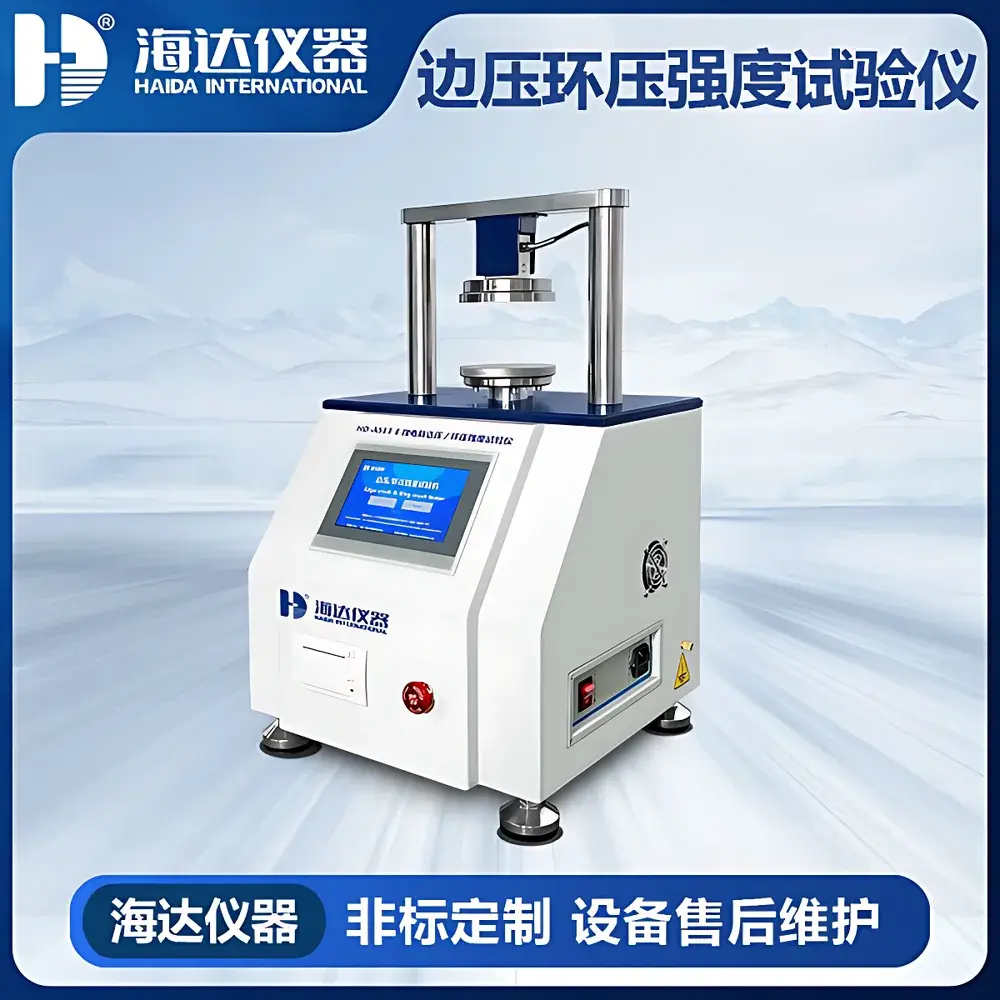
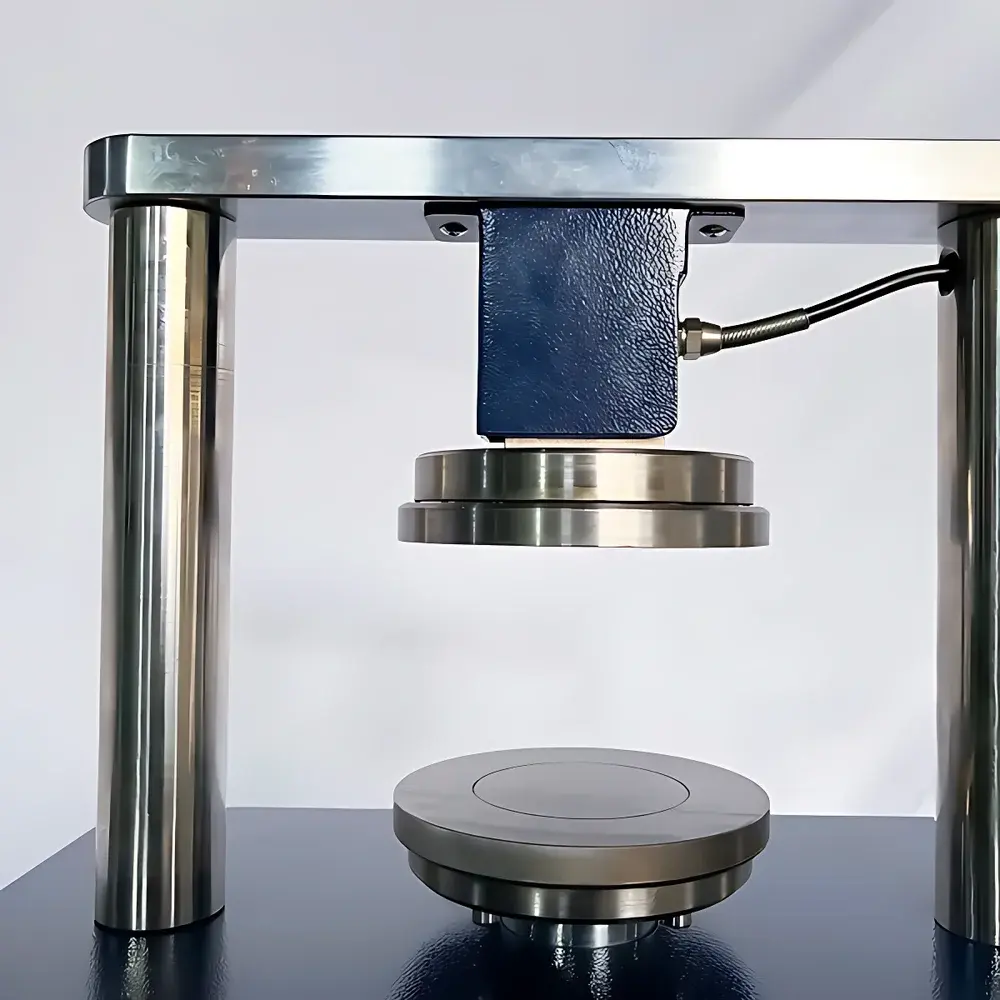
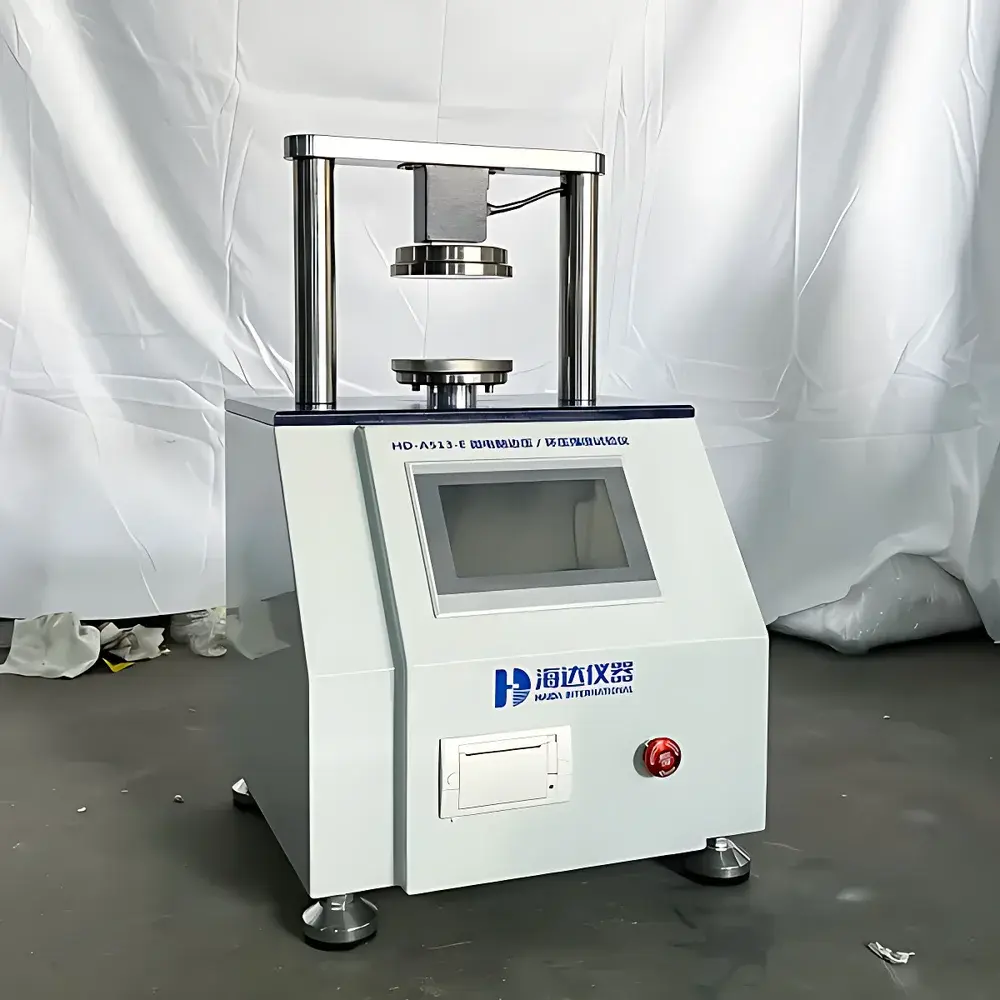
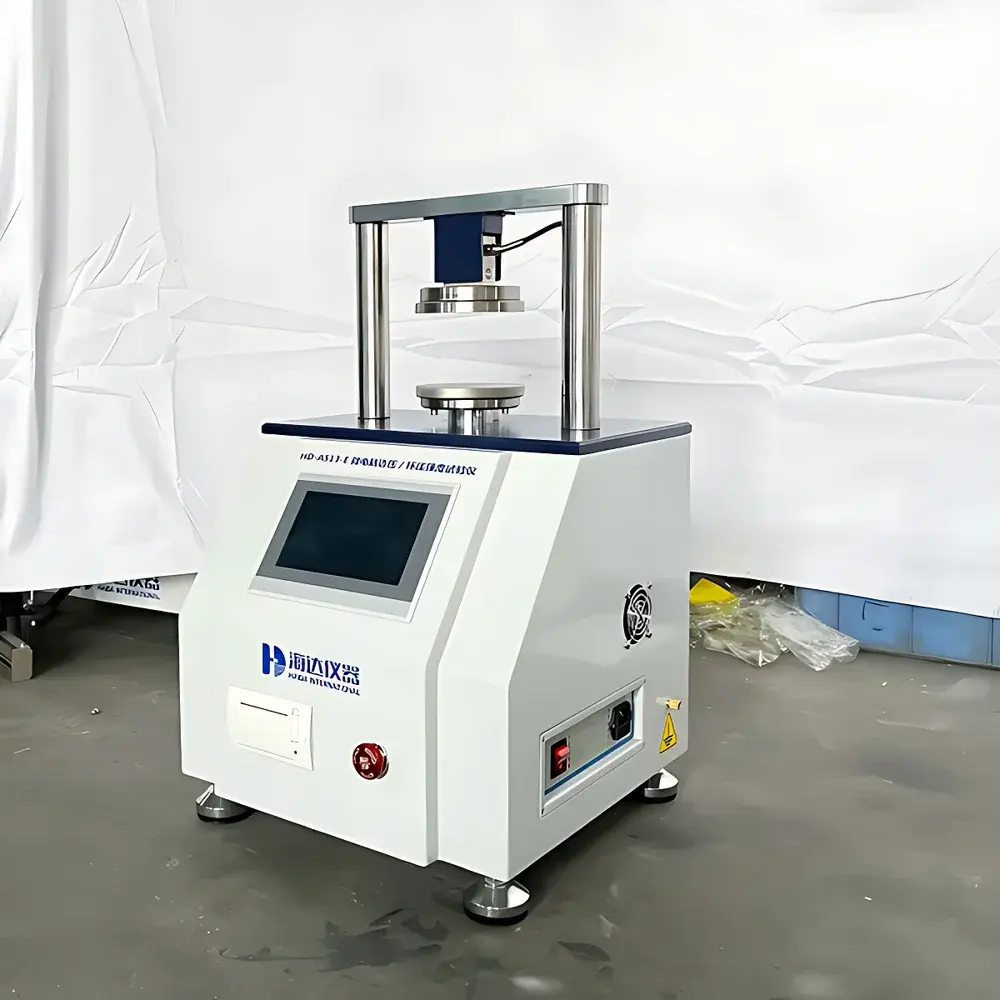
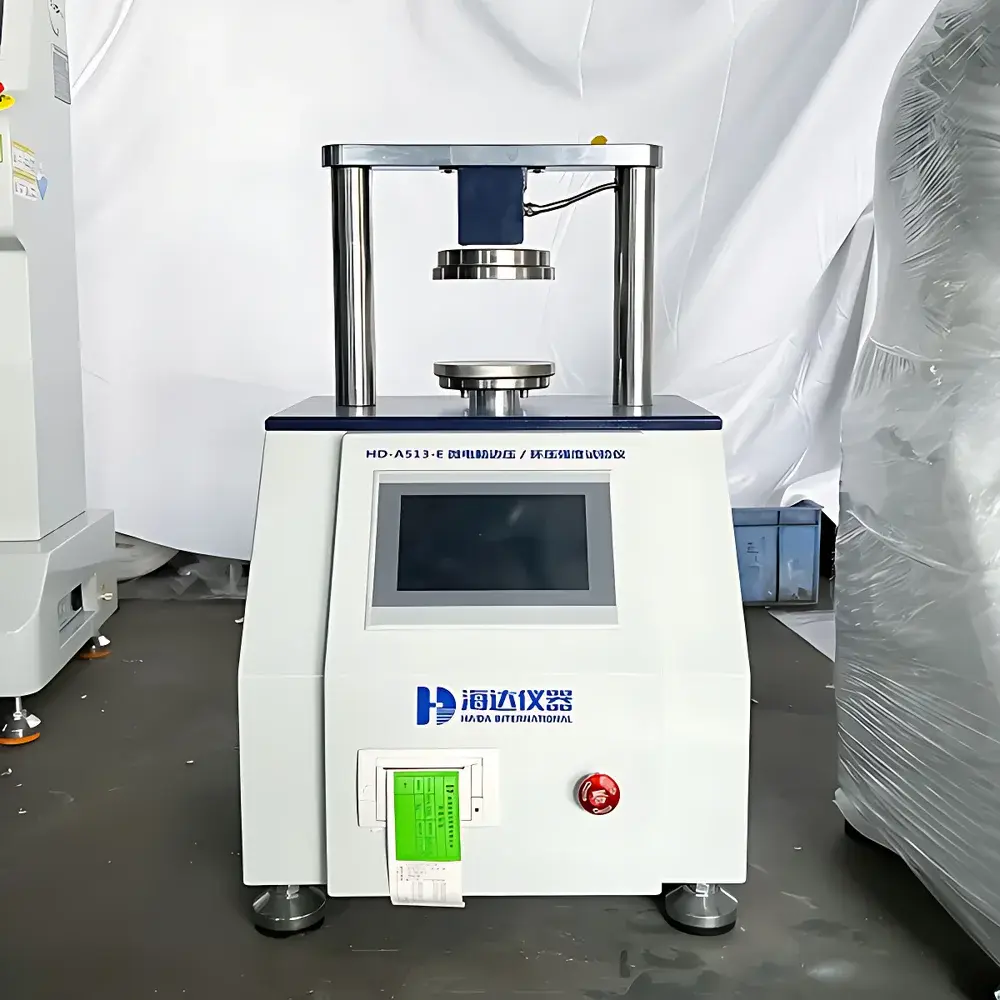
HAIDA HD-A513-E Microcomputer-Controlled Edge Crush Test (ECT) / Ring Crush Test (RCT) Instrument
| Brand | HAIDA INTERNATIONAL |
|---|---|
| Origin | Guangdong, China |
| Manufacturer Type | Direct Manufacturer |
| Model | HD-A513-E |
| Display | 7-inch Color Touchscreen |
| Load Capacity | 2 kN |
| Force Resolution | 1/250,000 full scale |
| Force Accuracy | ≤ ±0.5% FS |
| Maximum Applied Load | 1800 N |
| Minimum Force Resolution | 0.02 N |
| Test Speed | (12.5 ± 2.5) mm/min |
| Compression Plate Diameter | φ120 mm |
| Parallelism of Compression Plates | ≤ 0.06 mm |
| Plate Travel Range | 0.1–80 mm |
| RCT Specimen Size | 152 × 12.7 mm (L × W) |
| ECT Specimen Size | 100 × 25 mm (L × W) |
| Flat Crush Test (FCT) Anvil | 12 mm thick, φ120 mm |
| Dimensions (L×W×H) | 400 × 400 × 650 mm |
| Weight | ~40 kg |
| Power Supply | 1Ø AC 220 V |
| Power Consumption | ~220 W |
| Force Units | kgf, lbf, N |
| Compliance Standards | GB/T 2679.8–2016, GB/T 2679.17–1997, GB/T 6546–1998, ISO 3035:2011, TAPPI T804–2011, TAPPI T811–2007, TAPPI T809–2011, JIS P8126 |
Overview
The HAIDA HD-A513-E Microcomputer-Controlled Edge Crush Test (ECT) / Ring Crush Test (RCT) Instrument is a precision mechanical testing system engineered for quantitative evaluation of compressive resistance in corrugated fiberboard and paper-based packaging materials. It operates on the fundamental principle of uniaxial compression under controlled displacement rate, measuring the maximum load at failure (crush point) when a standardized specimen is compressed between parallel platens oriented perpendicular to the flute direction. This method directly correlates to real-world stacking strength, palletized unit load integrity, and vertical compression performance in distribution environments. The instrument complies with internationally recognized test methodologies including ISO 3035 (Flat Crush Test), TAPPI T804 (Ring Crush), TAPPI T811 (Edge Crush), and GB/T 2679 series standards—ensuring data compatibility across global quality assurance laboratories and packaging R&D facilities.
Key Features
- 7-inch high-resolution color touchscreen interface with real-time force-displacement curve visualization and dual-language (English/Chinese) software navigation
- High-stability 2 kN load cell calibrated to ≤ ±0.5% full-scale accuracy, traceable to national metrological standards (JJG[Guangdong] 018–2014)
- Precision ground ball-screw actuation system ensuring repeatable crosshead positioning and minimal mechanical hysteresis over extended operational cycles
- Integrated upper/lower mechanical limit switches and electronic overload protection, preventing sensor damage during abnormal loading conditions
- Automated post-test return-to-start function with programmable dwell time, reducing operator intervention and improving throughput consistency
- Real-time detection and digital recording of peak crush force, enabling automatic identification of failure onset without subjective visual judgment
Sample Compatibility & Compliance
The HD-A513-E accommodates standardized specimens per major international protocols: ring crush (152 × 12.7 mm), edge crush (100 × 25 mm), flat crush (using φ120 mm anvil with 12 mm thickness), and adhesive bond strength (PAT) via optional peel fixtures. All test configurations maintain strict adherence to dimensional tolerances defined in ISO 3035:2011, TAPPI T804–2011, and GB/T 2679.8–2016. The platen parallelism (≤0.06 mm) and force resolution (0.02 N) meet minimum requirements for GLP-compliant reporting in regulated environments. While not FDA 21 CFR Part 11 certified out-of-box, audit-ready data logs—including timestamped test IDs, operator credentials, and raw force/time arrays—are exportable in CSV format for integration into validated LIMS or QMS platforms.
Software & Data Management
The embedded firmware supports automated calculation of key metrics: peak crush force (N), average crush force (N), coefficient of variation (%), and derived material indices such as ECT (N/m) and RCT (kN/m). Up to 50 sequential test records are retained in non-volatile memory, each containing full force–displacement curves, pass/fail flags, and user-defined sample identifiers. Data export is supported via USB interface; no proprietary drivers or cloud dependencies are required. Calibration parameters—including sensor offset, gain, and linearity coefficients—are password-protected and stored separately from operational profiles, satisfying basic traceability requirements under ISO/IEC 17025 Clause 6.5.2.
Applications
- Corrugated board manufacturing: routine QC verification of linerboard and medium stiffness prior to sheeting
- Package engineering labs: comparative analysis of flute geometry (A/B/C/E/F), recycled content impact, and moisture conditioning effects on crush resistance
- Third-party certification bodies: execution of accredited tests per ISTA 3A, ASTM D642, or ISO 13820 for transport packaging validation
- Academic research: correlation studies between crush strength, basis weight, and fiber morphology using scanning electron microscopy (SEM) cross-validation
- Supplier qualification programs: batch-level conformity assessment against contractual ECT/RCT thresholds specified in purchase agreements
FAQ
What standards does the HD-A513-E support for ring crush testing?
It fully implements GB/T 2679.8–2016, TAPPI T804–2011, and JIS P8126, with configurable test speed and specimen alignment routines aligned to each standard’s procedural clauses.
Can the instrument perform flat crush tests on single-faced board?
Yes—using the included φ120 mm anvil set to 12 mm thickness, it complies with ISO 3035:2011 and GB/T 2679.6–1996 for both single- and double-faced configurations.
Is calibration documentation provided with shipment?
Each unit ships with a factory calibration certificate referencing traceable standards per JJG(Guangdong) 018–2014, including as-tested force accuracy, linearity deviation, and zero stability data.
Does the system support external PC connectivity for centralized data aggregation?
USB mass-storage mode enables direct file transfer; RS-232 and Ethernet options are available as factory-installed accessories for SCADA or MES integration.
How is specimen alignment verified before testing?
The instrument includes optical alignment guides and a removable centering ring for RCT, while ECT fixtures incorporate precision-ground locating pins to ensure consistent 100 × 25 mm specimen orientation relative to the flute axis.






