
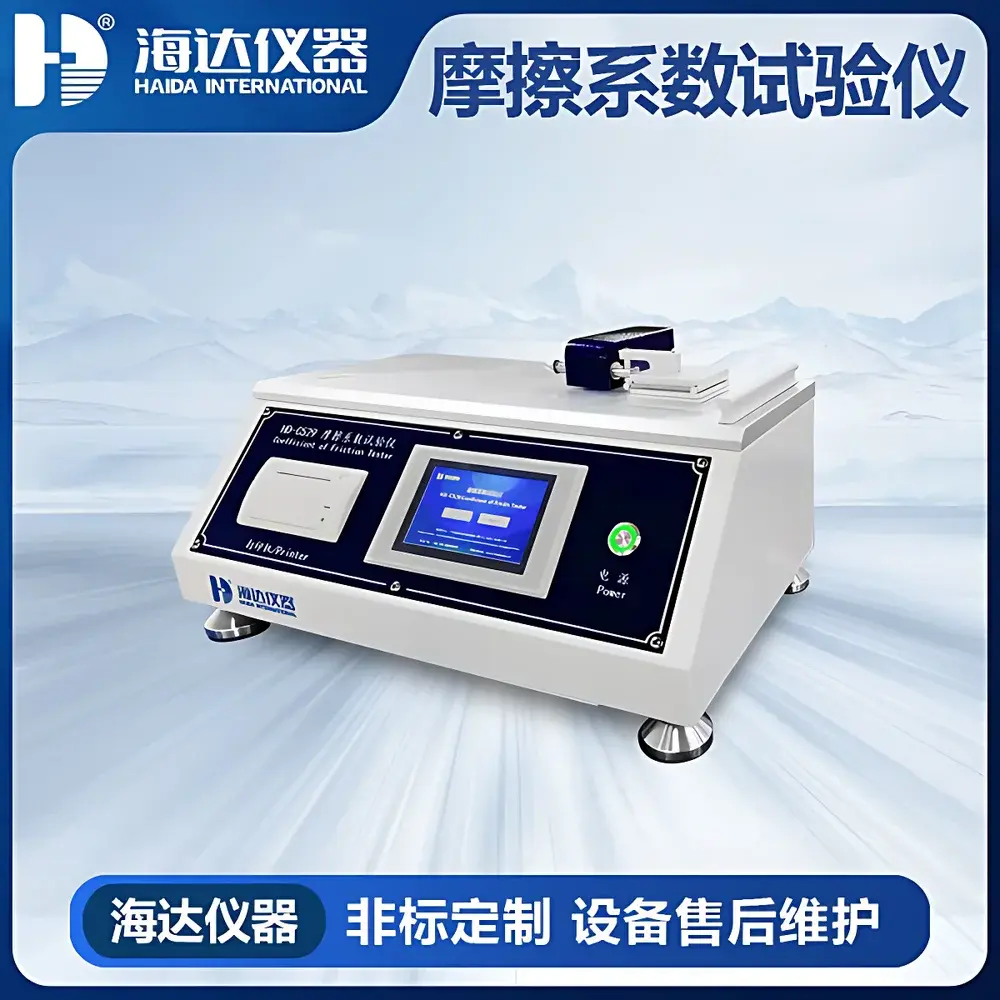
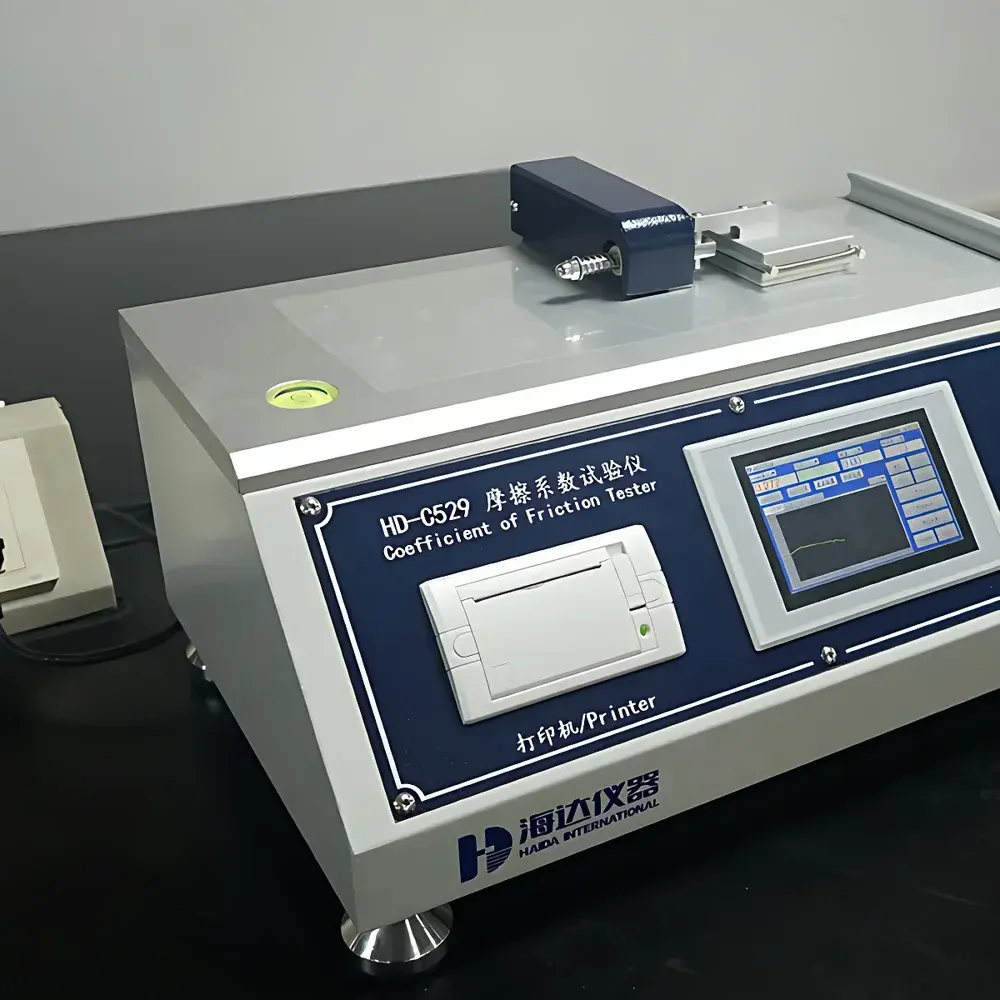
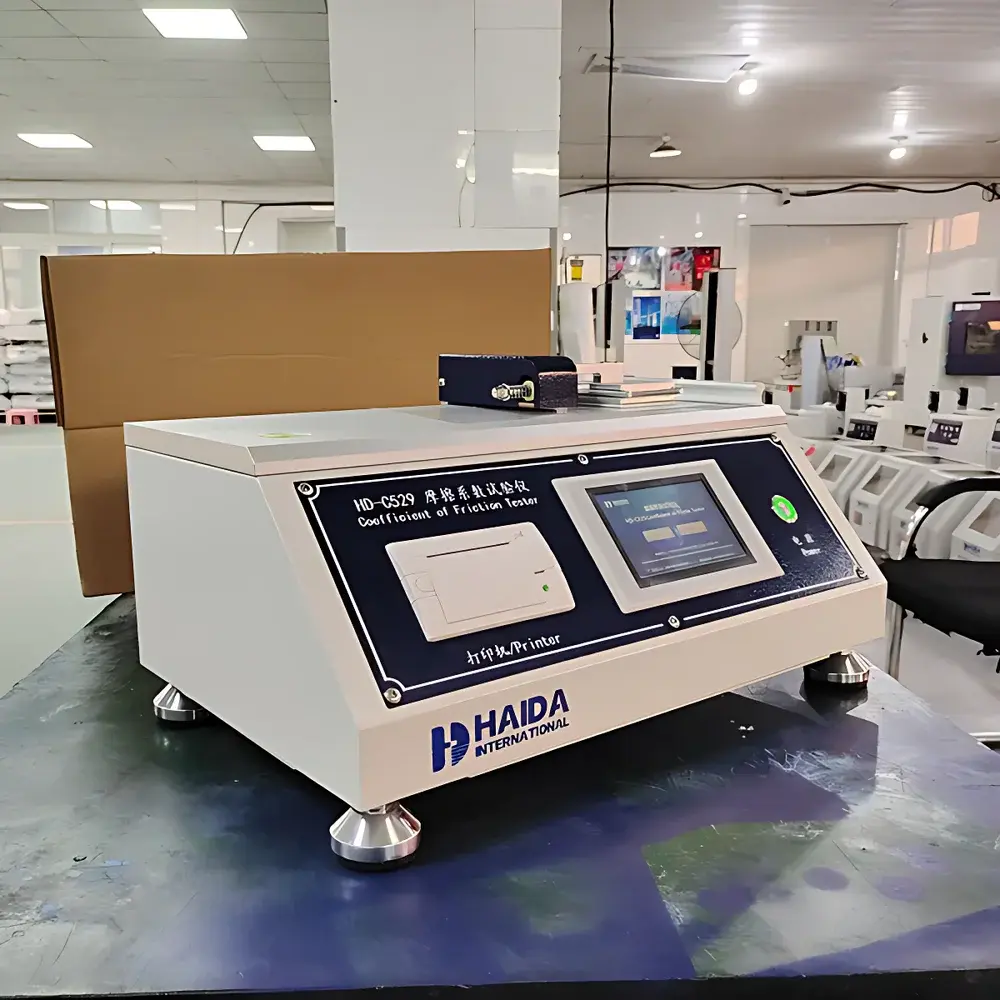
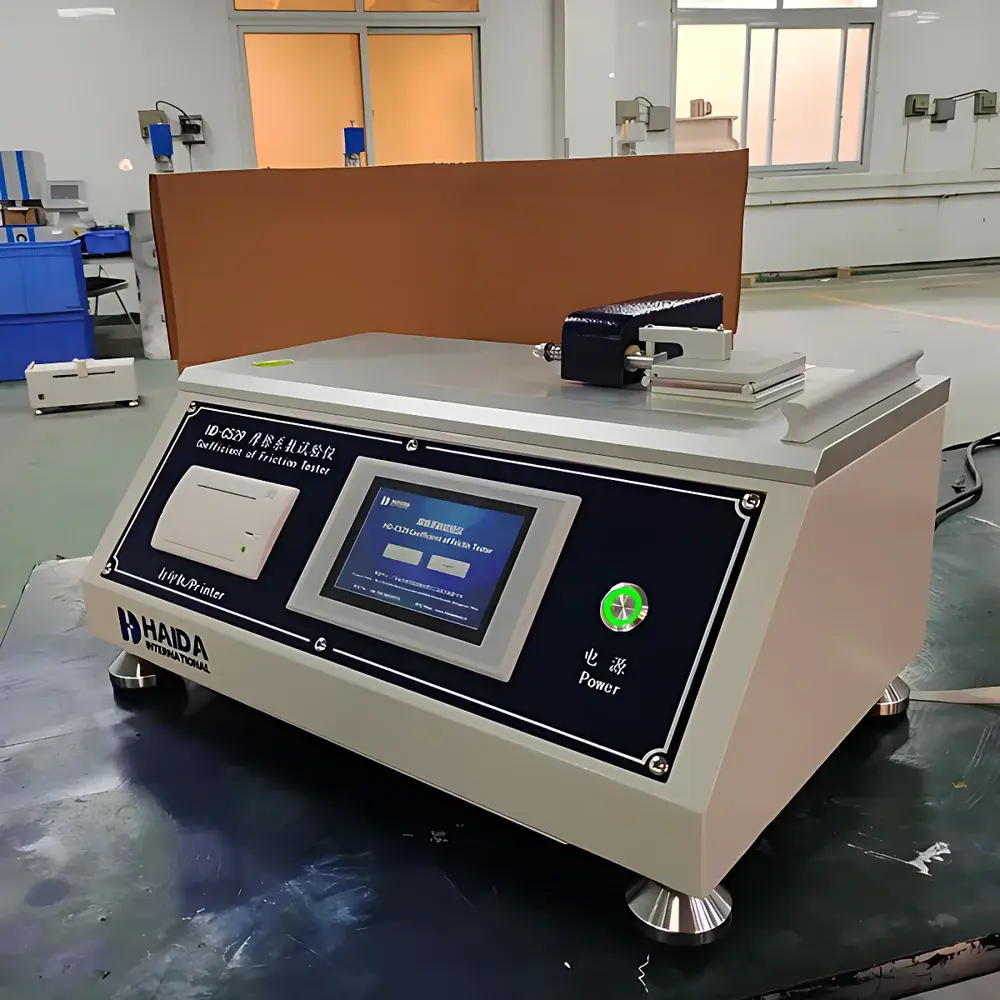
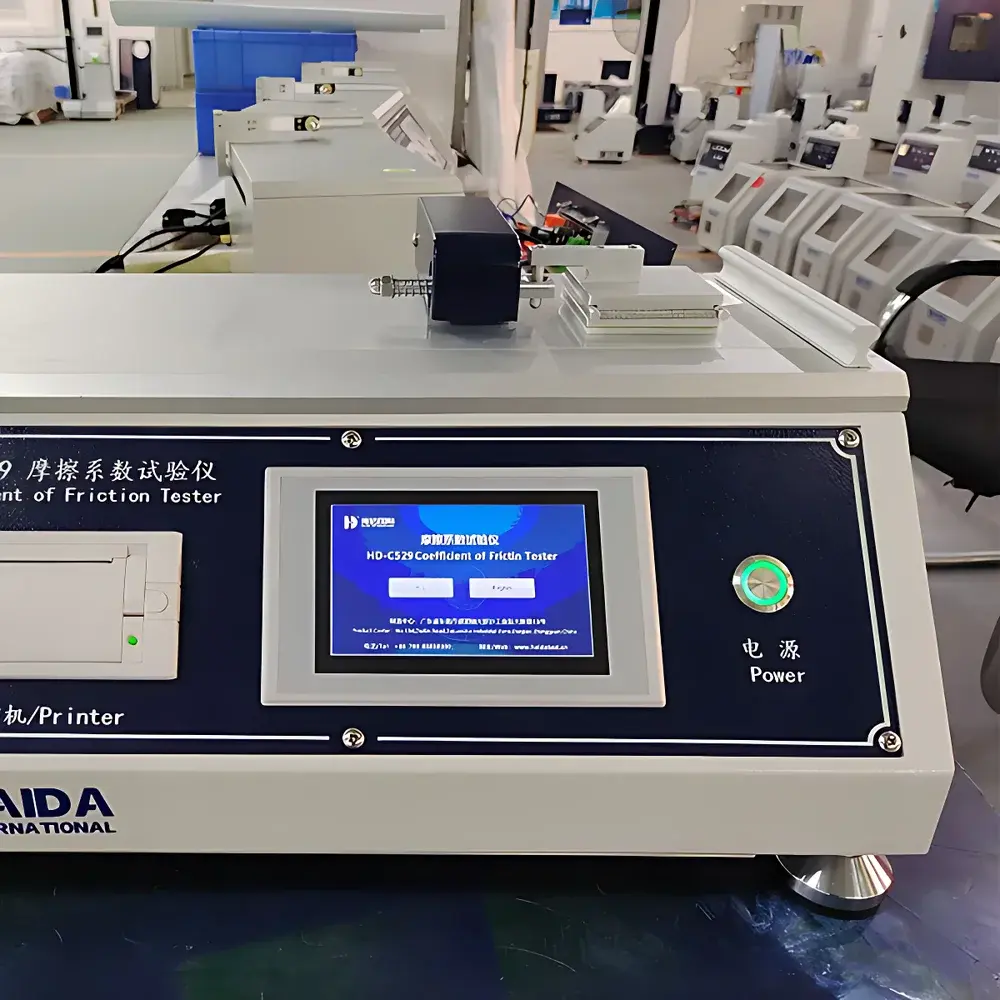
HAIDA HD-C529 Coefficient of Friction Tester
| Brand | HAIDA INTERNATIONAL |
|---|---|
| Origin | Guangdong, China |
| Manufacturer Type | Direct Manufacturer |
| Product Category | Domestic |
| Model | HAIDA HD-C529 Coefficient of Friction Tester |
| Instrument Type | Reciprocating Tribological Tester |
| Maximum Friction Force | 0.001–5 N (expandable) |
| Operating Temperature | Ambient (20 ± 10 °C) |
| Control Interface | Touchscreen |
| Test Stroke | 1–200 mm |
| Test Speed | 100 ± 10 mm/min (adjustable) |
| Slider Mass | 200 ± 2 g (customizable) |
| Upper Specimen Size | 63 mm × 63 mm (L × W) |
| Lower Specimen Size | 80 mm × 200 mm (L × W) |
| Force Measurement Accuracy | ±0.02 N |
| Force Range | 0.001–5 N |
| Dimensions (L×W×H) | ≈490 × 320 × 210 mm |
| Weight | ≈18 kg |
| Power Supply | 1Φ AC 220 V |
| Power Consumption | ≈350 W |
| Relative Humidity Limit | <85% RH |
Overview
The HAIDA HD-C529 Coefficient of Friction Tester is an engineered precision instrument designed for the quantitative determination of static and kinetic coefficients of friction (COF) in thin, non-tacky sheet materials—primarily plastic films, paper, aluminum foil, textiles, rubber sheets, printed substrates, and screen protection films. It operates on the fundamental principle of horizontal sliding resistance measurement: a standardized slider (typically 200 g) is drawn at controlled linear velocity across a fixed specimen surface; the tangential force required to initiate motion (static COF) and sustain steady-state sliding (kinetic COF) is measured via high-resolution load cell technology. The system complies with internationally recognized test methodologies—including ASTM D1894 (Standard Test Method for Static and Kinetic Coefficients of Friction of Plastic Film and Sheeting), ISO 8295:1986 (Plastics — Film and Sheet — Determination of the Coefficient of Friction), and GB/T 10006–1988 (Chinese national standard for plastic film friction testing). Its design emphasizes mechanical stability, repeatability, and traceable force metrology under ambient laboratory conditions.
Key Features
- High-precision stepper motor drive system ensures consistent stroke positioning and velocity control (100 ± 10 mm/min), delivering superior motion reproducibility over repeated cycles.
- Dual linear rail guidance with dual precision linear bearings guarantees smooth, low-friction translation of the force measurement module—minimizing parasitic torque and enhancing measurement fidelity.
- Integrated 7-inch industrial touchscreen HMI enables intuitive parameter setup (stroke length, speed, dwell time), real-time force curve visualization, and one-touch test initiation without external PC dependency.
- Onboard thermal line printer provides immediate hardcopy output of COF values (μs and μk), peak force, and test metadata—supporting GLP-compliant documentation workflows.
- Robust powder-coated steel chassis offers corrosion resistance, structural rigidity, and ergonomic footprint (490 × 320 × 210 mm); total mass (~18 kg) dampens vibration-induced noise during operation.
- Comprehensive safety architecture includes mechanical end-stop limit switches, automatic fault detection, audible/visual alarm prompts, and emergency stop functionality per IEC 61000-6-2 EMC and IEC 61000-6-4 emission standards.
Sample Compatibility & Compliance
The HD-C529 accommodates specimens up to 80 mm wide × 200 mm long (lower stage) and 63 mm × 63 mm (upper slider mount), making it suitable for routine QC testing of flexible packaging films (<0.2 mm thickness), label stocks, laminated foils, and coated papers. Its force transducer (range: 0.001–5 N, resolution ≤0.001 N, accuracy ±0.02 N) is calibrated traceably to national standards and validated for linearity across its full dynamic range. The instrument meets essential requirements for regulatory compliance in packaging validation: data integrity aligns with FDA 21 CFR Part 11 principles (audit trail enabled via optional software upgrade), and test reports satisfy ISO/IEC 17025 documentation expectations when used within accredited laboratories. All mechanical components conform to RoHS Directive 2011/65/EU restrictions on hazardous substances.
Software & Data Management
While the base configuration features embedded firmware with touchscreen interface and direct thermal printing, optional PC-based software (HAIDA-Tribosoft v3.2) extends functionality to include multi-curve overlay analysis, statistical process control (SPC) charting (X̄–R charts), automated report generation (PDF/Excel), and raw force-time dataset export (CSV). The software supports user-defined test protocols, password-protected method libraries, electronic signature capture, and full audit trail logging—including operator ID, timestamp, calibration history, and parameter modification records—enabling alignment with GMP/GLP quality systems. Data files are stored locally on internal flash memory (16 GB) with optional USB backup.
Applications
- Quality assurance of food and pharmaceutical packaging films for slip performance verification prior to high-speed filling line integration.
- Evaluation of anti-blocking agent efficacy in polyolefin films during formulation development.
- Comparative assessment of surface treatment (e.g., corona, plasma, silicone coating) impact on COF in label facestocks and release liners.
- Friction benchmarking of tactile surfaces in consumer electronics (e.g., screen protectors, touch panel overlays).
- Research-grade tribological screening of biodegradable films (PLA, PHA) under controlled humidity and temperature environments.
- Validation of ink adhesion and surface energy modifications in printed flexible electronics substrates.
FAQ
What standards does the HD-C529 comply with?
It is fully aligned with ISO 8295:1986, ASTM D1894–22, and GB/T 10006–1988 for static and kinetic coefficient of friction testing.
Can the slider mass be customized beyond 200 g?
Yes—HAIDA offers configurable slider assemblies ranging from 100 g to 1000 g, with certified mass tolerance ≤±0.5 g, subject to mechanical compatibility review.
Is the force sensor calibrated and traceable?
Each unit ships with a factory calibration certificate referencing NIM (National Institute of Metrology, China) standards; optional UKAS-accredited calibration is available upon request.
Does the instrument support network connectivity or LIMS integration?
Native Ethernet and RS-232 ports enable serial communication; HL7 and ASTM E1384-compliant data export is supported via optional software modules.
What maintenance is required for long-term accuracy?
Biannual verification of slider alignment, rail lubrication (per ISO 6743-9), and load cell zero-drift check using certified deadweights are recommended per HAIDA’s Maintenance Protocol MP-HD-C529 Rev. 4.



