
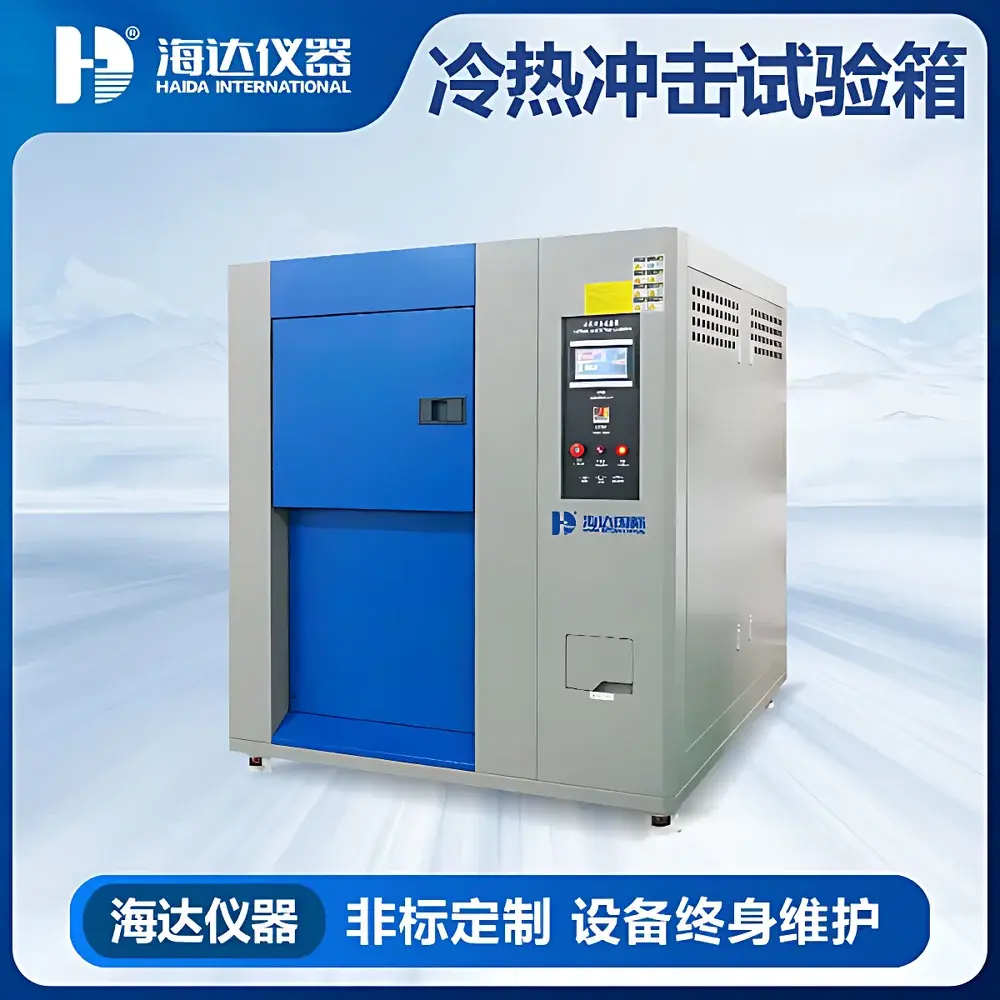
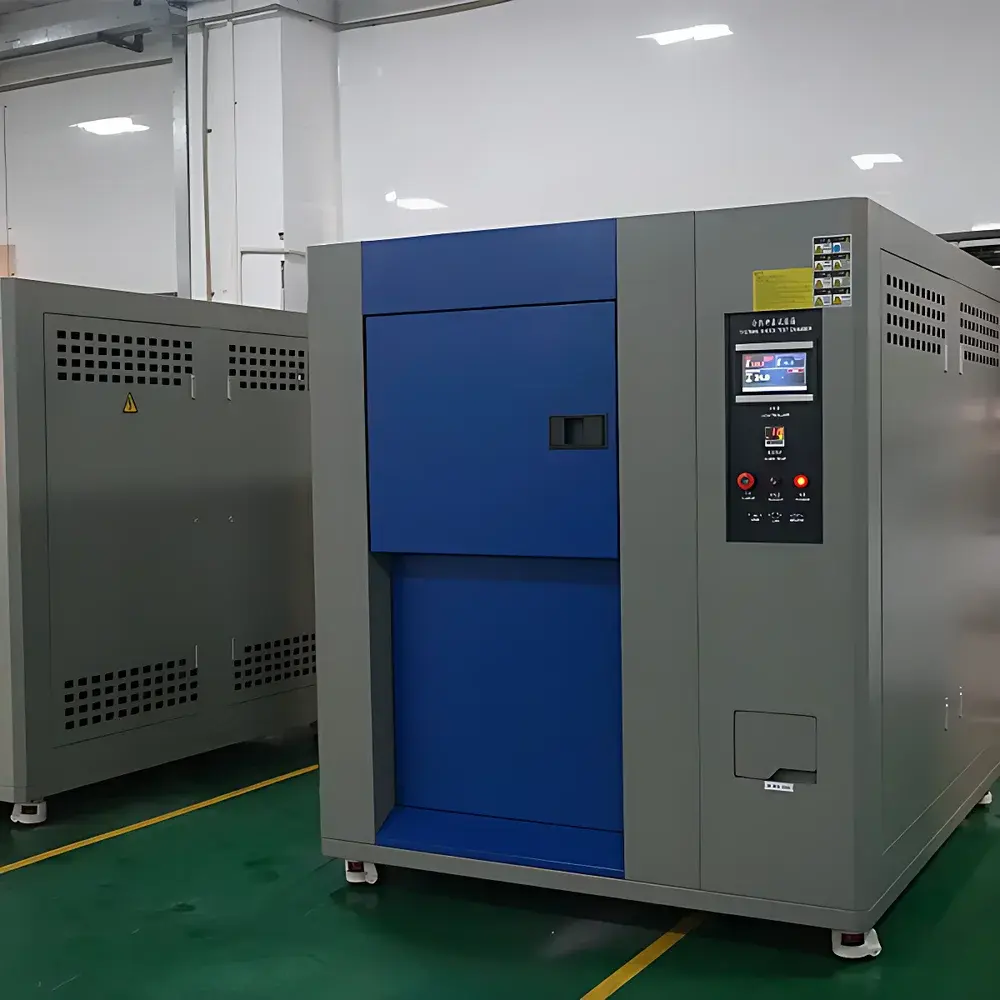
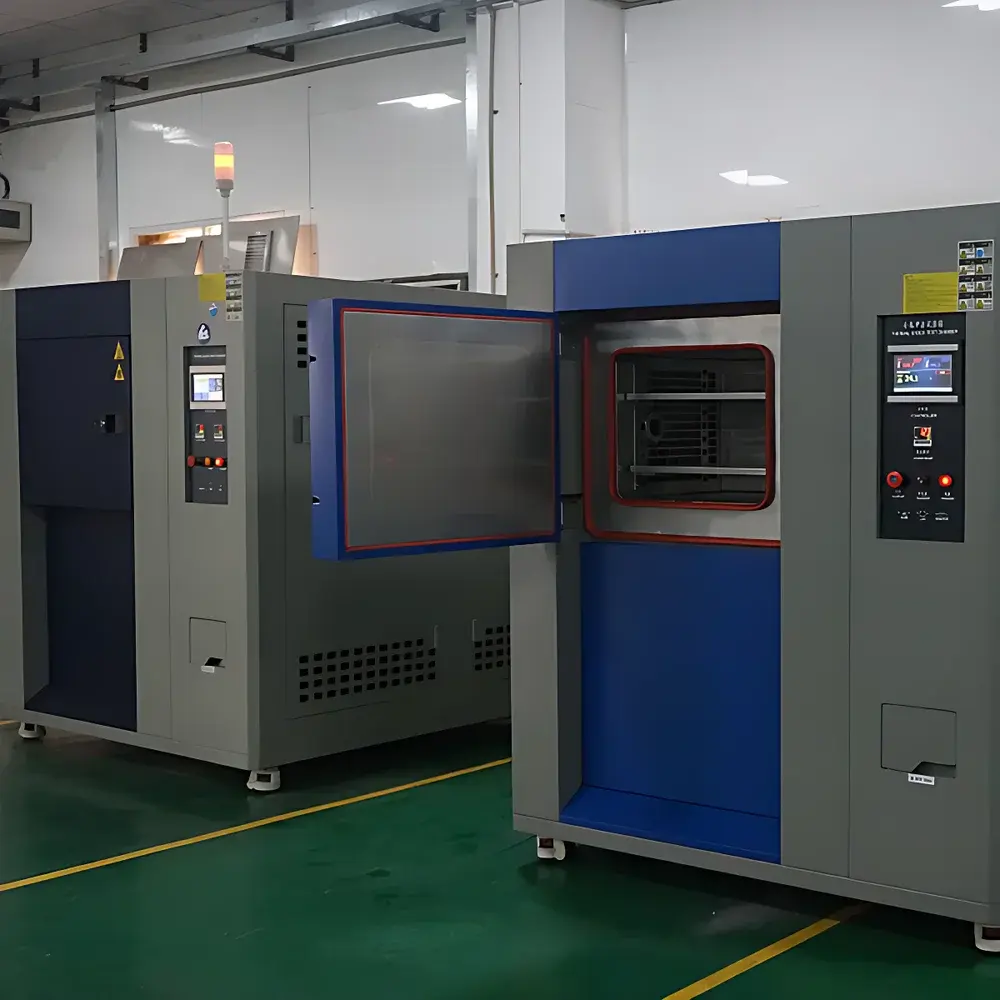
HAIDA HD-E703-50 Programmable Three-Zone Thermal Shock Test Chamber
| Brand | HAIDA INTERNATIONAL |
|---|---|
| Origin | Guangdong, China |
| Manufacturer Type | Direct Manufacturer |
| Product Category | Domestic |
| Model | HAIDA HD-E703-50 Programmable Three-Zone Thermal Shock Test Chamber |
| High-Temperature Range | RT to 170 °C |
| Low-Temperature Range | −75 °C to RT |
| Thermal Shock Range | 60 °C to 150 °C / 170 °C (high) |
| Temperature Stability | ±2 °C |
| Heating Rate | 5–10 °C/min |
| Cooling Rate | 1–2 °C/min |
Overview
The HAIDA HD-E703-50 Programmable Three-Zone Thermal Shock Test Chamber is an engineered environmental stress screening (ESS) system designed for rapid, repeatable, and highly controlled temperature transitions between extreme thermal states. Unlike two-chamber or single-chamber alternatives, this three-zone architecture—comprising independent high-temperature (preheat), low-temperature (precool), and ambient test chambers—enables true thermal shock testing by eliminating mechanical movement of test specimens. The system operates on the principle of controlled air transfer via pneumatically actuated stainless-steel isolation doors, allowing test samples to remain stationary while ambient, hot, and cold airstreams are selectively routed through the test chamber via precision-engineered ductwork and centrifugal circulation fans. This design ensures minimal thermal inertia, enhanced test repeatability, and compliance with rigorous military, automotive, and electronics qualification standards—including MIL-STD-810, GJB 150.5A, and IEC 60068-2-14. The chamber is widely deployed in reliability engineering labs, component qualification centers, and R&D facilities where accelerated life testing, solder joint integrity validation, and failure mode analysis under thermal cycling stress are mission-critical.
Key Features
- Three-zone independent thermal architecture: dedicated preheat (RT–170 °C), precool (−75 °C–RT), and ambient test zones—eliminating specimen handling and reducing thermal lag
- High-efficiency dual-refrigeration circuit: configured with selectable compressors (e.g., Tecumseh, Copeland, or Hitachi) and environmentally compliant refrigerants (R404A/R23), integrated with plate-type heat exchangers and cryogenic storage plates for rapid thermal energy transfer
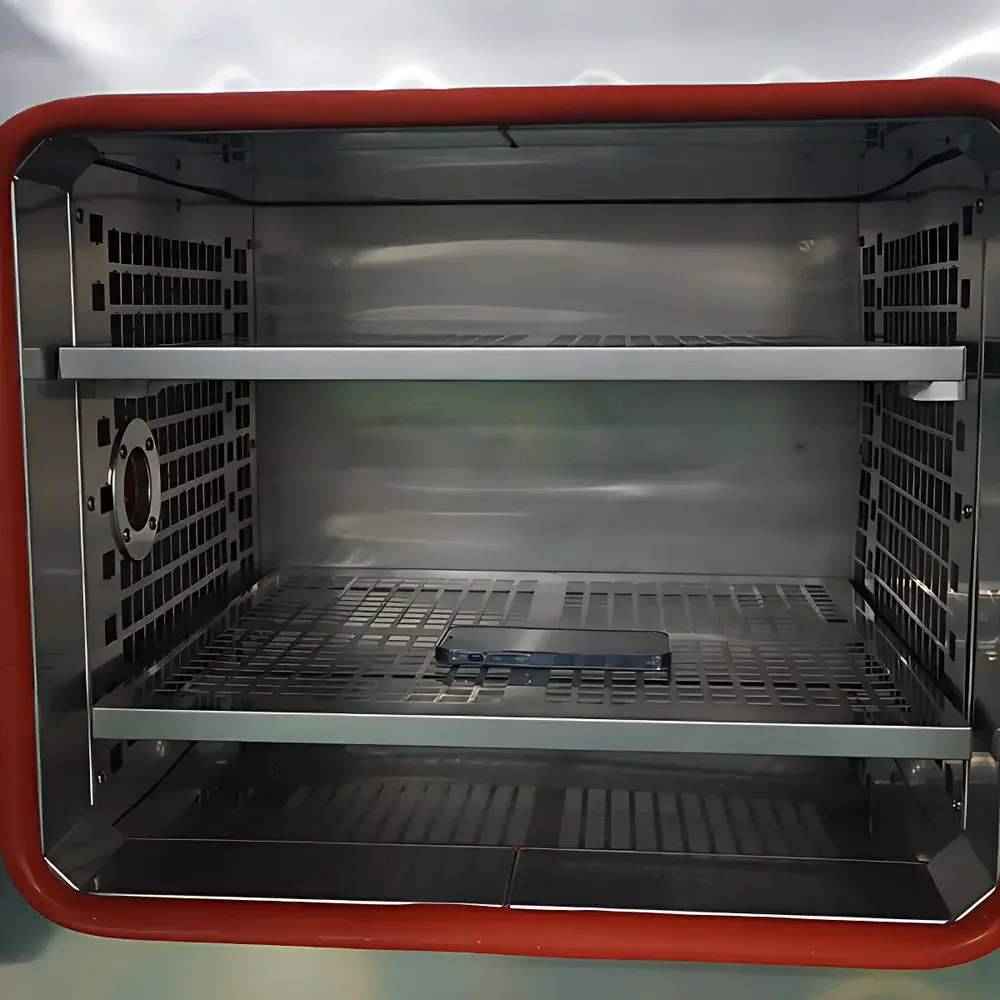
- Robust structural construction: outer shell fabricated from 1.2 mm cold-rolled steel with electrostatic epoxy-polyester powder coating; inner chamber liner made of 1.0 mm SUS304 stainless steel with argon arc welding and passivation finish
- Advanced thermal isolation: multi-layer insulation combining high-density glass fiber wool and rigid polyurethane foam (≥100 mm thickness), supplemented with high-temperature epoxy resin thermal breaks at all chamber interfaces and door linings
- Intelligent airflow management: programmable pneumatic damper system with silicone-sealed 304 stainless steel flaps; independent circulation fans per zone; perforated stainless steel air guide baffle in test chamber for uniform airflow distribution (≤2 °C temperature uniformity)
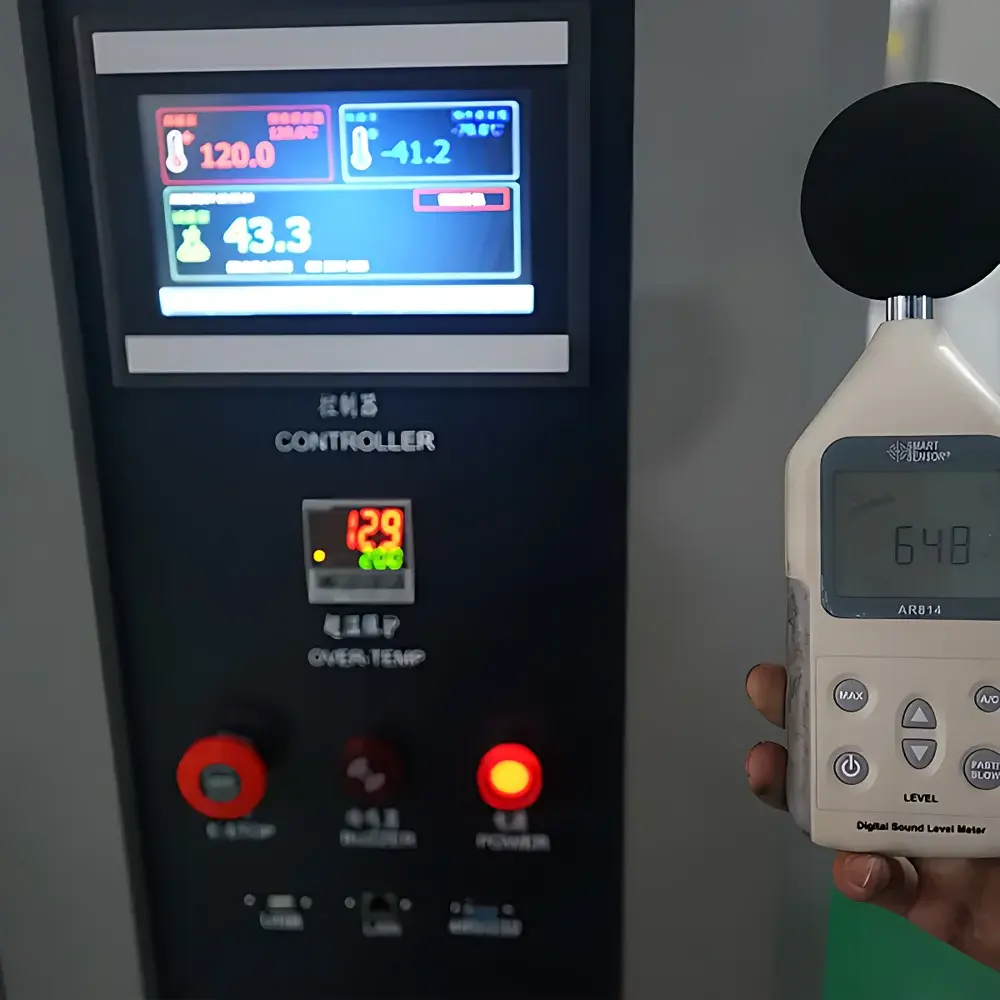
- Full-spectrum controller integration: S-800-TST-CR30 programmable microprocessor-based controller with 7-inch TFT LCD touchscreen, PID + SSR coordinated control algorithm, 0.1 °C resolution, and support for up to 999 segments across 99 programs
- Comprehensive safety architecture: includes overtemperature protection (test/preheat/precool zones), compressor high/low pressure cutouts, phase sequence monitoring, motor overcurrent protection, water flow interlock (for water-cooled models), and automatic emergency shutdown with fault logging
Sample Compatibility & Compliance
The HD-E703-50 accommodates standard electronic assemblies, PCBs, semiconductor packages (QFP, BGA, CSP), automotive ECUs, aerospace avionics modules, and polymer-based components up to 20 kg per shelf. Its 350 × 400 × 350 mm (W×H×D) internal volume supports typical qualification sample configurations without compromising airflow dynamics. All operational parameters—including ramp rates, dwell times, cycle counts, and transition modes—are fully programmable and auditable, supporting GLP/GMP-aligned test documentation requirements. The system conforms to multiple international test standards: IEC 60068-2-14:2009 (Environmental testing – Part 2-14: Tests – Test N: Change of temperature), GB/T 2423.22–2012 (identical to IEC 60068-2-14), GJB 150.5A–2009 (MIL-STD-810G equivalent for Chinese defense applications), and ISO 16750-4 (Road vehicles – Environmental conditions and testing for electrical and electronic equipment – Climatic loads). Optional calibration traceability to NIST or CNAS-accredited laboratories is available upon request.
Software & Data Management
The embedded S-800-TST-CR30 controller provides native support for real-time data acquisition, parameter logging, and event-triggered alarm recording. Temperature readings from multiple PT100 platinum resistance sensors (one per zone, plus redundant monitoring in test chamber) are sampled at 1 Hz and stored internally with timestamping. Data export is enabled via RS-232 serial interface, Ethernet (TCP/IP), or USB flash drive—allowing seamless integration with LabVIEW, MATLAB, or enterprise LIMS platforms. All test profiles, execution logs, and deviation alerts are retained with full audit trail capability, satisfying FDA 21 CFR Part 11 requirements for electronic records and signatures when paired with user access controls and digital signature modules. Remote monitoring and supervisory control can be implemented using optional Modbus TCP or OPC UA gateways.
Applications
This chamber serves as a core tool in product development and quality assurance workflows across regulated industries. In electronics manufacturing, it validates interfacial adhesion, identifies delamination risks in stacked-die packages, and accelerates latent defects in conformal-coated assemblies. Automotive suppliers use it for qualifying ADAS sensors, battery management systems (BMS), and power electronics under repeated thermal transients simulating under-hood conditions. Aerospace contractors deploy it for screening flight-critical components against rapid cabin decompression-induced thermal gradients. Research institutions apply it in material science studies—including coefficient of thermal expansion (CTE) mismatch analysis in composite laminates—and in evaluating thermal fatigue life of solder interconnects per IPC-9701. It is also routinely employed in incoming inspection protocols for high-reliability components destined for medical devices and industrial control systems.
FAQ
What distinguishes a three-zone thermal shock chamber from two-zone designs?
A three-zone architecture eliminates specimen movement entirely, enabling faster transitions (no mechanical shuttle delay), superior temperature stability during dwell phases, and reduced mechanical wear—critical for high-cycle-count qualification testing.
Can the HD-E703-50 perform tests per MIL-STD-810 Method 503.5?
Yes—its programmable dwell time, transition rate control, and precise zone temperature regulation meet the procedural requirements for Temperature Shock testing outlined in MIL-STD-810H, Method 503.5.
Is remote diagnostics and firmware updates supported?
Standard Ethernet connectivity enables secure remote access via VPN-configured networks; firmware upgrades are performed via signed .bin files loaded through the USB port or network share.
What maintenance intervals are recommended for the refrigeration system?
Compressor oil analysis and refrigerant purity verification are advised every 2,000 operating hours; condenser coil cleaning (air-cooled) or descaling (water-cooled) should occur quarterly based on ambient conditions.
Does the system support automated reporting for ISO/IEC 17025 accredited labs?
Yes—when configured with optional report generation module, it exports PDF/CSV test reports containing operator ID, calibration status, environmental metadata, raw sensor logs, and pass/fail evaluation against predefined acceptance criteria.



