
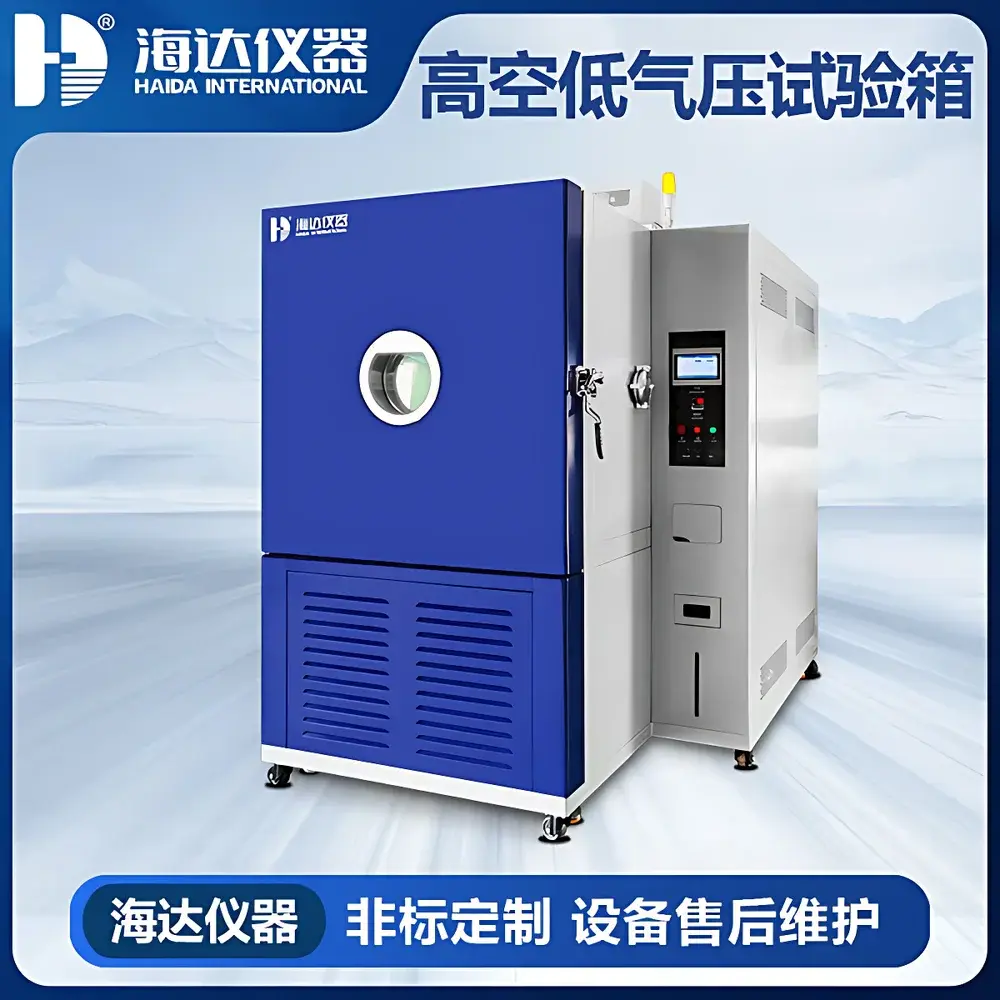
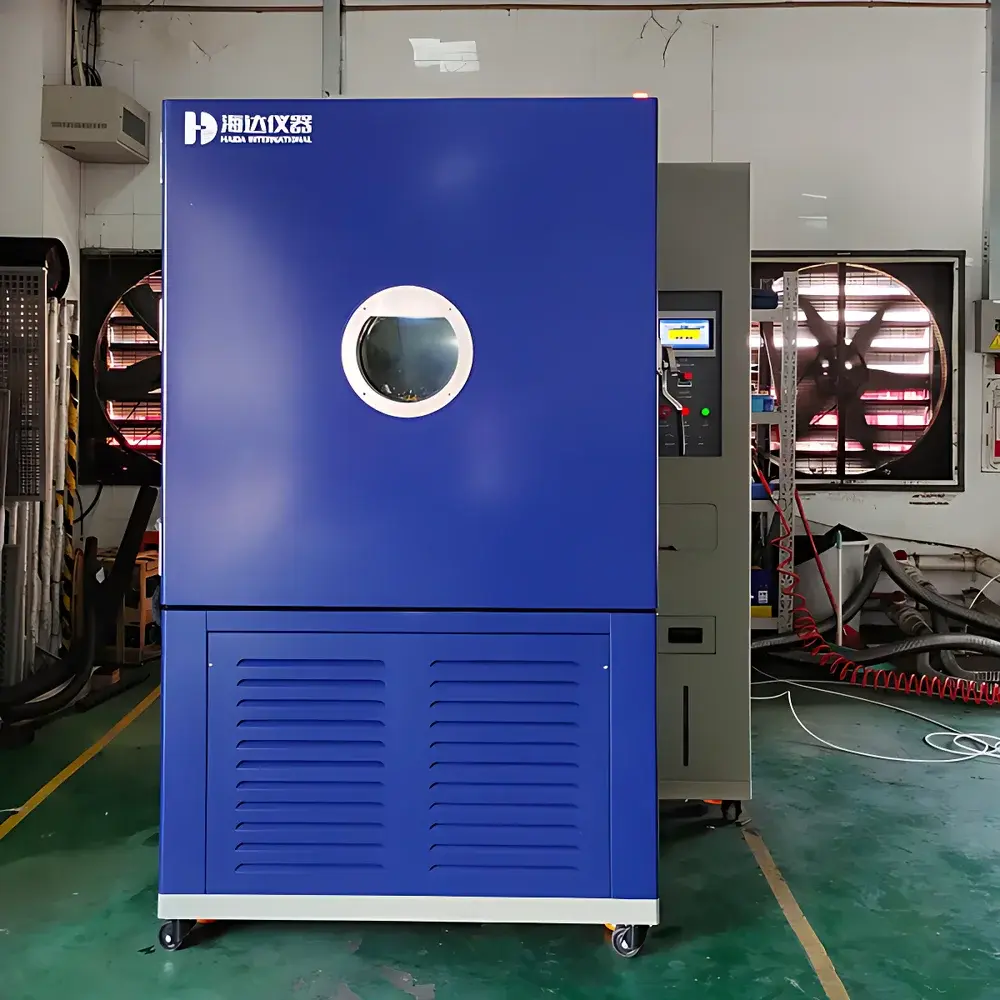
HAIDA HD-E714 High-Low Temperature & Low-Pressure Environmental Test Chamber
| Brand | HAIDA INTERNATIONAL |
|---|---|
| Origin | Guangdong, China |
| Manufacturer Type | Direct Manufacturer |
| Model | HD-E714 |
| Temperature Range | −40 °C to +100 °C |
| Refrigeration Method | Compressor-based Cooling |
| Explosion-Proof | Standard (Non-Explosion-Proof) |
| Temperature Uniformity | ≤2 °C |
| Temperature Stability | ±0.5 °C |
| Temperature Deviation | ±2 °C |
| Heating Rate | ≥1 °C/min |
| Cooling Rate | ≥1 °C/min |
| Internal Chamber Dimensions | 1000 mm × 1000 mm × 1000 mm (1 m³) |
| Pressure Range | 101.3 kPa (ambient) to 1 kPa |
| Pressure Control Accuracy | ±5% |
| Depressurization Time (101.3 kPa → 1 kPa) | ≤30 min |
| Power Supply | 380 V AC, 50 Hz, 3-phase 5-wire |
| Control Resolution | Temperature 0.1 °C, Pressure 0.01 Pa |
| Control Accuracy | Temperature ±0.5 °C, Pressure ±1.0 Pa |
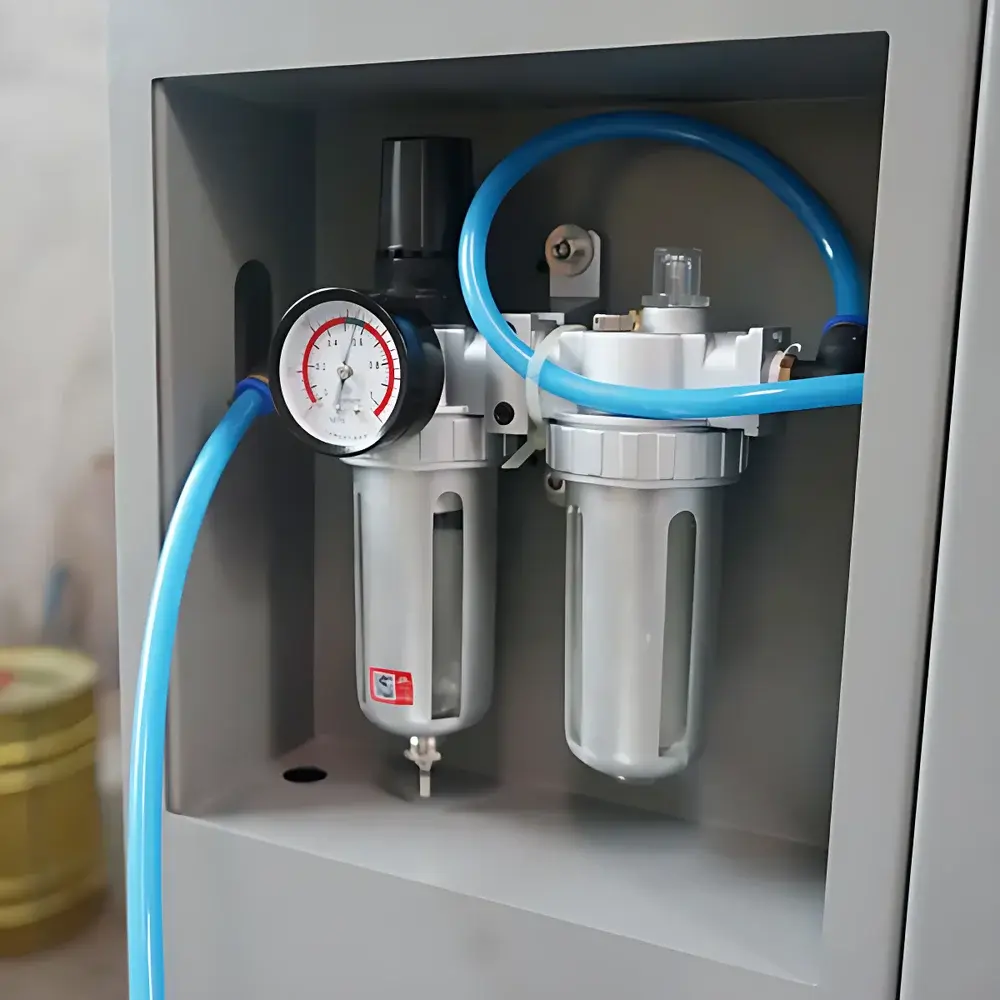
| Vacuum System | Oil-free, Clean Scroll Vacuum Pump with Integrated Piezoresistive Pressure Transducer |
| Insulation | Multi-layer Composite Pressure-Rated Polyurethane + Ultra-fine Glass Fiber |
| Inner Chamber Material | SUS304 Stainless Steel |
| Door Seal | Dual-layer High-Temperature Silicone Rubber Gasket |
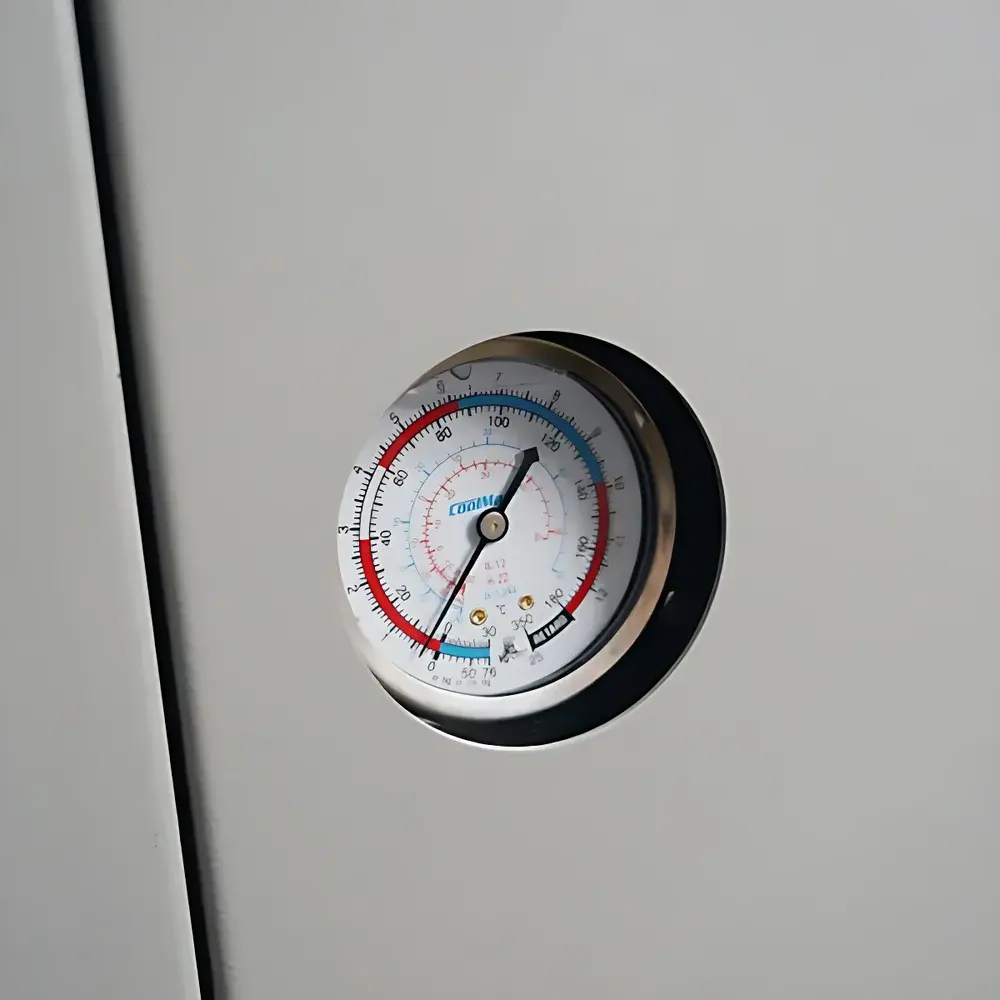
| Safety Protections | Over-temperature, over-current, compressor high-pressure, motor overheat, leakage, short-circuit, phase-loss, under/over-voltage, oil-level monitoring |
Overview
The HAIDA HD-E714 High-Low Temperature & Low-Pressure Environmental Test Chamber is an integrated simulation platform engineered for rigorous environmental stress screening of aerospace components, avionics systems, electronic assemblies, and advanced materials under combined thermal and hypobaric conditions. It operates on the physical principles of controlled convective heat transfer and regulated vacuum generation, enabling precise replication of high-altitude atmospheric profiles — from sea-level pressure (101.3 kPa) down to 1 kPa (equivalent to ~30 km altitude). The chamber employs a dual-stage refrigeration system using R404A/R23 mixed refrigerants and a certified oil-free scroll vacuum pump to ensure contamination-free operation and long-term repeatability. Its “double-chamber” (inner test cavity within outer insulated shell) architecture isolates thermal and pressure domains, minimizing cross-coupling effects during simultaneous temperature-pressure cycling. Designed for compliance-driven laboratories, the HD-E714 supports deterministic qualification testing per MIL-STD-810H, RTCA DO-160G Section 4 & 5, and IEC 60068-2 series standards.
Key Features
- Triple-parameter independent control: Precise regulation of temperature (−40 °C to +100 °C), pressure (101.3 kPa to 1 kPa), and time-synchronized sequencing.
- High-fidelity thermal uniformity: Achieves ≤2 °C spatial deviation across the full 1 m³ working volume, validated per ISO 16750-4 Annex A.
- Dynamic pressure ramping: Full depressurization from ambient to 1 kPa completed in ≤30 minutes, with real-time feedback via calibrated piezoresistive transducers (0.01 Pa resolution).
- Rugged mechanical construction: SUS304 stainless steel inner chamber, reinforced low-pressure-rated insulation, and dual-seal door mechanism rated for >100,000 operational cycles.
- Intelligent safety architecture: Comprehensive protection suite including compressor discharge pressure monitoring, refrigerant oil-level sensing, vacuum pump thermal cutoff, and redundant over-temperature cutouts.
- Industrial-grade human-machine interface: 7-inch color touchscreen with multi-language support (English default), programmable profile storage (≥200 segments), and real-time trend visualization of all critical parameters.
Sample Compatibility & Compliance
The HD-E714 accommodates both powered and unpowered test specimens up to 100 kg total mass (distributed across adjustable stainless steel shelves). It supports active electrical monitoring during exposure — including voltage/current measurement ports compatible with standard data acquisition systems. The chamber meets structural and performance requirements of GB/T 2423.25–2022 (IEC 60068-2-11), GB/T 2423.26–2022 (IEC 60068-2-12), GJB 150.3A–2009 (low-pressure), GJB 150.4A–2009 (temperature), and GJB 5170.10–2008 (equipment verification). All vacuum components comply with ISO 8573-1 Class 0 air purity specifications; refrigerant selection conforms to EU F-Gas Regulation (EC) No 517/2014. Electrical design follows IEC 61000-6-2/6-4 for immunity and emissions, and grounding meets IEC 60204-1 requirements.
Software & Data Management
Embedded firmware supports local logging of temperature, pressure, and time-stamped event markers at user-defined intervals (1 s to 60 min). Data export is available via USB flash drive or Ethernet (TCP/IP) in CSV format. Optional PC-based software provides full remote operation — including profile upload/download, real-time parameter override, alarm acknowledgment, and automated report generation (PDF/Excel) compliant with GLP/GMP documentation standards. Audit trail functionality records all operator actions, setpoint changes, and system faults with timestamped user ID attribution. Communication protocols include Modbus TCP and HTTP REST API for integration into MES or LIMS platforms. All stored data retains integrity under power interruption via non-volatile memory backup.
Applications
- Aerospace component validation: Testing of flight control actuators, inertial sensors, and radar modules under simulated stratospheric conditions (−40 °C / 1 kPa).
- Electronic reliability assessment: Screening of PCBAs, connectors, and optoelectronic devices for outgassing-induced delamination or contact resistance drift.
- Material science research: Evaluating thermal expansion coefficients, glass transition behavior, and moisture desorption kinetics in composites and polymers.
- Automotive electronics qualification: Verifying ECU functionality and solder joint integrity during rapid thermal cycling under reduced pressure.
- Defense system certification: Supporting MIL-STD-810H Method 500.7 (Low Pressure) and Method 501.7 (Temperature) test plans for ground support equipment.
- Research-grade environmental simulation: Enabling reproducible studies of gas-phase reaction kinetics, dielectric breakdown thresholds, and thermal runaway propagation in battery cells.
FAQ
What is the maximum allowable heat load for powered testing inside the chamber?
The chamber supports active device operation up to 1.5 kW total dissipation when stabilized at −40 °C, and up to 3.2 kW at +25 °C. Actual limits vary with setpoint and must be confirmed via refrigeration capacity derating curves supplied in the technical manual.
Does the system support automated test sequencing across temperature and pressure domains?
Yes — the controller allows nested programming of up to 999 steps per profile, with conditional branching based on elapsed time, temperature stability window, or pressure hold duration.
Is the vacuum system compatible with corrosive or reactive test atmospheres?
Standard configuration uses inert-gas compatible seals and stainless steel wetted parts; optional nitrogen purge capability and halogen-resistant vacuum pump variants are available upon request.
How is calibration traceability maintained for temperature and pressure sensors?
All primary sensors ship with NIST-traceable calibration certificates (ISO/IEC 17025 accredited lab). On-site recalibration intervals are recommended every 12 months or after 2000 operating hours, whichever occurs first.
Can the chamber be integrated into a centralized facility monitoring network?
Yes — standard Ethernet interface supports SNMP v3, OPC UA, and MQTT protocols. Optional I/O expansion modules provide dry-contact alarm outputs and 4–20 mA analog signal interfaces for PLC integration.



