
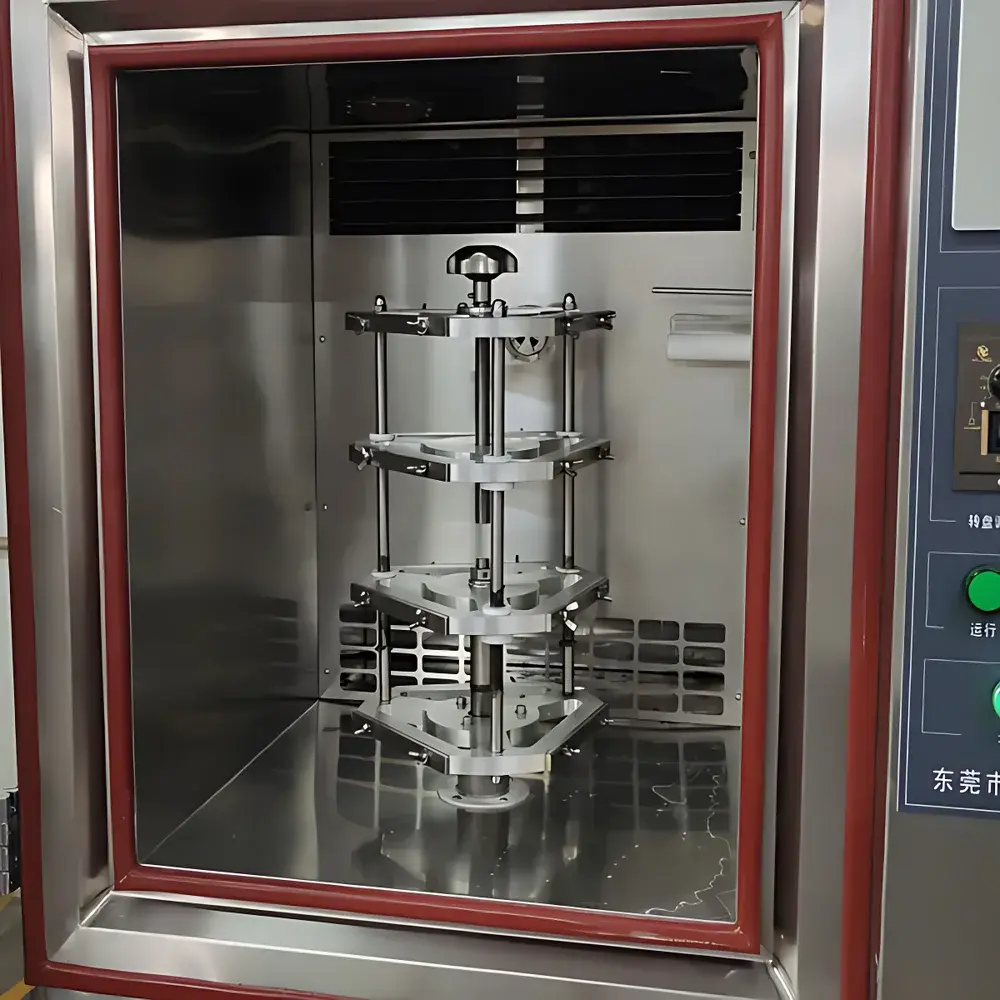
HAIDA HD-E801 Ozone Aging Test Chamber
| Brand | HAIDA INTERNATIONAL |
|---|---|
| Origin | Guangdong, China |
| Manufacturer Type | OEM/ODM Manufacturer |
| Country of Origin | China |
| Model | HD-E801 |
| Ozone Concentration Range | 50–1000 pphm |
| Ozone Control Accuracy | ±10 pphm (50–100 pphm), ±10% (100–1000 pphm) |
| Temperature Range | 20–60 °C |
| Temperature Uniformity | ±2 °C (empty chamber) |
| Temperature Stability | ±0.5 °C |
| Humidity Range | 30–98 %RH |
| Airflow Rate | 100 L/min |
| Internal Dimensions | 400 × 500 × 500 mm (D×W×H) |
| External Dimensions | 950 × 980 × 1650 mm (D×W×H) |
| Net Volume | 800 L |
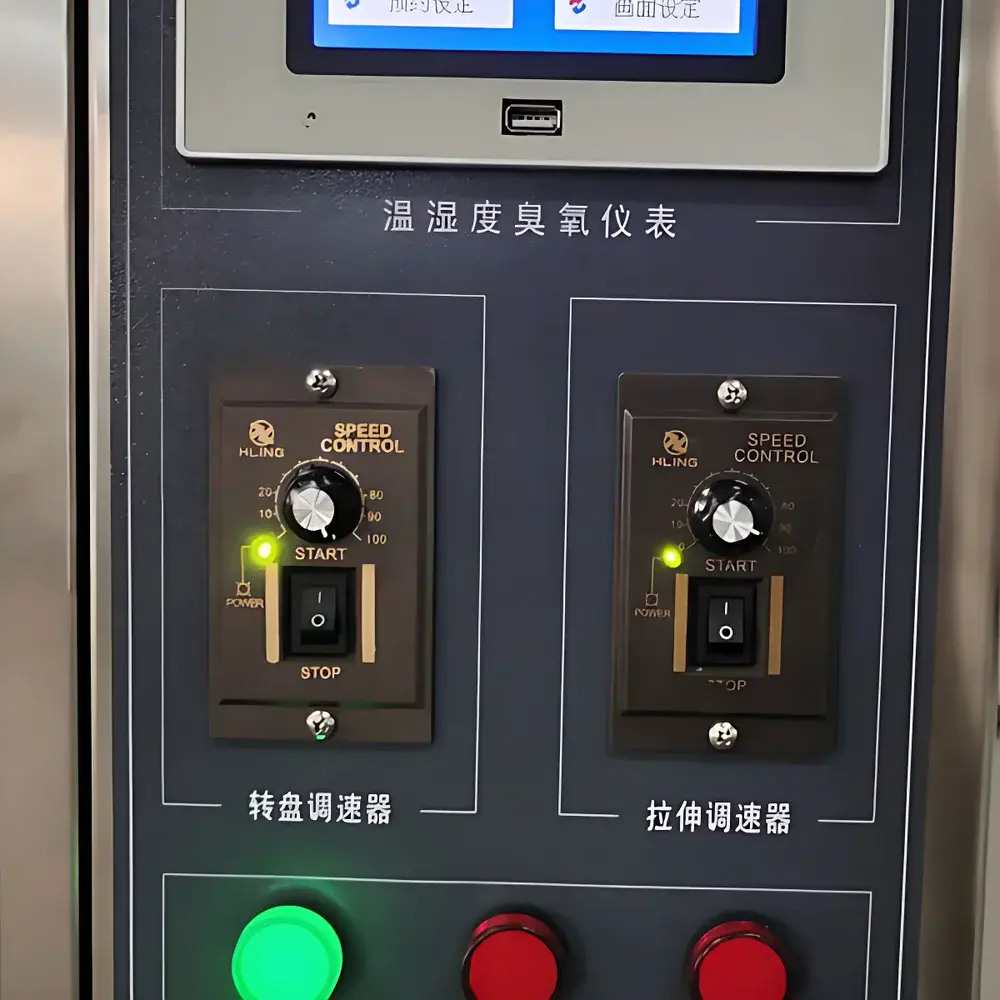
| Dynamic Sample Rotation Speed | 2–10 rpm (adjustable) |
| Vertical Extension Frequency | 2–15 cycles/min |
| Extension Stroke | 20–100 mm (adjustable) |
| Refrigerant | R404a |
| Compressor | Hermetic French Tecumseh unit |
| Heating System | SUS304 U-shaped finned tubular heater (1500 W) |
| Humidification System | SUS304 U-shaped humidifier |
| Ozone Generator | Silent high-voltage corona discharge type |
| Ozone Sensor | Electrochemical sensor |
| Controller | TEMP880 high-precision color touchscreen PID controller with USB/RS232/RS485 interfaces |
| Compliance Standards | GB/T 7762–2003, GB/T 2951.21–2008, GB/T 2951.5–1997 |
Overview
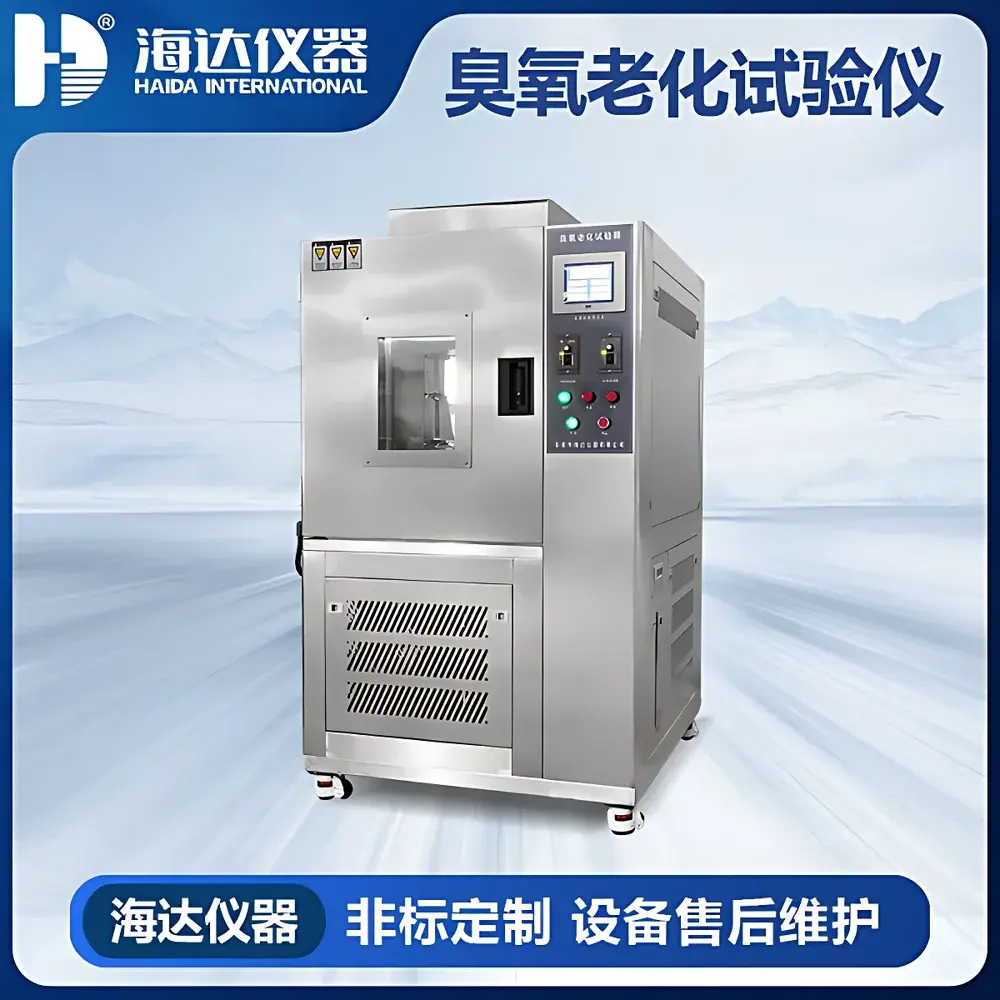
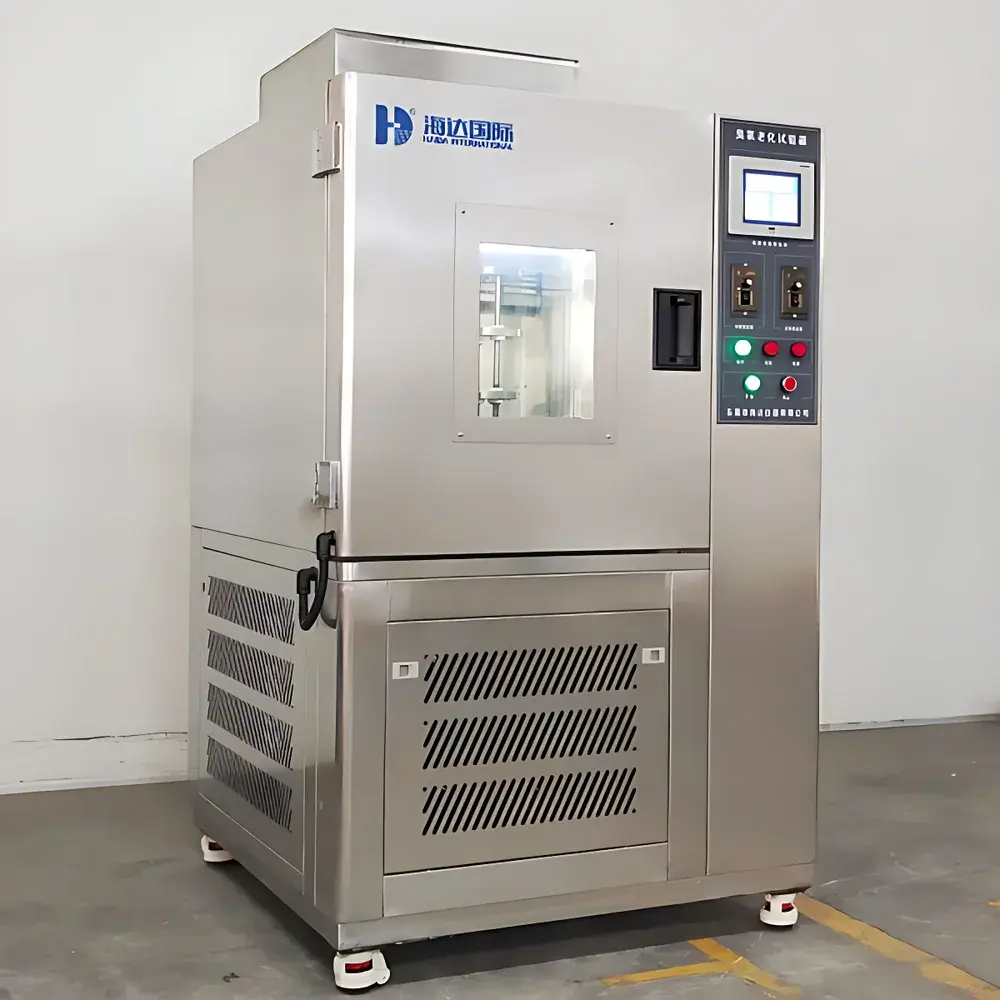
The HAIDA HD-E801 Ozone Aging Test Chamber is an engineered environmental test system designed to simulate and accelerate ozone-induced degradation in elastomeric materials under controlled thermal, humid, and oxidative conditions. It operates on the principle of dynamic exposure—combining precisely regulated ozone concentration (50–1000 pphm), temperature (20–60 °C), relative humidity (30–98 %RH), and mechanical strain (cyclic extension and rotation)—to replicate real-world atmospheric aging mechanisms. This methodology aligns with standardized accelerated aging protocols defined in ISO 1431-1, ASTM D1149, and GB/T 7762–2003, enabling quantitative evaluation of ozone resistance in vulcanized rubber, synthetic elastomers, cable insulation, automotive seals, and aerospace gaskets. The chamber’s dual-mode operation—static (non-stressed) and dynamic (mechanically strained)—supports both material screening and formulation development, particularly for antioxidant and antiozonant efficacy testing.
Key Features
- Electrochemical ozone sensor with real-time feedback control, delivering ±10 pphm accuracy in low-range (50–100 pphm) and ±10% in high-range (100–1000 pphm) operation.
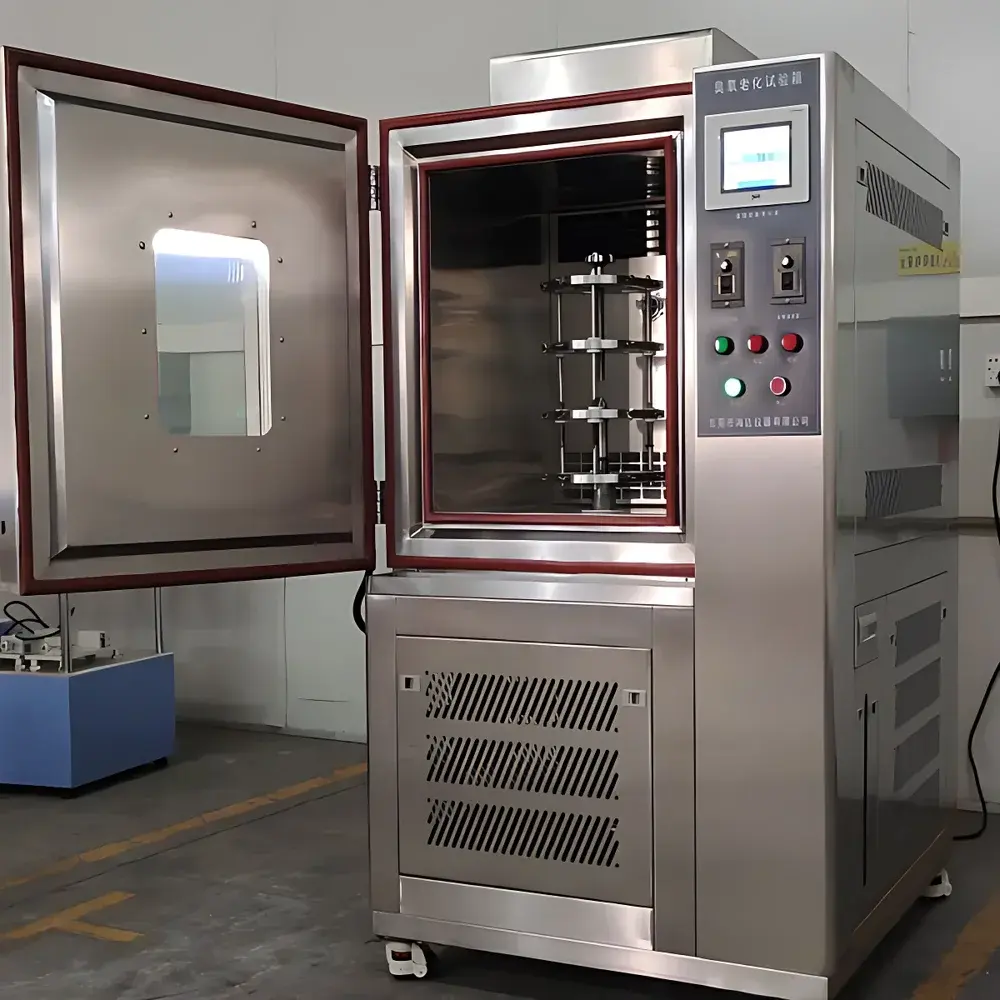
- Dynamic sample manipulation system: motor-driven rotating sample rack (2–10 rpm) integrated with vertically oscillating clamps (2–15 cycles/min, 20–100 mm stroke), enabling simultaneous tensile cycling and rotational exposure per GB/T 2951.21–2008.
- Hermetically sealed refrigeration circuit using Tecumseh compressors and environmentally compliant R404a refrigerant, supporting stable thermal conditioning across the full operating range.
- SUS304 stainless steel inner chamber (1.2 mm thickness) with PU foam + fiberglass insulation, ensuring corrosion resistance, thermal integrity, and long-term ozone stability.
- TEMP880 high-resolution color touchscreen controller featuring multi-loop PID regulation (6 temperature + 6 humidity zones), programmable test profiles (100 steps × 100 patterns), non-volatile RAM data retention, and audit-trail-capable event logging.
- Dual independent heating (1500 W finned SUS304 heater) and humidification (SUS304 U-tube humidifier) systems, decoupled from refrigeration for precise thermohygrometric control.
- Comprehensive safety architecture: overtemperature protection (chamber, heater, compressor), phase failure/phase reversal detection, refrigerant high-pressure cutoff, condensate level monitoring, ozone over-concentration shutdown, and automatic fault-triggered power isolation.
Sample Compatibility & Compliance
The HD-E801 accommodates standard dumbbell-shaped, ring-shaped, or strip specimens per ISO 1431-1 and ASTM D1149, with a maximum load capacity of ≥50 kg distributed across its adjustable SUS304 mesh sample rack. Specimen fixtures are precision-machined to ensure uniform stress distribution during dynamic extension. The system complies with national and international standards including GB/T 7762–2003 (Rubber—Determination of resistance to ozone cracking—Dynamic strain method), GB/T 2951.21–2008 (Electric cables—Test methods for non-metallic materials—Part 21: Ozone resistance), and GB/T 2951.5–1997. While not certified to IEC 61000 or UL 61010 by default, its electrical architecture meets CE Low Voltage Directive (2014/35/EU) and EMC Directive (2014/30/EU) requirements when installed per manufacturer-specified grounding and ventilation guidelines. Optional validation packages support IQ/OQ documentation for GLP and GMP-regulated laboratories.
Software & Data Management
The TEMP880 controller supports traceable data acquisition via embedded Pt100 temperature sensors, capacitive humidity transducers, and electrochemical ozone probes—all calibrated to NIST-traceable references. Time-stamped measurement logs (temperature, RH, ozone ppm, rotation speed, extension count) are stored internally and exportable via USB flash drive or RS232/RS485 serial link to external PCs. Optional software modules provide graphical curve plotting (temperature vs. time, ozone concentration vs. exposure duration), statistical deviation analysis (±0.5 °C stability verification), and CSV-formatted reports suitable for regulatory submission. All controller firmware versions, parameter changes, alarm events, and manual overrides are recorded with timestamps and operator IDs—enabling full 21 CFR Part 11 compliance when paired with user-access-controlled login protocols and electronic signature modules (available upon request).
Applications
This chamber is routinely deployed in quality assurance laboratories for incoming raw material qualification (e.g., SBR, EPDM, CR, FKM compounds), R&D formulation optimization (antiozonant dosage studies), and production lot release testing per automotive OEM specifications (e.g., VW TL 226, GMW 15635). It serves as a core tool in cable manufacturing for validating insulation integrity under simulated tropospheric ozone loads; in medical device packaging development for assessing elastomeric seal degradation; and in aerospace component certification where ozone resistance directly impacts service life in high-altitude operational envelopes. Universities and national metrology institutes utilize the HD-E801 for interlaboratory round-robin studies on elastomer aging kinetics, supported by its reproducible airflow (100 L/min ±3%) and laminar flow design minimizing boundary layer effects.
FAQ
What ozone generation technology does the HD-E801 employ?
It uses silent high-voltage corona discharge ozone generation, optimized for stable output and minimal nitrogen oxide byproduct formation.
Can the chamber operate at ambient pressure only, or does it support overpressure/underpressure testing?
The HD-E801 is designed for atmospheric-pressure operation only; it does not include pressure vessel certification or vacuum/overpressure capability.
Is third-party calibration certification included with delivery?
Factory calibration certificates for temperature, humidity, and ozone sensors are provided; ISO/IEC 17025-accredited field calibration services are available as an optional add-on.
Does the TEMP880 controller support remote monitoring via Ethernet or cloud platforms?
Standard configuration includes RS232/RS485 and USB; Ethernet or MQTT-enabled remote access requires hardware upgrade and custom firmware licensing (contact HAIDA technical sales).
How is air circulation managed to ensure uniform ozone distribution?
A multi-blade centrifugal fan combined with calibrated airflow valves (0–100 L/min range) and internal baffle geometry ensures turbulent yet homogeneous gas mixing across the 800 L working volume.



