
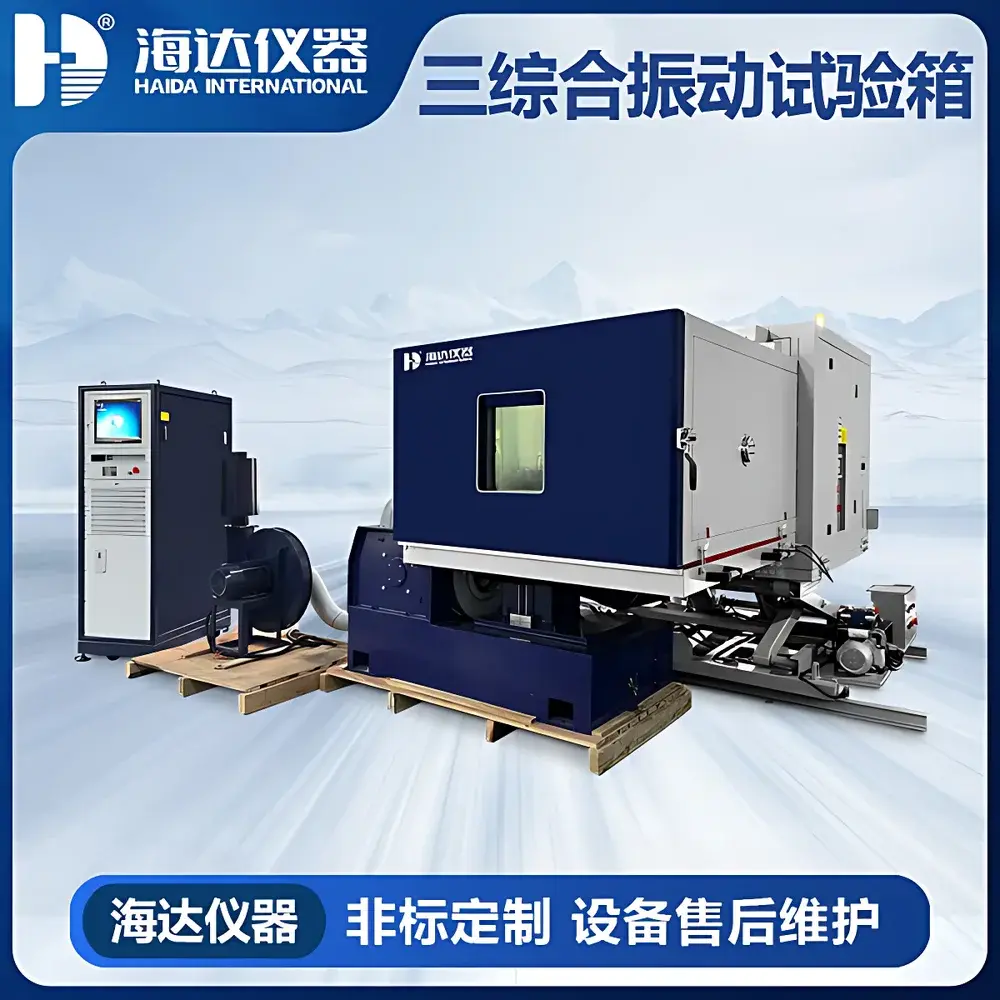
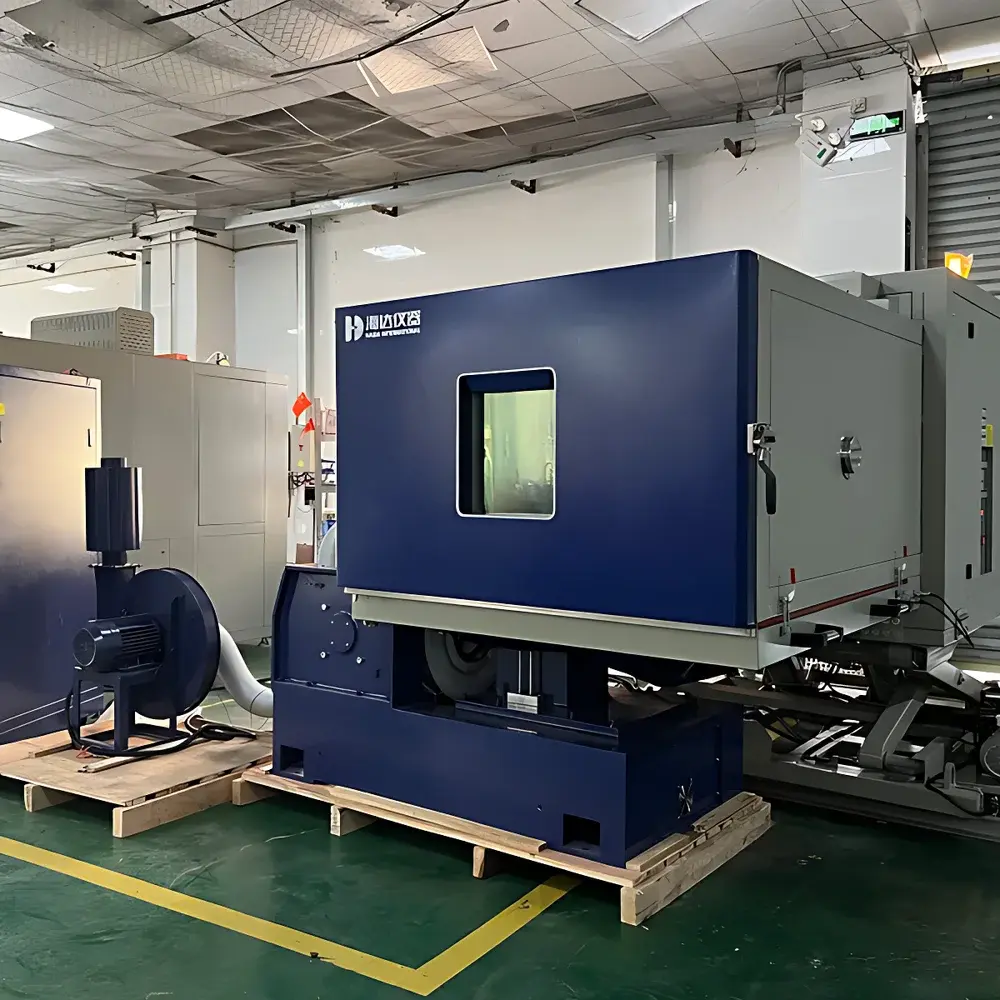
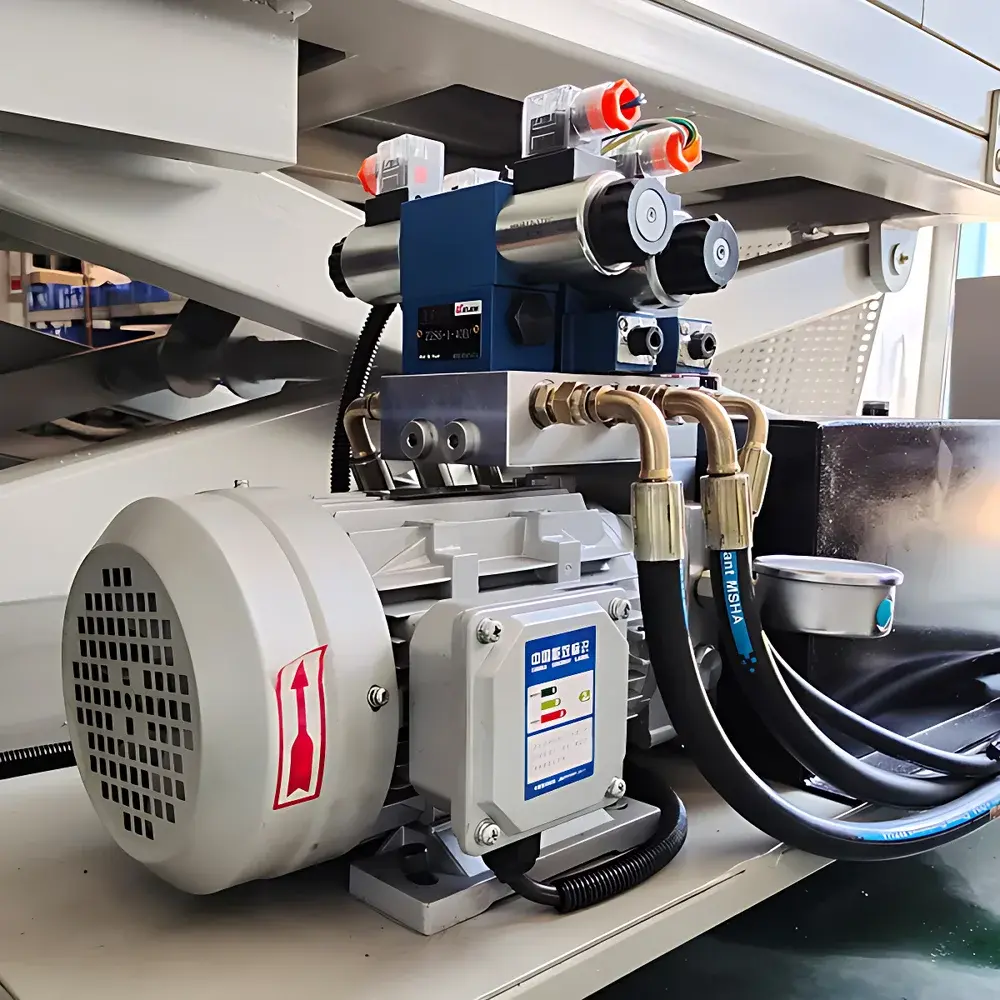
HAIDA HD-E809 Combined Temperature-Humidity-Vibration Test System
| Brand | HAIDA INTERNATIONAL |
|---|---|
| Origin | Guangdong, China |
| Manufacturer Type | Direct Manufacturer |
| Product Origin | Domestic (China) |
| Model | HAIDA HD-E809 Combined Temperature-Humidity-Vibration Test System |
| Temperature Range | −40 °C to +150 °C |
| Humidity Range | 30–95 %RH |
| Temperature Ramp Rate | ≥3 °C/min (heating, no-load, average) / 0.7–1 °C/min (cooling, no-load, average) |
| Temperature Uniformity | ≤2.0 °C |
| Temperature Fluctuation | ≤±0.5 °C |
| Humidity Fluctuation | ≤±2 %RH |
| Humidity Accuracy | ±5 %RH (≤75 %RH), ±3 %RH (>75 %RH) |
| Vibration Force | 1000 kgf peak (sine), 1000 kgf rms (random), 2000 kgf peak (shock) |
| Frequency Range | 2–3000 Hz |
| Max Displacement | 51 mm p-p |
| Max Velocity | 2 m/s |
| Max Acceleration | 100 g (980 m/s², unloaded) |
| Payload Capacity | 200 kg |
| Shaker Coil Diameter | Ø200 mm |
| Coil Mass | 12 kg |
| Table Fixtures | 17 × M10 stainless steel threaded inserts |
| Magnetic Leakage | <10 Gauss |
| Eccentric Moment Tolerance | 100 N·m |
| Vertical Extension Table | 300 × 300 mm aluminum alloy, hard-anodized surface |
| Horizontal Oil-Film Slip Table | 300 × 300 mm aluminum alloy, hard-anodized, 100 × 100 mm grid M10 inserts |
| Internal Chamber Dimensions | 1200 × 1200 × 800 mm (W × D × H) |
| Test Port | One Ø100 mm port on left side |
| Refrigeration | Cascade dual-stage compression |
| Temperature Control Algorithm | PID + BTC (Balance Temperature Control) + DCC (Dynamic Cooling Capacity Control) + DEC (Dynamic Electrical Control) |
| Temperature Resolution | 0.01 °C |
| Humidity Resolution | 0.1 %RH |
Overview
The HAIDA HD-E809 Combined Temperature-Humidity-Vibration Test System is an integrated environmental simulation platform engineered for rigorous reliability validation of electronic assemblies, automotive components, aerospace subsystems, and industrial electronics under concurrent thermal, hygric, and mechanical stress conditions. It combines a high-fidelity climatic chamber with a high-performance electromagnetic shaker system—both fully synchronized via a unified control architecture—to replicate real-world operational and transit environments in accordance with international test standards including IEC 60068-2, MIL-STD-810H, RTCA DO-160G, and ISO 16750-4. The system operates on the principle of simultaneous multi-stress exposure: temperature and humidity are precisely regulated within the insulated chamber using cascade refrigeration and PID-driven BTC control, while mechanical vibration is delivered via a low-distortion, wide-bandwidth electromagnetic actuator capable of reproducing sine, random, and transient shock profiles across 2–3000 Hz. This co-located, time-synchronized testing eliminates sequential test artifacts and enables accelerated life-cycle analysis with high reproducibility.
Key Features
- Integrated tri-stress architecture: Simultaneous control of temperature (−40 °C to +150 °C), relative humidity (30–95 %RH), and broadband vibration (2–3000 Hz) within a single test envelope
- High-dynamic electromagnetic shaker: 1000 kgf peak sinusoidal force, 100 g maximum acceleration (980 m/s²), 51 mm p-p displacement, and 2 m/s velocity capability—optimized for payload up to 200 kg
- Low-magnetic-leakage design: <10 Gauss residual field at 300 mm distance ensures compatibility with magnetically sensitive devices (e.g., MEMS sensors, Hall-effect components)
- Hard-anodized aluminum extension and oil-film slip tables: 300 × 300 mm active surfaces with 17 × M10 stainless steel inserts (vertical) and 100 × 100 mm grid M10 inserts (horizontal), supporting repeatable fixture mounting and low-friction lateral motion
- Advanced chamber control: Dual-stage cascade refrigeration with BTC + DCC + DEC algorithms ensures stable thermal-hygric response—achieving ≤±0.5 °C temperature fluctuation and ≤±2 %RH humidity fluctuation under dynamic load
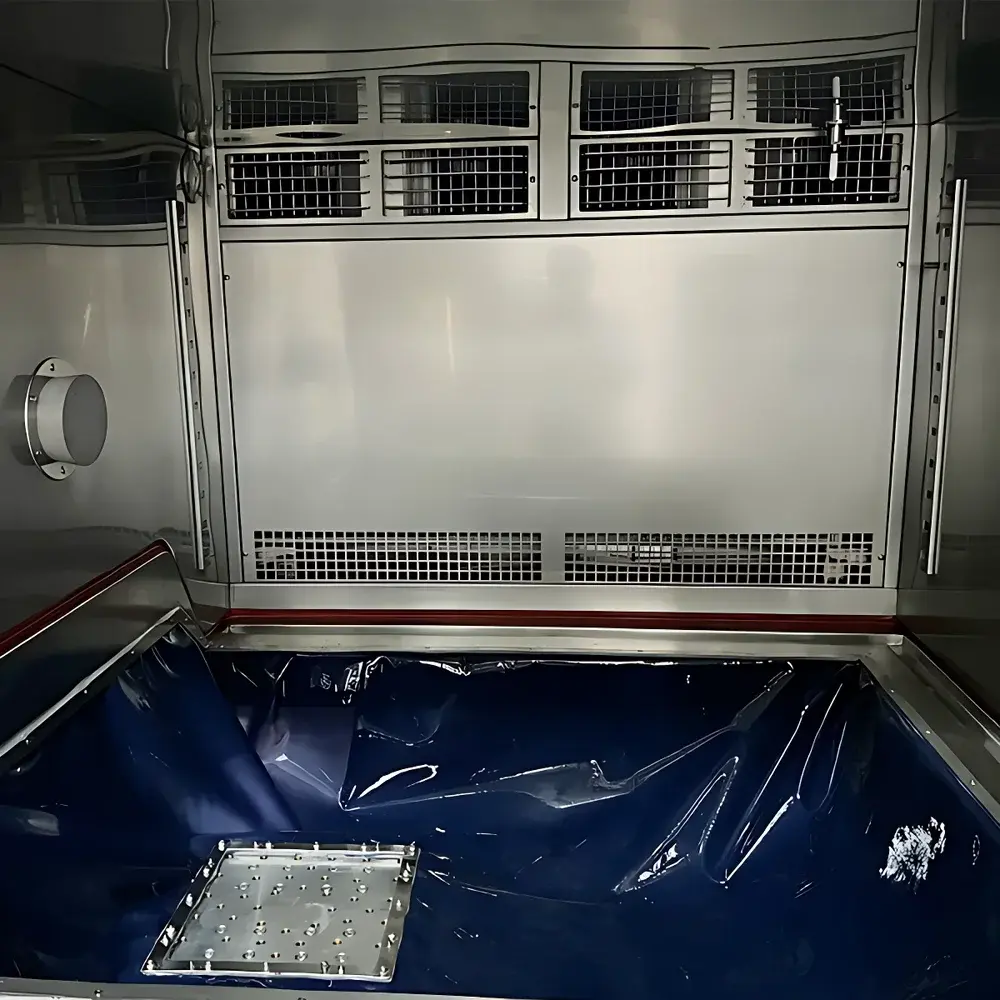
- Chamber integrity: 1200 × 1200 × 800 mm internal volume with welded stainless steel inner walls, polyurethane insulation, and one Ø100 mm access port for signal/power feedthrough
- Real-time synchronization: All three stress domains (thermal, humidity, vibration) are time-aligned and logged with microsecond-level timestamp resolution for traceable correlation analysis
Sample Compatibility & Compliance
The HD-E809 accommodates samples up to 200 kg mass and dimensions compatible with the 300 × 300 mm table interface—suitable for ECUs, battery modules, PCB assemblies, sensor housings, and small mechanical subassemblies. Its performance complies with key environmental test standard requirements for test severity, control tolerance, and measurement uncertainty. Temperature uniformity (≤2.0 °C) and humidity accuracy (±5 %RH below 75 %RH; ±3 %RH above) meet IEC 60068-3-5 and ASTM E145 Class B specifications. Vibration force linearity, transmissibility, and cross-axis rejection are verified per ISO 10816-1 and ISO 5347 calibration protocols. The system supports audit-ready data logging compliant with GLP and GMP documentation practices, including user access control, electronic signatures, and 21 CFR Part 11–compatible audit trails when paired with optional validated software modules.
Software & Data Management
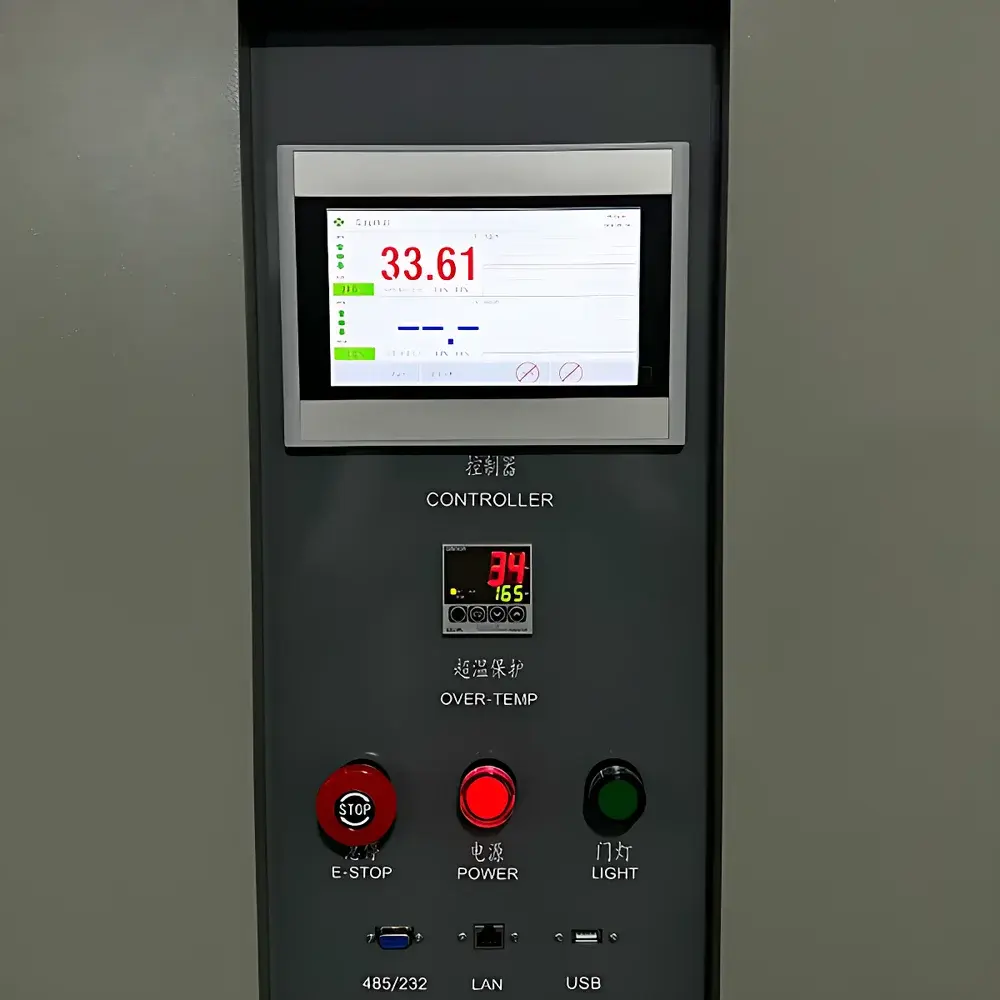
Control and monitoring are executed via HAIDA’s proprietary TriSync™ software suite, running on a dedicated industrial PC with real-time Linux OS. The interface provides synchronized waveform generation (sine, random PSD, shock pulses), profile-based environmental sequencing, and live overlay of temperature/humidity/vibration traces. All raw data—including accelerometer voltage, thermocouple mV, capacitive RH output, and chamber refrigerant pressures—is acquired at ≥10 kHz sampling rate and stored in HDF5 format for post-processing interoperability with MATLAB, Python (h5py), or commercial FEA tools. Export options include CSV, PDF test reports with pass/fail annotations, and XML metadata compliant with ASAM ATX standards. Optional firmware modules enable remote diagnostics, predictive maintenance alerts (based on coil impedance drift and compressor current harmonics), and integration with enterprise MES/QMS systems via RESTful API.
Applications
- Automotive: Validation of ADAS camera modules, radar enclosures, and infotainment units under combined thermal cycling, moisture ingress, and road-spectrum vibration
- Aerospace: Qualification of avionics line-replaceable units (LRUs) per DO-160G Sections 23 (vibration), 24 (temperature), and 25 (humidity)
- Electronics manufacturing: HALT/HASS screening of PCBAs with embedded humidity-sensitive components (e.g., polymer capacitors, RF filters)
- Energy storage: Cycle testing of Li-ion battery packs under thermal-hygric-vibrational stress to assess seal integrity, electrolyte stability, and interconnect fatigue
- Medical device development: Environmental robustness verification of portable diagnostic instruments subjected to transport and clinical-use conditions
- Research laboratories: Multi-physics correlation studies linking microstructural degradation (e.g., solder joint cracking, conformal coating delamination) to synchronized stress inputs
FAQ
What standards does the HD-E809 support for combined environment testing?
The system is configured to execute test plans aligned with IEC 60068-2-68 (combined temperature/humidity/vibration), MIL-STD-810H Method 520.5 (combined stresses), and RTCA DO-160G Sections 23–25. Calibration certificates reference ISO/IEC 17025-accredited procedures.
Can the vibration table operate independently of the environmental chamber?
Yes—the shaker subsystem can be decoupled from climate control via software configuration, enabling standalone vibration testing at ambient conditions or under user-defined static temperature setpoints.
Is the system suitable for testing sealed enclosures with internal condensation risk?
The chamber’s precise humidity ramp control, coupled with programmable dew-point tracking and optional desiccant purge mode, allows controlled condensation simulation per IPC-9701A and JEDEC JESD22-A101 requirements.
What is the typical lead time for factory acceptance testing (FAT) and on-site commissioning?
Standard FAT includes functional verification against IEC 60068-3-5 and ISO 5347, with documented uncertainty budgets; on-site commissioning (including seismic anchoring, utility integration, and operator training) typically requires 5–7 business days following shipment.
Does HAIDA provide IQ/OQ/PQ documentation packages for regulated industries?
Yes—validated software modules, full traceable calibration records, and 21 CFR Part 11–compliant electronic record templates are available as optional deliverables, supported by third-party validation consulting services.



