
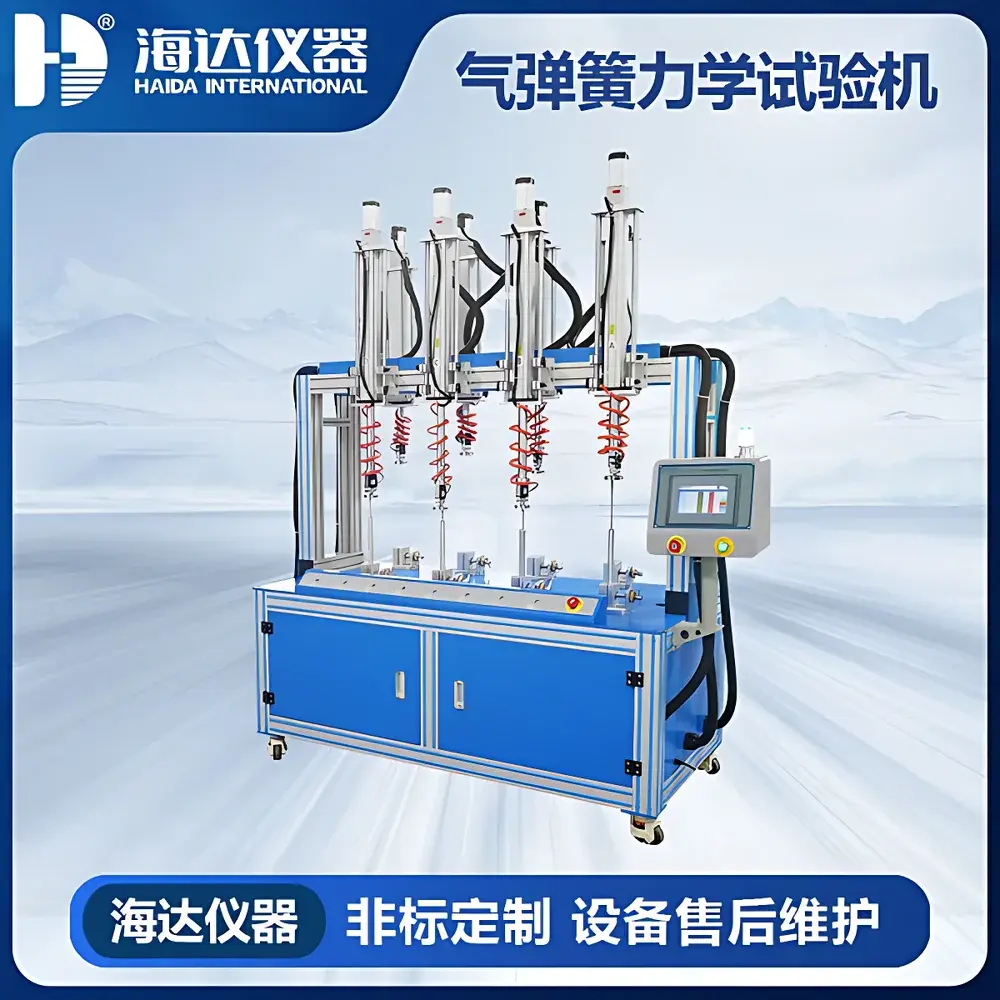
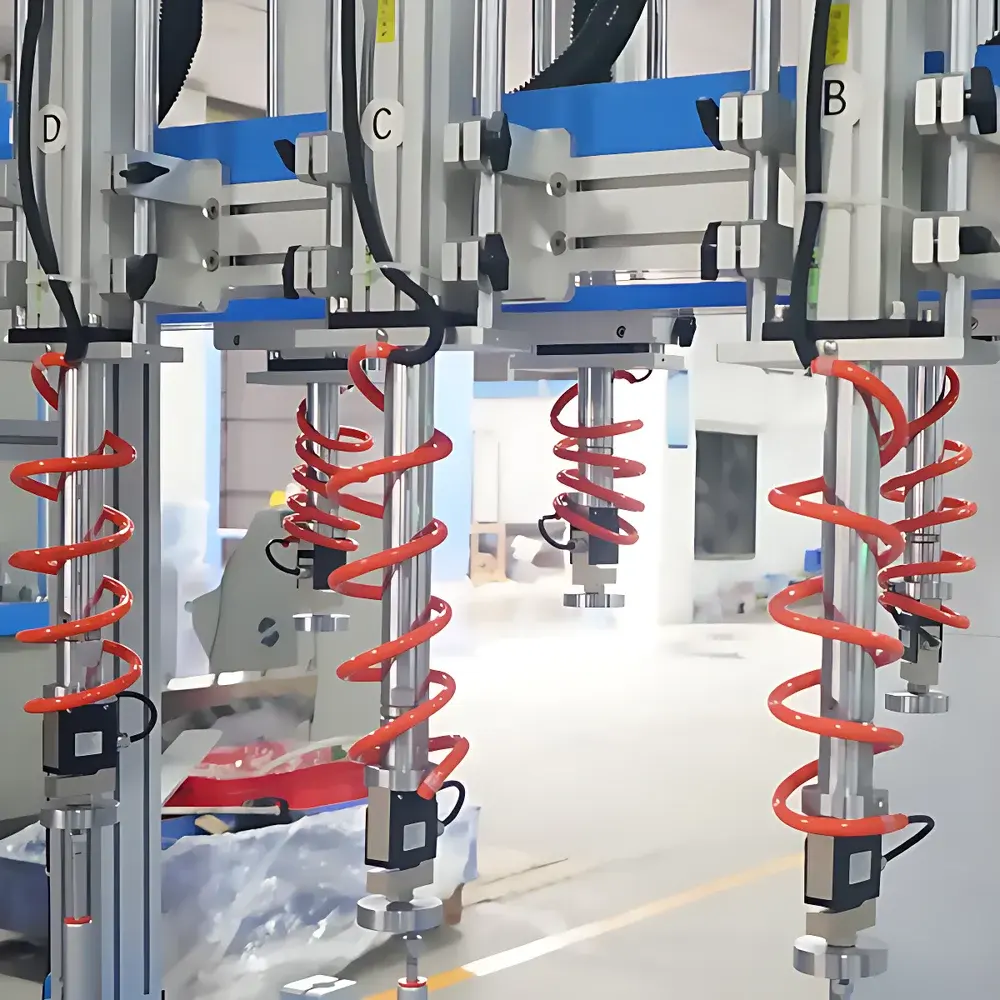
HAIDA HD-F773-4 Pneumatic Spring Mechanical Characterization Tester
| Brand | HAIDA INTERNATIONAL |
|---|---|
| Origin | Guangdong, China |
| Manufacturer Type | Direct Manufacturer |
| Product Origin | Domestic (China) |
| Model | HAIDA HD-F773-4 Pneumatic Spring Mechanical Characterization Tester |
| Max Test Force | 50–1200 N |
| Tensile Stroke | 500 mm |
| Compression Stroke Range (Extended Length) | 150–500 mm |
| Speed Control Range | 5–250 mm/s |
| Motor | 400 W Panasonic Servo Motor |
| Drive System | 400 W Panasonic Servo Driver |
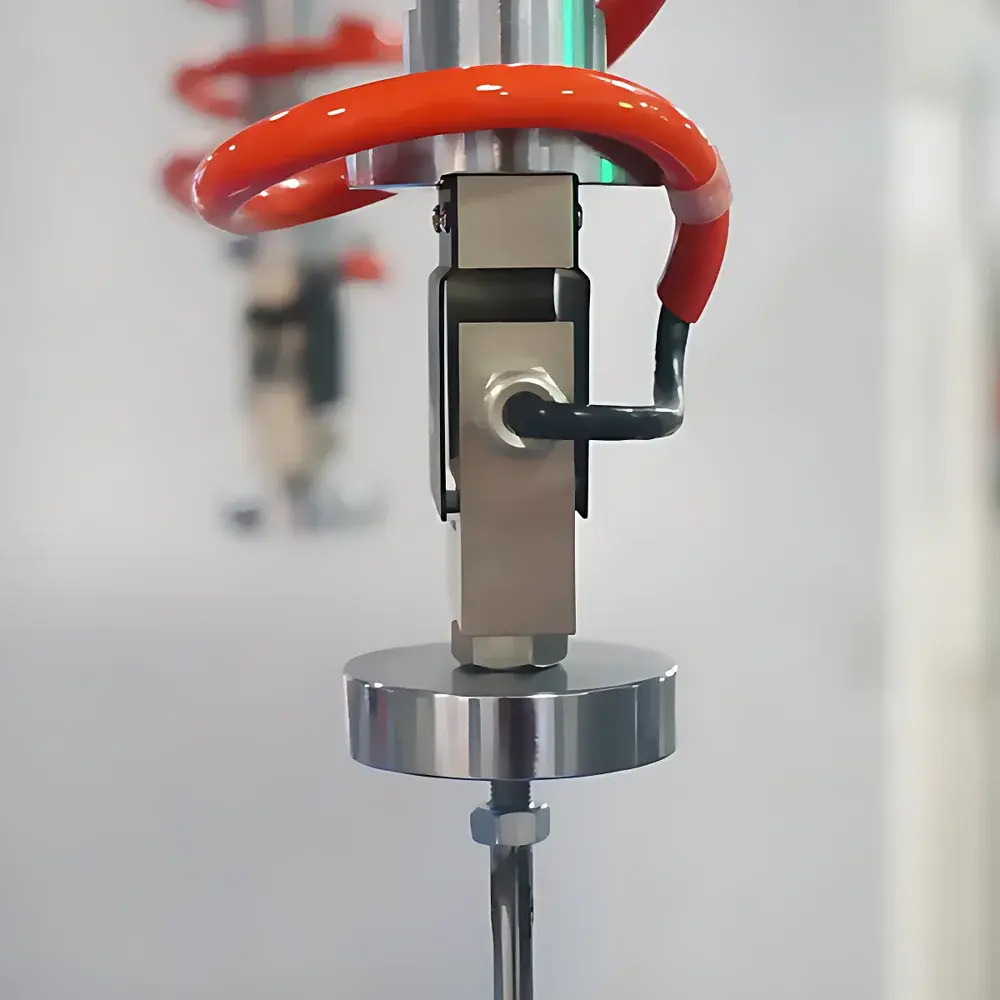
| Load Cell | Imported High-Precision Sensor |
| Displacement Accuracy | Grade 0.5 |
| Control System | PLC-Based Real-Time Control |
| Power Supply | 1∅, AC 220 V, 50 Hz |
| Rated Power | 3500 W (8-station configuration) |
| Dimensions (L×W×H) | 2000 × 800 × 1950 mm |
| Weight | Approx. 200 kg |
Overview
The HAIDA HD-F773-4 Pneumatic Spring Mechanical Characterization Tester is a dedicated electromechanical testing system engineered for the precise evaluation of force-displacement behavior in lockable pneumatic springs under controlled compression and extension cycles. It operates on the principle of servo-driven linear actuation, where a high-torque Panasonic servo motor drives a precision electric cylinder to apply calibrated axial loads while synchronously acquiring real-time force and displacement data. Designed in strict accordance with GB/T 25750–2010 “Technical Specifications for Lockable Pneumatic Springs”, the instrument executes standardized mechanical characterization protocols—including measurement of minimum and maximum compression forces at defined stroke positions—to verify compliance with functional and safety requirements for industrial, automotive, and furniture-grade gas springs.
Key Features
- High-fidelity force measurement using imported load cells calibrated across the 50–1200 N range, ensuring traceable accuracy per ISO 376 and ASTM E4 guidelines;
- PLC-based closed-loop control architecture minimizes electromagnetic interference and eliminates data latency inherent in PC-dependent systems, supporting stable long-duration testing;
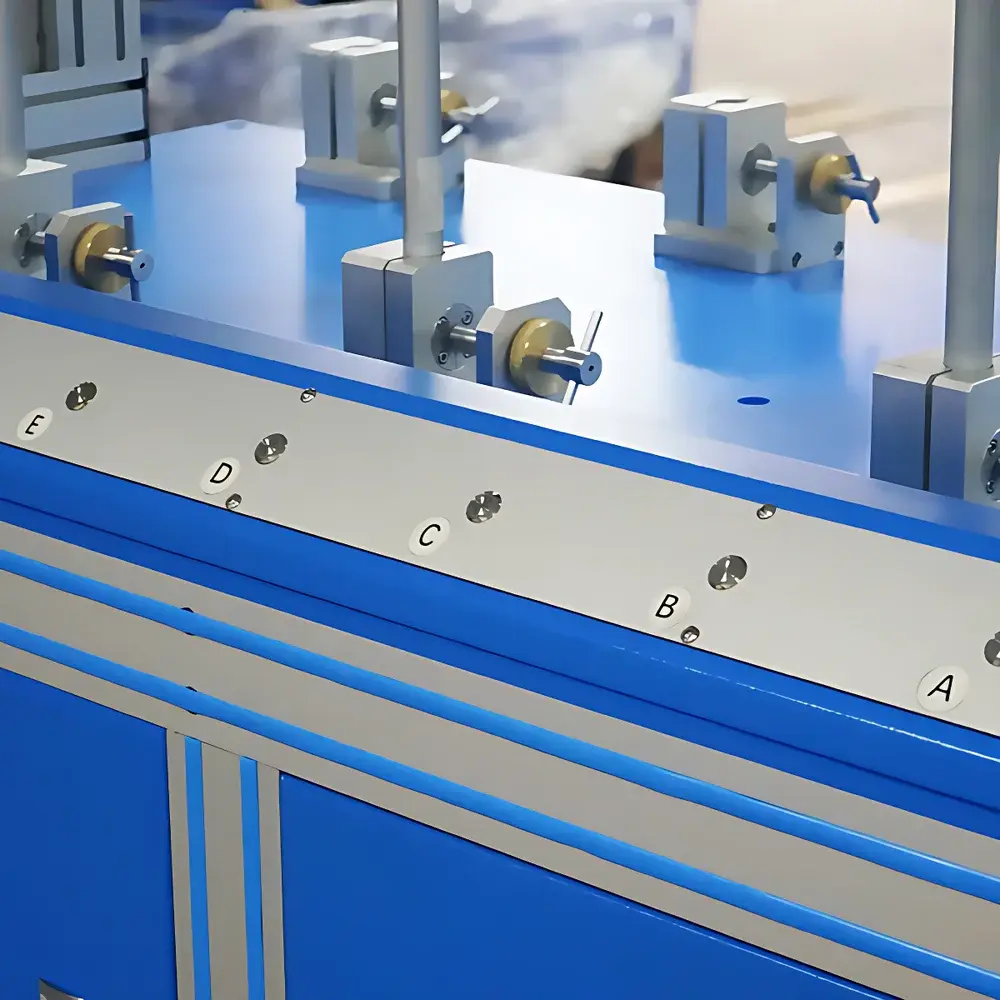
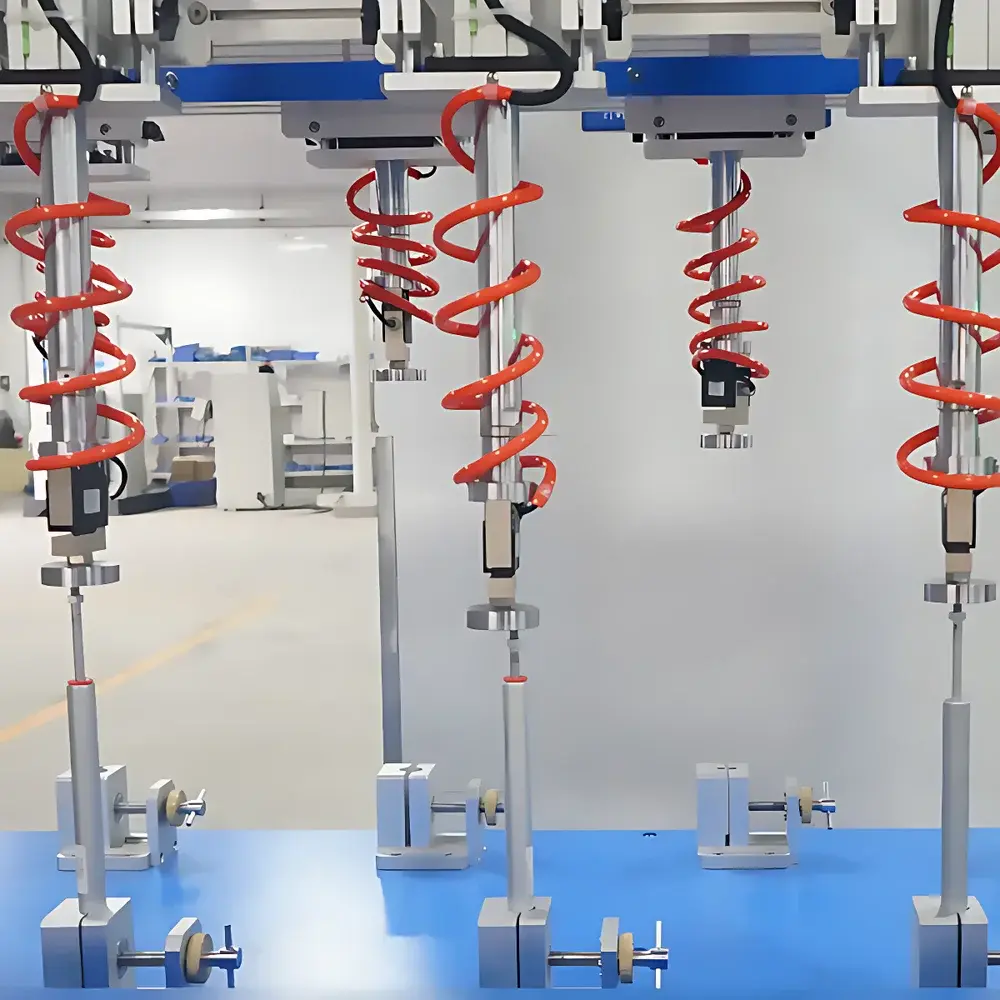
- Modular multi-station design (configurable from 2 to 8 independent test zones), enabling parallel evaluation of multiple samples without cross-channel crosstalk;
- Manually adjustable test modules accommodate variable spring lengths (150–500 mm extended state) and stroke depths (up to 500 mm), supporting rapid reconfiguration between specimen types;
- Comprehensive hardware safety suite including mechanical end-limit switches, overload cutoff, power-loss memory retention, and real-time fault diagnostics;
- Interchangeable sensor options and custom fixture kits allow adaptation to diverse mounting interfaces (e.g., ball-and-socket, clevis, threaded ends) and force-range requirements.
Sample Compatibility & Compliance
The HD-F773-4 accommodates lockable pneumatic springs with nominal extended lengths from 150 mm to 500 mm and operational force ranges spanning 50 N to 1200 N. Its mechanical architecture supports both static and dynamic compression tests as specified in Clause 7 (“Mechanical Characteristics”) of GB/T 25750–2010. While primarily aligned with Chinese national standards, the system’s metrological traceability, repeatable displacement resolution (Grade 0.5 per JJG 475), and deterministic control logic enable its use in GLP-compliant environments when integrated into validated laboratory workflows. Optional calibration certificates are available per ISO/IEC 17025-accredited procedures.
Software & Data Management
The embedded controller runs HAIDA’s proprietary force-characterization firmware, offering bilingual (English/Chinese) UI navigation, real-time curve plotting (force vs. displacement), and automated C-point detection—defined in GB/T 25750–2010 as the inflection point marking transition from initial resistance to full compression. All test sequences are timestamped and stored locally with metadata (operator ID, sample ID, environmental conditions). Raw data exports in CSV format support downstream analysis in MATLAB, Excel, or LIMS platforms. Though not natively 21 CFR Part 11 compliant, audit-trail logging and user-access levels can be configured to meet internal QA documentation requirements.
Applications
- Quality assurance of lockable gas springs used in office chairs, hospital beds, and automotive hatches;
- R&D validation of damping characteristics, locking torque consistency, and cycle-life endurance under repeated compression;
- Supplier qualification testing per OEM technical specifications referencing GB/T 25750 or equivalent EN 15627–1 criteria;
- Failure mode analysis—including seal leakage detection via anomalous force decay profiles—and root-cause investigation of premature lock failure;
- Calibration verification of production-line inline testers through reference-standard correlation studies.
FAQ
What standards does the HD-F773-4 comply with?
It is designed and verified against GB/T 25750–2010, with hardware and software architecture supporting alignment with ISO 7243 and EN 15627–1 for comparative benchmarking.
Can the system perform tensile testing in addition to compression?
Yes—the 500 mm bidirectional stroke enables both controlled compression and controlled extension, allowing full hysteresis loop acquisition for energy dissipation analysis.
Is remote monitoring or network connectivity supported?
The base configuration uses isolated PLC control; optional Ethernet/IP or Modbus TCP modules are available for SCADA integration and centralized fleet monitoring.
What maintenance intervals are recommended for the servo drive and electric cylinder?
Per Panasonic specifications, preventive maintenance—including lubrication and encoder calibration—is advised every 2,000 operating hours or annually, whichever occurs first.
Does HAIDA provide installation and operator training?
Yes—on-site commissioning, mechanical alignment verification, and certified operator training (including GB/T 25750 test protocol execution) are included in standard delivery terms.



