HAIDA HD-H209 Battery Combustion Test Chamber
| Brand | HAIDA INTERNATIONAL |
|---|---|
| Origin | Guangdong, China |
| Manufacturer Type | Direct Manufacturer |
| Country of Origin | China |
| Model | HAIDA HD-H209 Battery Combustion Test Chamber |
| Quotation | Available upon Request |
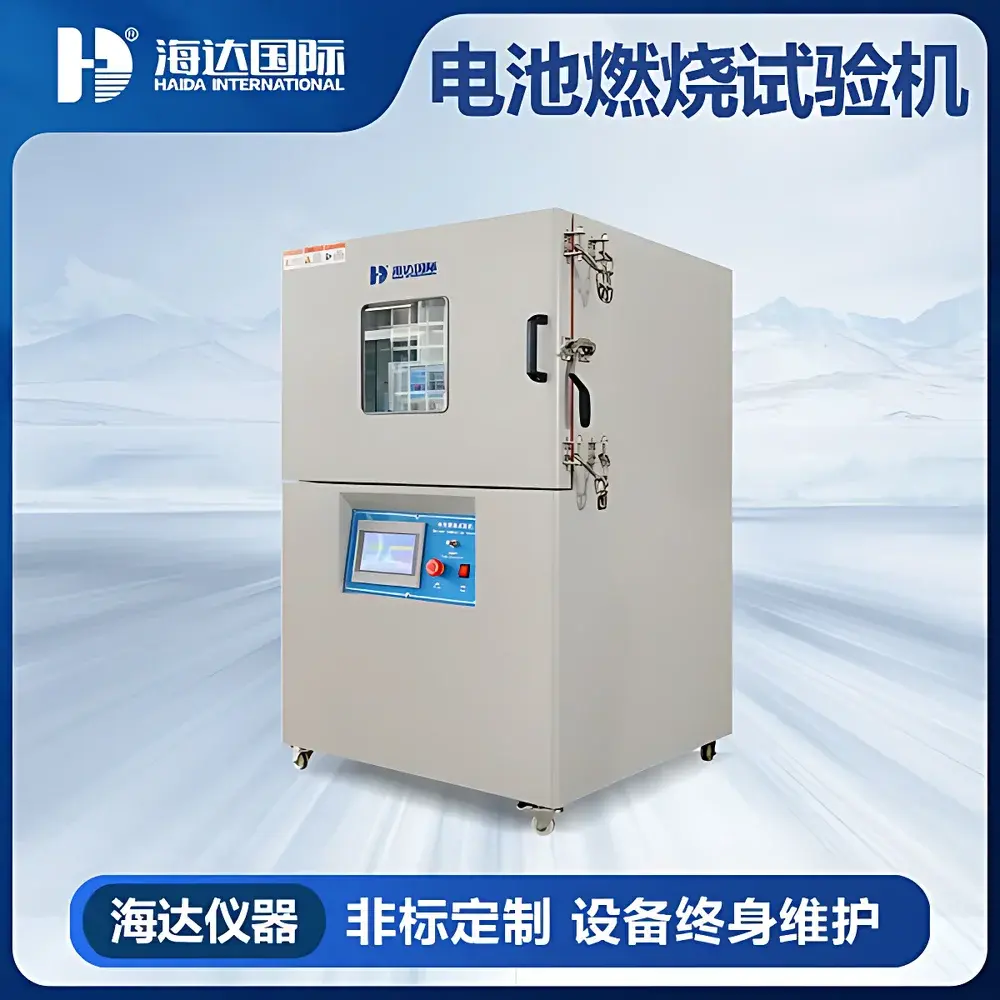
| Internal Chamber Dimensions | 750 × 750 × 500 mm (L×W×H) |
| External Dimensions (incl. door lock) | 1000 × 950 × 1310 mm (L×W×H) |
| Internal Material | SUS2304 Stainless Steel, 1.2 mm thickness |
| External Material | 1.5 mm Cold-Rolled Steel with Powder Coating |
| Viewing Window | 250 × 250 mm, Dual-Layer Tempered Glass with Stainless Steel Mesh |
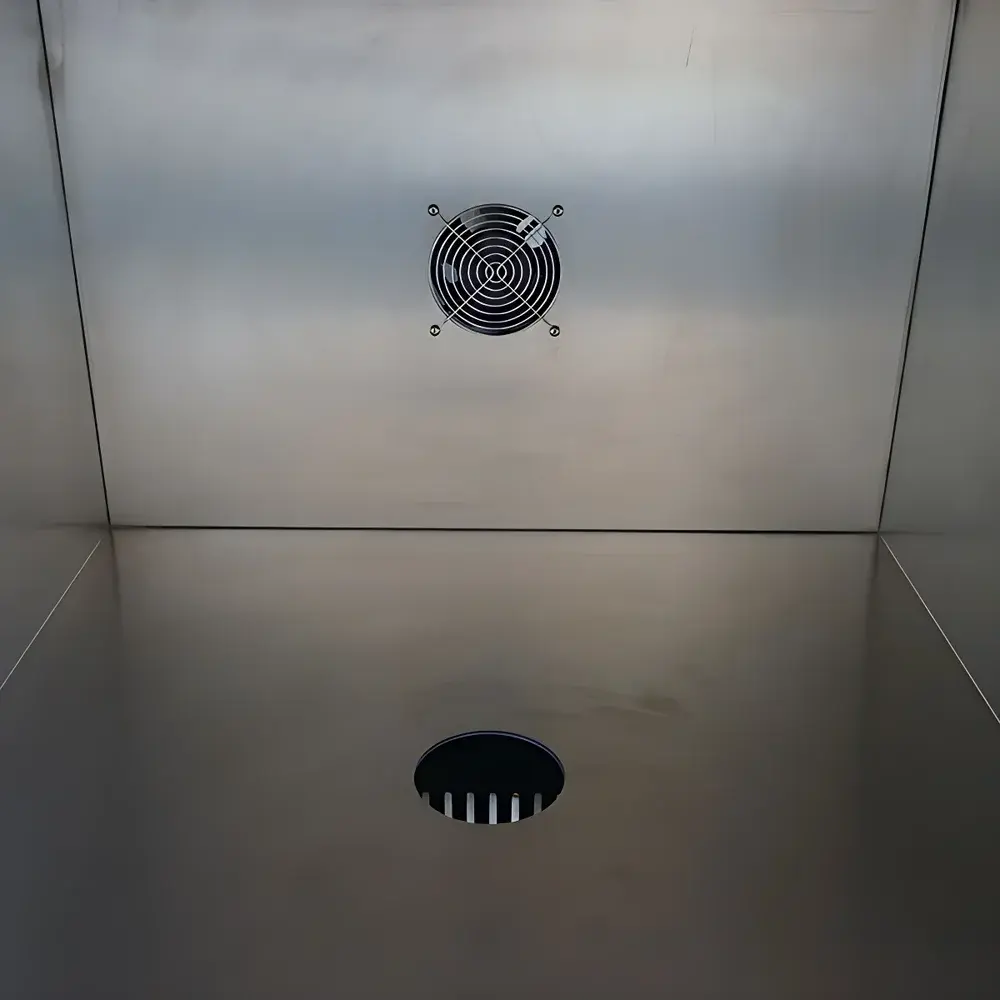
| Exhaust Port Diameter | 100 mm (rear-mounted) |
| Pressure Relief Opening | 200 × 200 mm (rear-mounted, spring-actuated) |
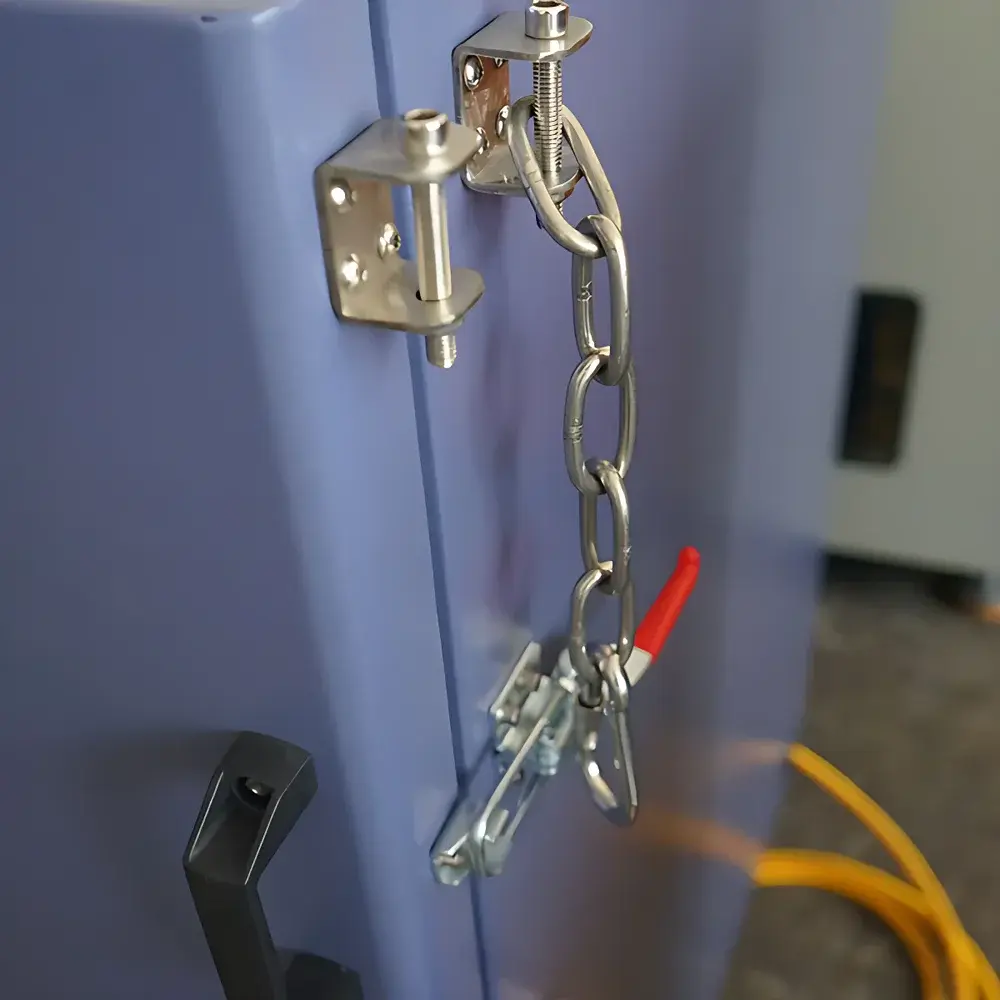
| Door Configuration | Single left-swing door with safety interlock switch and explosion-proof chain |
| Control Interface | Push-button panel |
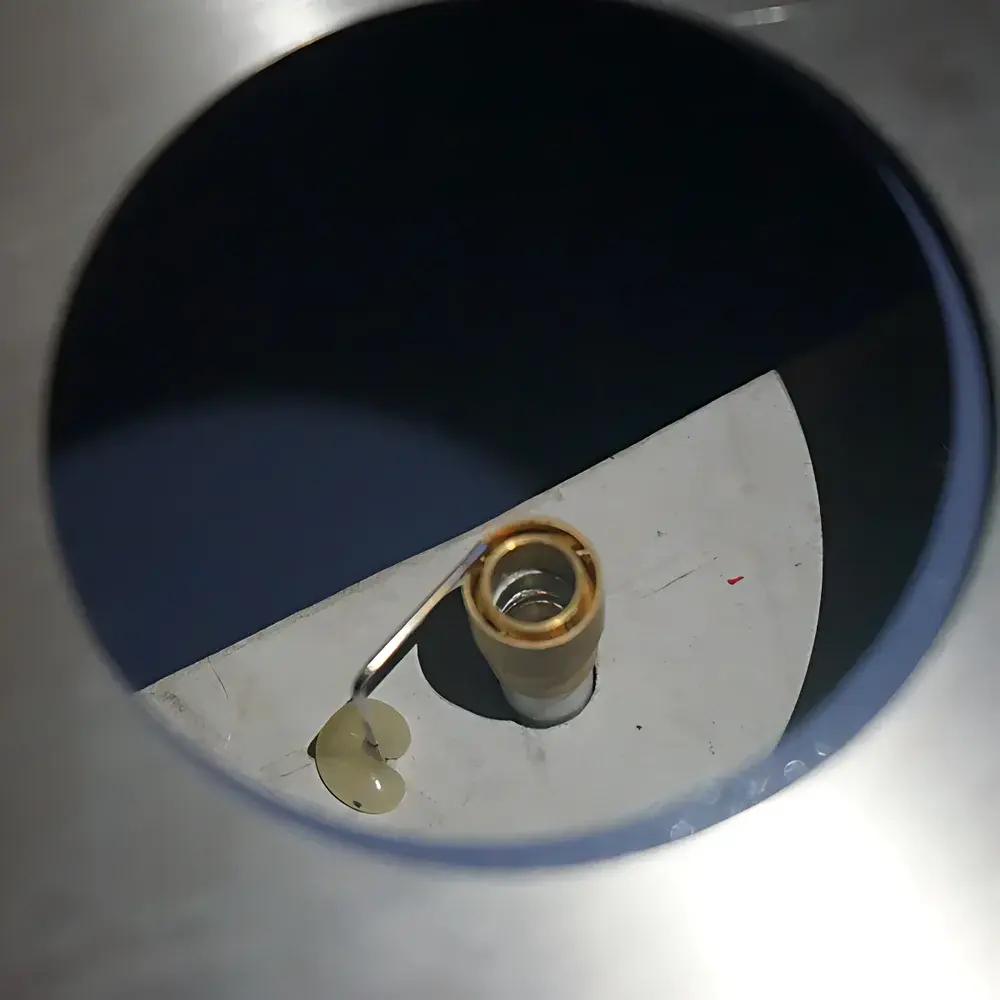
| Bunsen Burner Tip ID | 10 mm, length ≈ 100 mm |
| Combustion Duration Setting Range | 0–99 h 99 min |
| Test Aperture Diameter | 102 ± 2 mm |
| Test Wire Mesh | Woven stainless steel, 0.43 mm wire diameter, 20 mesh/inch |
| Flame Height Above Mesh | 38 mm |
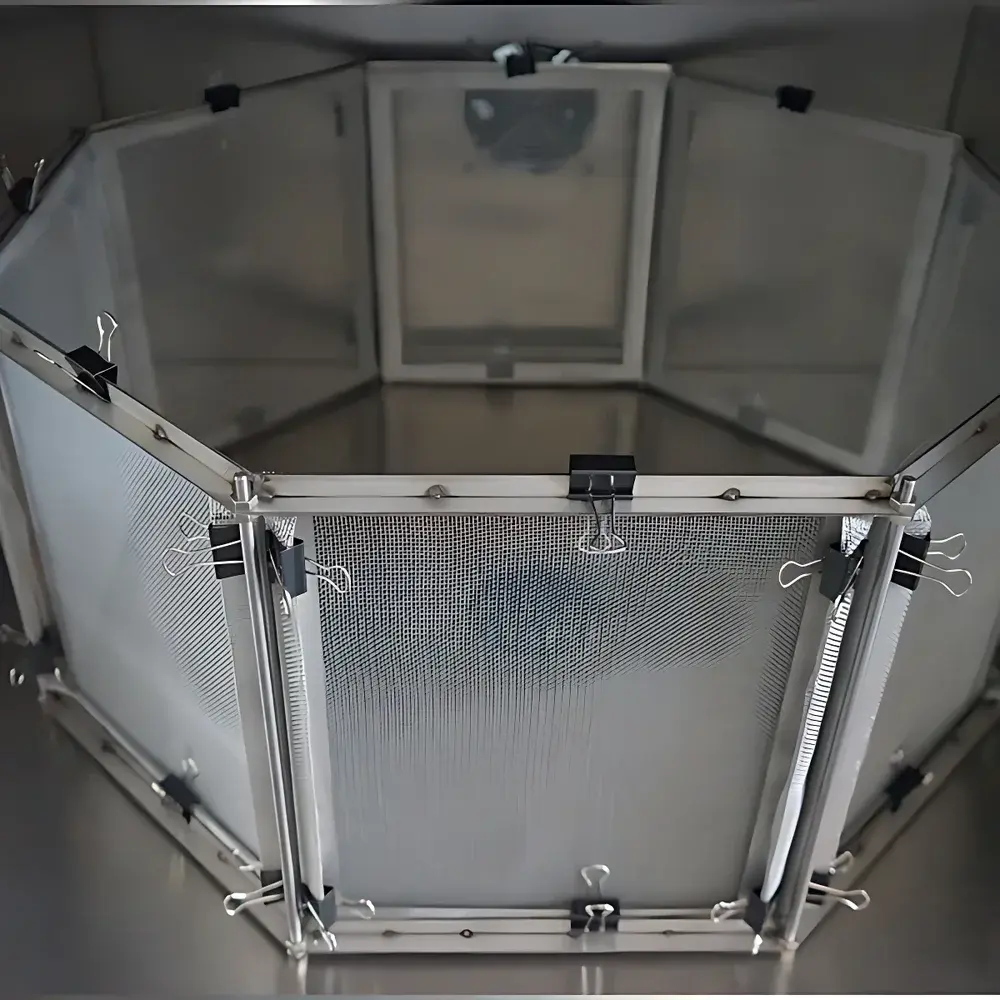
| Octagonal Aluminum Enclosure | Opposite sides spaced 610 mm (24″), height 305 mm (12″), modular hinged design |
| Fuel Supply | Methane or LPG (user-supplied) |
| Net Weight | 160 kg |
| Power Supply | 1∮ AC 220 V |
| Rated Power | 200 W |
Overview
The HAIDA HD-H209 Battery Combustion Test Chamber is a purpose-built safety evaluation system engineered for controlled thermal abuse testing of lithium-ion cells and battery packs in accordance with internationally recognized transport and safety standards. It implements the standardized flame exposure protocol defined in UN Manual of Tests and Criteria Part III, Section 38.3, GB/T 31241–2014, UL 1642:2012, and IEC 62133:2012. The apparatus subjects test specimens to direct open-flame heating under reproducible geometric and thermal boundary conditions—specifically, a calibrated Bunsen burner flame positioned 38 mm beneath a 102 mm-diameter perforated platform, enclosed within an octagonal aluminum safety shroud. This configuration ensures consistent heat flux delivery while containing hazardous combustion byproducts, thermal runaway events, and potential cell venting or explosion. The chamber’s structural integrity, pressure-relief architecture, and fail-safe door interlocks are designed to meet laboratory-level risk mitigation requirements for high-energy-density electrochemical systems.
Key Features
- Robust dual-wall construction: 1.2 mm SUS2304 stainless steel interior for corrosion resistance and thermal stability; 1.5 mm powder-coated cold-rolled steel exterior for mechanical durability.
- Integrated pressure-relief system: Spring-loaded 200 × 200 mm rear-mounted vent panel that automatically deploys during overpressure events (e.g., cell rupture), directing force away from operator zones.
- Optimized observation and containment: 250 × 250 mm dual-layer tempered glass viewport with embedded stainless steel mesh—providing real-time visual monitoring without compromising structural integrity or personnel safety.
- Modular octagonal aluminum enclosure: Hinged, disassemblable 8-sided shroud (610 mm face-to-face, 305 mm height) compliant with UN38.3 dimensional specifications; facilitates setup, alignment verification, and post-test residue handling.
- Fail-safe access control: Left-hinged door equipped with certified safety interlock switch and redundant explosion-proof chain restraint—ensuring power cutoff and mechanical immobilization prior to opening.
- Precision flame delivery: Standardized 10 mm ID Bunsen burner with adjustable gas flow and fixed 38 mm flame-to-mesh standoff, compatible with methane or LPG fuel sources (user-supplied).
Sample Compatibility & Compliance
The HD-H209 accommodates cylindrical, prismatic, and pouch-format lithium-ion cells and small-format battery modules (up to 200 mm diagonal footprint) on its 102 mm test aperture platform. Its geometry and operational parameters strictly adhere to the physical test setup requirements of UN38.3 Clause 38.3.2.3 (Battery Combustion Test), UL 1642 Section 9, GB/T 31241–2014 Clause 7.7, and IEC 62133:2012 Clause 8.2.2. All structural components—including the stainless steel test mesh (20 mesh/inch, 0.43 mm wire), aluminum shroud, and exhaust ducting—are dimensionally traceable to original standard schematics. The chamber supports audit-ready documentation per ISO/IEC 17025:2017 general requirements for testing laboratories and aligns with functional safety expectations under IEC 61508 for equipment used in hazardous energy environments.
Software & Data Management
The HD-H209 operates via a dedicated push-button control interface with digital timer (0–99 h 99 min resolution) for precise combustion duration setting and elapsed time logging. While it does not incorporate embedded data acquisition or PC connectivity, all timing and operational parameters are manually recorded in accordance with GLP-compliant test protocols. Users may integrate external time-synchronized video recording (via the viewport) and thermocouple-based surface temperature monitoring (optional accessory port) to support traceable event annotation. Calibration records for the burner assembly, mesh dimensions, and aperture tolerance (±2 mm) are maintained per manufacturer documentation and updated with each service cycle—supporting regulatory readiness for FDA 21 CFR Part 11-aligned quality systems when paired with validated lab notebooks or electronic lab notebook (ELN) entries.
Applications
This test chamber is deployed in R&D laboratories, third-party certification bodies, and battery manufacturing QA/QC departments for pre-shipment safety validation, failure mode analysis, and regulatory submission testing. Typical use cases include: qualification of new cell chemistries (e.g., NMC, LFP, solid-state prototypes) against thermal runaway thresholds; comparative assessment of separator stability and electrolyte flammability; verification of module-level fire containment designs; root-cause investigation of field failure incidents involving thermal propagation; and internal compliance screening prior to formal UN38.3 or UL 1642 certification audits. Its design enables repeatable execution of the “forced ignition” test sequence required for air transport eligibility determination under IATA Dangerous Goods Regulations.
FAQ
What safety certifications does the HD-H209 itself hold?
The HD-H209 is CE-marked per Machinery Directive 2006/42/EC and conforms to EN 61000-6-2 (immunity) and EN 61000-6-4 (emissions). It is not intrinsically rated for Class I Div 1 hazardous locations but meets general-purpose industrial lab safety requirements.
Is methane the only acceptable fuel source?
No—both methane and liquefied petroleum gas (LPG) are specified in UN38.3 and UL 1642. Users must ensure consistent gas supply pressure and burner orifice compatibility; calibration verification is recommended after fuel type changes.
Can the chamber be modified to accommodate larger battery packs?
No—the 102 mm aperture and 610 mm octagonal shroud dimensions are fixed to maintain strict compliance with referenced test standards. Larger assemblies require alternative test methods (e.g., large-scale calorimetry or outdoor burn pan testing).
Does HAIDA provide installation or commissioning support?
Yes—on-site commissioning, operator training, and as-built dimensional verification are available as optional services. Installation requires dedicated ventilation ducting connected to the 100 mm exhaust port and stable 220 V / 200 W power supply.
How frequently should the stainless steel test mesh be replaced?
Mesh replacement is condition-based: inspect before each test for warping, oxidation, or wire breakage. Under typical usage (≤5 tests/week), replacement is recommended every 6 months or after 150 test cycles—whichever occurs first.