
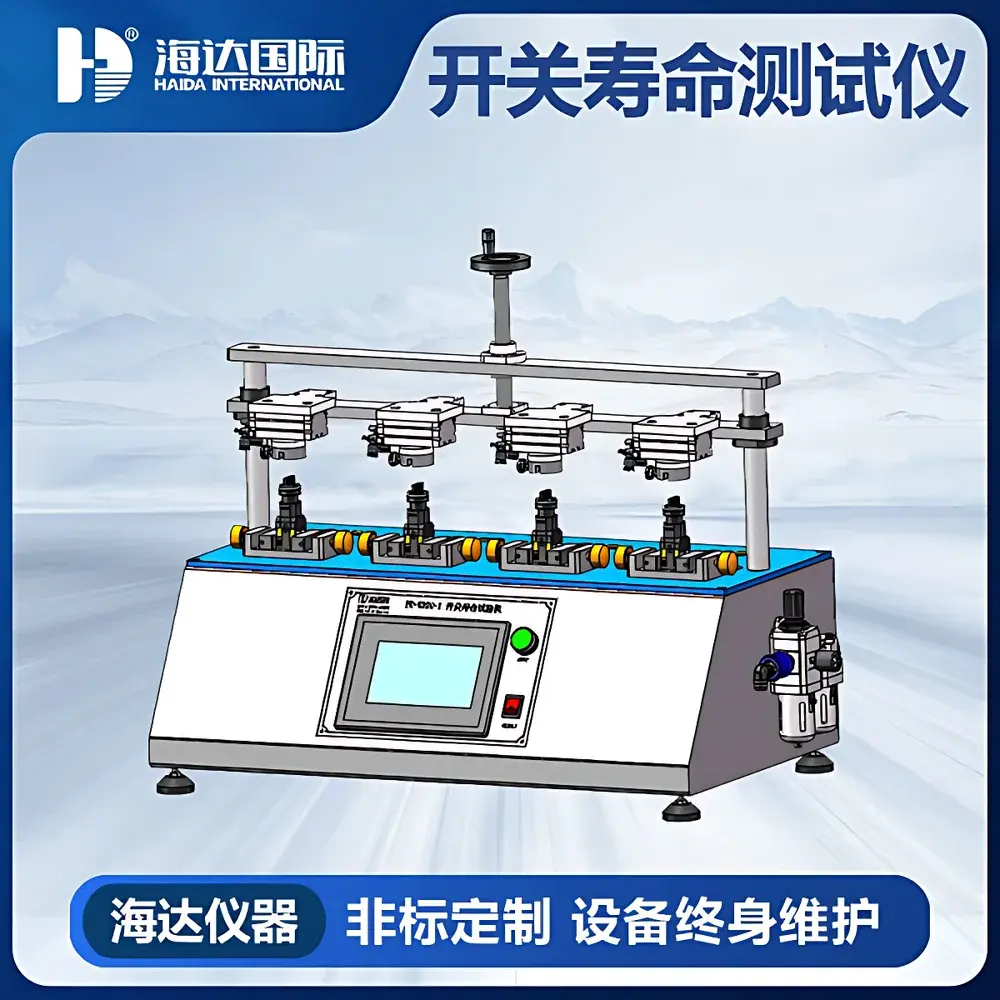
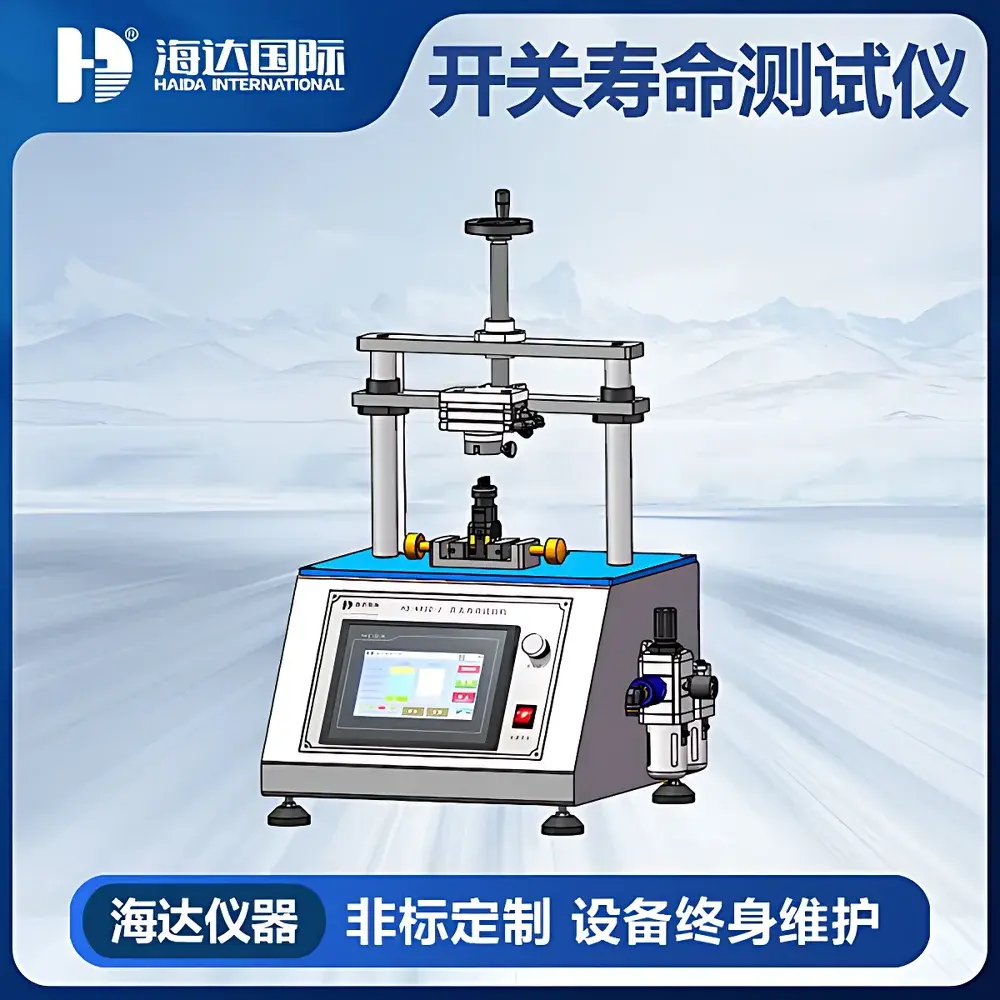
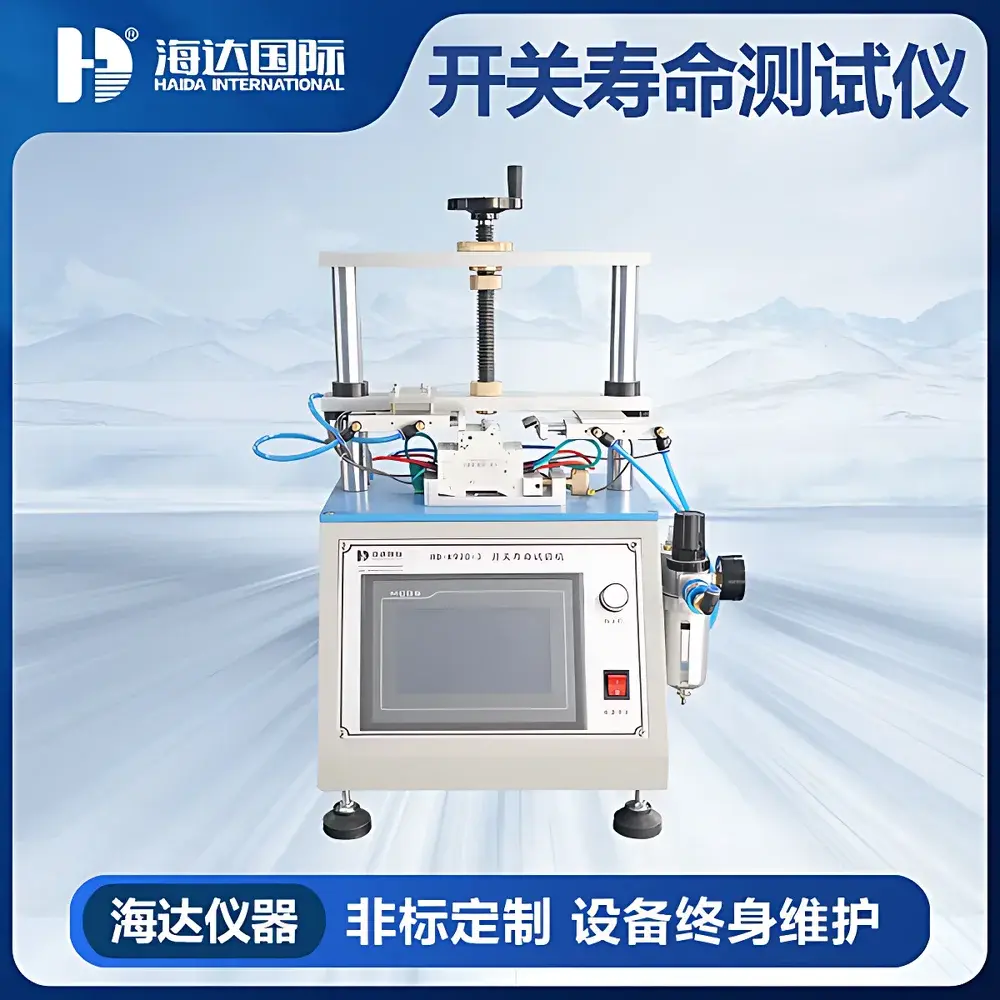
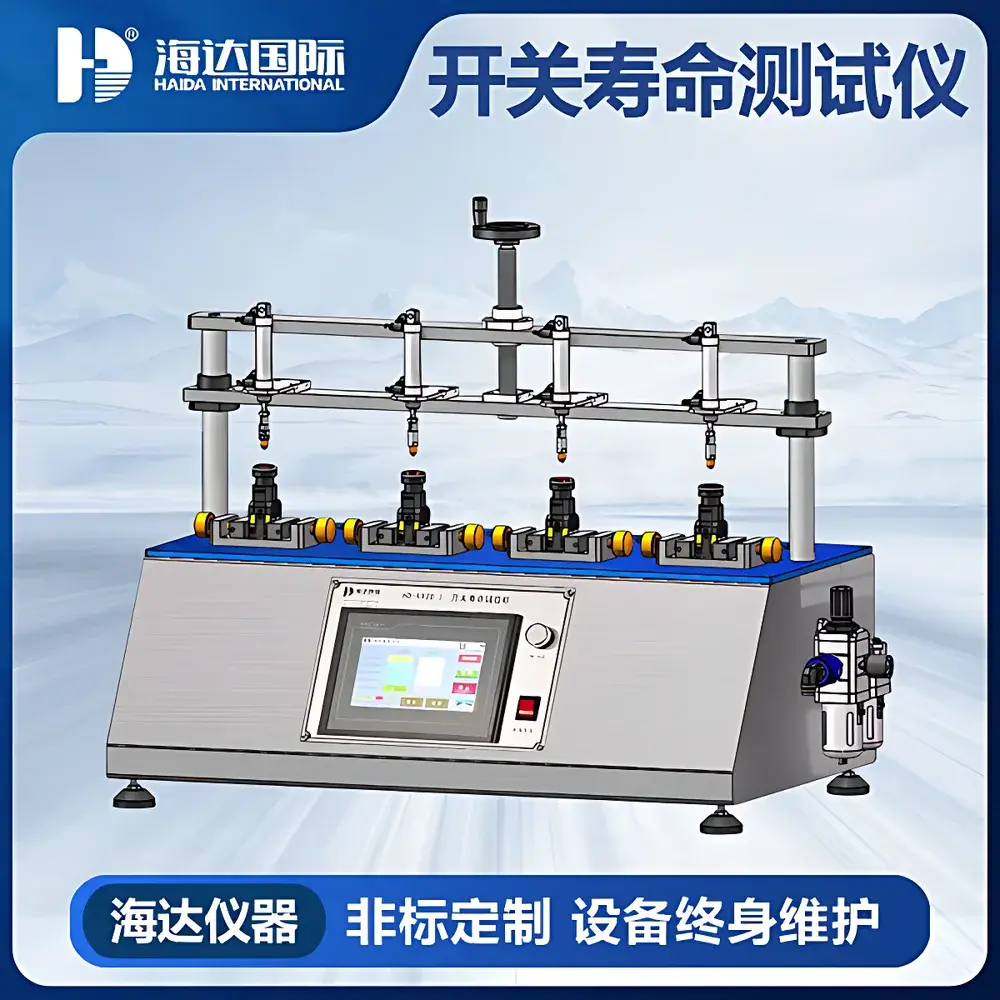
HAIDA HD-K920 Push Button Switch Life Cycle Tester
| Brand | HAIDA INTERNATIONAL |
|---|---|
| Origin | Guangdong, China |
| Manufacturer Type | Original Equipment Manufacturer (OEM/ODM) |
| Product Category | Domestic (China-Made) |
| Model | HAIDA HD-K920 Push Button Switch Life Cycle Tester |
| Pricing | Available Upon Request |
Overview
The HAIDA HD-K920 Push Button Switch Life Cycle Tester is an electromechanical durability evaluation system engineered for precise, repeatable, and standardized fatigue testing of tactile push-button switches used in consumer electronics, automotive control panels, industrial human-machine interfaces (HMIs), medical devices, and household appliances. It operates on a servo-controlled linear actuation principle, applying programmable force, stroke depth, dwell time, and cycle frequency to simulate real-world operational stress over extended test durations—ranging from thousands to millions of actuations. Designed in accordance with fundamental mechanical endurance testing paradigms, the HD-K920 enables quantitative assessment of switch failure modes including contact resistance drift, tactile feedback degradation, actuator spring fatigue, housing deformation, and terminal loosening. Its architecture supports both single-point and multi-cycle endurance protocols, making it suitable for R&D validation, incoming quality control (IQC), and production-line reliability screening.
Key Features
- Servo-driven precision actuator with closed-loop position and force feedback, ensuring consistent stroke repeatability ±0.05 mm and load accuracy ±1.5% of full scale
- Programmable test parameters: cycle count (1–99,999,999), actuation speed (1–60 cycles/min), dwell time (0.01–99.99 s), pre-load force (0–50 N), and peak actuation force (0–100 N)
- Integrated digital force sensor and displacement encoder for real-time acquisition of load-displacement curves during each actuation event
- Modular fixture interface accommodating standard button diameters (Φ6–Φ30 mm) and customizable mounting plates for non-standard switch geometries
- Onboard 7-inch TFT touchscreen HMI with intuitive test setup wizard, live waveform display, and pass/fail threshold configuration for contact continuity or resistance monitoring (optional external multimeter integration via RS-232/USB)
- Robust aluminum alloy frame with anti-vibration base and ESD-safe enclosure, compliant with IEC 61000-4 electromagnetic immunity requirements
Sample Compatibility & Compliance
The HD-K920 accommodates a broad spectrum of momentary and latching push-button switches—including metal dome, rubber keypad, membrane, and mechanical micro-switch variants—with configurable actuator tips (flat, concave, spherical) to match surface curvature and contact area. It supports testing per internationally recognized standards including IEC 61000-4-2 (ESD immunity), UL 61058-1 (switch safety), GB/T 15092.1 (Chinese national standard for push-button switches), ISO 9241-411 (human-system interaction ergonomics), and ASTM F1812 (standard practice for evaluating tactile feedback in electronic controls). All mechanical test routines are traceable to NIST-traceable force calibration standards, and the system’s design facilitates audit readiness for ISO/IEC 17025-accredited laboratories and GLP-compliant environments.
Software & Data Management
The HD-K920 operates with HAIDA’s proprietary TestMaster v3.2 software suite (Windows-based), enabling remote test initiation, parameter synchronization, and automated report generation in PDF/CSV formats. Software features include multi-channel data logging (force, displacement, cycle count, timestamp), statistical process control (SPC) charting (X̄-R, Cpk), anomaly detection algorithms for premature failure identification, and export-ready metadata embedding (operator ID, sample lot, environmental conditions). Audit trail functionality complies with FDA 21 CFR Part 11 requirements when configured with user authentication, electronic signatures, and immutable data archiving. Data files are structured to interoperate with LIMS platforms via HL7 or RESTful API extensions.
Applications
- Validation of switch longevity under accelerated life testing (ALT) protocols for automotive infotainment systems
- Comparative wear analysis between silicone rubber vs. metal dome tactile actuators in medical device control panels
- Qualification of new switch designs prior to mold release in consumer electronics manufacturing
- Root cause analysis of contact bounce and hysteresis shift after thermal cycling exposure (when integrated with environmental chambers)
- Supporting conformance testing for CE marking, CCC certification, and UL recognition submissions
- Collaborative reliability studies with third-party test labs and national metrology institutes (e.g., CNAS-accredited facilities)
FAQ
What types of switches can be tested on the HD-K920?
The system supports momentary, latching, illuminated, and sealed push-button switches with actuator heights between 1.5 mm and 15 mm and diameters from 6 mm to 30 mm.
Does the HD-K920 support real-time electrical continuity monitoring during cycling?
Yes—via optional integration with a calibrated digital multimeter or dedicated contact resistance module (model HD-RCM1), enabling synchronized measurement of contact resistance, bounce duration, and make/break timing.
Can test data be exported to Excel or imported into Minitab for statistical analysis?
All raw and summary data are exportable in CSV and XLSX formats; TestMaster v3.2 includes direct Minitab-compatible output templates and SPC chart export as PNG/PDF.
Is the HD-K920 compliant with ISO/IEC 17025 requirements for accredited testing laboratories?
The instrument meets mechanical and metrological criteria for inclusion in accredited scope; full compliance requires documented calibration records, uncertainty budgets, and procedural SOPs developed by the end-user laboratory.
What maintenance is required to ensure long-term measurement stability?
Recommended quarterly verification using certified force and displacement standards; annual recalibration by HAIDA-certified service engineers or ISO/IEC 17025-accredited providers.



