
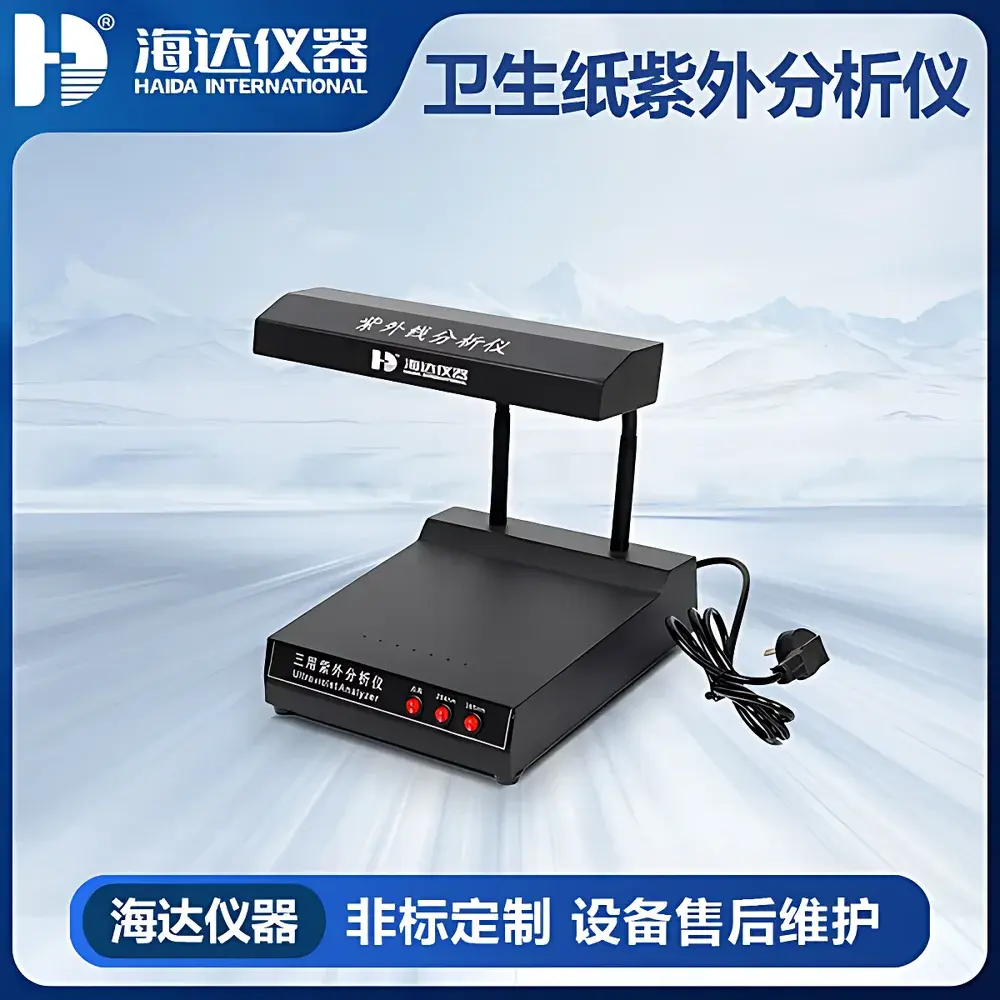
HAIDA HD-T008 Tissue Paper UV Analyzer
| Brand | HAIDA INTERNATIONAL |
|---|---|
| Origin | Guangdong, China |
| Manufacturer Type | Direct Manufacturer |
| Product Origin | Domestic (China) |
| Model | HD-T008 |
| Wavelengths | 254 nm & 365 nm (dual-band UV) + incandescent white light |
| UV Filter Size | 200 × 50 mm |
| Power Supply | AC 220 V ±10%, 50 Hz |
| Weight | 3.7 kg |
Overview
The HAIDA HD-T008 Tissue Paper UV Analyzer is a purpose-engineered benchtop instrument designed for qualitative and semi-quantitative fluorescence assessment of tissue paper products under controlled ultraviolet illumination. It operates on the principle of selective UV excitation—utilizing two discrete, high-stability narrowband UV sources (254 nm and 365 nm) to induce characteristic fluorescence responses in optical brightening agents (OBAs), residual bleaching byproducts, or contaminants commonly present in pulp-based hygiene papers. Unlike broad-spectrum UV lamps, the HD-T008 integrates precision interference filter optics to suppress visible emission (>400 nm), ensuring high signal-to-noise ratio in fluorescence observation. Its low thermal output and instant-on solid-state UV lamp architecture enable uninterrupted operation during extended QC inspection cycles—critical for high-throughput laboratory or production-line environments where rapid visual screening of OBA uniformity, migration, or degradation is required.
Key Features
- Dual-wavelength UV output: Independently selectable or simultaneous activation of 254 nm (germicidal/short-wave) and 365 nm (long-wave) irradiation—optimized for differential excitation of common paper additives and impurities.
- Optimized optical path: Integrated 200 × 50 mm UV bandpass filter ensures >95% spectral purity at target wavelengths and eliminates visible-light bleed, enhancing contrast in fluorescence visualization.
- Energy-efficient design: Rated power consumption ≤25 W; minimal heat generation (<35 °C surface temperature after 2 h continuous operation), eliminating need for active cooling or duty-cycle restrictions.
- Instant activation: No warm-up time required—UV emission reaches full intensity within <1 second of power-on, supporting just-in-time inspection workflows.
- Robust mechanical construction: Aluminum alloy housing with ESD-safe finish; compact footprint (280 × 120 × 150 mm) suitable for fume hoods, laminar flow benches, or shared lab workstations.
- Integrated white-light mode: Built-in incandescent lamp enables side-by-side comparative analysis under ambient-equivalent illumination—essential for correlating UV-induced fluorescence with macroscopic paper appearance.
Sample Compatibility & Compliance
The HD-T008 accommodates standard tissue paper formats—including single-ply and multi-ply rolls, cut sheets (A4, letter, or custom sizes up to 220 mm width), and folded napkin samples—without requiring sample preparation or mounting fixtures. Its open-top configuration allows direct placement and real-time observation under UV. The instrument complies with IEC 61000-6-3 (EMC emissions) and IEC 61000-6-1 (immunity) standards for laboratory equipment. While not classified as a medical device, its UV output adheres to ICNIRP 2022 exposure limits for occupational UV-A (315–400 nm) and UV-C (100–280 nm) bands when operated per manufacturer instructions. For GLP/GMP-aligned labs, the unit supports traceable visual documentation when paired with calibrated digital imaging systems (e.g., ISO 17025-accredited CCD cameras).
Software & Data Management
The HD-T008 is a hardware-only analytical platform with no embedded firmware or proprietary software. It functions as a dedicated illumination source compatible with third-party image acquisition and analysis tools—including NIST-traceable fluorescence imaging software (e.g., ImageJ with ROI quantification plugins), industrial machine vision platforms (e.g., Halcon, OpenCV), and LIMS-integrated documentation workflows. All operational parameters (wavelength selection, exposure duration, ambient light calibration) are manually controlled via front-panel toggle switches—ensuring deterministic repeatability and eliminating software validation overhead under FDA 21 CFR Part 11 or EU Annex 11 requirements. Audit trails for inspection records must be maintained externally via laboratory documentation systems.
Applications
- Fluorescence mapping of optical brightener distribution across tissue web—identifying streaks, edge depletion, or coating inconsistencies.
- Detection of residual hydrogen peroxide or transition metal catalysts post-bleaching that exhibit UV-quenching behavior.
- Verification of OBA thermal stability during creping or calendering process qualification.
- Non-destructive screening for microbial contamination indicators (e.g., tryptophan-derived fluorescence at 280/350 nm excitation-emission pairs).
- Supplier qualification testing per ISO 12625-8 (tissue paper—optical properties) and TAPPI T 452 om-22 (brightness and fluorescence).
FAQ
Is the HD-T008 compliant with ISO/IEC 17025 for accredited testing laboratories?
Yes—when used as a defined illumination source within a validated method (e.g., internal SOP referencing ASTM D7251 for UV fluorescence assessment), its performance characteristics (wavelength accuracy, irradiance stability) support measurement traceability to national standards.
Can the 254 nm UV source be used for germicidal applications?
No—the HD-T008 is not engineered for sterilization; its 254 nm output is optimized for fluorescence excitation only, with irradiance levels well below disinfection thresholds per CDC/WHO guidelines.
Does the instrument require annual recalibration?
Not inherently—wavelength accuracy is fixed by interference filter design and does not drift; however, users should verify UV output intensity annually using a NIST-traceable radiometer (e.g., ILT950UV) per internal quality protocols.
Is ozone generation a concern during operation?
No—254 nm emission occurs in air without significant ozone production; ozone formation requires wavelengths <200 nm and elevated power densities not present in this system.



