
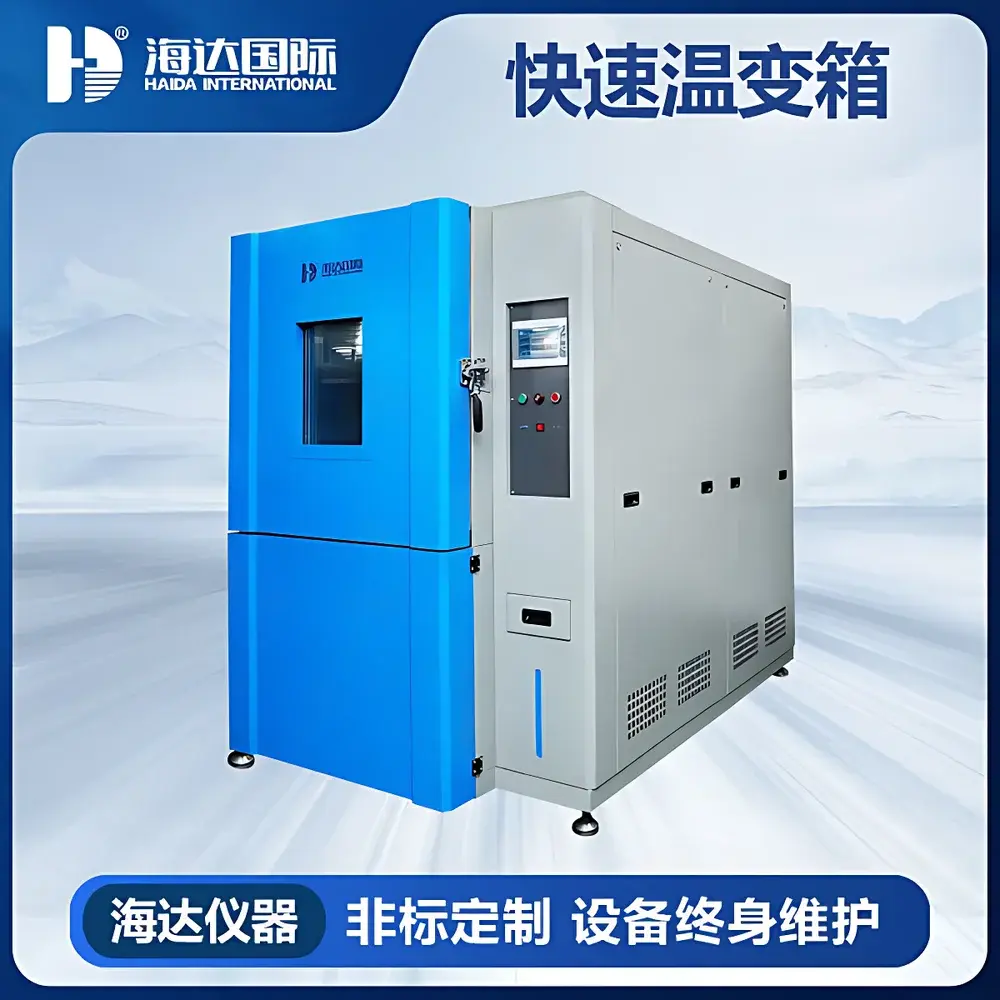
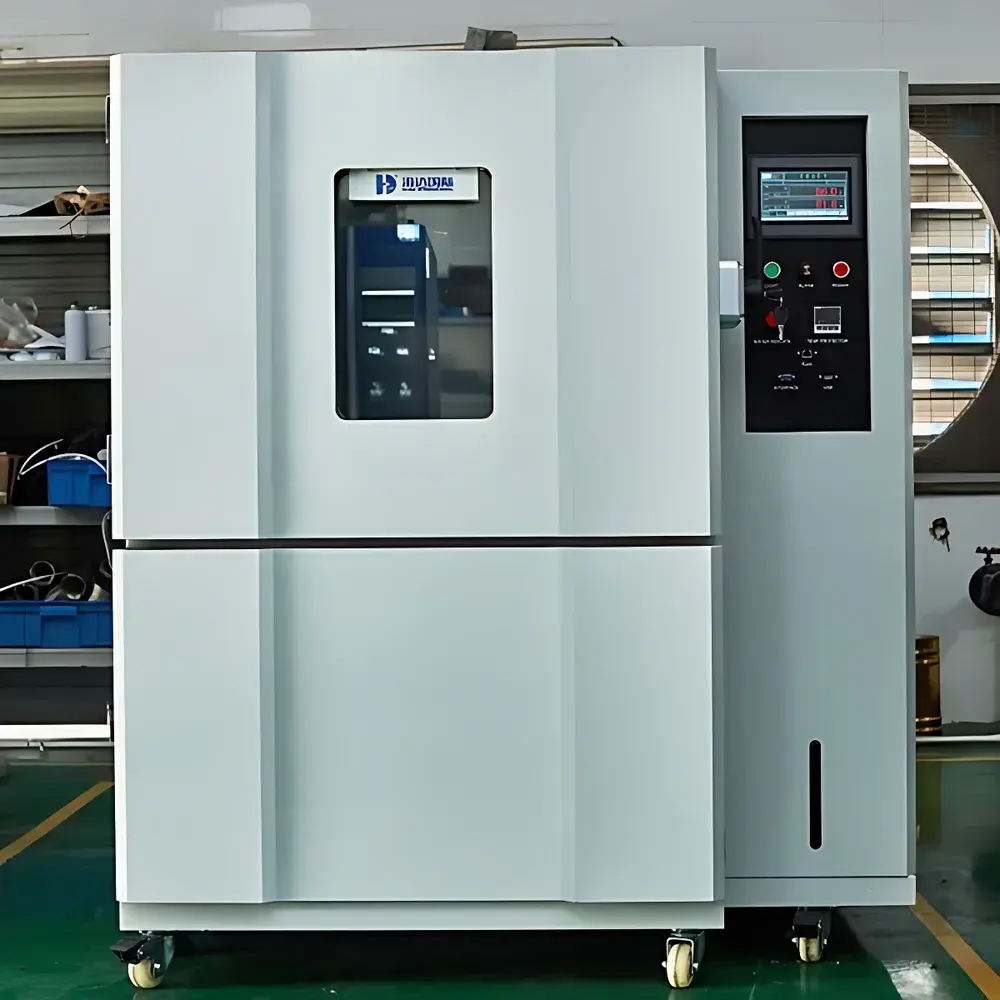
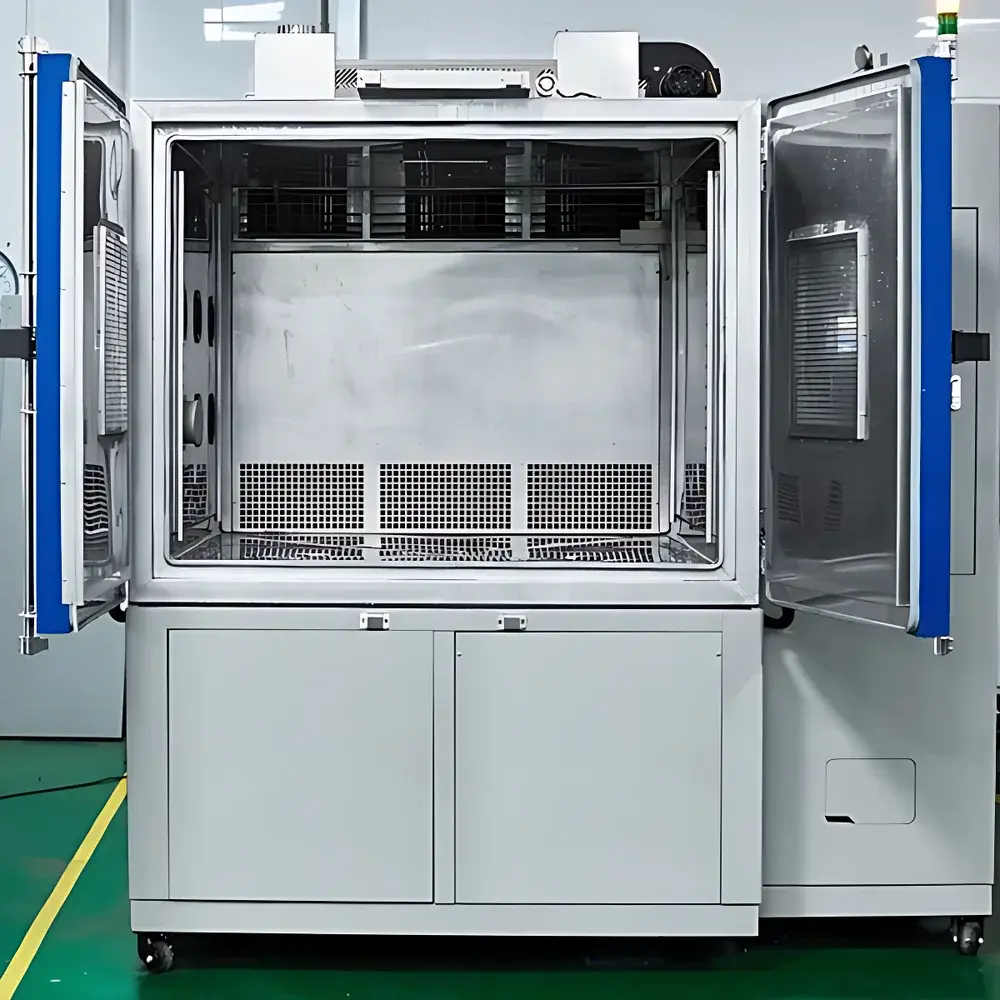
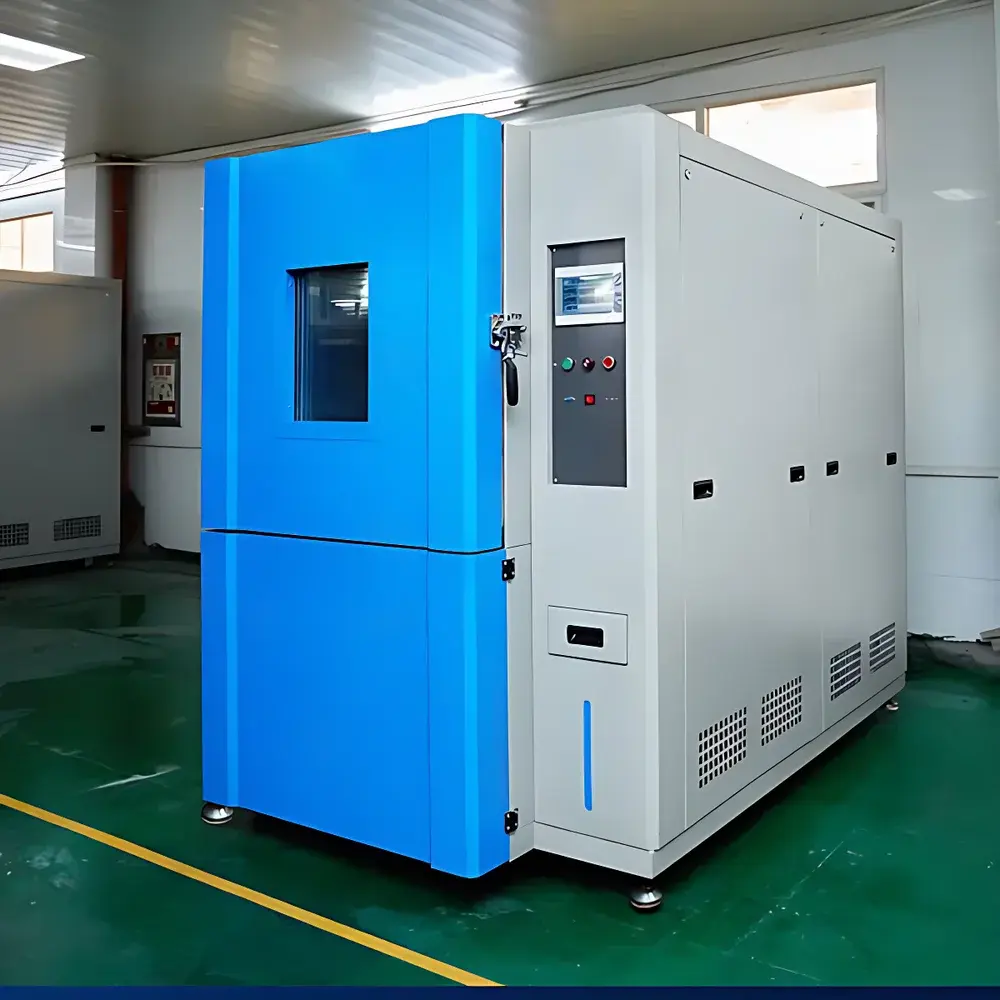
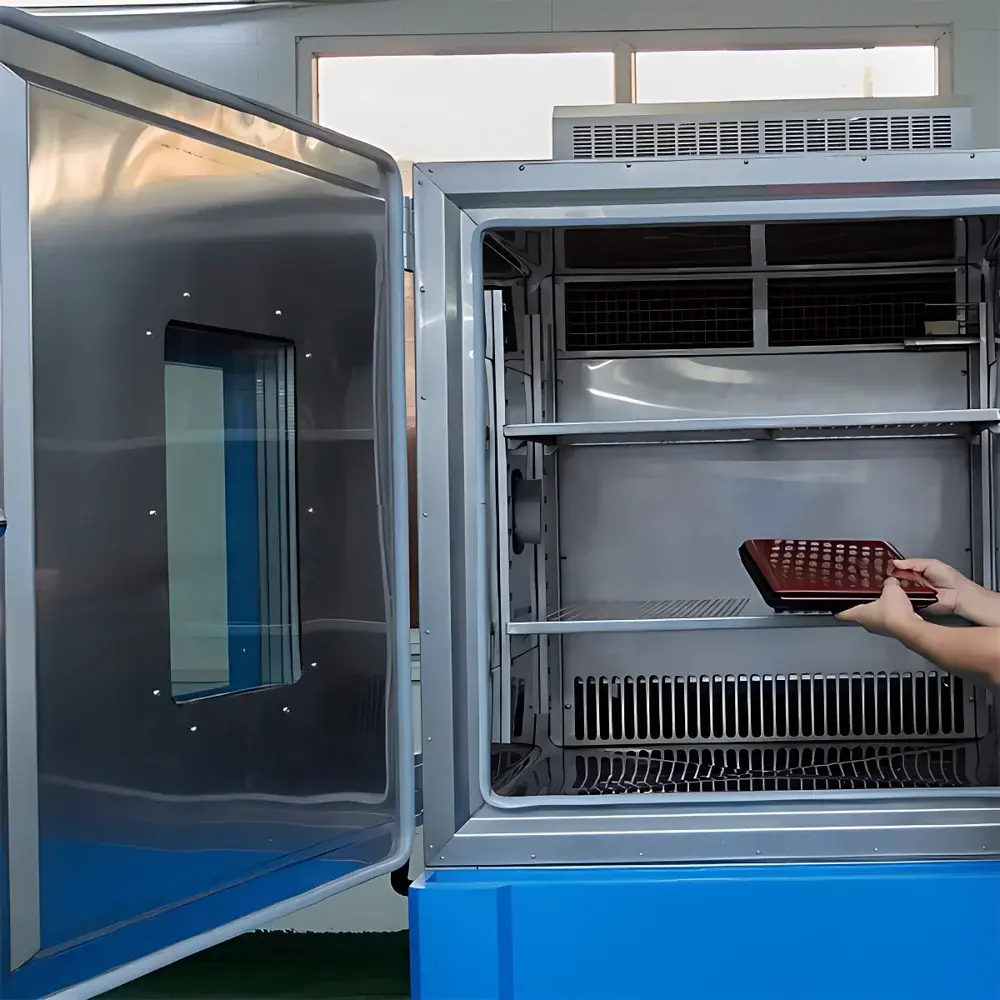
HAIDA INTERNATIONAL HD-E708 Rapid Temperature Change Chamber
| Brand | HAIDA INTERNATIONAL |
|---|---|
| Origin | Guangdong, China |
| Manufacturer Type | Direct Manufacturer |
| Product Category | Domestic |
| Model | HD-E708 Rapid Temperature Change Chamber |
| Temperature Range | −70 °C to +150 °C |
| Refrigeration Method | Compressor-based |
| Explosion-Proof | Standard (Non-Explosion-Proof) |
| Temperature Fluctuation | ≤ ±0.5 °C (unloaded) |
| Temperature Deviation | ≤ 2 °C (unloaded) |
| Temperature Uniformity | ≤ 2 °C (unloaded, 15-point measurement) |
| Heating Rate | ≥ 3 °C/min (average, unloaded) |
| Cooling Rate | ≥ 10 °C/min (70 °C → −10 °C, average, unloaded, at outlet) |
| Internal Chamber Dimensions | 1700 × 1700 × 2500 mm (W × D × H) |
| Chamber Volume | 7 m³ |
| Airflow Capacity | ≥ 17,500 CFM |
| Maximum Thermal Load | 500 kg aluminum mass (13 kW heat dissipation) |
| Floor Load Capacity | ≥ 1000 kg/m² (uniformly distributed) |
| Insulation | ≥ 100 mm rigid polyurethane foam |
| Interior Material | SUS#304 stainless steel (≥1.0 mm thickness) |
| Exterior Material | SUS#304 stainless steel or galvanized steel with dual-side paint (≥1.0 mm thickness) |
| Temperature Overshoot | ≤ 5 °C (15-point measurement) |
Overview
The HAIDA INTERNATIONAL HD-E708 Rapid Temperature Change Chamber is an engineered environmental test system designed for accelerated thermal stress evaluation of electronic components, optoelectronic devices, PCB assemblies, and mechanical subsystems under dynamically varying temperature conditions. It operates on the principle of controlled convective air circulation within a thermally insulated chamber, utilizing high-capacity compressor-based refrigeration and precision electric heating to achieve programmable ramp rates up to 10 °C/min (unloaded) and ≥5 °C/min under representative thermal load conditions. Unlike standard thermal cycling chambers, the HD-E708 is specifically calibrated for rapid transitions—enabling realistic simulation of field-induced thermal shocks and cyclic thermal fatigue that expose latent design flaws, interfacial delamination, solder joint cracking, CTE mismatch failures, and material embrittlement. Its 7 m³ internal volume (1700 × 1700 × 2500 mm) supports full-system-level testing of large-scale units such as avionics racks, power converters, and automotive ECUs—without compromising thermal stability or spatial uniformity.
Key Features
- High-fidelity thermal control architecture with dual independent PID loops for heating and cooling subsystems, ensuring minimal overshoot (≤5 °C) and stable dwell performance
- Robust airflow design delivering ≥17,500 CFM volumetric flow, optimized via adjustable vane diffusers and rear-mounted centrifugal blowers for uniform temperature distribution across 15 standardized sensor locations
- Structural integrity validated for continuous operation under thermal load: interior walls constructed from 1.0 mm-thick SUS#304 stainless steel; exterior options include corrosion-resistant SUS#304 or powder-coated galvanized steel
- Thermal insulation comprising ≥100 mm rigid polyurethane foam (closed-cell, low thermal conductivity), minimizing parasitic heat leakage and improving energy efficiency during extended cycling profiles
- Load-rated floor platform supporting ≥1000 kg/m² uniformly distributed mass—validated for testing with 500 kg aluminum thermal mass (13 kW simulated device dissipation)
- Compliance-ready hardware interface supporting optional data logging modules with timestamped, audit-trail-capable output aligned with GLP/GMP documentation requirements
Sample Compatibility & Compliance
The HD-E708 accommodates a broad range of sample configurations—from bare die and surface-mount packages to fully assembled chassis-mounted systems—provided dimensional and thermal constraints are observed. Its large internal volume and reinforced floor allow integration of auxiliary fixtures, vibration tables, or in-situ electrical monitoring harnesses. The chamber meets the metrological and operational criteria defined in multiple international standards, including IEC 60068-2-14:2009 (Environmental testing – Part 2-14: Test N – Change of temperature), GB/T 2423.1–2008 (IEC 60068-2-1:2007, cold testing), GB/T 2423.2–2008 (IEC 60068-2-2:2007, dry heat), and GB/T 5170.2–2008 (Verification procedures for temperature testing equipment). All thermal performance specifications—including uniformity, deviation, and fluctuation—are verified using traceable PT100 sensors per ISO/IEC 17025-accredited calibration protocols. While not intrinsically explosion-proof, the HD-E708 can be modified per ATEX or IECEx Zone 2 requirements upon request.
Software & Data Management
The HD-E708 integrates with HAIDA’s proprietary TCS-Link™ control software, offering Windows-based programming of multi-segment thermal profiles (ramp-hold-soak cycles), real-time graphical monitoring of up to 32 external thermocouple inputs, and automated pass/fail evaluation against user-defined tolerance bands. All operational logs—including setpoint history, actual chamber temperatures, compressor duty cycle, heater output, and alarm events—are stored in CSV and PDF formats with embedded digital signatures. Optional 21 CFR Part 11 compliance packages provide role-based access control, electronic signatures, and immutable audit trails suitable for FDA-regulated product development and validation workflows. Data export interfaces support Modbus TCP and OPC UA protocols for integration into enterprise MES or PLM systems.
Applications
- Qualification testing of aerospace-grade electronics per MIL-STD-810H Method 503.5 (Temperature Shock)
- Design verification of automotive ADAS modules subjected to under-hood thermal transients
- Failure mode identification in LED lighting arrays experiencing repeated on/off thermal cycling
- Process validation of conformal coating adhesion and solder reflow reliability
- Accelerated life testing of battery management systems (BMS) operating across extreme ambient gradients
- Material compatibility screening for polymer encapsulants, potting compounds, and thermal interface materials (TIMs)
FAQ
What is the maximum thermal load the HD-E708 can stabilize under rapid cycling conditions?
The chamber maintains specified temperature deviation (≤5 °C) and fluctuation (≤±1.0 °C) while managing a representative 500 kg aluminum thermal mass dissipating up to 13 kW—verified per GB/T 5170.2–2008 Annex B.
Does the HD-E708 support custom profile sequencing with conditional branching?
Yes—TCS-Link™ software enables nested loop structures, event-triggered transitions (e.g., “hold until internal sensor reaches target”), and external signal synchronization via digital I/O ports.
Is third-party calibration certification included with delivery?
A factory-issued calibration report traceable to NIM (China National Institute of Metrology) is provided; ISO/IEC 17025-accredited field calibration services are available as an add-on.
Can the chamber be integrated into an existing environmental test laboratory network?
Standard Ethernet (RJ45), RS-485, and analog 4–20 mA interfaces enable seamless integration with centralized monitoring platforms and SCADA systems.
What maintenance intervals are recommended for compressor and airflow systems?
Compressor oil and filter replacement every 3,000 operating hours; blower wheel inspection and duct cleaning every 6 months—documented in the included Maintenance Logbook compliant with ISO 9001:2015 clause 7.1.5.



