
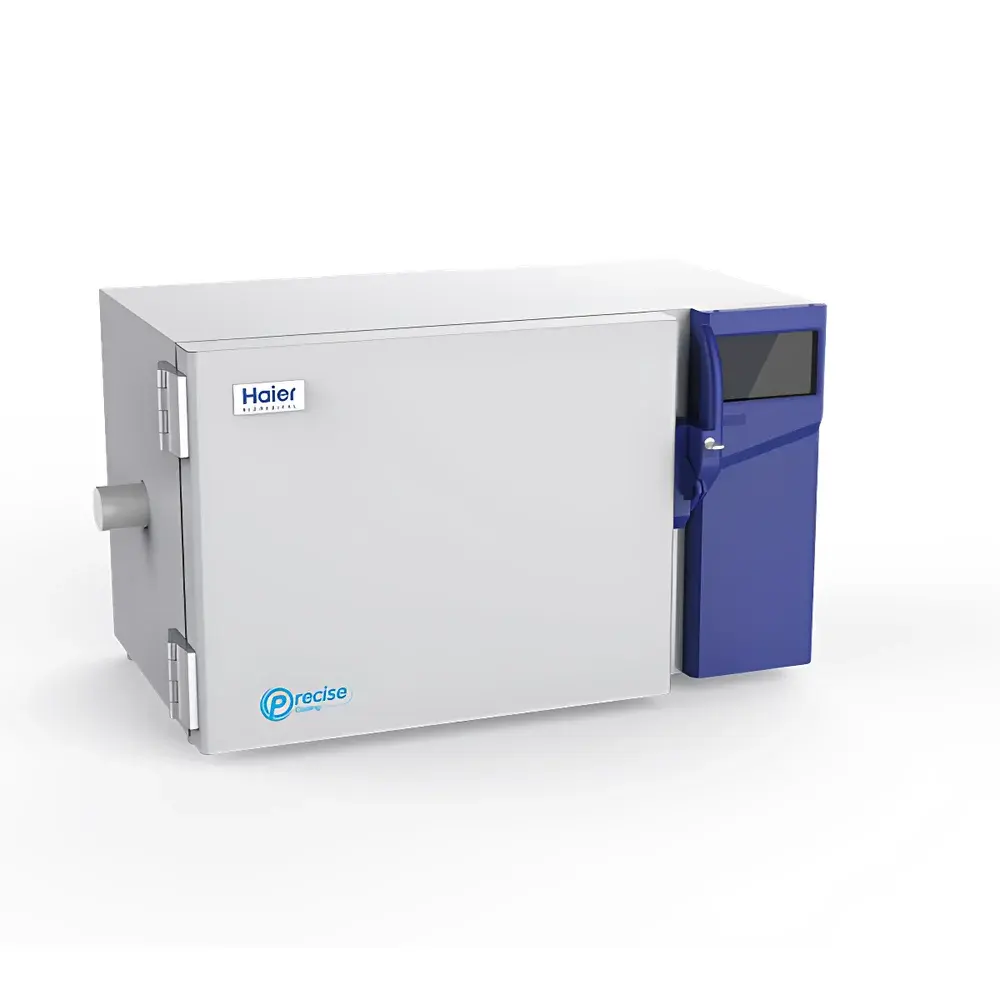
Haier Biomedical CJ-L37 Programmable Controlled-Rate Freezing System
| Brand | Haier Biomedical |
|---|---|
| Origin | Shandong, China |
| Manufacturer Type | Original Equipment Manufacturer (OEM) |
| Country of Origin | China |
| Model | CJ-L37 |
| Temperature Control Range | −180 °C to +50 °C |
| Temperature Accuracy | ≤ ±0.5 °C |
| Temperature Uniformity | < ±2 °C |
| Cooling/Heating Rate Adjustment Range | 0.1–12 °C/min |
| Display Resolution | 0.1 °C |
| Liquid Nitrogen Level Monitoring | Real-time with <20% threshold alarm |
| Preloaded Programs | 6 standard protocols |
| Custom Protocol Support | Yes |
| ADRC Control Algorithm | Patented Active Disturbance Rejection Control |
Overview
The Haier Biomedical CJ-L37 Programmable Controlled-Rate Freezing System is an engineered solution for cryopreservation of sensitive biological materials requiring precise thermal management during the critical pre-freeze phase. Based on liquid nitrogen–assisted vapor-phase cooling and patented Active Disturbance Rejection Control (ADRC) algorithm, the system delivers high reproducibility in cooling and warming profiles across a wide operational range (−180 °C to +50 °C). Unlike passive freezing methods or non-controlled-rate freezers, the CJ-L37 implements dynamic dual-solenoid valve regulation of liquid nitrogen injection, enabling continuous, programmable ramping at user-defined rates between 0.1 and 12 °C/min—both during cooling and controlled rewarming. This architecture ensures minimal intracellular ice formation, reduced osmotic shock, and preservation of membrane integrity—key determinants of post-thaw viability in primary cells, stem cells, and engineered immune effector cells.
Key Features
- Patented ADRC temperature control algorithm ensuring real-time compensation for thermal load fluctuations and ambient disturbances, maintaining temperature stability within ±0.5 °C throughout the entire freeze cycle.
- Dual electromagnetic valve system for fine-grained liquid nitrogen dosing, supporting bidirectional rate control (cooling and warming) with resolution down to 0.1 °C/min.
- Integrated liquid nitrogen level sensor with real-time monitoring and audible/visual alert when reserve falls below 20%, preventing process interruption and safeguarding sample integrity.
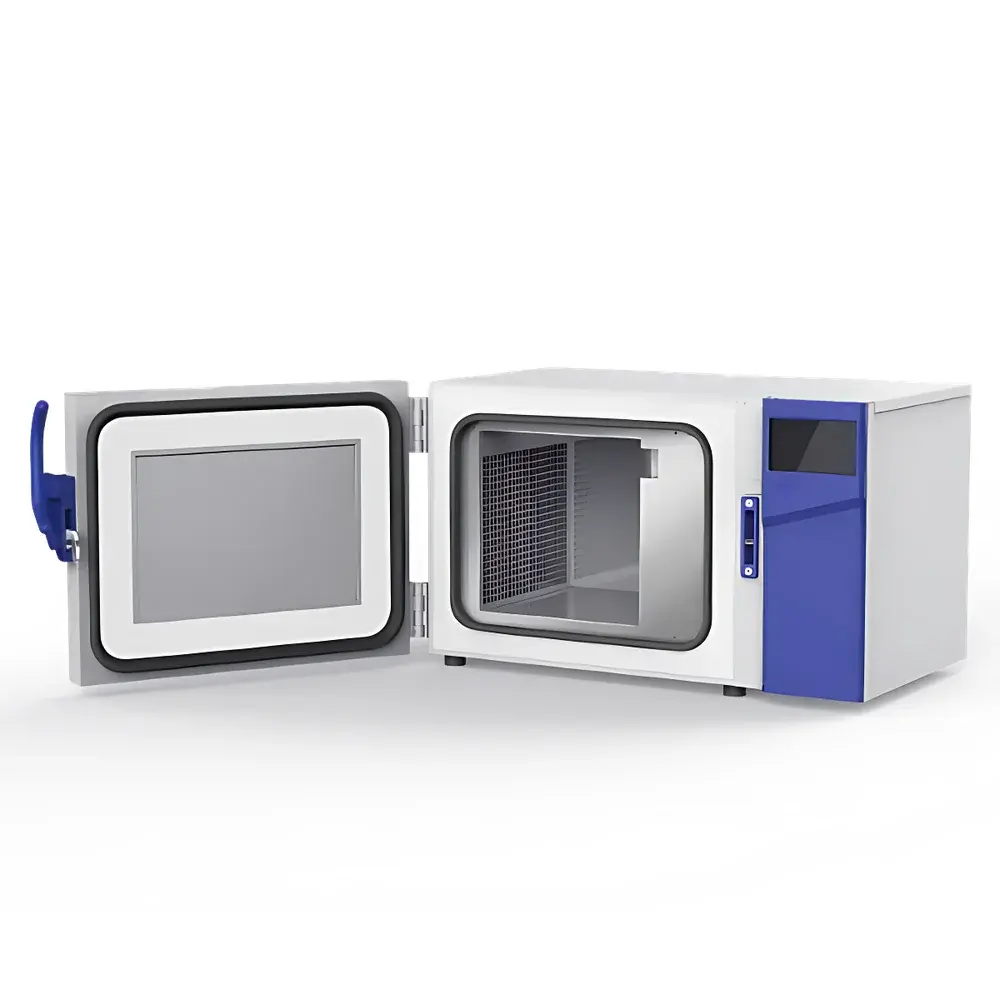
- 7-inch capacitive touchscreen HMI with intuitive navigation, multi-language support (English, Chinese, Spanish), and real-time overlay of sample temperature, chamber temperature, setpoint, and deviation curve.
- Six validated default freeze protocols optimized for NK cells, T cells, CAR-T, mesenchymal stem cells (MSCs), induced pluripotent stem cells (iPSCs), hematopoietic stem cells (HSCs), and umbilical cord blood mononuclear cells—with documented post-thaw recovery >95% under standardized conditions.
- Full-cycle data logging compliant with 21 CFR Part 11 requirements: timestamped records include temperature traces, event logs (alarms, door status, valve actuation), operator ID, and protocol metadata—exportable as CSV or PDF for audit and regulatory submission.
Sample Compatibility & Compliance
The CJ-L37 accommodates standard cryovial formats (1.8–5.0 mL), cryo-bags (up to 250 mL), and multi-well plates (96-well format with optional adapter tray). Its uniform temperature distribution (< ±2 °C across chamber volume) meets ISO 20387:2018 requirements for biobanking infrastructure and supports adherence to ASTM F1986-22 (Standard Practice for Controlled-Rate Freezing of Cells). The system is designed for use in GLP- and GMP-aligned environments, including clinical cell therapy manufacturing facilities operating under FDA guidance for Human Cells, Tissues, and Cellular and Tissue-Based Products (HCT/Ps). All firmware and software modules undergo periodic validation per ICH Q5D and USP <1043> recommendations for cryopreservation process qualification.
Software & Data Management
Embedded microcomputer control enables standalone operation without external PC dependency. However, optional USB or Ethernet connectivity permits remote program upload/download, real-time telemetry streaming, and centralized fleet management via Haier’s BioLink™ software suite (v3.2+). Data files are stored in encrypted SQLite databases with SHA-256 hashing and immutable audit trails—including user login/logout timestamps, parameter modifications, and emergency abort events. Exported datasets retain full traceability to original acquisition time, instrument serial number, and calibration certificate ID. Optional integration with LIMS platforms (e.g., LabVantage, Thermo Fisher SampleManager) is supported through HL7 v2.5.1 and ASTM E1384-compliant APIs.
Applications
- Clinical-scale cryopreservation of autologous and allogeneic T-cell products for adoptive immunotherapy.
- Long-term banking of human embryonic and induced pluripotent stem cell lines under ISO 20387-certified biobank conditions.
- Process development and scale-up of cryopreservation protocols for novel cell therapies (e.g., gamma-delta T cells, regulatory T cells, tumor-infiltrating lymphocytes).
- Stabilization of primary human tissue specimens (e.g., tumor biopsies, PBMC isolates) prior to genomic or proteomic analysis.
- Preservation of high-value biologics, including monoclonal antibody-producing CHO cell banks and recombinant protein-expressing HEK293 master cell stocks.
- Supporting regulatory submissions by generating IQ/OQ/PQ documentation packages aligned with EU Annex 15 and FDA Process Validation Guidance.
FAQ
What temperature range does the CJ-L37 support, and how is extreme low-temperature stability achieved?
The system operates from −180 °C to +50 °C using vapor-phase liquid nitrogen cooling. Stability at ultra-low temperatures is maintained via closed-loop ADRC control, insulated chamber construction with vacuum-jacketed walls, and redundant platinum resistance thermometers (Pt1000) calibrated to NIST-traceable standards.
Can the CJ-L37 be integrated into a validated quality management system?
Yes. It supports electronic signatures, role-based access control (RBAC), and ALCOA+ compliant data archiving. Full validation documentation—including Design Qualification (DQ), Installation Qualification (IQ), Operational Qualification (OQ), and Performance Qualification (PQ)—is available upon request.
Is custom protocol development available for proprietary cell types?
Haier Biomedical offers collaborative protocol optimization services, including DoE-based ramp profiling, cryoprotectant matrix screening, and post-thaw functional assay correlation (viability, apoptosis, phenotype, potency). All generated protocols are transferable to GMP production environments.
How is liquid nitrogen consumption minimized during extended freeze cycles?
The dual-solenoid valve architecture enables pulsed, demand-driven LN₂ injection rather than continuous flow. Combined with adaptive thermal inertia modeling, average LN₂ usage is reduced by up to 35% compared to conventional constant-flow systems—verified per ISO 13485 Annex C test reports.
Does the system comply with international biobanking standards?
Yes. The CJ-L37 conforms to ISO 20387:2018 (biobanking), ISO/IEC 17025:2017 (testing laboratories), and supports compliance with EN 15523-1:2021 for biosafety in cryogenic handling. Chamber uniformity and accuracy data are included in factory calibration certificates issued with each unit.



