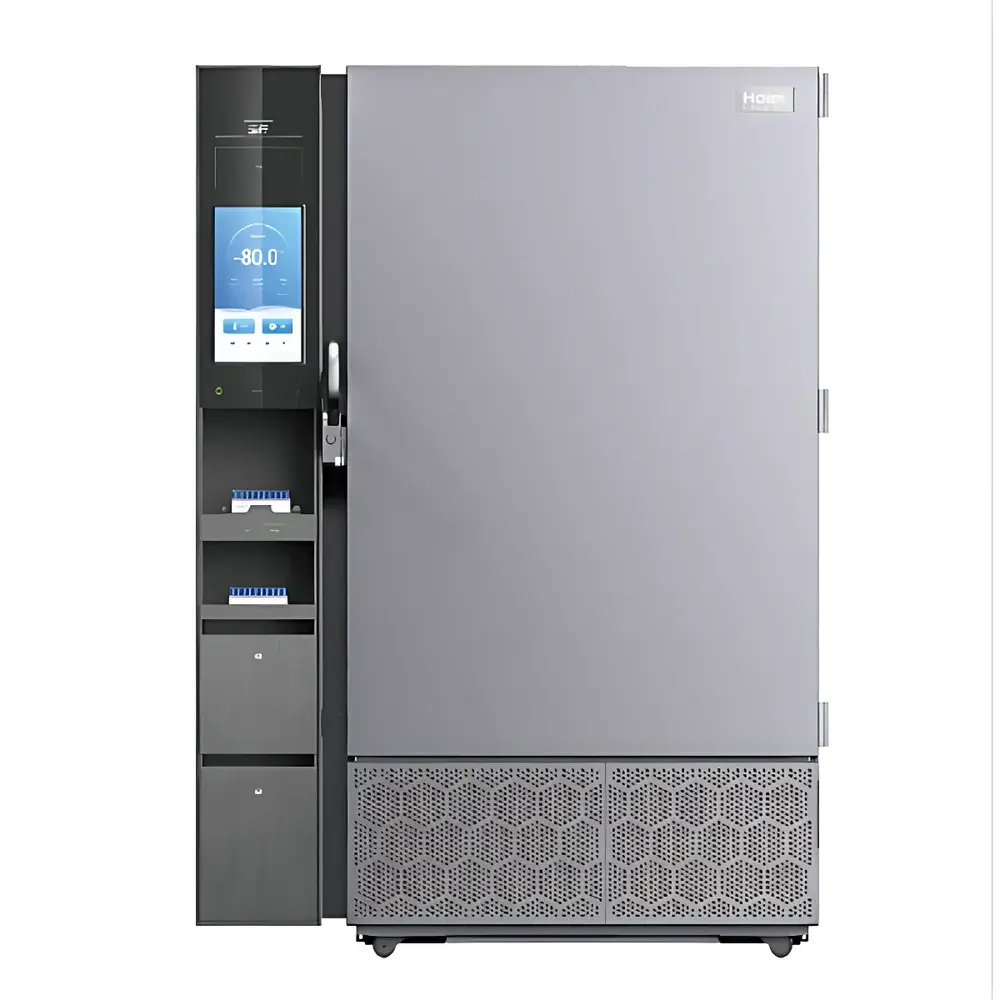
Haier Biomedical DW-86L728BPST(R) Ultra-Low Temperature Freezer with Intelligent Sample Management System
| Brand | Haier Biomedical |
|---|---|
| Origin | Shandong, China |
| Manufacturer Type | Direct Manufacturer |
| Product Category | Domestic |
| Model | DW-86L728BPST(R) |
| Configuration | Upright |
| Effective Volume | 728 L |
| External Dimensions (W×D×H) | 1300 × 1045 × 1980 mm |
| Power Supply | 220 V, 50 Hz |
Overview
The Haier Biomedical DW-86L728BPST(R) is an upright ultra-low temperature (ULT) freezer engineered for mission-critical biobanking and high-containment laboratory environments. Operating at a stable –86 °C setpoint, it integrates a proprietary intelligent sample management architecture—co-developed with Edmund Biosystems—to address systemic challenges in sample traceability, integrity assurance, and operational efficiency across biosafety level 3 (BSL-3) facilities, national pathogen repositories, clinical research biobanks, and pharmaceutical R&D laboratories. Unlike conventional ULT freezers relying on manual logbooks or external barcode scanners, this system embeds non-contact radio-frequency identification (RFID) readers, NAIT (Near-field Adaptive Intelligent Tracking) spatial localization sensors, and a fully integrated BIMS (Biological Inventory Management System) software suite directly into the cold chamber infrastructure. The design adheres to core principles of cold-chain integrity: minimizing thermal disturbance during access, eliminating frost-induced read failure, and ensuring zero-sample exposure during inventory reconciliation.
Key Features
- Intelligent No-Door Inventory Reconciliation: Completes full-chamber sample audit in ≤5 seconds without opening the door—eliminating thermal shock, condensation risk, and operator exposure.
- NAIT Spatial Positioning Technology: Provides millimeter-level 3D coordinate mapping of every cryovial and storage box within the 728 L chamber, enabling precise retrieval and real-time location tracking.
- Frost-Tolerant RFID Read Engine: Operates reliably under continuous frost accumulation (up to 5 mm ice layer), ensuring consistent identification performance without defrost cycles interrupting workflow.
- Modular Cryo-Management Architecture: Supports configurable rack layouts, sterilizable cryoboxes, and validated sterile cryovials compliant with ISO 15189 and CLSI GP44-A4 standards.
- Fail-Safe Thermal Stability: Dual independent refrigeration circuits with cascade compressor staging and redundant evaporator monitoring ensure uninterrupted –86 °C operation per IEC 61000-4-2 and ISO 13732-1 requirements.
- GLP/GMP-Ready Audit Trail: All user actions—including access events, temperature deviations, inventory changes, and software configuration updates—are time-stamped, digitally signed, and stored locally with optional encrypted cloud backup.
Sample Compatibility & Compliance
The DW-86L728BPST(R) accommodates standard ANSI/SLAS-compliant cryovials (0.5–2.0 mL), matrix storage boxes (e.g., 10×10, 8×12 formats), and custom-designed racks for tissue fragments, PBMC pellets, and viral isolates. It is validated for long-term storage of high-consequence pathogens (including WHO Risk Group 3 agents), primary human cells (RBCs, WBCs), reproductive tissues (sperm, oocytes), and biopharmaceutical intermediates. Regulatory alignment includes compliance with ISO 15189:2022 (medical laboratories), ISO 20387:2018 (biobanking), USP <1043> (cryopreservation), and FDA 21 CFR Part 11 (electronic records/signatures). Its electronic perimeter (e-fence) functionality meets institutional biosafety committee (IBC) requirements for access-controlled pathogen vaults.
Software & Data Management
BIMS (Biological Inventory Management System) v4.2 serves as the central software platform, deployed on an embedded industrial-grade controller with TLS 1.3 encryption and role-based access control (RBAC). It supports automated import/export of sample metadata via HL7/FHIR interfaces, batch-level chain-of-custody logging, and configurable alerts for temperature excursions (>±2 °C over 5 min), door-open duration (>30 s), or unauthorized access attempts. Audit logs are immutable and exportable in PDF/A-2b format for regulatory submissions. Optional integration with LIMS (e.g., Thermo Fisher SampleManager, LabVantage) enables end-to-end sample lifecycle tracking from collection to analysis.
Applications
- National and provincial CDC pathogen strain banks requiring daily inventory verification under BSL-3 containment protocols.
- Academic and clinical biorepositories managing >500,000 specimens where manual reconciliation introduces unacceptable error rates (>1.2% per audit cycle).
- Pharmaceutical QC labs storing reference standards and stability samples under ICH Q5C conditions.
- P3 laboratories conducting virology research on SARS-CoV-2, influenza, or arboviruses where sample integrity correlates directly with assay reproducibility.
- Translational medicine centers archiving FFPE blocks, liquid biopsies, and single-cell suspensions requiring position-aware retrieval for spatial omics workflows.
FAQ
Does the system require external barcode scanners or handheld RFID readers?
No. All identification hardware—including dual-axis RFID antennas and NAIT positioning modules—is factory-integrated into the inner chamber walls and drawer assemblies.
Can BIMS be validated for 21 CFR Part 11 compliance in GxP environments?
Yes. The system includes electronic signature workflows, audit trail review tools, and configurable permission sets aligned with ALCOA+ data integrity principles.
What happens if the freezer loses power for more than 4 hours?
With standard insulation and vacuum panel construction, internal temperature remains below –70 °C for ≥9.2 hours (tested per ISO 23432:2020 Annex A), preserving sample viability for most cell types and nucleic acids.
Is remote monitoring supported?
Yes—via SNMPv3 and MQTT protocols with secure TLS tunneling; compatible with enterprise IT infrastructure and centralized facility management systems (FMS).
How is firmware updated without compromising cold-chain continuity?
Updates are performed over authenticated HTTPS with delta-patching; background installation occurs during idle cycles with automatic rollback on validation failure.