
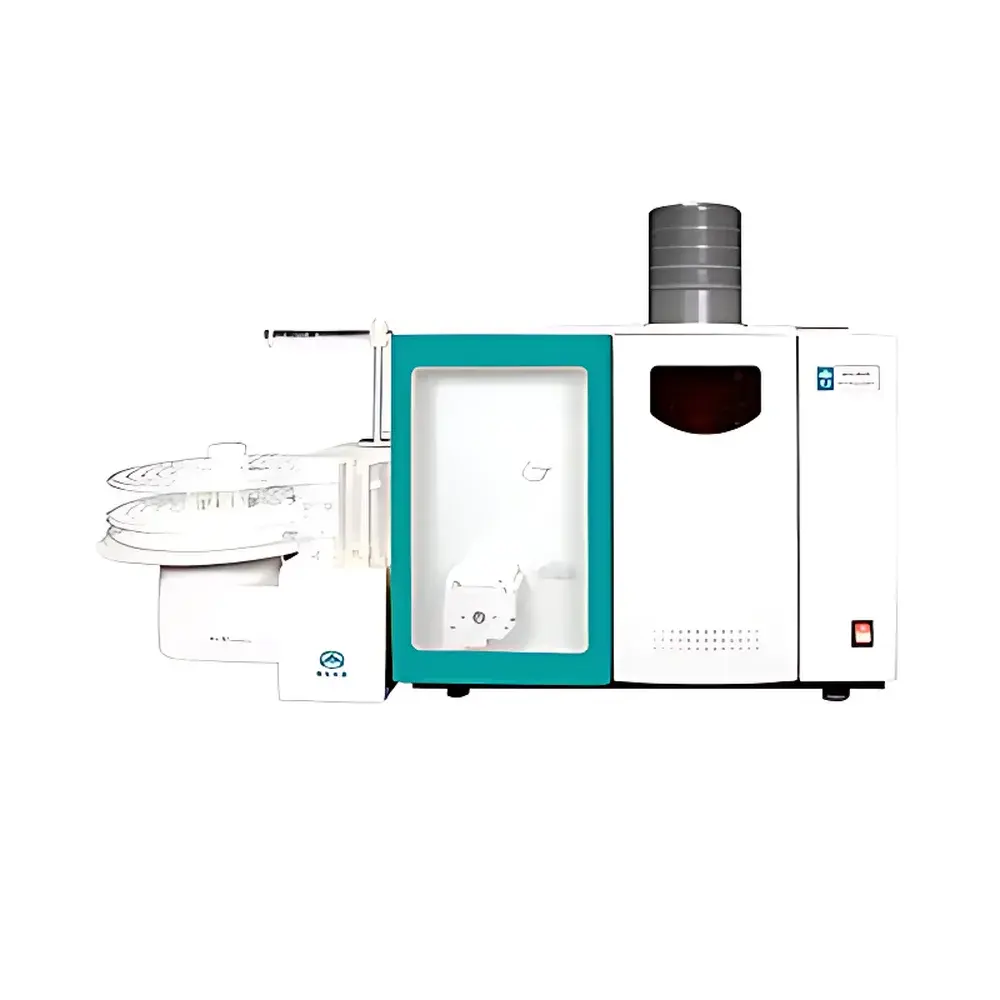
Haiguang AFS-8900 Multi-Channel Atomic Fluorescence Spectrometer
| Brand | Haiguang Instrument |
|---|---|
| Origin | Beijing, China |
| Model | AFS-8900 |
| Instrument Type | Multi-channel Atomic Fluorescence Spectrometer |
| Sample Introduction | Peristaltic Pump |
| Detectable Elements | As, Se, Pb, Bi, Sb, Te, Sn, Hg, Cd, Zn, Ge, Au |
| Detection Mode | Hydride Generation – Cold Vapor Atomic Fluorescence Spectrometry (HG-CV-AFS) |
| Automation Features | Onboard Calibration Curve Generation, Auto-dilution, Full Measurement Automation |
| Lamp System | High-Performance Encoded Hollow Cathode Lamps with Lifetime Monitoring |
| Atomizer | Shielded Low-Temperature Quartz Furnace Atomizer |
| Gas-Liquid Separator | Sealed Two-Stage Separation Unit |
| Gas Control | Array-Structured Argon Flow System with Flow Optimization Module |
| Software Platform | Windows 7/8/10/XP Compatible AFS Control Suite with Audit Trail & Data Export to Excel |
| Compliance Ready | Designed for GLP/GMP environments |
| Upgrade Interfaces | 预留形态分析、Hg/Cd电热蒸发接口 |
| Safety & Diagnostics | Real-time Argon-Hydrogen Flame Monitoring Window, Power Isolation Architecture, Self-Check & Fault Alert Protocol |
Overview
The Haiguang AFS-8900 is a multi-channel atomic fluorescence spectrometer engineered for trace-level quantification of hydride-forming and cold-vapor elements in environmental, food safety, pharmaceutical, and geological laboratories. It operates on the principle of hydride generation–cold vapor atomic fluorescence spectrometry (HG-CV-AFS), where analyte species (e.g., As, Se, Sb, Bi, Pb, Sn, Te) are chemically reduced to volatile hydrides in acidic medium, while mercury is reduced to elemental vapor. These gaseous species are swept into a shielded quartz furnace atomizer, where they undergo atomization under controlled low-temperature conditions. Excitation by a high-intensity hollow cathode lamp induces element-specific atomic fluorescence, which is detected with high signal-to-noise ratio using a photomultiplier tube (PMT) and optimized optical path. The system delivers sub-ppt detection capability for key toxic elements, supporting compliance with ISO 17025-accredited testing protocols and regulatory frameworks including EPA Method 1631E, GB 5009.11–2014, and USP /.
Key Features
- Integrated discontinuous flow hydride generation system with online cleaning capability—sample and carrier stream alternate introduction to minimize carryover and reduce reagent consumption by up to 40%.
- Sample/carrier isolation technology eliminates diffusion-induced baseline drift and ensures measurement stability across extended analytical sequences.
- Encoded hollow cathode lamps with automatic recognition and real-time lifetime tracking; driven by constant-current + pulsed power supply for enhanced spectral line intensity and lamp longevity.
- Shielded quartz furnace atomizer operating at precisely regulated low temperature (≤900 °C), significantly suppressing fluorescence quenching and gas-phase interferences while improving atomization efficiency and reproducibility.
- Sealed two-stage gas–liquid separator requiring no manual liquid addition or waste drainage—reducing operator intervention and contamination risk.
- Modular argon gas distribution architecture with intelligent flow regulation, achieving >30% reduction in argon consumption without compromising vapor transport efficiency.
- Rugged electrical design featuring strict separation of high-voltage and low-voltage circuitry across function-specific PCB modules, enhancing electromagnetic compatibility and long-term operational reliability.
- Real-time flame observation window enables visual verification of Ar–H₂ flame ignition status and stability during analysis—critical for troubleshooting and method validation.
Sample Compatibility & Compliance
The AFS-8900 accommodates aqueous samples—including drinking water, wastewater, soil extracts, biological digests (e.g., urine, blood, tissue), and food leachates—without matrix-dependent recalibration in most routine applications. Its peristaltic pump-based sample handling supports viscosity-tolerant aspiration (up to 10 cP) and integrates robust memory-effect mitigation strategies validated per ASTM D5673-18 guidelines. The instrument architecture conforms to fundamental requirements of ISO/IEC 17025:2017 for analytical instrumentation control and data integrity. Optional audit trail logging, electronic signature support, and user access level management align with FDA 21 CFR Part 11 expectations when deployed in regulated quality control environments.
Software & Data Management
The native AFS Control Suite provides full instrument control, method development, calibration curve fitting (including single-point standardization), auto-dilution logic, and real-time spectral monitoring. All raw and processed data are stored in structured binary format with embedded metadata (operator ID, timestamp, instrument parameters, lamp hours). Export functions support direct conversion to Microsoft Excel (.xlsx) with column-mapped headers compliant with LIMS ingestion standards. The software includes context-sensitive help modules and built-in troubleshooting wizards accessible without external documentation. Network deployment allows centralized method library sharing and remote diagnostics—enabling multi-user laboratory coordination while maintaining individual audit trails.
Applications
The AFS-8900 is routinely deployed for regulatory compliance testing in municipal water utilities (As, Hg, Se per WHO and EU Directive 2020/2184), rice and seafood monitoring (inorganic As speciation readiness via upgrade interface), clinical toxicology screening (urinary Hg, Cd), and geological exploration assays (Te, Bi in ore concentrates). Its <30-second per-sample cycle time supports high-throughput batch analysis in contract testing labs, while its modular expansion ports allow future integration of LC-AFS hyphenated systems for arsenic/bismuth speciation or electrothermal vaporization for ultra-trace Cd determination.
FAQ
What detection limits can be expected for arsenic and mercury under standard operating conditions?
Typical instrumental detection limits (IDLs) are ≤0.01 µg/L for As and ≤0.001 µg/L for Hg in 5% HCl medium, measured per IUPAC definitions and verified using NIST SRM 1643e certified reference material.
Is the system compatible with automated sample introduction via autosampler?
Yes—the AFS-8900 features standardized RS-232 and USB communication interfaces and supports third-party autosamplers with TTL-triggered start/stop signaling and position feedback.
Can the software generate reports compliant with ISO/IEC 17025 documentation requirements?
All measurement records include immutable timestamps, operator identifiers, calibration history, and system diagnostic logs—enabling full traceability as required by ISO/IEC 17025 Clause 7.7 and Annex A.2.
What maintenance intervals are recommended for the quartz furnace and gas–liquid separator?
Quartz furnace inspection is advised every 500 analyses; the sealed two-stage separator requires no routine servicing beyond periodic visual inspection of condensate traps every 200 runs.
Does the instrument support method transfer from older AFS platforms?
Method parameters (lamp current, delay time, read time, carrier flow rate) are fully configurable and retain backward compatibility with Haiguang AFS-830/8500 series methods via importable .mth files.





