
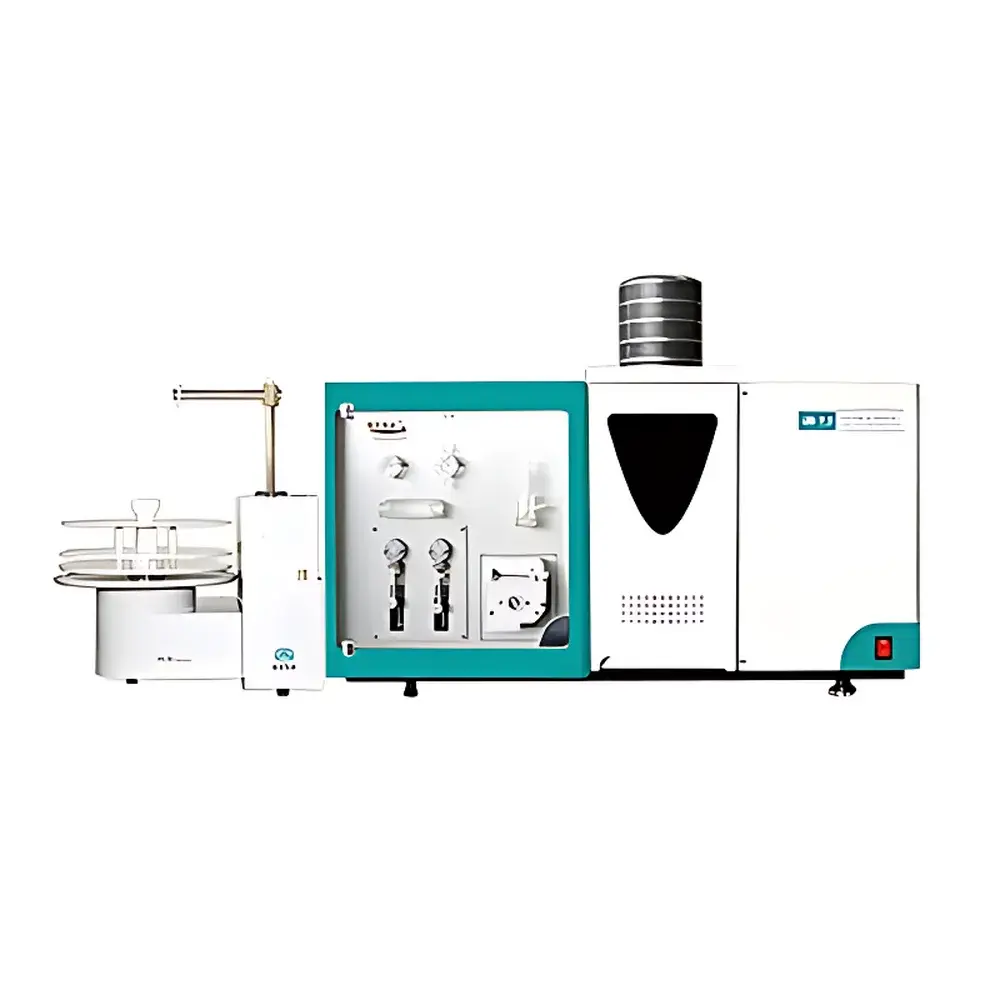
Haiguang AFS-9560 Atomic Fluorescence Spectrometer
| Brand | Haiguang Instrument |
|---|---|
| Origin | Beijing, China |
| Manufacturer Type | Authorized Distributor |
| Product Category | Domestic (China-made) |
| Model | AFS-9560 |
| Price Range | USD 56,000 – 70,000 (FOB Beijing) |
| Instrument Type | Multi-channel Atomic Fluorescence Spectrometer |
| Sample Introduction | Dual Sequential Injection Pump |
| Detectable Elements | As, Se, Pb, Bi, Sb, Te, Sn, Hg, Cd, Zn, Ge, Au |
| RSD | <1.0% (for As at 1 µg/L, n=11) |
| Linear Dynamic Range | >3 orders of magnitude (typical for hydride-generating elements) |
| Detection Limits | Sub-pg/mL level (e.g., As: 0.01 ng/L |
| Hg | 0.001 ng/L |
| Se | 0.03 ng/L, per ISO 17294-2 and GB/T 223.74–2021) |
Overview
The Haiguang AFS-9560 Atomic Fluorescence Spectrometer is a high-performance, multi-channel analytical instrument engineered for trace-level quantification of hydride-forming and cold-vapor elements in environmental, food safety, geological, pharmaceutical, and clinical laboratories. It operates on the principle of atomic fluorescence spectroscopy (AFS), where analyte atoms—generated in situ via hydride generation (HG) or cold vapor atomic fluorescence (CV-AFS)—are excited by a high-intensity, element-specific hollow cathode lamp (HCL), and their characteristic fluorescence emission is measured at right angles to the excitation beam. This configuration delivers exceptional signal-to-noise ratio, low spectral interference, and superior detection sensitivity compared to conventional atomic absorption techniques. The AFS-9560 is designed to meet rigorous regulatory requirements including ISO/IEC 17025, US EPA Method 1631E (for mercury), ASTM D5673 (for arsenic in water), and Chinese national standards GB/T 223.74–2021 and HJ 694–2014.
Key Features
- Dual-channel sequential injection system enables simultaneous, independent measurement of two elements (e.g., As and Hg) without cross-contamination or spectral overlap—reducing total analysis time per sample by up to 40%.
- Polar-coordinate autosampler supports interchangeable sample trays (up to 144 positions), accommodating vials, microtubes, and custom racks for high-throughput batch analysis.
- Peristaltic valve technology replaces conventional solenoid or multi-port valves—eliminating reagent contact with valve internals, preventing corrosion, carryover, and memory effects; rated for >500,000 actuation cycles.
- Isolated sample/carrier stream design minimizes axial diffusion and band broadening, ensuring sharp peak profiles and improved reproducibility (RSD <1.0% at sub-pptr levels).
- Shielded quartz furnace atomizer operates at optimized low temperature (≈800 °C), suppressing fluorescence quenching from O2/N2 and reducing volatile species loss—enhancing atomization efficiency and long-term stability.
- Sealed, two-stage gas–liquid separator requires no manual reagent addition or waste drainage; integrated condensate trap prevents aerosol carryover into the atomization zone.
- Smart-coded hollow cathode lamps auto-identify element type and track operational hours—enabling predictive maintenance and calibration traceability.
- Modular argon gas manifold with array-type distribution and dynamic flow regulation reduces Ar consumption by ~35% versus conventional constant-flow systems—lowering operational cost and improving sustainability.
- Real-time argon–hydrogen flame observation window allows visual verification of flame ignition, stability, and geometry—critical for method validation and troubleshooting.
- Electronically isolated architecture separates high-voltage power supplies, analog signal conditioning, and digital control logic onto dedicated PCB modules—minimizing electromagnetic interference and enhancing measurement fidelity.
Sample Compatibility & Compliance
The AFS-9560 accepts aqueous liquid samples (including digested soils, filtered wastewater, acidified biological fluids, and food extracts) directly compatible with hydride generation chemistry. It supports both acidic (HCl-based) and alkaline (NaBH4/KOH) reduction protocols. Instrument compliance includes full audit trail functionality per FDA 21 CFR Part 11 (when paired with validated software version), electronic signature support, and GLP/GMP-ready data integrity features. All hardware and firmware comply with IEC 61326-1 (EMC) and IEC 61010-1 (safety). Method validation reports align with ISO 8466-1 (calibration models) and ISO 11843-2 (detection capability estimation).
Software & Data Management
Haiguang’s proprietary AFS Control Suite v4.2 runs natively on Windows 7/8/10/11 (64-bit) and provides full instrument control, real-time signal visualization, automated calibration (single-point, multi-point, and standard addition), and intelligent dilution calculation. The software implements secure user role management (admin/operator/auditor), timestamped raw data logging (with checksum integrity), and automatic metadata embedding (sample ID, operator, method ID, instrument serial number). Export formats include native .afsd binary, CSV, and direct Excel (.xlsx) output with customizable templates. Network deployment supports centralized data archiving via SMB/CIFS or FTP(S); optional LIMS integration via ASTM E1384-compliant HL7 or XML interfaces.
Applications
The AFS-9560 is routinely deployed for regulatory monitoring of toxic elements in drinking water (WHO/EPA/GB 5749–2022), rice and seafood (for inorganic As and methylmercury precursors), soil leachates (TCLP/SPLP), pharmaceutical excipients (ICH Q3D), and clinical urine/blood matrices (for occupational exposure assessment). Its sub-pg/mL detection capability makes it suitable for ultra-trace speciation support—when coupled with optional HPLC- or GC-AFS hyphenation modules—and for validating reference materials (CRM) certification protocols under ISO Guide 35.
FAQ
What elements can the AFS-9560 quantify with certified accuracy?
The instrument is validated for As, Se, Pb, Bi, Sb, Te, Sn, Hg, Cd, Zn, Ge, and Au using standardized reference materials (e.g., NIST SRM 1640a, GBW 07601) and meets recovery criteria per ISO 17294-2.
Does the system support automated calibration and QC checks?
Yes—software-driven single-point calibration, bracketing standards, blank subtraction, and daily performance checks (e.g., sensitivity drift, background noise) are fully programmable and reportable.
Is remote diagnostics or service access available?
Instrument firmware supports secure SSH-based remote maintenance (with customer authorization), enabling Haiguang-certified engineers to perform health checks, parameter optimization, and firmware updates without on-site visits.
Can the AFS-9560 be upgraded for elemental speciation analysis?
Yes—dedicated interface ports support seamless integration with HPLC (for As/Se species) and electrothermal vaporization (ETV) modules for Hg/Cd speciation, all controlled via synchronized software triggers.
What documentation is provided for regulatory audits?
Factory-issued IQ/OQ documentation, full traceable calibration certificates (NIST-traceable standards), and 21 CFR Part 11 compliance packages—including electronic signature logs and change control records—are supplied upon request.





