
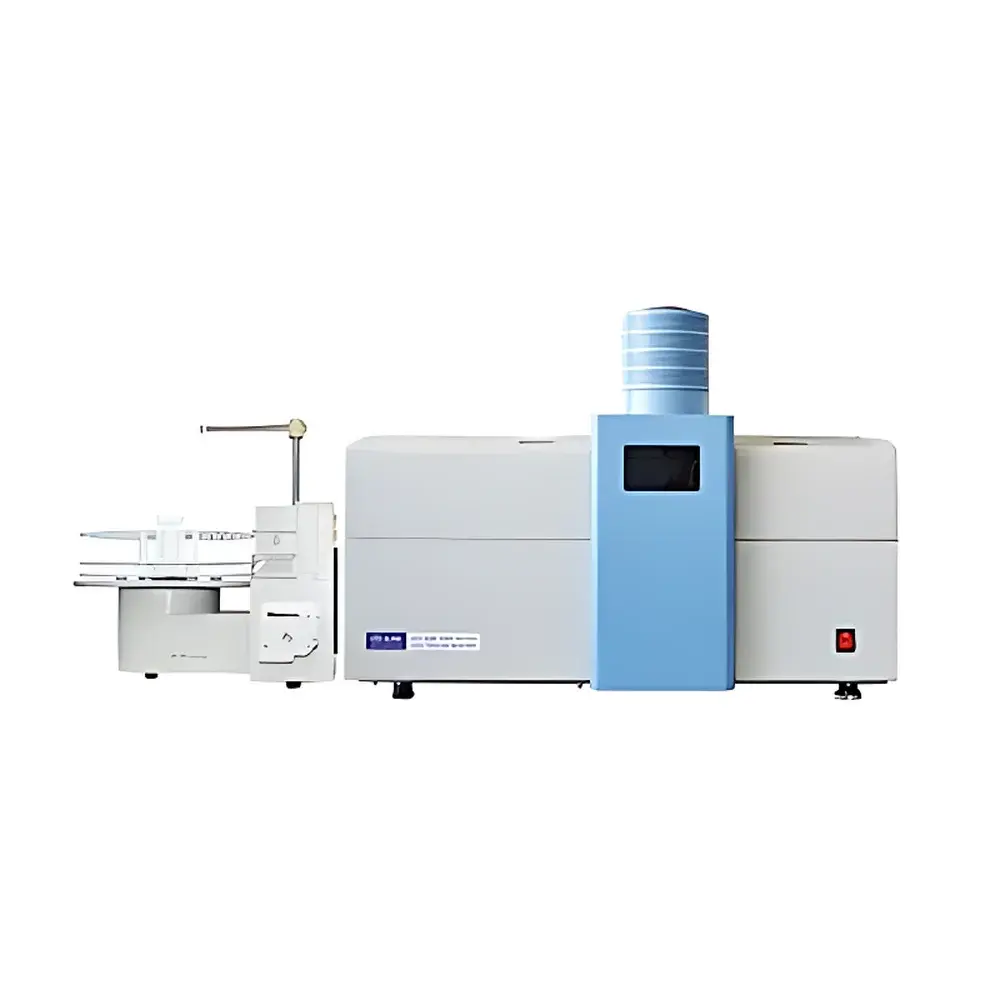
Haiguang AFS-9600 Semi-Automatic Four-Lamp Atomic Fluorescence Spectrometer
| Brand | Haiguang Instrument |
|---|---|
| Origin | Beijing, China |
| Manufacturer Type | Authorized Distributor |
| Country of Origin | China |
| Model | AFS-9600 |
| Price Range | USD 42,000 – 56,000 |
| Instrument Type | Single-Channel Atomic Fluorescence Spectrometer |
| Sample Introduction | Peristaltic Pump |
| Detectable Elements | As, Se, Pb, Bi, Sb, Te, Sn, Hg, Cd, Ge, Zn, Au |
| RSD | <1.0% (for As at 1 µg/L) |
| Linear Dynamic Range | >3 orders of magnitude |
| Detection Limits | Sub-pg/mL level for As, Hg, Se (e.g., As ≤ 0.01 µg/L, Hg ≤ 0.001 µg/L, Se ≤ 0.03 µg/L) |
Overview
The Haiguang AFS-9600 is a semi-automatic, four-lamp atomic fluorescence spectrometer engineered for high-sensitivity trace elemental analysis in environmental, food safety, pharmaceutical, and geological laboratories. It operates on the principle of hydride generation–atomic fluorescence spectroscopy (HG-AFS), where target analytes—primarily Group IV–VI metalloids and transition metals—are chemically reduced to volatile hydride species (e.g., AsH₃, Hg⁰ vapor, SeH₂) or cold vapor (for Hg), atomized in a low-temperature quartz cell under argon-hydrogen flame, and excited by a high-intensity, element-specific hollow cathode lamp. The resulting atomic fluorescence emission is measured at right angles to the excitation beam, minimizing background scatter and enabling sub-pictogram-per-milliliter detection sensitivity. Designed for routine QC/QA workflows, the AFS-9600 balances robustness, regulatory readiness, and operational simplicity without compromising analytical fidelity.
Key Features
- Fixed four-lamp turret with automatic lamp identification via encoded hollow cathode lamps—enabling rapid multi-element method switching without manual re-alignment.
- Optimized low-temperature quartz furnace atomizer with electromagnetic shielding to suppress fluorescence quenching and gaseous-phase interferences, ensuring high atomization efficiency and signal stability.
- Two-stage gas–liquid separation system: a vortex-type primary separator ensures complete chemical reaction and efficient phase separation; a sealed secondary membrane-based separator eliminates manual reagent addition and waste drainage, enhancing operational safety and reproducibility.
- Modular 3U-standard electronics architecture with strict separation of high-voltage and low-noise signal paths—reducing electromagnetic interference and improving long-term baseline stability.
- Argon–hydrogen flame observation window integrated into the atomization chamber, allowing real-time visual verification of flame ignition, stability, and geometry during method development or troubleshooting.
- Intelligent peristaltic pump system featuring ten-roller, six-channel design with independent flow-rate control per channel—supporting precise, programmable sample–blank alternation, online rinsing, and mechanical waste expulsion to prevent carryover.
- Self-diagnostic firmware with automated startup checks, real-time hardware status monitoring, and context-aware fault alerts—including lamp aging tracking, gas pressure anomalies, and pump occlusion detection.
Sample Compatibility & Compliance
The AFS-9600 supports aqueous liquid samples across diverse matrices—including drinking water, soil extracts (EPA Method 7063), rice flour digests (GB 5009.11/5009.17), seafood homogenates, and clinical urine specimens. Its hydride-generation interface is compatible with standard acid digestion protocols (HNO₃–HCl–HF or microwave-assisted) and meets key regulatory requirements for trace metal quantification. While not inherently 21 CFR Part 11 compliant out-of-the-box, its software architecture supports audit-trail-enabling configurations when deployed under validated laboratory information management systems (LIMS). The instrument conforms to ISO/IEC 17025:2017 general requirements for competence of testing and calibration laboratories, and measurement protocols align with ASTM D6722-22 (for As in water) and GB/T 223.78–2017 (Chinese national standard for As/Hg determination).
Software & Data Management
The AFS-9600 is controlled via dedicated Windows 7/8-compatible acquisition software featuring an embedded expert help system, intuitive method wizard, and customizable report templates. All measurement parameters—including lamp current, delay time, read time, pump speed, and calibration curve mode (single-point, multi-point, or standard addition)—are fully configurable. Raw intensity data, peak area integration, and QC metrics (RSD, recovery %, LOD/LOQ) are exported natively to CSV or Excel formats with one-click functionality. Network-enabled data sharing supports secure file transfer over local area networks, and raw data files include embedded metadata (operator ID, timestamp, instrument serial number, method version) to support GLP/GMP documentation practices.
Applications
The AFS-9600 delivers reliable performance in regulated and research settings requiring ultra-trace quantification of toxic and essential elements. Primary applications include: arsenic speciation screening in rice and groundwater (per WHO guideline values); mercury monitoring in fish tissue and dental amalgam leachates; selenium assessment in infant formula and dietary supplements; antimony and bismuth analysis in catalyst residues and pharmaceutical intermediates; and gold assay in exploration geochemistry. Its modular design permits future upgrade to LC-AFS coupling (e.g., with anion-exchange HPLC) for As(III)/As(V), methylmercury, or selenomethionine speciation—extending utility beyond total-element analysis into redox-state and organometallic characterization.
FAQ
What elements can the AFS-9600 quantify with certified detection limits?
The instrument is validated for As, Hg, Se, Pb, Bi, Sb, Te, Sn, Cd, Ge, Zn, and Au—with detection limits meeting or exceeding those specified in GB/T 223.78–2017 and EPA 7063. Typical sub-pg/mL LODs apply to As (≤0.01 µg/L), Hg (≤0.001 µg/L), and Se (≤0.03 µg/L) under optimized HG-AFS conditions.
Is the AFS-9600 suitable for regulated environmental testing?
Yes—when operated with documented SOPs, calibrated standards, and QC samples, it fulfills method performance criteria for EPA, CNAS, and provincial CDC environmental monitoring programs. Full compliance with 21 CFR Part 11 requires integration with third-party electronic lab notebook (ELN) or LIMS platforms.
Can the instrument be upgraded for speciation analysis?
Yes—the AFS-9600 chassis includes预留接口 (pre-wired interfaces) for LC-AFS hyphenation, supporting post-column hydride generation and cold vapor trapping modules for elemental species separation and detection.
What maintenance routines are recommended for long-term stability?
Daily: rinse pump tubing and gas–liquid separator with dilute HCl; verify argon purity (>99.995%) and pressure (0.25–0.35 MPa). Weekly: inspect quartz atomizer tube for carbon deposits; clean lamp windows with ethanol-dampened lint-free swab. Annually: recalibrate photomultiplier voltage and validate lamp intensities against reference standards.
Does the software support multi-user access with role-based permissions?
The base software supports operator-level user accounts; full role-based permission management (e.g., admin, analyst, reviewer) requires deployment within a validated LIMS environment.






