
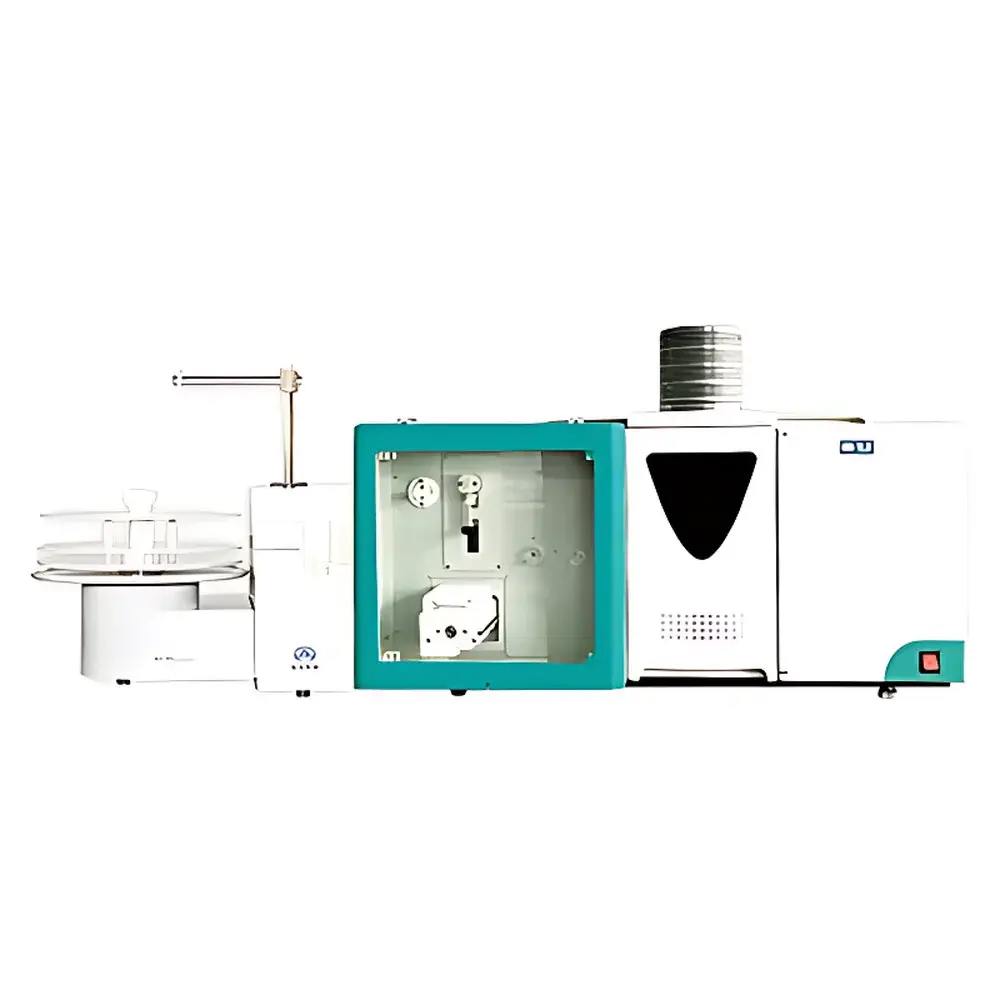
Haiguang AFS-9710 Dual-Channel Atomic Fluorescence Spectrometer
| Brand | Haiguang Instrument |
|---|---|
| Origin | Beijing, China |
| Model | AFS-9710 |
| Instrument Type | Multi-channel Atomic Fluorescence Spectrometer |
| Sample Introduction | Sequential Injection Pump |
| Detectable Elements | As, Se, Pb, Bi, Sb, Te, Sn, Hg, Cd, Zn, Ge, Au |
| Sample Tray Capacity | 69 × 25 mL / 134 × 15 mL / 183 × 10 mL coordinate-style autosampler |
| Valving Technology | Clamp-tube valve (≥500,000 cycles lifetime) |
| Atomizer | Shielded low-temperature quartz furnace atomizer |
| Gas–Liquid Separator | Closed-loop dual-stage cyclonic separator |
| Lamp System | Encoded hollow-cathode lamps with auto-identification and life monitoring |
| Gas Control | Array-structured argon flow system with intelligent gas-saving module |
| Software Platform | Windows XP/7/8/10 compatible |
| Compliance Features | Built-in self-diagnostic routines, real-time flame status monitoring via observation window, GLP/GMP-ready audit trail logging (via optional software module), 21 CFR Part 11 compliance achievable with validated configuration |
| Upgrade Options | LC-AFS hyphenation interface for elemental speciation (e.g., As(III)/As(V), methylmercury), electrothermal evaporation (ETV) modules for Hg/Cd, automated dilution and calibration curve generation |
Overview
The Haiguang AFS-9710 Dual-Channel Atomic Fluorescence Spectrometer is an engineered solution for trace and ultra-trace quantification of hydride-forming elements in environmental, food safety, pharmaceutical, and geological laboratories. Based on the principle of atomic fluorescence spectroscopy (AFS), the instrument excites ground-state atoms—generated in situ via hydride generation (HG) or cold vapor (CV) techniques—with a high-intensity, element-specific hollow-cathode lamp. The resulting resonance fluorescence emission is measured at right angles to the excitation path, minimizing background scatter and enabling sub-picomolar detection sensitivity. Designed specifically for routine regulatory analysis (e.g., EPA Method 1632, ISO 17294-2, GB/T 5750.6–2023), the AFS-9710 employs dual-channel optical detection to enable simultaneous measurement of two elements—such as As and Se or Hg and Sb—without spectral interference or cross-talk, significantly improving throughput while maintaining metrological integrity.
Key Features
- Dual-channel synchronous detection architecture with independent photomultiplier tube (PMT) signal paths and optimized optical filtering, ensuring high signal-to-noise ratio and minimal inter-channel crosstalk.
- Coordinate-style autosampler supporting three interchangeable sample tray configurations: 69-position (25 mL vials), 134-position (15 mL vials), or 183-position (10 mL vials), all programmable with customizable rinse, delay, and injection volume parameters.
- Clamp-tube valving system eliminates wetted metal components; reagents contact only inert tubing, eliminating corrosion, carryover, and memory effects—validated for ≥500,000 operational cycles under continuous use.
- Shielded quartz furnace atomizer operates at precisely controlled low temperatures (typically 750–900 °C), reducing fluorescence quenching from molecular species and minimizing gaseous-phase interferences during atomization.
- Closed-loop dual-stage cyclonic gas–liquid separator enables complete phase separation without manual addition of antifoam reagents or periodic waste drainage—reducing operator intervention and contamination risk.
- Encoded hollow-cathode lamps with integrated EEPROM store lamp identity, recommended current, and operational history; the system auto-detects lamp type and adjusts power settings accordingly.
- Modular gas control architecture featuring an array-configured argon manifold with dynamic flow regulation, achieving up to 40% reduction in argon consumption versus conventional constant-flow systems.
Sample Compatibility & Compliance
The AFS-9710 accepts liquid samples—including aqueous extracts, acid digests (HNO₃/HCl), and enzymatic hydrolysates—within defined matrix tolerance limits (e.g., ≤5% v/v organic content, ≤0.5 M total acid concentration). It complies with key international method frameworks: EPA 1632 (mercury in water), ISO 17294-2 (elements in water by HG-AFS), and Chinese national standard GB/T 5750.6–2023 (As, Se, Sb, Bi, Hg in drinking water). Its hardware-level diagnostics—including real-time argon pressure monitoring, flame stability assessment via optical observation window, and PMT gain validation—support GLP and GMP documentation requirements. When configured with audit-trail-enabled software and electronic signature modules, the system meets FDA 21 CFR Part 11 readiness criteria for regulated environments.
Software & Data Management
The proprietary Haiguang AFS Control Suite runs natively on Windows XP through Windows 10 and features a modular GUI with dedicated tabs for method development, sequence programming, real-time signal visualization, and report generation. All analytical sequences—including single-point calibration, multi-point linear/nonlinear curve fitting, automatic sample dilution, and spike recovery calculation—are scriptable and repeatable. Raw intensity data and processed results export directly to Microsoft Excel (.xlsx) with metadata preservation (sample ID, timestamp, lamp hours, gas flow rate, integration time). Network deployment allows centralized method library management and shared calibration databases across laboratory workstations. Optional validation packages include IQ/OQ documentation templates and electronic logbook functionality aligned with ISO/IEC 17025 clause 7.7.
Applications
The AFS-9710 delivers robust performance in high-volume trace metal testing workflows: monitoring arsenic in rice flour per Codex Alimentarius STAN 193–1995; quantifying total mercury in fish tissue following AOAC 995.12; verifying selenium enrichment in dietary supplements per USP ; screening antimony leaching from PET packaging per EU Directive 10/2011; and validating bismuth content in pharmaceutical intermediates. Its dual-channel capability accelerates multi-element compliance checks—for instance, simultaneous As + Sb analysis in wastewater per ISO 17294-2—while its upgrade-ready architecture supports future integration with HPLC for As(III)/DMA/MMA speciation or ETV for solid-sample Cd determination without hardware replacement.
FAQ
What hydride-forming elements can the AFS-9710 quantify?
The instrument is validated for As, Se, Pb, Bi, Sb, Te, Sn, Hg, Cd, Zn, Ge, and Au using standardized HG-AFS or CV-AFS protocols.
Does the system support automated calibration and dilution?
Yes—integrated sequential injection pump enables single-point calibration, multi-point curve generation, and on-the-fly sample dilution with programmable factor ranging from 2× to 100×.
Can the AFS-9710 be upgraded for elemental speciation analysis?
Yes—dedicated LC-AFS coupling interface is factory-installed; users may add HPLC modules (e.g., ion chromatography for As species) and configure gradient elution, post-column hydride generation, and time-resolved fluorescence detection.
Is remote diagnostics or service support available?
The embedded Ethernet port enables secure remote connection for firmware updates, parameter troubleshooting, and collaborative method optimization with Haiguang Application Scientists.
What maintenance intervals are recommended for routine operation?
Clamp-tube valves require no scheduled replacement; quartz tubes and reaction coils are inspected every 2000 injections; hollow-cathode lamps are monitored continuously and replaced based on intensity decay thresholds (typically 1,500–3,000 h).





