
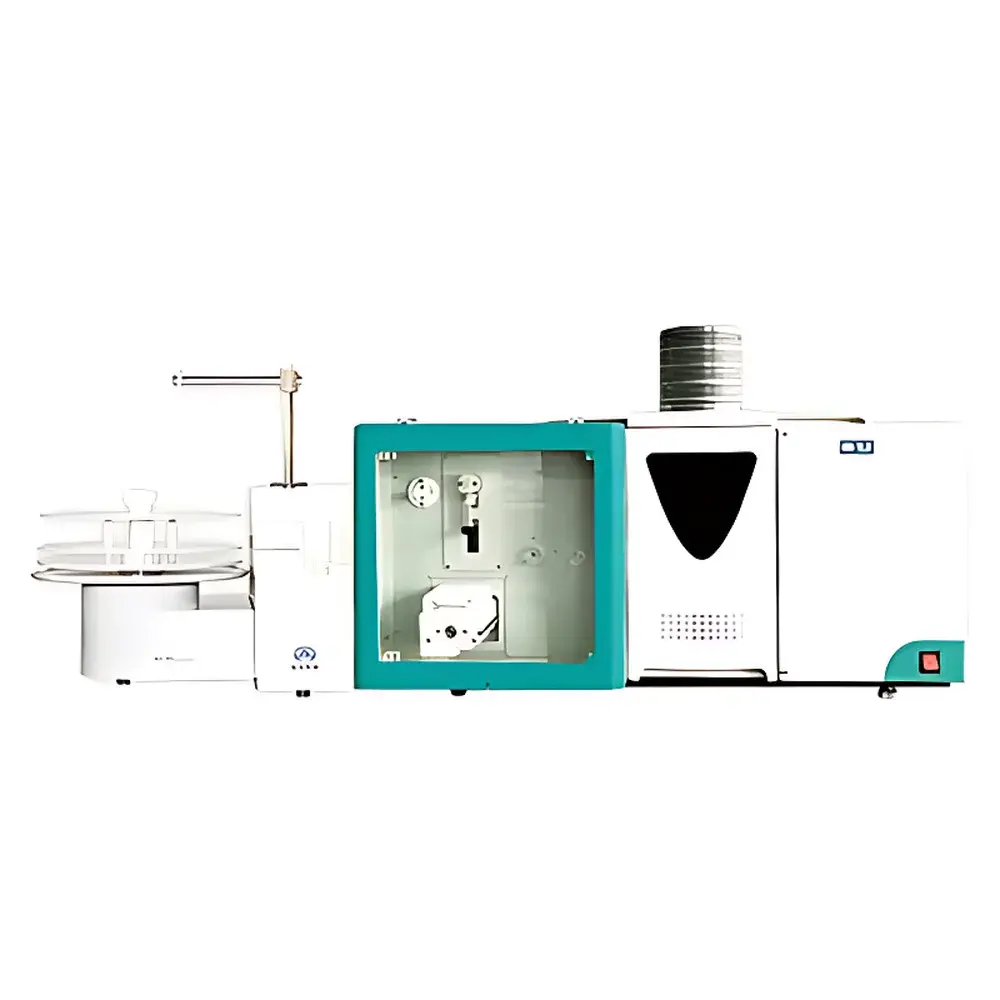
Haiguang AFS-9770 Multi-Channel Atomic Fluorescence Spectrometer
| Brand | Haiguang Instrument |
|---|---|
| Origin | Beijing, China |
| Model | AFS-9770 |
| Instrument Type | Multi-channel Atomic Fluorescence Spectrometer |
| Sample Introduction | Integrated Sequential Injection with Peristaltic Pump |
| Detectable Elements | As, Se, Pb, Bi, Sb, Te, Sn, Hg, Cd, Zn, Ge, Au |
| Optical Configuration | Fixed Four-Channel Short-Focal-Length Lens System |
| Atomizer | Argon-Hydrogen Flame Shielded Quartz Furnace with Dual-Zone Independent Temperature Control (Room Temp–450 °C) |
| Detection System | R7154 Photomultiplier Tube (PMT), Japan |
| Auto-sampler Capacity | 180-position Rotary Tray |
| Software Compliance | Audit Trail, User Permission Management, Data Traceability per FDA 21 CFR Part 11 & GLP Requirements |
| Gas Control | Triple-Channel Digital Mass Flow Controller (Carrier, Shield, Auxiliary Ar) |
| Safety Systems | Real-time Leak, Pressure, Flame, Temperature, and Ambient Hazard Gas Monitoring |
| Exhaust Treatment | Integrated Hydride Trap for Toxic Effluent Capture |
Overview
The Haiguang AFS-9770 Multi-Channel Atomic Fluorescence Spectrometer is a high-performance, fully automated analytical instrument engineered for trace-level quantification of hydride-forming and cold-vapor elements in environmental, geological, food safety, pharmaceutical, and clinical laboratories. It operates on the principle of atomic fluorescence spectroscopy (AFS), where analyte atoms—generated in situ via hydride generation (HG) or cold vapor (CV) techniques—are excited by a sharp-line radiation source (hollow cathode lamp), and the resulting resonance fluorescence is measured at right angles to the excitation path. This configuration delivers exceptional sensitivity and selectivity for elements including arsenic (As), mercury (Hg), selenium (Se), antimony (Sb), bismuth (Bi), lead (Pb), tin (Sn), cadmium (Cd), zinc (Zn), tellurium (Te), germanium (Ge), and gold (Au). The AFS-9770 implements a non-dispersive optical design with a fixed four-channel short-focal-length lens assembly, enabling simultaneous multi-element detection without mechanical wavelength scanning—thereby improving throughput, reproducibility, and long-term signal stability.
Key Features
- Four-channel simultaneous measurement capability with full optical isolation and stray-light suppression via a sealed, light-tight alignment system.
- Integrated sequential injection–peristaltic pump hydride generation system: eliminates syringe corrosion and leakage; enables precise micro-volume sampling (5 µL–2.5 mL) with ≤0.01% volumetric accuracy using microstepping control and compensation algorithms.
- Fixed four-lamp position architecture with planar fan-shaped distribution around the quartz furnace; supports pre-heating of up to nine hollow cathode lamps via a 360° rotatable lamp turret equipped with micrometer-grade 2D PSD auto-alignment and motorized fine positioning.
- Argon–hydrogen flame-shielded quartz furnace atomizer with dual-zone independent temperature control (0–450 °C), minimizing fluorescence quenching and gas-phase interferences while maintaining robust performance across seasonal humidity variations.
- Digital triple-channel electronic mass flow control (carrier, shield, auxiliary argon) with real-time diagnostics, automatic fault protection, and integrated argon-saving mode.
- Self-monitoring sensor suite tracking liquid level, tubing leak status, gas pressure/flow, lamp operating hours, atomizer temperature, flame integrity, ambient hazardous gases, altitude, and ambient temperature.
- High-reliability ignition system: contactless, filament-free plasma ignition rated for >1,000,000 cycles—eliminating consumable replacement and thermal drift associated with resistive filaments.
- Onboard hydride trap for adsorptive capture of residual toxic hydrides (e.g., AsH3, Hg0 vapor), ensuring operator safety and regulatory compliance with OSHA and ISO 15190 laboratory safety standards.
Sample Compatibility & Compliance
The AFS-9770 accommodates aqueous liquid samples—including digested environmental matrices (soil, sediment, water), biological tissues (urine, blood, hair), food extracts, and pharmaceutical intermediates—without requiring matrix-matched calibration in most routine applications. Its HG-CV methodology conforms to internationally recognized standard methods, including EPA Method 1631E (Hg in water), ISO 17892-7 (geotechnical testing), GB/T 5009.11–2014 and GB/T 5009.17–2014 (Chinese national standards for As and Hg in food), and ASTM D6722–22 (total mercury in coal and coke). All hardware and firmware modules are designed to support Good Laboratory Practice (GLP) and current Good Manufacturing Practice (cGMP) workflows, with full traceability of instrument parameters, user actions, and data modifications as required under FDA 21 CFR Part 11.
Software & Data Management
The embedded Windows-based control software provides complete instrument orchestration—from method setup and auto-calibration to report generation and export. It features multi-threaded operation, allowing concurrent sample queue editing, report formatting, and raw data review during acquisition. Data integrity is ensured through cryptographic audit trails, role-based access control (admin/operator/analyst tiers), and immutable timestamped logs of all hardware events, software exceptions, and user interventions. Calibration curves support single-point standard addition, automatic high-concentration sample dilution, and dynamic range extension. Export options include native .csv, Excel-compatible .xlsx, and PDF reports with embedded metadata. Network deployment supports centralized data archiving and LIMS integration via OPC UA or HTTP RESTful APIs.
Applications
The AFS-9770 is routinely deployed in regulatory testing labs for compliance monitoring of heavy metals in drinking water (WHO Guideline Limits), rice and seafood (EU Commission Regulation (EC) No 1881/2006), infant formula (Codex Stan 72–1981), and herbal medicines (USP /). Its sub-ppt detection capability makes it suitable for speciation studies when coupled with HPLC–AFS interfaces (e.g., As(III)/As(V)/MMA/DMA separation), though standalone operation suffices for total elemental screening. In geochemical research, it enables rapid field-deployable analysis of As and Sb in groundwater surveys; in clinical toxicology, it supports longitudinal biomonitoring of Hg exposure in occupational health programs.
FAQ
What elements can the AFS-9770 quantify, and what detection limits are achievable?
The instrument is validated for As, Hg, Se, Sb, Bi, Pb, Sn, Cd, Zn, Te, Ge, and Au using standardized hydride generation protocols. Typical method detection limits (MDLs) range from 0.003 ng/L (Hg) to 0.025 ng/L (As) under optimized conditions—consistent with EPA 1631E and ISO 17892-7 validation criteria.
Does the system support regulatory-compliant data handling?
Yes. The software implements full 21 CFR Part 11 compliance: electronic signatures, audit trail logging, data immutability, user authentication, and permission-tiered access control—all verified during third-party GLP audits.
How is cross-contamination prevented during high-throughput analysis?
Through synchronized sample–blank alternating introduction, online needle washing, mechanical waste expulsion, and low-memory-effect fluidic components—including ceramic-faced solenoid valves and surge-type gas–liquid separators.
Can the AFS-9770 be integrated into an existing laboratory informatics infrastructure?
Yes. It supports LIMS connectivity via configurable TCP/IP ports, OPC UA server interface, and direct database write capabilities (ODBC/JDBC) for seamless data ingestion into enterprise systems.
What maintenance intervals are recommended for routine operation?
Preventive maintenance is scheduled every 6 months; key consumables—including quartz tubes, reagent tubing, and PMT high-voltage modules—have documented service lifetimes exceeding 12 months under typical usage (≤8 h/day, 5 days/week).




