
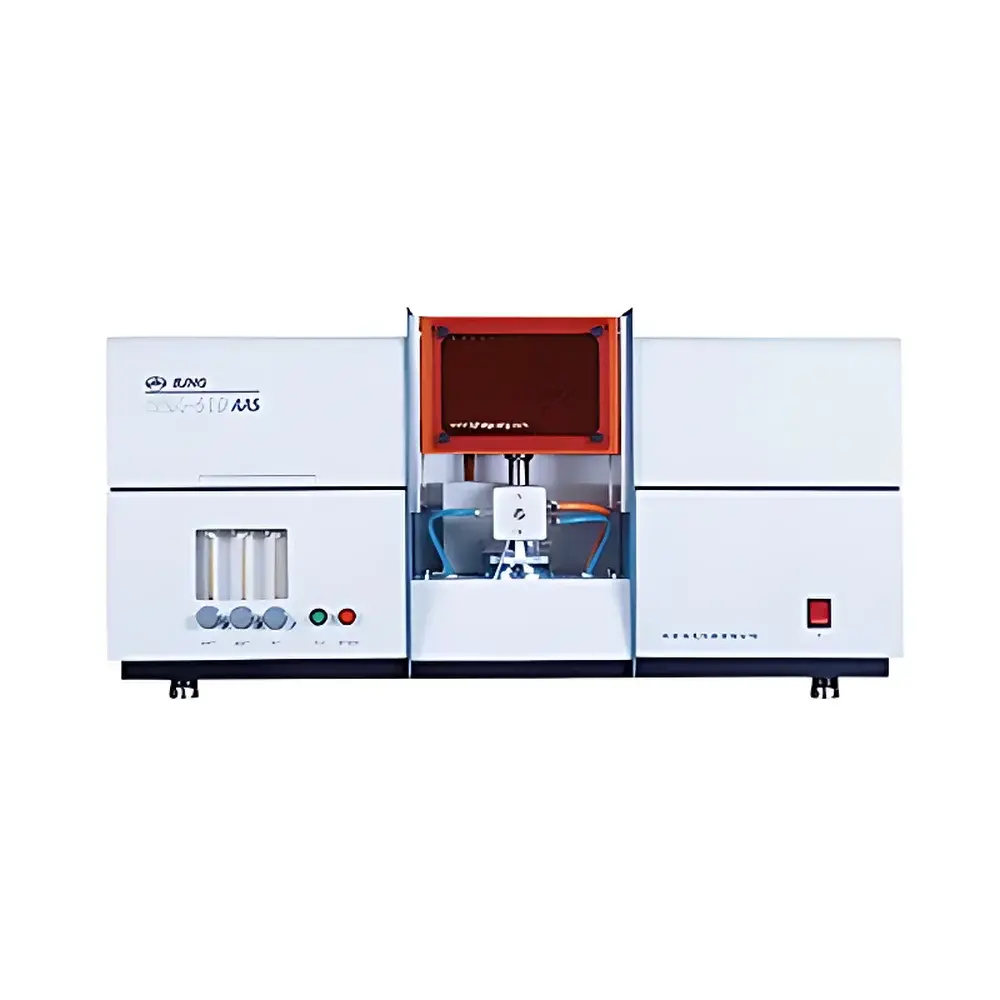
Haiguang GGX-610 Flame Atomic Absorption Spectrophotometer
| Brand | Haiguang Instrument |
|---|---|
| Origin | Beijing, China |
| Model | GGX-610 |
| Instrument Type | Flame AAS |
| Monochromator | Concave Grating |
| Optical System | Single-beam |
| Detector | Photomultiplier Tube (PMT) |
| Background Correction | Deuterium Lamp |
| Spectral Bandwidth | 0.2 / 0.4 / 1.0 / 2.0 nm (motorized switching) |
| Wavelength Range | 190–900 nm |
| Flame Emission Capability | Yes (for K, Na, Li) |
| Safety Features | Automatic gas cutoff, flame failure interlock, flashback arrestor |
| Housing Material | Corrosion-resistant all-plastic enclosure |
| Software Platform | Windows 7/8/XP-compatible proprietary AAS control and data analysis suite |
Overview
The Haiguang GGX-610 Flame Atomic Absorption Spectrophotometer is a precision-engineered analytical instrument designed for quantitative elemental determination in liquid samples via flame atomization and absorption spectroscopy. Based on the fundamental principle of atomic absorption—where ground-state free atoms in a flame absorb characteristic radiation emitted by a hollow cathode lamp—the GGX-610 delivers robust performance for routine trace metal analysis across regulated and research environments. Its optimized Czerny-Turner optical layout (270 mm focal length) ensures high photon throughput and minimal stray light, while the 1800-line/mm plane diffraction grating provides adequate spectral resolution for elemental line isolation under standard flame AAS conditions. As a dedicated flame-only system, it excludes graphite furnace capability but excels in throughput, operational stability, and cost-efficiency for laboratories performing high-volume analyses of metals such as Ca, Mg, Fe, Zn, Cu, Pb, Cd, Cr, Ni, K, and Na.
Key Features
- Flame atomization system with titanium alloy burner head—resistant to thermal shock and acid corrosion, fully adjustable in three dimensions for optimal alignment and signal reproducibility.
- High-efficiency concentric glass nebulizer with integrated impact bead, coupled with a specially treated mixed-type spray chamber—minimizing memory effects and ensuring rapid washout between samples.
- Deuterium lamp background correction with >60-fold correction capacity, enabling accurate quantification in complex matrices with moderate molecular absorption interference.
- Motorized spectral bandwidth selection (0.2, 0.4, 1.0, 2.0 nm), wavelength auto-scanning, automatic gain control, and dynamic lamp current optimization—reducing operator dependency and improving measurement consistency.
- Integrated flame emission mode for alkali and alkaline earth elements (K, Na, Li), supporting dual-mode operation without hardware reconfiguration.
- Comprehensive safety architecture: real-time flame monitoring, automatic fuel gas shutoff upon power loss or flame extinction, and mechanical flashback arrestors compliant with ISO 22196 and national laboratory safety guidelines.
- All-plastic housing engineered for resistance to ambient acidic vapors commonly encountered in wet chemistry labs—extending service life and reducing maintenance frequency.
Sample Compatibility & Compliance
The GGX-610 is validated for use with aqueous and diluted organic extracts following standard sample preparation protocols—including acid digestion (HNO₃/HCl/HF), microwave-assisted digestion, and dilution series. It supports direct aspiration of low-viscosity solutions (<5 cP) and accommodates common chelating agents (e.g., EDTA) where required for stabilization. The instrument meets essential requirements of multiple Chinese national standards (GB series) and environmental testing methods (HJ series), including GB 5009.12–2017 (Pb in food), HJ 491–2019 (Cu, Zn, Pb, Ni, Cr in soil/sediment), and GB/T 17141–1997 (Pb/Cd in soil). While not pre-certified for FDA 21 CFR Part 11, its software architecture supports audit-trail-enabled operation when deployed within GLP/GMP-aligned workflows using external validation documentation.
Software & Data Management
The GGX-610 operates via a native Windows-based application built for analytical chemists—not IT specialists. The interface enables full instrument control (lamp selection, wavelength setup, flame optimization, integration time), real-time absorbance monitoring, and multi-point calibration (linear and quadratic). All measurement parameters—including lamp ID, slit width, burner height, and background correction status—are automatically logged with each result. Raw data and processed reports export natively to CSV or Excel-compatible formats (.xls/.xlsx), facilitating integration into LIMS environments and regulatory submission packages. Zero-point drift compensation algorithms are embedded at firmware level, eliminating manual baseline resets during extended batch runs.
Applications
The GGX-610 serves laboratories requiring reliable, repeatable flame AAS performance in diverse sectors: food safety testing (heavy metals in infant formula, spices, beverages); environmental monitoring (metal content in drinking water, wastewater, soil leachates); agricultural product analysis (nutrient cations in fertilizers, plant tissues); pharmaceutical excipient screening (catalyst residue testing per ICH Q2(R2)); and academic teaching labs where hands-on understanding of atomic spectroscopy fundamentals is prioritized. Its flame emission functionality further expands utility in clinical nutrition labs measuring serum potassium and sodium.
FAQ
Is the GGX-610 compatible with graphite furnace accessories?
No—the GGX-610 is a dedicated flame AAS platform and does not support graphite furnace atomization or associated hardware upgrades.
What operating systems are supported by the control software?
The native software is validated for Windows 7, Windows 8, and Windows XP (32-bit editions); compatibility with Windows 10/11 requires driver-level verification and is not guaranteed out-of-box.
Can background correction be disabled during method development?
Yes—users may manually toggle deuterium background correction on/off per element method, allowing comparative evaluation of raw vs. corrected absorbance signals.
Does the system include IQ/OQ documentation templates?
Haiguang provides basic installation and operational checklists; full GxP-compliant qualification packages (including PQ protocols) must be developed internally or with third-party validation consultants.
What maintenance intervals are recommended for the nebulizer and burner head?
Nebulizer inspection and cleaning are advised after every 100 samples or daily in high-throughput labs; burner head cleaning and alignment verification should occur weekly or after analysis of highly saline or suspended particulate samples.





