
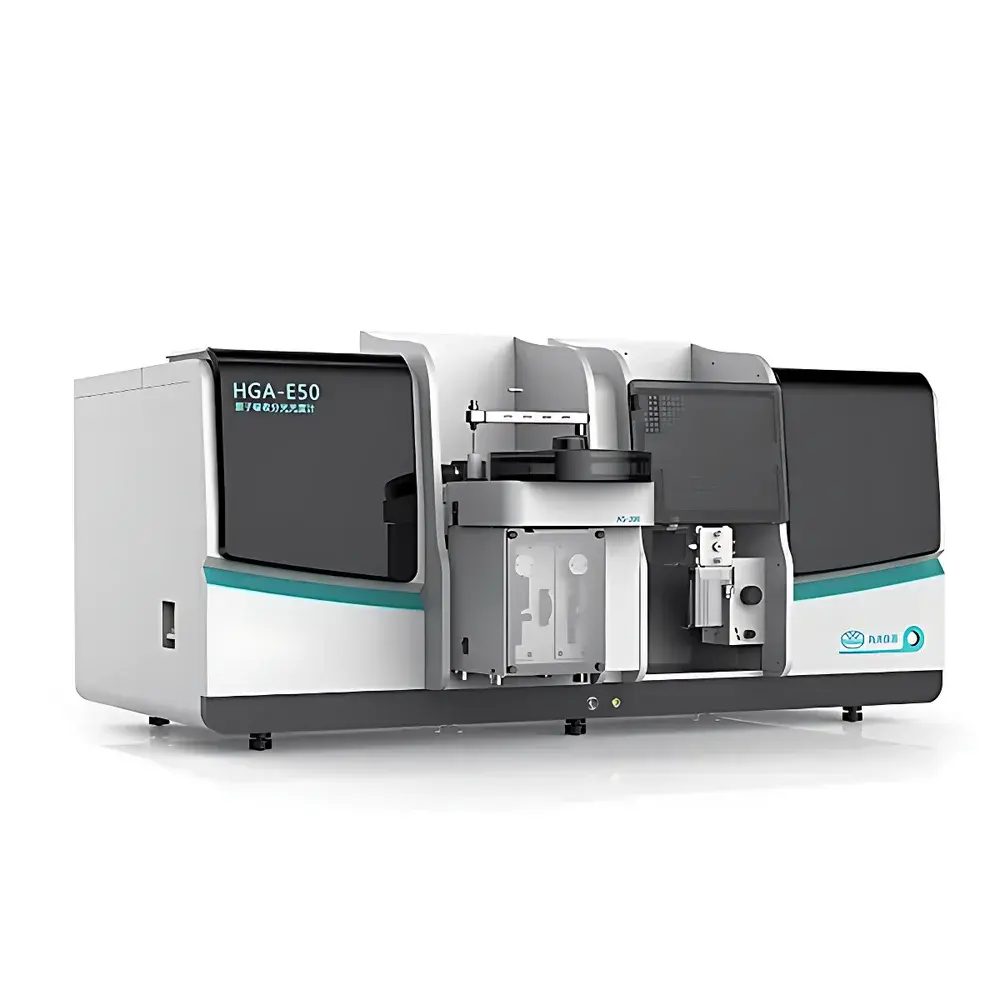
Haiguang HGA-E50 Flame and Graphite Furnace Integrated Atomic Absorption Spectrophotometer
| Brand | Haiguang Instrument |
|---|---|
| Origin | Beijing, China |
| Model | HGA-E50 |
| Instrument Type | Flame–Graphite Furnace AAS |
| Monochromator | Plane Grating |
| Optical System | Single-Beam |
| Detector | Photomultiplier Tube (PMT) |
| Background Correction | Deuterium Lamp |
| Safety Features | Over-Temperature Alarm, Low Gas Pressure Alert, Graphite Tube Break/Loose Clamp Detection |
| Automated Functions | Self-Check at Startup, Automatic Slit Adjustment, Peak Search, Lamp Positioning |
Overview
The Haiguang HGA-E50 is a fully integrated flame and graphite furnace atomic absorption spectrophotometer engineered for high-precision elemental quantification across diverse sample matrices. Unlike conventional sequential or modular configurations, the HGA-E50 employs a true serial optical path architecture where both atomization systems share a single monochromator and detector—but operate via independent, optimized light paths and dedicated hollow cathode lamps. This design eliminates mechanical lamp or atomizer repositioning, reducing alignment drift and operational downtime. The instrument operates on the fundamental principle of atomic absorption spectroscopy: ground-state atoms in the flame or graphite furnace vapor phase absorb characteristic radiation from element-specific hollow cathode lamps, with absorbance proportional to analyte concentration per the Beer–Lambert law. Its dual-atomization capability enables seamless transition between rapid, high-throughput flame analysis (for major and minor elements at µg/mL levels) and ultra-trace graphite furnace analysis (for sub-pg detection limits), all under unified software control and consistent calibration traceability.
Key Features
- True flame–graphite furnace integration with no mechanical switching—atomizer positioning remains fixed, ensuring long-term optical stability and reproducibility.
- Dual independent light source system: Each atomization mode (flame and furnace) utilizes its own dedicated hollow cathode lamp turret and deuterium background correction lamp, minimizing optical path length and energy loss.
- Two 8-lamp rotating carousels support simultaneous preheating of up to 16 lamps—enabling rapid multi-element method sequencing without manual intervention.
- Deuterium lamp background correction implemented separately for flame and furnace modes, with adaptive energy regulation to maintain optimal spectral output and extend lamp service life.
- Integrated graphite furnace power supply delivers longitudinal heating with real-time optical temperature monitoring and post-run temperature calibration—critical for method robustness and inter-laboratory comparability.
- Comprehensive safety architecture includes furnace over-temperature cutoff, argon/nitrogen pressure monitoring, graphite tube integrity verification (breakage and clamping status), and automatic gas flow validation prior to heating cycles.
- Flame emission functionality supports direct measurement of alkali and alkaline earth metals (e.g., K, Na, Ca) without atomization, enhancing accuracy for easily ionized elements.
- Standard interface for hydride generation accessories enables As, Se, Sb, Bi, Te, and Pb analysis with enhanced sensitivity and reduced matrix interference.
Sample Compatibility & Compliance
The HGA-E50 accommodates liquid samples (aqueous, acidic digests, organic extracts), suspended particulates (after ultrasonic dispersion), and solid micro-samples (via slurry introduction into graphite furnace). It meets functional requirements of multiple international and national regulatory frameworks, including ISO/IEC 17025:2017 for testing laboratory competence, and supports audit-ready workflows aligned with GLP and GMP principles. Its analytical performance aligns with key methods referenced in food safety (GB 5009 series), environmental monitoring (HJ 491, HJ 757), and soil quality assessment (GB/T 17141). While not certified to FDA 21 CFR Part 11 out-of-the-box, the system’s data logging architecture—including timestamped method parameters, raw absorbance traces, and instrument status flags—provides foundational traceability required for regulated environments when deployed with compliant LIMS integration.
Software & Data Management
The proprietary Haiguang AAS Control Suite provides intuitive method development, automated sequence execution, and quantitative reporting with customizable templates. All acquisition parameters—including lamp current, slit width, burner height, furnace temperature ramp profiles, and background correction settings—are stored with each measurement. Raw signal data (absorbance vs. time/wavelength) are saved in ASCII-compatible format for third-party statistical analysis. Audit trails record user logins, method modifications, calibration events, and instrument error logs—retained for ≥365 days with optional encrypted backup. Software supports export to CSV, PDF, and XML formats compliant with laboratory information management systems (LIMS) and electronic lab notebooks (ELN).
Applications
The HGA-E50 serves as a primary elemental analyzer in food safety laboratories performing lead (Pb), cadmium (Cd), copper (Cu), chromium (Cr), and nickel (Ni) testing per GB 5009 standards; environmental labs quantifying heavy metals in water, soil, and sediment per HJ 491 and HJ 757; geological survey units analyzing ore-grade metals; clinical and pharmaceutical QC labs measuring trace catalyst residues; and academic research facilities conducting method development for speciation studies. Its flame emission mode is routinely applied to sodium and potassium determination in biological fluids and plant tissues, while hydride-compatible configurations support arsenic speciation in rice and seafood matrices.
FAQ
Does the HGA-E50 require manual realignment when switching between flame and graphite furnace modes?
No. The optical path is statically configured for both atomizers; switching is fully automated via software-controlled shutter and lamp selection—no physical movement of components occurs.
Can the instrument perform simultaneous multi-element analysis?
No. It operates in sequential mode; however, the dual 8-lamp turret allows rapid lamp exchange within seconds, minimizing cycle time for multi-element protocols.
Is the deuterium background correction validated per ASTM E275 or ISO 11171?
While not formally certified to those specific standards, the deuterium system complies with the functional requirements of background correction defined in ISO 11170 and USP , with documented linearity and dynamic range validation across 220–350 nm.
What maintenance intervals are recommended for the graphite furnace and burner head?
Graphite tubes: replaced after 200–500 firings depending on matrix; burner heads: cleaned weekly with dilute nitric acid and inspected monthly for clogging or corrosion.
Is remote operation or network connectivity supported?
Yes—the system features Ethernet port and TCP/IP protocol support for remote monitoring, method transfer, and centralized instrument fleet management via secure LAN deployment.




