
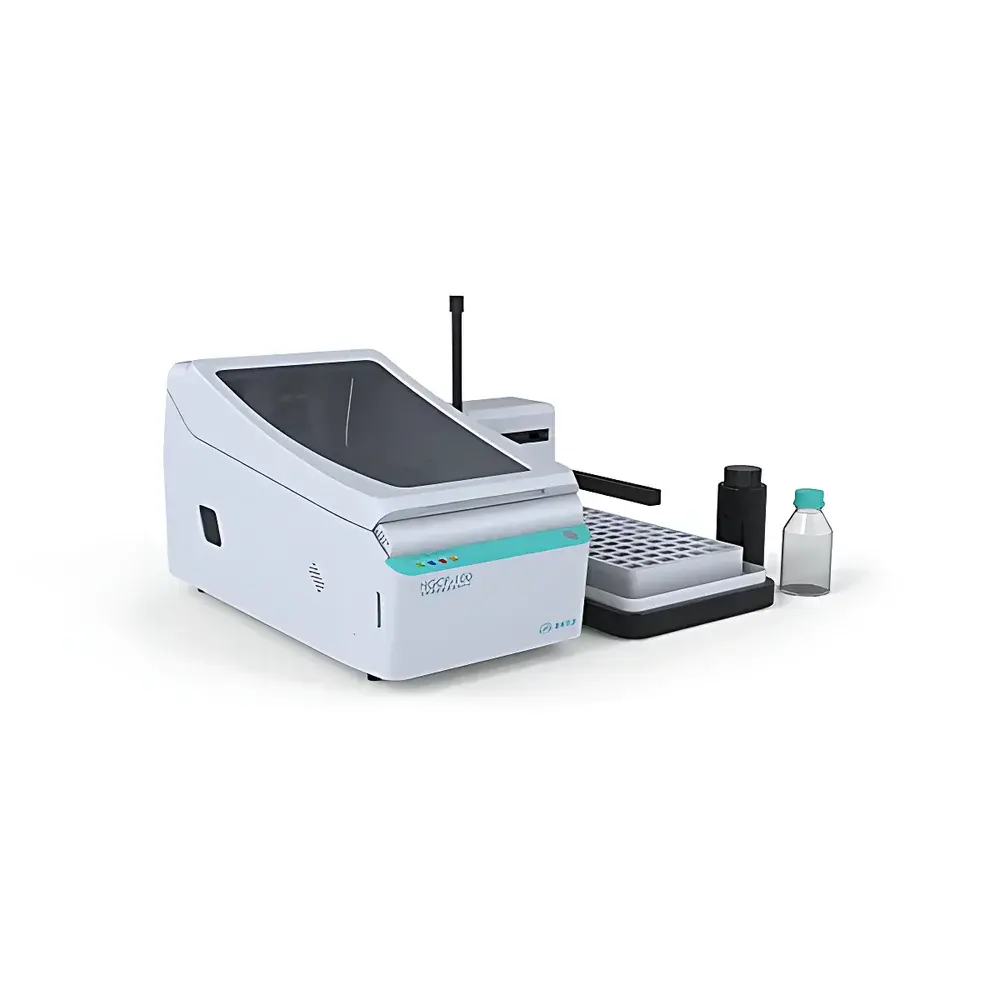
Haiguang HGCF-100 Ammonia Nitrogen Continuous Flow Analyzer
| Brand | Haiguang Instrument |
|---|---|
| Origin | Beijing, China |
| Manufacturer Type | Authorized Distributor |
| Product Origin | Domestic (China) |
| Model | HGCF-100 for Ammonia Nitrogen |
| Price Range | USD 28,000 – 35,000 |
| Instrument Type | Laboratory Benchtop |
| Measurement Principle | Air-Segmented Continuous Flow Analysis (CFA) with Distillation and Colorimetric Detection |
| Measurement Range | 0.01–5 mg/L NH₃–N |
| Accuracy | ±1% of reading |
| Detection Limit | ≤0.005 mg/L NH₃–N |
| Sample Throughput | 30 samples/hour |
| Batch Capacity | Unlimited (software-controlled queue) |
Overview
The Haiguang HGCF-100 Ammonia Nitrogen Continuous Flow Analyzer is a fully automated, benchtop laboratory system engineered for high-throughput, trace-level quantification of ammonia nitrogen (NH₃–N) in complex aqueous matrices. It implements air-segmented continuous flow analysis (CFA), a well-established ISO/US EPA-aligned methodology that isolates discrete sample zones with air bubbles to prevent cross-contamination and ensure reproducible reaction kinetics. For ammonia nitrogen determination, the system integrates on-line steam distillation—prior to colorimetric detection via the indophenol blue method—to effectively separate volatile NH₃ from interfering ions (e.g., Ca²⁺, Mg²⁺, Fe³⁺), suspended solids, and organic turbidity commonly found in wastewater, surface water, and digested soil extracts. This architecture eliminates manual distillation steps, reduces analyst exposure to hazardous reagents (e.g., NaOH, phenol, hypochlorite), and delivers metrologically traceable results compliant with ISO 14911, EPA Method 350.1, HJ 535–2009, and GB 7479–1987.
Key Features
- Modular channel design: Each independent analytical channel integrates a precision peristaltic pump, chemically inert quartz reaction coil (2 mm i.d.), temperature-controlled digestion/distillation zone, and optical detection subsystem—enabling parallel multi-parameter analysis without hardware reconfiguration.
- Air segmentation technology ensures complete sample/reagent mixing, minimizes carryover (<0.05%), and maintains laminar flow profiles critical for stoichiometric reaction control.
- On-board pre-treatment suite supports automated dilution, heating (up to 100 °C), acid/base adjustment, UV/persulfate digestion (for total N conversion), dialysis, and liquid–liquid extraction—all programmable within a single method sequence.
- Optical detection options include a full-spectrum CCD array (190–850 nm) for simultaneous multi-wavelength background correction or a dual-beam silicon photodiode detector with extended dynamic range (0–3.5 AU) and <0.001 AU baseline stability over 8-hour runs.
- Quartz reaction coils (2 mm i.d.) provide superior chemical resistance to strong alkalis and oxidants, minimal memory effect (<0.1% RSD after high-concentration samples), and resistance to clogging—even with raw wastewater or filtered sludge supernatants.
- Low-power LED light sources (peak emission at 630 nm for indophenol) achieve thermal stabilization in <30 seconds and maintain intensity drift <0.2% over 1,000 hours—reducing recalibration frequency and operational downtime.
Sample Compatibility & Compliance
The HGCF-100 accepts unfiltered, undegassed liquid samples—including raw municipal wastewater, anaerobic digester effluents, river sediments (aqueous extracts), seawater (with salinity compensation), milk homogenates, and fertilizer leachates. Its integrated distillation module tolerates TSS up to 500 mg/L and chloride concentrations ≤10,000 mg/L without performance degradation. System validation adheres to ISO/IEC 17025 requirements for method verification; all calibration curves, QC checks, and instrument performance logs are timestamped, user-attributed, and stored with audit-trail capability meeting FDA 21 CFR Part 11 and GLP data integrity standards. Regulatory alignment includes EPA Methods 350.1 (ammonia), 354.1 (nitrate), and 4500-NH₃ F; ISO 14911 (ammonia), ISO 11905-1 (total Kjeldahl nitrogen); and Chinese national standards HJ 535–2009 and GB/T 5750.5–2023.
Software & Data Management
Control and data acquisition are managed through Haiguang’s CFA-Studio v4.2 software—a Windows-based platform supporting ICH-compliant electronic signatures, role-based access control (admin/operator/auditor), and automatic generation of LIMS-ready CSV/Excel reports. The software enforces method-defined QC protocols: initial calibration verification (ICV), continuing calibration blank (CCB), matrix spike duplicates (MSD), and instrument detection limit (IDL) confirmation—all logged with pass/fail flags and automatic alerting upon deviation. Raw spectral data, chromatograms, and event logs (pump actuation, valve switching, temperature excursions) are archived in HDF5 format for long-term reproducibility and third-party reprocessing.
Applications
The HGCF-100 serves environmental testing laboratories performing routine compliance monitoring under NPDES permits, drinking water utilities verifying disinfection byproduct precursors, agricultural research centers quantifying nitrogen leaching from fertilized soils, and food safety labs assessing ammonia accumulation in dairy processing streams. Its validated methods extend beyond ammonia nitrogen to cyanide (ISO 6703-1), phenols (ISO 6439), phosphate (ISO 6878), nitrate/nitrite (EPA 353.2), and total phosphorus (ISO 11885)—all executed on the same hardware platform via method-swappable modules and reagent kits.
FAQ
Does the HGCF-100 require daily maintenance beyond standard cleaning cycles?
No. Scheduled maintenance is limited to monthly replacement of peristaltic pump tubing and quarterly inspection of distillation heater elements. The quartz coil and CCD optics require no routine servicing.
Can the system interface with existing LIMS via ASTM E1384 or HL7 protocols?
Yes. CFA-Studio supports ASTM E1384-compliant data export and offers optional OPC UA server integration for real-time bidirectional LIMS communication.
Is operator training included with purchase?
Haiguang provides two days of on-site installation qualification (IQ) and operational qualification (OQ) training, including method development workshops and GLP documentation practices.
What is the expected lifetime of the distillation module under continuous wastewater operation?
Rated for ≥10,000 distillation cycles (approx. 3 years at 20 samples/day), with replaceable borosilicate glass condenser and PTFE-coated heating elements.
Are reference materials and certified calibration standards supplied?
NIST-traceable ammonia nitrogen standards (10–1000 mg/L) and matrix-matched QC check standards are available as consumable kits, each accompanied by CoA and uncertainty budgets.
Related Products







