
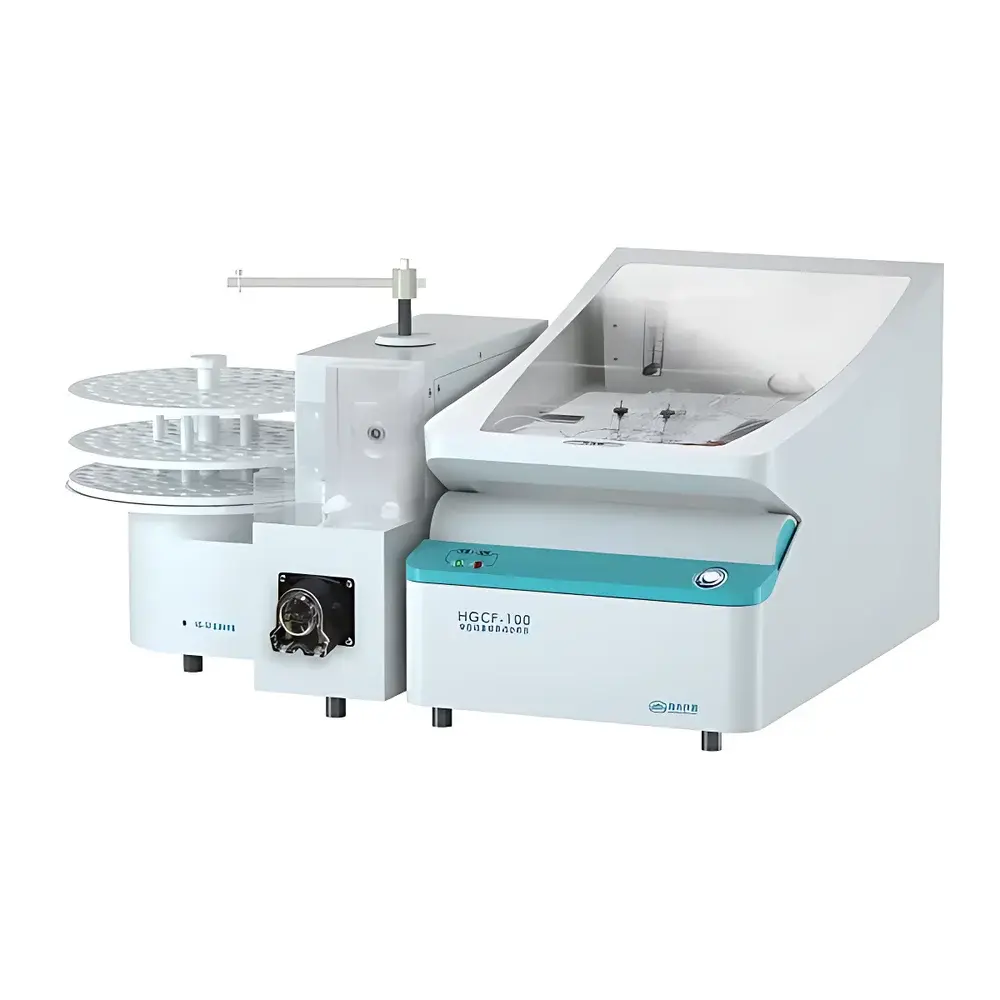
Haiguang HGCF-100 Automated Continuous Flow Analyzer
| Brand | Haiguang Instrument |
|---|---|
| Origin | Beijing, China |
| Model | HGCF-100 |
| Product Type | Continuous Flow Analyzer (CFA) |
| Air Segmentation Technology | Yes |
| Online Pretreatment Modules | Heating, Digestion, Distillation, Dialysis, Extraction, Deaeration |
| Detection Options | Full-spectrum CCD detector or high-sensitivity dual-beam silicon photodiode detector |
| Flow Cell Pathlength Options | 10 mm – 200 mm |
| Reaction Coil Material | Fused silica (2 mm ID) |
| Sample Introduction | Optional autosampler with automatic needle cleaning, programmable wash solution replacement, carbon fiber or borosilicate glass sampling probes |
| Compliance Standards | GB, HJ, EPA Methods (e.g., EPA 375.4, 450.1, 420.1), ISO 6878, ISO 11908, ISO 15681 |
Overview
The Haiguang HGCF-100 Automated Continuous Flow Analyzer is an engineered solution for high-throughput, regulatory-compliant wet-chemistry analysis in environmental, agricultural, food, and industrial laboratories. Based on the classical continuous flow analysis (CFA) principle—where samples and reagents are propelled through precisely dimensioned tubing under controlled laminar flow, segmented by discrete air bubbles to prevent cross-contamination—the HGCF-100 delivers reproducible, low-maintenance quantification of analytes in liquid matrices. Unlike flow injection analysis (FIA), CFA ensures complete reaction kinetics via extended residence time in thermostatically stabilized reaction coils and integrated heating/digestion modules. The system operates fully autonomously: from sample aspiration and online pretreatment (including distillation, dialysis, UV digestion, and steam distillation for volatile analytes) to photometric detection and data reporting. Its modular architecture supports parallel multi-parameter analysis across independent channels, each equipped with dedicated peristaltic pumping, chemical manifold, temperature-controlled reaction zone, and optical detection unit.
Key Features
- Modular channel design: Each analytical channel functions independently with its own peristaltic pump, fused-silica reaction coil (2 mm internal diameter), thermoregulated manifold, and optical detection system—enabling concurrent analysis of multiple parameters without cross-channel interference.
- Air-segmented flow technology: Ensures complete sample-reagent mixing, eliminates carryover, and maintains strict separation between discrete sample zones—critical for compliance with EPA and ISO methods requiring validated carryover control.
- Integrated online pretreatment: Fully automated in-line operations including precise reagent addition, homogenization, thermal digestion (up to 120 °C), steam distillation (for cyanide and phenol), membrane dialysis (for turbid or particulate-laden samples), and solvent extraction—minimizing manual intervention and method variability.
- Flexible detection configuration: Dual-detector support—full-spectrum CCD detector for simultaneous multi-wavelength measurement and background correction (e.g., compensation for turbidity or color interferences), or high-dynamic-range dual-beam silicon photodiode for enhanced stability and linearity in routine single-wavelength applications.
- Optimized optical path: Interchangeable flow cells with pathlengths from 10 mm to 200 mm allow sensitivity tuning per analyte—enabling trace-level detection (e.g., µg/L cyanide) or high-concentration measurement (e.g., mg/L phosphate) within the same platform.
- Low-maintenance fluidics: Chemically inert fused-silica reaction coils resist fouling and exhibit negligible memory effect—even in wastewater, sludge extracts, or high-salinity seawater matrices—reducing downtime and recalibration frequency.
Sample Compatibility & Compliance
The HGCF-100 is validated for use with aqueous environmental samples (surface water, groundwater, drinking water, seawater, wastewater effluent and influent), digested soil extracts, fertilizer solutions, milk and dairy products, tobacco homogenates, and food leachates. It meets methodological requirements of Chinese national standards (GB), ecological and environmental protection standards (HJ), U.S. EPA compendium methods—including EPA Method 375.4 (cyanide), 420.1 (phenols), 365.4 (phosphorus), and 353.2 (nitrate/nitrite)—as well as ISO standards ISO 6878 (phosphate), ISO 11908 (phenol), ISO 15681-1/-2 (phosphorus and nitrogen), and ISO 10304-1 (anions). System operation supports GLP/GMP-aligned audit trails, electronic signatures, and 21 CFR Part 11–compliant data integrity protocols when paired with optional compliant software modules.
Software & Data Management
Control and data acquisition are managed via Haiguang’s proprietary CFA-Studio software—a Windows-based application supporting method development, sequence programming, real-time monitoring, calibration curve generation (linear, quadratic, or cubic fit), QC flagging (e.g., drift, blank deviation, recovery failure), and automated report export (PDF, CSV, XML). The software logs all instrument events—including pump revolutions, valve actuation, temperature setpoints, lamp stabilization status, and detector signal baselines—with timestamped, user-attributed entries. Raw spectral data from the CCD detector is stored in vendor-neutral formats for third-party spectral processing. Data backups, role-based access control, and configurable audit trail retention align with laboratory quality management systems (QMS) per ISO/IEC 17025.
Applications
The HGCF-100 performs standardized determinations across diverse sectors: total and free cyanide (distillation + pyridine-barbituric acid), volatile phenols (4-aminoantipyrine), ammonia-nitrogen (salicylate or indophenol), orthophosphate and total phosphorus (ascorbic acid/molybdate), total nitrogen (persulfate digestion + cadmium reduction), nitrate/nitrite (diazotization), sulfide (methylene blue), hexavalent chromium (diphenylcarbazide), anionic surfactants (MBAS), chemical oxygen demand (COD, via dichromate reflux integration), permanganate index (KMnO₄ oxidation), and urea (diacetyl monoxime). It is routinely deployed in municipal water utilities, environmental monitoring stations, agrochemical testing labs, dairy quality control facilities, and contract environmental laboratories conducting routine compliance testing.
FAQ
Does the HGCF-100 support EPA-certified methods out-of-the-box?
Yes—pre-configured method templates for EPA 375.4, 420.1, 365.4, and 353.2 are included, with hardware validation documentation and performance qualification (PQ) test protocols.
Can the system handle highly turbid or suspended-solid samples without filtration?
Yes—integrated dialysis and inline filtration modules enable direct analysis of wastewater, digested sludge, or soil extracts without manual pre-filtration.
Is remote monitoring or LIMS integration possible?
The system supports OPC UA and ASTM E1384-compliant data export; custom API integration with major LIMS platforms (e.g., LabWare, STARLIMS, Thermo SampleManager) is available upon request.
What maintenance intervals are recommended for routine operation?
Peristaltic pump tubing should be replaced every 500–800 hours of operation; fused-silica coils require no scheduled replacement but are inspected quarterly during PQ verification.
How is calibration traceability maintained?
Certified reference materials (CRMs) traceable to NIST or CNAS-accredited providers are used for initial calibration; system suitability checks (SSCs) are performed before each analytical batch per ISO 8466-1 guidelines.




