
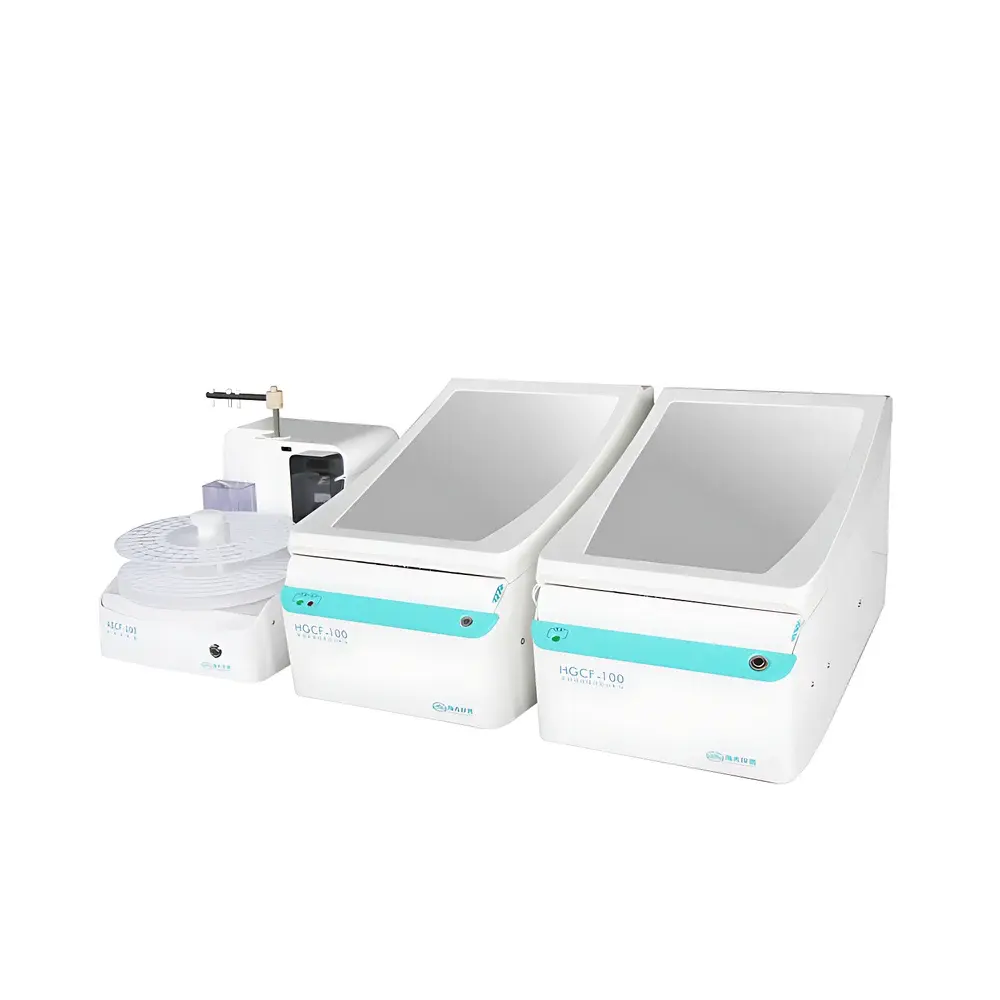
Haiguang HGCF-100 Continuous Flow Analyzer
| Brand | Haiguang Instrument |
|---|---|
| Origin | Beijing, China |
| Manufacturer Type | Authorized Distributor |
| Country of Origin | China |
| Model | HGCF-100 |
| Price Range | USD 28,000 – 70,000 |
| Instrument Type | Laboratory Water Quality Analyzer |
| Measured Parameters | Total Cyanide, Free Cyanide, Volatile Phenols, Anionic Surfactants (LAS), Ammonia-Nitrogen (NH₃-N), Orthophosphate, Total Phosphorus, Total Nitrogen, Sulfides, Hexavalent Chromium (Cr⁶⁺), Nitrate, Nitrite, Permanganate Index (CODₘₙ), Urea |
Overview
The Haiguang HGCF-100 Continuous Flow Analyzer (CFA) is a fully automated, laboratory-grade analytical platform engineered for high-throughput, multi-parameter water and environmental matrix analysis. Based on segmented continuous flow (SCF) methodology—specifically air-segmented flow with precise fluidic control—the system delivers reproducible, low-background quantification by physically isolating discrete sample zones with air bubbles in narrow-bore PTFE or quartz tubing. This architecture minimizes carryover, suppresses diffusion-driven mixing, and ensures stoichiometric reaction completeness under controlled residence time and temperature. The HGCF-100 operates across a broad spectrum of regulatory-compliant colorimetric and photometric methods, including salicylate, molybdate, diazotization, and chromotropic acid-based chemistries, enabling trace-level detection in complex matrices such as municipal wastewater, industrial effluents, soil extracts, and marine samples without manual pretreatment.
Key Features
- Air-segmented continuous flow architecture with 2 mm internal diameter fused quartz reaction coils—chemically inert, low-memory, high-transmittance, and resistant to clogging from particulate-laden samples.
- Integrated online pre-treatment module supporting automated digestion (acid/alkaline), distillation (steam-trap or blow-down), dialysis, liquid–liquid extraction, heating (up to 100 °C), and degassing—all programmable per method sequence.
- Dual optical detection options: (a) Full-spectrum CCD detector enabling simultaneous multi-wavelength acquisition for background correction (e.g., turbidity compensation, dual-wavelength ratioing); or (b) Dual-beam silicon photodiode detector with extended dynamic range (>4 OD), optimized for high-sensitivity single-wavelength assays.
- Low-power, long-life LED light sources with rapid thermal stabilization (<30 s), delivering stable intensity across 340–900 nm spectral range depending on configuration.
- Modular, project-specific channel design: each analyte pathway operates independently with dedicated pumps, reactors, detectors, and waste lines—eliminating cross-contamination and enabling concurrent multi-analyte runs.
- Automated fluid handling: robotic autosampler with self-cleaning probe (carbon fiber or borosilicate glass tip), programmable dilution, reagent addition, mixing, and post-run system flush using configurable wash cycles and solvent switching.
- Variable-pathlength flow cells (10–200 mm) allow optimization of sensitivity vs. linear range for diverse analytes—from sub-ppb ammonia-N to high-mg/L phosphate concentrations.
Sample Compatibility & Compliance
The HGCF-100 is validated for use with aqueous environmental matrices including surface water, groundwater, drinking water, seawater, municipal and industrial wastewater, soil leachates, fertilizer extracts, tobacco homogenates, dairy products, and agricultural feedstocks. It conforms to over 20 internationally recognized standard methods, including HJ 665–670, HJ 667, CJJ/T 141, SL/T 788, NY/T 1121.7, NY/T 1228, ISO 14402, ISO 14403, ISO 23913, and ISO 15681-2. All method implementations support full audit trail generation, electronic signature capability, and data integrity controls aligned with GLP and GMP principles. When configured with secure user authentication and instrument log archiving, the system meets foundational requirements for FDA 21 CFR Part 11 compliance in regulated laboratories.
Software & Data Management
Control and data acquisition are managed via Haiguang’s proprietary CFA Control Suite—a Windows-based application supporting method development, sequence scheduling, real-time signal monitoring, peak integration, calibration curve fitting (linear, quadratic, or cubic), and QC flagging (e.g., drift, blank exceedance, recovery failure). Raw absorbance/time profiles and processed results are stored in structured SQLite databases with timestamped metadata (operator ID, instrument status, ambient temperature, reagent lot numbers). Export formats include CSV, PDF reports (with customizable templates), and LIMS-compatible ASTM E1384 or HL7 ADT messages. System diagnostics—including pump pressure logs, lamp intensity decay tracking, and valve cycle counters—are recorded automatically for preventive maintenance planning.
Applications
The HGCF-100 serves as a core analytical workhorse in environmental testing laboratories accredited to ISO/IEC 17025, municipal water quality control centers, EPA-certified contract labs, agricultural research institutes, and food safety monitoring programs. Its robustness in handling high-TSS wastewater enables routine compliance monitoring for NPDES permits. In soil testing, it supports nutrient profiling (NPK) and contaminant screening (Cr⁶⁺, CN⁻) per national agricultural standards. For food and beverage applications, it quantifies residual nitrites in cured meats, urea in milk powder, and phenolic contaminants in plant-based extracts—replacing labor-intensive batch spectrophotometry with walk-away automation and statistical process control-ready output.
FAQ
What sample preparation is required prior to analysis?
Minimal to none: raw, unfiltered, and undegassed samples can be directly introduced. The integrated online pretreatment modules handle filtration-equivalent functions (dialysis), degassing (vacuum or purge), and matrix removal (extraction/distillation) automatically.
Can the HGCF-100 be integrated into an existing LIMS environment?
Yes—via configurable ODBC drivers and ASCII/CSV export protocols; optional HL7 or ASTM E1384 message mapping is available upon request.
How is method validation supported?
The system includes built-in tools for spike recovery assessment, calibration verification standards, reagent blank trending, and long-term stability monitoring—fully documented in accordance with ISO/IEC 17025 clause 7.7.
What maintenance intervals are recommended?
Pump tubing replacement every 3–6 months (depending on usage), quartz coil inspection quarterly, and annual optical alignment verification—guided by embedded maintenance scheduler and service log export.
Is remote monitoring or troubleshooting possible?
Remote desktop access (via secure VPN) and diagnostic telemetry (pump voltage, detector dark current, temperature logs) are enabled through optional IT security-compliant firmware modules.
Related Products







