
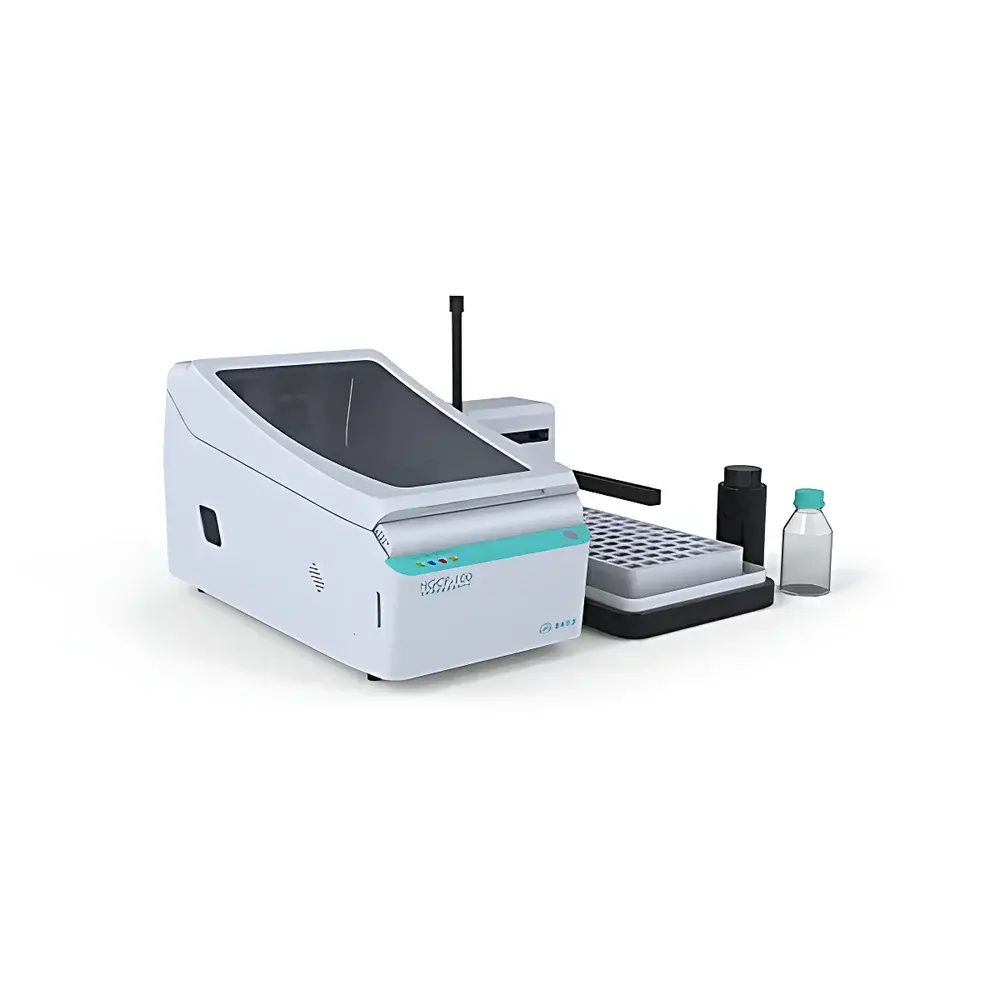
Haiguang HGCF-100 Continuous Flow Analyzer for Cyanide Determination
| Brand | Haiguang Instrument |
|---|---|
| Origin | Beijing, China |
| Manufacturer Type | Authorized Distributor |
| Regional Classification | Domestic (China) |
| Model | HGCF-100 Cyanide |
| Price Range | USD 21,000 – 42,000 (FOB Beijing) |
| Instrument Type | Benchtop Laboratory Analyzer |
Overview
The Haiguang HGCF-100 Continuous Flow Analyzer (CFA) for cyanide determination is a fully automated benchtop analytical platform engineered for high-throughput, trace-level quantification of total and free cyanide in complex aqueous matrices. Based on segmented continuous flow analysis (SCFA) with air-segmented stream technology, the system isolates discrete sample zones using precisely metered air bubbles—eliminating carryover, minimizing dispersion, and ensuring complete reaction kinetics under controlled residence time. Unlike manual or discrete analyzer workflows, the HGCF-100 integrates all critical steps—including online distillation, acidification, ligand release, colorimetric derivatization (e.g., pyridine-barbituric acid or ISO 6703-1 compliant methods), optical detection, and system regeneration—into a single, unattended sequence. Its modular channel architecture enables parallel processing of multiple analytes, while its closed-loop fluidic design meets stringent environmental laboratory requirements for operator safety and reagent containment.
Key Features
- Modular, channel-independent architecture: Each dedicated analysis channel integrates a peristaltic pump, chemically inert quartz reaction coil (2 mm i.d.), temperature-controlled reaction manifold, and optical detection unit—enabling concurrent multi-analyte operation without cross-contamination.
- Air-segmented continuous flow technology: Ensures quantitative sample segmentation, reproducible reaction timing, and near-zero memory effect—critical for compliance with EPA Method 335.4, ISO 6703-1, and HJ 484–2009.
- Integrated online pretreatment: Fully automated distillation (for total cyanide), acid hydrolysis, UV digestion (for complex-bound species), dialysis, and gas-diffusion separation—all performed in-line without manual intervention.
- Optical detection flexibility: Supports dual detection modes—full-spectrum CCD detector (190–850 nm) for multi-wavelength background correction and spectral deconvolution, or dual-beam silicon photodiode detector with extended dynamic range (0–3.5 AU) and <0.001 AU baseline stability over 8-hour runs.
- Low-maintenance fluidics: Quartz reaction coils (2 mm i.d.) provide superior chemical resistance to strong acids, alkalis, and oxidants; no pre-filtration or degassing of samples required—even for raw wastewater or sediment extracts.
- Energy-efficient LED light sources: Cold-white LEDs (365 nm & 540 nm standard) deliver stable intensity (>10,000 h lifetime), sub-second warm-up, and negligible thermal drift—ensuring long-term photometric reproducibility.
- Configurable flow cell options: Interchangeable cuvettes (10 mm to 200 mm pathlength) allow optimization of sensitivity (sub-µg/L for cyanide) and linear dynamic range (up to 5 mg/L).
Sample Compatibility & Compliance
The HGCF-100 is validated for direct analysis of untreated or minimally prepared samples across diverse environmental and industrial matrices—including surface water, groundwater, drinking water, seawater, municipal and industrial wastewater, soil leachates, tobacco extracts, dairy products, and fertilizer solutions. It complies with method requirements for total cyanide (distillation + colorimetry), free cyanide (diffusion + spectrophotometry), and co-analyzed parameters such as phenols, ammonia nitrogen, phosphate, nitrate, sulfide, Cr(VI), and permanganate index. Regulatory alignment includes GB/T 7486–1987, HJ 484–2009, EPA Methods 335.4 and 375.1, ISO 6703-1:2018, and ASTM D7511–18. The system supports audit-ready data integrity via electronic signatures, full audit trail logging, and optional 21 CFR Part 11-compliant software configuration.
Software & Data Management
Control and data acquisition are managed through Haiguang’s CFA-Studio v4.x software—a Windows-based application supporting method development, real-time chromatogram visualization, peak integration (tangent skim, valley-to-valley), calibration curve fitting (linear, quadratic, or weighted least-squares), QC flagging (LCL/UCL, %RSD, recovery thresholds), and automated report generation in PDF/CSV/XLSX formats. All instrument events—including valve actuation, pump speed changes, heater status, and detector voltage—are timestamped and stored with raw spectral data. Raw data files are immutable; modifications require documented reason codes and user authentication. Optional LIMS connectivity (via ASTM E1384 or HL7 interfaces) enables seamless integration into GLP/GMP-compliant laboratory workflows.
Applications
The HGCF-100 serves as a core platform for environmental monitoring laboratories conducting routine compliance testing under national discharge permits and drinking water standards. Its robustness in high-salinity, high-turbidity, and high-organic-load matrices makes it especially suitable for wastewater treatment plant effluent monitoring, landfill leachate characterization, and mining site runoff assessment. In food and agricultural testing, it supports rapid screening of cyanogenic glycosides in cassava, almonds, and feedstuffs. The system also supports research applications requiring kinetic profiling of cyanide speciation (e.g., CN⁻ vs. Fe(CN)₆⁴⁻), method validation studies, and inter-laboratory comparison exercises aligned with ISO/IEC 17043 proficiency testing schemes.
FAQ
What regulatory methods does the HGCF-100 support for total cyanide analysis?
It is validated for EPA Method 335.4, ISO 6703-1:2018, HJ 484–2009, and GB/T 7486–1987—covering distillation, ligand release, and colorimetric detection.
Can the system analyze cyanide in saline or wastewater samples without dilution?
Yes—the quartz flow path, corrosion-resistant valves, and adaptive baseline correction algorithms enable direct analysis of seawater and raw wastewater up to 35 g/L TDS.
Is method transfer from manual wet chemistry possible?
Absolutely—CFA-Studio includes template wizards for recreating APHA Standard Methods and ISO protocols, with automatic conversion of reaction times, reagent concentrations, and detection wavelengths.
How is carryover minimized between high-concentration and low-concentration samples?
Air segmentation physically isolates samples; combined with post-run high-flow flush cycles (programmable volume/speed) and integrated needle-wash stations, carryover remains below 0.1% for 100 µg/L → 1 µg/L transitions.
Does the system support remote monitoring and diagnostics?
Yes—optional Ethernet/IP connectivity enables secure remote access for real-time status checks, log review, and firmware updates via TLS-encrypted web interface.







