
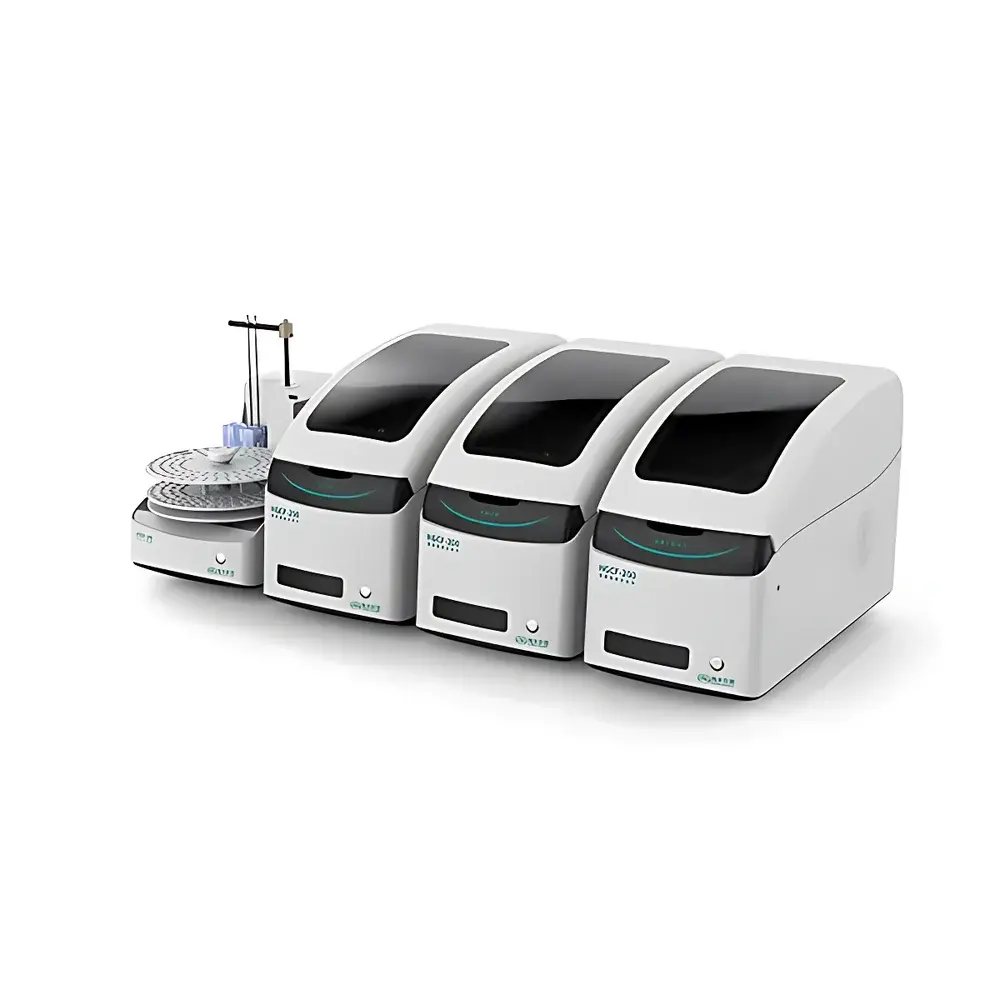
Haiguang HGCF-200 Continuous Flow Analyzer
| Brand | Haiguang Instrument |
|---|---|
| Origin | Beijing, China |
| Model | HGCF-200 / HGCF-210 |
| Instrument Type | Laboratory Water Quality Analyzer |
| Detection Parameters | Total Cyanide, Free Cyanide, Volatile Phenol, Anionic Detergents, Ammonia Nitrogen (NH₃-N), Orthophosphate, Total Phosphorus, Total Nitrogen, Sulfide, Hexavalent Chromium (Cr⁶⁺), Nitrate, Nitrite, Permanganate Index (CODₘₙ), Urea |
| Compliance Standards | HJ 665–2013, HJ 670–2013, HJ 667–2013, CJT 141–2018, SL/T 788–2019, NY/T 1121.7–2014, NY/T 1228–2015, ISO 14403:2012, ISO 14402:1999, ISO 23913:2016, ISO 15681-2:2003 |
| Optical Detection | Dual-beam silicon photodetector or full-spectrum CCD detector |
| Flow Cell Pathlength Options | 10 mm to 200 mm |
| Reaction Coil | 2 mm i.d. quartz mixing coil |
| Sample Introduction | Automated sampler with carbon fiber or borosilicate glass probe, auto-cleaning and wash solution auto-replacement |
| Online Pretreatment | Integrated heating, digestion, distillation, dialysis, extraction, degassing, dilution, and mixing modules |
| Light Source | Low-power LED with short stabilization time and >10,000 h lifetime |
Overview
The Haiguang HGCF-200 Continuous Flow Analyzer (CFA) is a laboratory-grade automated wet-chemistry platform engineered for high-throughput, multi-parameter water and environmental matrix analysis. Based on segmented flow analysis (SFA) principles—specifically air-segmented continuous flow technology—the system introduces discrete, gas-isolated sample and reagent zones into a precisely controlled carrier stream. This architecture ensures complete reaction homogeneity, eliminates carryover between samples, and maintains strict stoichiometric control throughout the analytical sequence. Unlike discrete batch analyzers, the HGCF-200 operates in true steady-state mode: once baseline equilibrium is achieved, optical detection occurs continuously under constant hydrodynamic and chemical conditions, delivering superior precision (RSD < 1.5% for most parameters) and long-term signal stability. Its design targets compliance-driven laboratories performing routine regulatory testing across municipal, industrial, and research water quality programs—including wastewater treatment plants, environmental monitoring agencies, and accredited testing labs operating under ISO/IEC 17025 frameworks.
Key Features
- Modular, project-specific channel architecture: Each analytical parameter (e.g., NH₃-N, Cr⁶⁺, total cyanide) is implemented in an independent, physically isolated flow path—enabling concurrent multi-analyte determination without cross-contamination or method interference.
- Quartz reaction manifold with 2 mm internal diameter: Chemically inert, low-memory quartz tubing minimizes adsorption of trace metals and organic analytes; its smooth bore resists clogging even with turbid or particulate-laden samples (e.g., digested sludge extracts or raw sewage).
- Integrated online pretreatment suite: Fully automated thermal digestion (up to 120 °C), steam distillation (for volatile phenols and cyanides), dialysis (for complex matrices), liquid–liquid extraction, and programmable dilution—all executed inline without manual intervention.
- Dual optical detection options: Select either a high-dynamic-range dual-beam silicon photodetector (ideal for single-wavelength, high-sensitivity applications such as sulfide or nitrite) or a full-spectrum CCD array detector (enabling simultaneous multi-wavelength acquisition for background correction, spectral deconvolution, and method flexibility).
- Variable-pathlength flow cells (10–200 mm): Optimized absorbance sensitivity per analyte—short cells for high-concentration parameters (e.g., phosphate in fertilizer leachates), longer cells for ultra-trace detection (e.g., Cr⁶⁺ at µg/L levels).
- Intelligent autosampler with dual-probe support: Carbon-fiber or borosilicate glass sampling needles; fully automated needle rinsing using programmable wash solutions with real-time fluid-level monitoring and automatic wash-bath replenishment.
Sample Compatibility & Compliance
The HGCF-200 is validated for use with diverse aqueous and semi-solid environmental matrices—including surface water, groundwater, drinking water, seawater, domestic and industrial wastewater, soil extracts (via EPA Method 3050B or HJ 491–2019 digestion), tobacco leachates, dairy effluents, and agricultural runoff. It meets or exceeds performance criteria defined in over 15 national and international standard methods: HJ 665–2013 (ammonia nitrogen), HJ 670–2013 (phosphate), ISO 14403:2012 (cyanide), ISO 23913:2016 (Cr⁶⁺), and ISO 15681-2:2003 (phosphorus). All hardware and software components are designed to support GLP and GMP workflows, including full audit trail logging, electronic signature capability, and data integrity features aligned with FDA 21 CFR Part 11 requirements when deployed with compliant LIMS integration.
Software & Data Management
Control and data acquisition are managed via Haiguang’s CFA-Studio v4.x software—a Windows-based application supporting method development, sequence scheduling, real-time chromatogram visualization, peak integration, calibration curve fitting (linear, quadratic, or cubic), and QC flagging (e.g., drift, blank elevation, recovery failure). Raw data files are stored in vendor-neutral .csv and .xml formats; metadata—including instrument configuration, reagent lot numbers, operator ID, and environmental sensor logs (temperature, pressure)—is embedded per analysis. The software supports direct export to LIMS via ASTM E1384-compliant interfaces and includes built-in reporting templates compliant with CNAS, CMA, and EPA reporting structures.
Applications
- Regulatory compliance monitoring for municipal wastewater discharge permits (e.g., NPDES, GB 18918–2002)
- Drinking water safety verification per GB 5749–2022 and WHO guidelines
- Soil and sediment toxicity screening in ecological risk assessments
- Industrial effluent characterization in petrochemical, pharmaceutical, and food processing facilities
- Research-scale nutrient cycling studies (N/P/K dynamics) in limnology and marine biogeochemistry
- Method validation and reference material certification in national metrology institutes
FAQ
Does the HGCF-200 support unattended overnight operation?
Yes—fully automated sequences, including startup, calibration, sample analysis, post-run cleaning, and shutdown, can be scheduled and executed without operator presence.
Can the system analyze suspended solids-containing samples without filtration?
Yes—integrated inline filtration is not required; the quartz flow path and high-flow-rate carrier stream accommodate samples with ≤50 mg/L total suspended solids (TSS) when paired with optional ultrasonic degassing and pulse dampening modules.
Is method transfer from existing segmented flow systems possible?
Yes—CFA-Studio supports import of method parameters (flow rates, timing, wavelengths, temperature setpoints) from legacy platforms, enabling rapid validation and equivalence testing per ISO 17025 clause 7.2.2.
What maintenance intervals are recommended for routine operation?
Daily: Needle cleaning verification and waste bottle check. Weekly: Carrier line flush with 10% nitric acid. Quarterly: Quartz coil inspection and detector alignment verification. Annual: Full pump tubing replacement and photometric calibration with NIST-traceable standards.
How is data integrity ensured during regulatory audits?
All user actions, instrument events, and analytical results are timestamped and logged in an immutable database with role-based access control; audit trails are exportable in PDF/A-2 format and include cryptographic hash verification for tamper detection.
Related Products







