
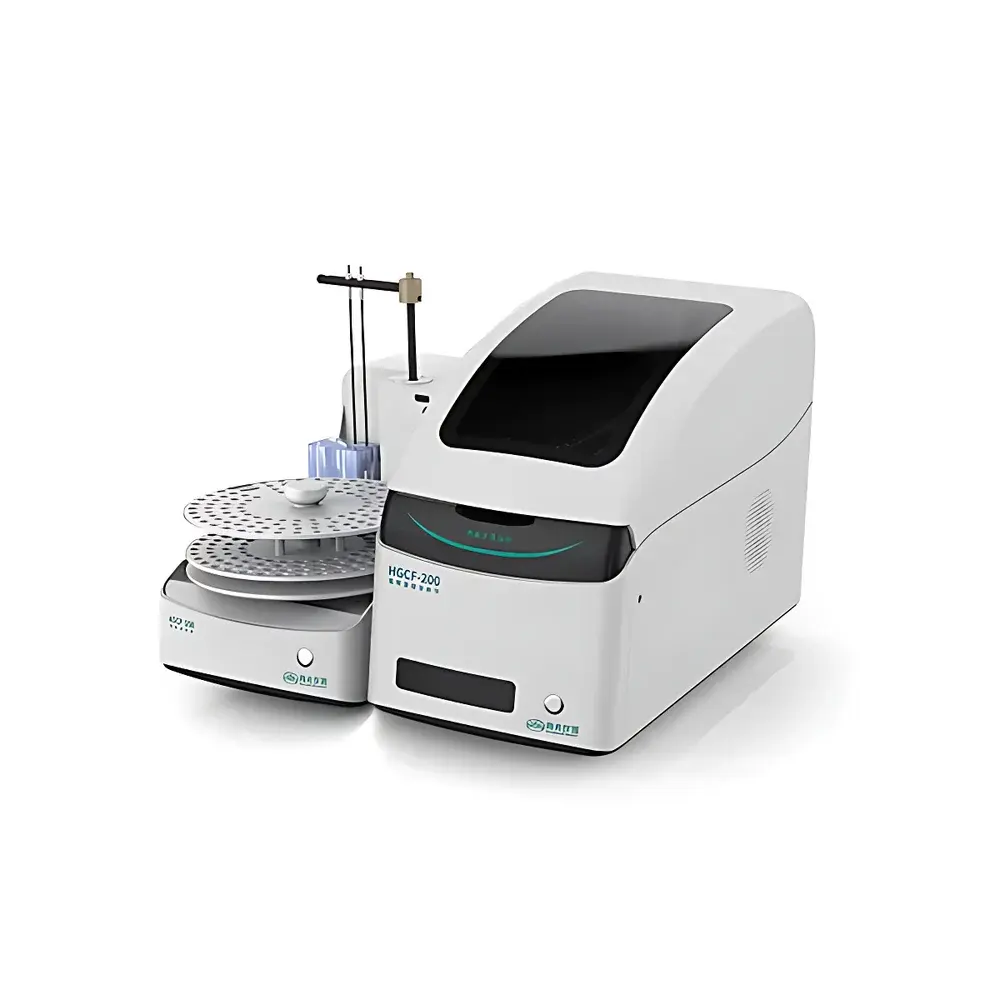
Haiguang HGCF-200 Continuous Flow Analyzer (Ammonia Nitrogen)
| Brand | Haiguang Instrument |
|---|---|
| Origin | Beijing, China |
| Model | HGCF-200 Ammonia Nitrogen |
| Measurement Principle | Colorimetric Flow Analysis (Salicylate Method) |
| Measurement Range | 0.01–5 mg/L NH₃–N |
| Detection Limit | ≤0.005 mg/L NH₃–N |
| Accuracy | ±1% of reading |
| Sample Throughput | 30 samples/hour |
| Batch Capacity | Unlimited |
| Optical Cell Material | Fused quartz |
| Light Source | Low-power LED |
| Detector | Full-spectrum CCD with built-in monochromator |
| Online Dilution Ratio | 1–5000× |
| Reaction Tubing ID | ≥2 mm |
| Compliance | HJ 665-2013, HJ 670-2013, HJ 667-2013, ISO 14403:2012, ISO 14402:1999, ISO 23913:2016, ISO 15681-2:2003 |
Overview
The Haiguang HGCF-200 Continuous Flow Analyzer (Ammonia Nitrogen) is a laboratory-grade automated wet-chemistry platform engineered for high-precision, high-throughput determination of ammonia nitrogen (NH₃–N) in environmental and industrial water matrices. It operates on the principle of segmented continuous flow analysis (CFA), utilizing air segmentation to isolate discrete sample and reagent zones within chemically inert fused quartz tubing. This architecture ensures complete reaction homogeneity, eliminates carryover between samples, and maintains steady-state photometric detection—critical for achieving sub-ppb detection limits and long-term baseline stability. The system implements the standardized salicylate-hypochlorite colorimetric method per HJ 665-2013 and ISO 14403:2012, generating a stable indophenol blue complex measurable at 655 nm. Unlike discrete analyzers or batch spectrophotometers, the HGCF-200 delivers reproducible kinetic control over reaction time, temperature, and mixing efficiency—key parameters governing assay specificity and robustness across heterogeneous sample types including wastewater, seawater, soil extracts, and dairy effluents.
Key Features
- Air-segmented flow architecture with fused quartz main manifold (ID ≥2 mm), minimizing memory effects and enabling direct analysis of turbid or particulate-laden samples without pre-filtration or degassing
- Integrated online pretreatment modules: programmable steam distillation unit for volatile ammonia liberation, UV digestion cell for organic nitrogen conversion, and dedicated bubble removal system for gas-sensitive assays
- Modular optical detection system featuring a thermally stabilized LED light source and full-spectrum CCD detector with internal monochromator—supporting dual-wavelength referencing, automatic baseline correction, and real-time drift compensation without mechanical filters
- Onboard precision dilution module (1–5000× range) co-located with the autosampler, enabling single-point calibration curve generation and auto-dilution of out-of-range samples prior to analysis
- Flexible autosampling options: polar-coordinate or 3D Cartesian configurations; variable rack capacity (up to 216 positions); dual-needle mode for parallel reagent/sample aspiration; integrated needle wash station with programmable solvent exchange
- Unified hardware-software architecture with embedded sensor network monitoring reagent levels, tubing pressure, waste volume, and lamp intensity—feeding real-time diagnostics into the LIMS-compatible control interface
Sample Compatibility & Compliance
The HGCF-200 is validated for use with diverse aqueous and extractive matrices, including surface water, groundwater, drinking water, seawater, municipal and industrial wastewater, soil leachates, fertilizer solutions, tobacco extracts, milk whey, and food processing effluents. Its robust fluidic design accommodates samples with suspended solids up to 50 mg/L and turbidity ≤100 NTU without clogging. Regulatory compliance is embedded at the system level: method protocols are pre-configured for HJ 665-2013 (ammonia nitrogen), HJ 670-2013 (phosphate), HJ 667-2013 (total nitrogen), and multiple ISO standards (ISO 14402, ISO 14403, ISO 23913, ISO 15681-2). All analytical sequences support audit-trail logging, electronic signatures, and data integrity controls aligned with GLP and EPA-compliant laboratory practices. The system meets hardware-level requirements for 21 CFR Part 11 readiness when deployed with validated software versions.
Software & Data Management
Control and data acquisition are managed via Haiguang’s CFA Studio v4.x software—a Windows-based application supporting method development, sequence scheduling, real-time chromatogram visualization, peak integration, and QC charting (Levey-Jennings, Shewhart). Raw absorbance data, spectral scans, and diagnostic logs are stored in vendor-neutral .csv and .xml formats. The software includes built-in validation tools for linearity assessment (r² ≥0.999), LOD/LOQ calculation per ICH Q2(R2), and recovery spike analysis. Data export modules support direct transmission to LIMS via ASTM E1384-compliant HL7 messaging or ODBC connectivity. Audit trails record all user actions—including method edits, calibration updates, and result overrides—with timestamps, operator IDs, and IP addresses. Software configuration files are digitally signed and version-controlled to ensure traceability during regulatory inspections.
Applications
The HGCF-200 supports fully automated quantification of over 15 water quality parameters beyond ammonia nitrogen, including total cyanide, free cyanide, phenols, anionic surfactants, orthophosphate, total phosphorus, total nitrogen, sulfide, hexavalent chromium, nitrate, nitrite, permanganate index (CODMn), and urea. Its modular flow path allows rapid method switching via software-defined valve sequencing—eliminating manual tubing reconfiguration. In municipal wastewater treatment plants, it enables daily compliance monitoring of NH₃–N discharge limits under national emission standards. In research laboratories, it facilitates kinetic studies of nitrification/denitrification processes in activated sludge reactors. Environmental monitoring agencies deploy it for multi-parameter river basin surveys, while agricultural labs utilize its soil-extract compatibility for nutrient profiling in fertilized fields.
FAQ
What regulatory methods does the HGCF-200 natively support for ammonia nitrogen analysis?
HJ 665-2013 (China), ISO 14403:2012 (international), and EPA Method 350.1 (with minor protocol adaptation).
Can the system analyze undiluted wastewater samples with high TSS content?
Yes—the ≥2 mm ID quartz manifold and air-segmented flow design permit direct injection of samples containing ≤50 mg/L suspended solids without filtration.
Is UV digestion included as standard equipment or optional?
The high-efficiency UV digestion module is factory-integrated and enabled by default for total nitrogen and organic-bound nitrogen assays.
How is calibration verification performed across extended operation?
The system performs automated bracketing checks using mid-level standards every 10 samples and triggers alarm if %RSD exceeds 3% across triplicate injections.
Does the software support remote monitoring and troubleshooting?
Yes—via secure HTTPS web interface with live status dashboards, diagnostic logs, and firmware update capability through authenticated admin access.







