
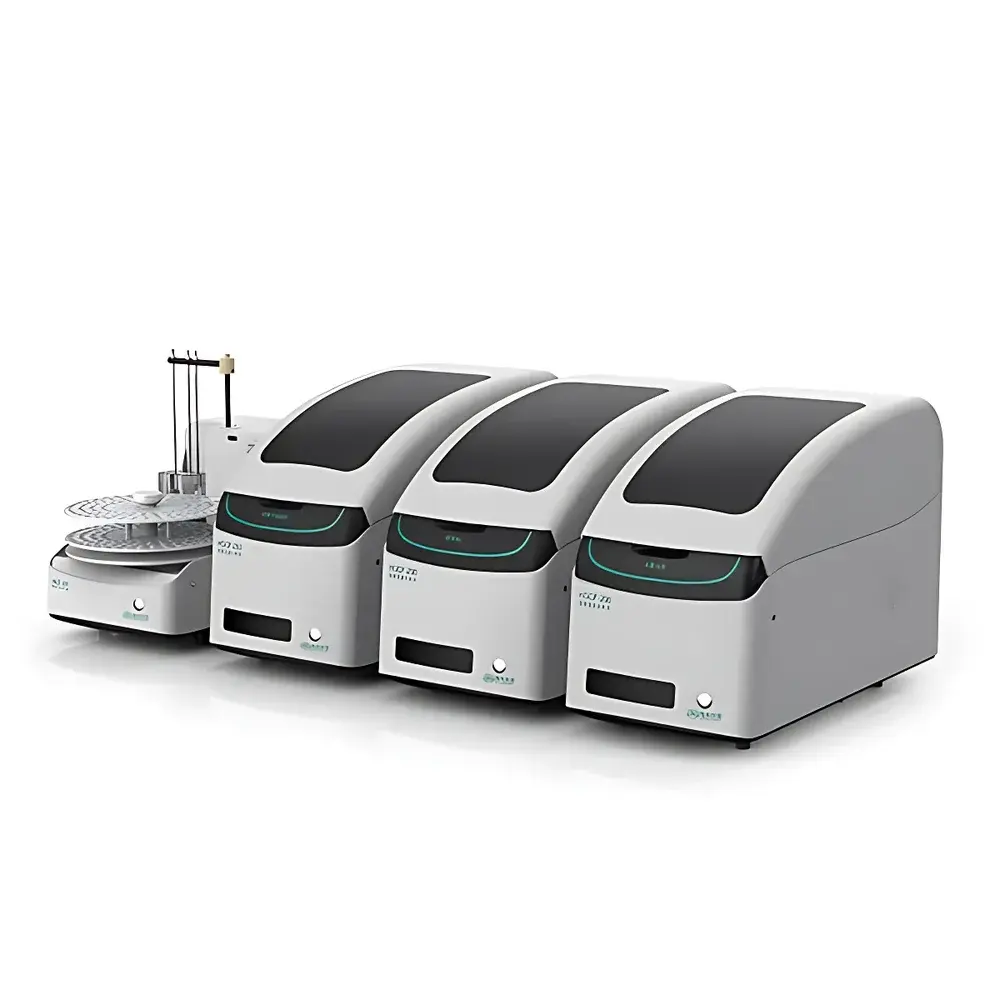
Haiguang HGCF-200 Series Continuous Flow Analyzer
| Brand | Haiguang Instrument |
|---|---|
| Origin | Beijing, China |
| Manufacturer Type | Authorized Distributor |
| Product Category | Domestic |
| Model | HGCF-200 |
| Price Range | USD 70,000 – 100,000 (FOB China) |
| Instrument Type | Continuous Flow Analyzer (CFA) |
| Detection Principle | Segmented Flow Spectrophotometry with Air Segmentation |
| Optical Detection Options | Full-spectrum CCD detector or high-sensitivity dual-beam silicon photodiode detector |
| Flow Cell Pathlength Options | 10 mm to 200 mm |
| Reaction Coil Material | Fused silica (2 mm inner diameter) |
| Integrated Sample Pretreatment | On-line digestion, distillation (steam distillation/blow-out), dialysis, extraction, heating, mixing, dilution, degassing, and auto-cleaning |
| Compliance Standards | ASTM D3869, ISO 14402, ISO 14403, ISO 23913, ISO 15681-2, HJ 665–667, HJ 670, CJJ/T 141, SL/T 788, NY/T 1121.7, NY/T 1228 |
Overview
The Haiguang HGCF-200 Series Continuous Flow Analyzer is an engineered platform for high-throughput, regulatory-compliant wet-chemistry analysis of environmental, agricultural, food, and industrial samples. It operates on the principle of segmented continuous flow analysis (CFA), where discrete sample and reagent segments are separated by precisely controlled air bubbles in a narrow-bore fused silica manifold. This segmentation eliminates carryover, ensures complete reaction kinetics under defined residence time, and enables true steady-state photometric detection—delivering reproducible quantification across complex matrices such as wastewater, soil extracts, seawater, and dairy products. Unlike flow injection analysis (FIA), the HGCF-200 maintains constant flow velocity and segment geometry throughout the entire analytical cycle, supporting full method traceability and compliance with GLP/GMP and EPA-equivalent validation frameworks.
Key Features
- Fused silica reaction coils (2 mm ID): Chemically inert, low memory effect, high resistance to clogging, and compatible with aggressive reagents including strong acids, oxidants, and organic solvents.
- Air-segmented flow architecture: Enables quantitative separation between samples and reagents, minimizing cross-contamination and ensuring stoichiometric reaction completeness—even for slow-kinetic assays like total nitrogen or cyanide liberation.
- Integrated on-line pretreatment module: Supports steam distillation (for ammonia, cyanide, phenol), UV/persulfate digestion (for total phosphorus/nitrogen), dialysis (for turbid or particulate-laden samples), solvent extraction (e.g., anionic surfactants), and temperature-controlled heating (up to 120 °C).
- Dual optical detection options: A full-spectrum CCD detector allows simultaneous multi-wavelength acquisition (e.g., reference + analyte bands) for real-time background correction; alternatively, a dual-beam silicon photodiode offers wide dynamic range (>4 OD), high signal stability, and sub-second response time.
- Modular assay design: Each parameter (e.g., NH₃-N, PO₄³⁻, CN⁻, Cr⁶⁺) is implemented as an independent fluidic channel with dedicated pumps, coils, and detectors—enabling concurrent multi-analyte analysis without hardware reconfiguration.
- Automated liquid handling: Precision syringe-driven peristaltic pumps with pressure monitoring ensure accurate reagent delivery; auto-washing of sampling probes (carbon fiber or borosilicate glass) includes programmable rinse solution exchange to prevent residue accumulation.
Sample Compatibility & Compliance
The HGCF-200 is validated for use with liquid, slurry, and digested solid-phase samples—including raw sewage, groundwater, marine water, soil leachates, fertilizer solutions, milk homogenates, and tobacco extracts. Its robust fluidic architecture tolerates suspended solids up to 50 mg/L without filtration and dissolved CO₂ without prior degassing. Method equivalence is documented against major international standards: ISO 14402 (phenol), ISO 14403 (cyanide), ISO 23913 (Cr⁶⁺), ISO 15681-2 (phosphate), ASTM D3869 (nitrate), and Chinese national standards HJ 665–667, HJ 670, SL/T 788, and NY/T 1121.7. All system logs—including reagent consumption, pressure profiles, calibration history, and audit trails—are timestamped and exportable in CSV/Excel format, satisfying FDA 21 CFR Part 11 requirements when deployed with compliant LIMS integration.
Software & Data Management
The embedded control software provides intuitive method editor with drag-and-drop flow path configuration, real-time pressure and absorbance monitoring, and automated QC flagging (e.g., baseline drift >2% over 30 min). Calibration curves support linear, quadratic, and 4-/5-parameter logistic fitting with automatic outlier rejection. Raw spectral data (CCD mode) and time-resolved analog signals (photodiode mode) are stored with metadata (operator ID, sample ID, instrument state). Data export complies with ASTM E1384 and ISO/IEC 17025 reporting templates. Optional API integration supports bidirectional communication with laboratory information management systems (LIMS) via HL7 or RESTful endpoints.
Applications
The HGCF-200 serves routine testing laboratories requiring high sample throughput (>50 samples/hour per channel) and long-term unattended operation. Primary application domains include municipal wastewater treatment plants (NH₃-N, TN, TP, CN⁻ monitoring), environmental monitoring agencies (EPA Method 350.1/354.1 equivalents), agrochemical QA/QC (soil N/P, fertilizer P₂O₅), food safety labs (milk urea, nitrate in vegetables), and drinking water utilities (Cl⁻ interference-free phenol detection). Its ability to handle viscous or particulate-rich samples—without manual filtration—reduces labor cost by >60% compared to discrete analyzers.
FAQ
What detection principles does the HGCF-200 support?
Segmented continuous flow spectrophotometry with air segmentation, optionally enhanced by on-line distillation, digestion, or extraction modules.
Is the system compliant with ISO/IEC 17025 and US EPA methods?
Yes—method equivalency is verified against ISO 14402, ISO 14403, ISO 23913, ISO 15681-2, and HJ-series standards; performance validation protocols align with ISO/IEC 17025 clause 7.7.
Can multiple parameters be analyzed simultaneously?
Yes—each analytical channel operates independently; up to six parameters can be run concurrently using modular fluidic paths.
What maintenance intervals are recommended for the fused silica manifold?
No scheduled replacement is required; typical service life exceeds 10,000 runs under standard operating conditions with proper acid/base flushing.
Does the system support remote diagnostics and software updates?
Yes—secure SSH-enabled remote access allows firmware updates, log retrieval, and real-time troubleshooting by certified Haiguang service engineers.




