
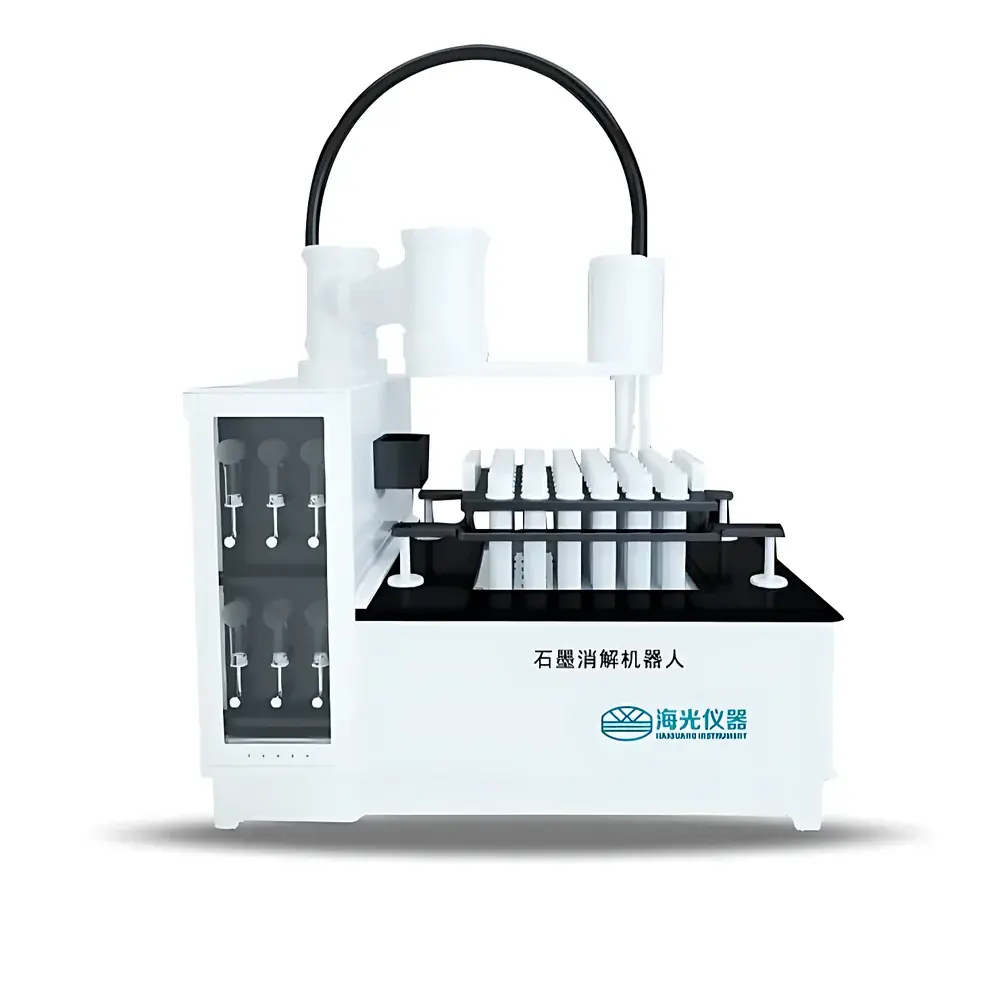
Haiguang HGD Series Graphite Digestion Robot
| Brand | Haiguang Instrument |
|---|---|
| Origin | Beijing, China |
| Manufacturer Type | Authorized Distributor |
| Product Category | Domestic |
| Model | HGD Series |
| Price Range | USD 42,000 – 70,000 |
| Instrument Type | Graphite Block Digestion System |
| Automation Level | Fully Automated |
| Digestion Positions | Configurable up to 48 samples (standard configuration) |
| Temperature Range | Ambient to 220 °C |
| Temperature Control Accuracy | ±0.5 °C |
| Heating Principle | Uniform graphite block conduction with PID-controlled dual-zone heating |
| Reagent Dispensing Channels | Up to 6 independent corrosion-resistant reagent lines (HNO₃, HCl, HF, H₂O₂, etc.) |
Overview
The Haiguang HGD Series Graphite Digestion Robot is an integrated, fully automated sample preparation platform engineered for trace-level elemental analysis workflows. It implements precise graphite-block-based conductive heating—leveraging high-thermal-mass isotropic graphite blocks—to deliver uniform temperature distribution across all digestion vessels. Unlike open-vessel hot plates or microwave systems, the HGD series operates under atmospheric pressure using closed-tube wet digestion chemistry, minimizing contamination risk and enabling reproducible decomposition of organic matrices (e.g., biological tissues, soils, food, polymers) into soluble inorganic forms. Its core function is to automate the entire sequence from reagent addition to final volume adjustment, serving as a critical front-end solution for atomic fluorescence spectrometry (AFS), atomic absorption spectroscopy (AAS), and inductively coupled plasma mass spectrometry (ICP-MS) laboratories requiring GLP-compliant, low-blank sample processing.
Key Features
- Fully automated digestion cycle: programmable sequences for acid addition, mixing (orbital shaking at 0–300 rpm), ramp-and-hold temperature control, reflux management, open-vessel acid evaporation (“acid removal”), and volumetric final dilution (10–50 mL range).
- Dual-zone PID temperature regulation: independent control of main digestion zone and reflux/cooling zone ensures thermal stability during multi-step protocols and prevents overheating of sensitive analytes.
- Corrosion-resistant fluid handling: six chemically inert reagent channels with peristaltic pumps calibrated for sub-mL precision (±0.02 mL); compatible with nitric, hydrochloric, hydrofluoric, and hydrogen peroxide solutions.
- Modular digestion block: interchangeable 24- or 48-position graphite blocks with PTFE-coated sample wells; maximum operating temperature 220 °C with thermal ramp rates adjustable from 0.1 to 5 °C/min.
- Integrated safety architecture: real-time vapor monitoring, overtemperature cutoff, leak detection, and emergency stop with hardware interlocks compliant with IEC 61000-6-2/6-4 EMC standards.
Sample Compatibility & Compliance
The HGD system accommodates standard 50 mL and 100 mL quartz, PTFE, or quartz-lined digestion tubes. It supports EPA Methods 3050B, 3051A, and 3052; ISO 11466 for soil metal extraction; and GB/T 5009.11–2014 (China National Standard) for food testing. All firmware and operational logs meet audit-trail requirements under FDA 21 CFR Part 11 when paired with optional electronic signature modules. The system is validated for ≤0.5 pg/g procedural blanks in ultrapure acid environments and conforms to ISO/IEC 17025 documentation practices for accredited testing laboratories.
Software & Data Management
Controlled via Haiguang’s DigMaster Pro software (Windows 10/11 compatible), the HGD series provides method library management, step-by-step protocol scripting, real-time thermal and reagent consumption graphs, and CSV/PDF report export. Each run generates a timestamped digital log including operator ID, method version, temperature profile, reagent volumes, and error flags—enabling full traceability. Optional LIMS integration is supported through ASTM E1482-compliant XML data exchange and OPC UA connectivity.
Applications
- Environmental labs: heavy metal quantification (As, Cd, Pb, Hg) in wastewater sludge, sediments, and plant tissues per EPA and EU WFD directives.
- Clinical & pharmaceutical QC: residual catalyst metals (Pd, Pt, Ni) in active pharmaceutical ingredients (APIs) per USP /.
- Food safety testing: total arsenic speciation prep (inorganic As III/V) prior to HPLC-ICP-MS analysis.
- Geochemical research: rare earth element (REE) recovery from silicate rocks using HF-HNO₃ mixtures with controlled fuming cycles.
- Materials science: dissolution of battery cathode materials (NMC, LFP) for Li/Ni/Co/Mn stoichiometry validation.
FAQ
What types of digestion vessels are supported?
Standard 50 mL and 100 mL quartz, PTFE, or quartz-lined tubes with O-ring seals; custom adapters available for alternative formats.
Can the system handle hydrofluoric acid (HF)?
Yes—reagent lines, valves, and pump heads are constructed from HF-resistant fluoropolymers (PFA, ETFE); dedicated HF channel with flow calibration and leak-sensing is standard.
Is remote monitoring possible?
Yes—DigMaster Pro supports secure VNC-based remote access and email/SNMP alerts for process completion or fault conditions.
How is method validation performed?
Each instrument ships with a factory-verified validation package including temperature uniformity mapping, reagent delivery accuracy reports, and blank assessment data per ISO 8466-1.
Does it comply with GLP/GMP documentation requirements?
Yes—audit trail, electronic signatures (optional), and 21 CFR Part 11–ready configuration are available with documented IQ/OQ/PQ protocols.
Related Products



