
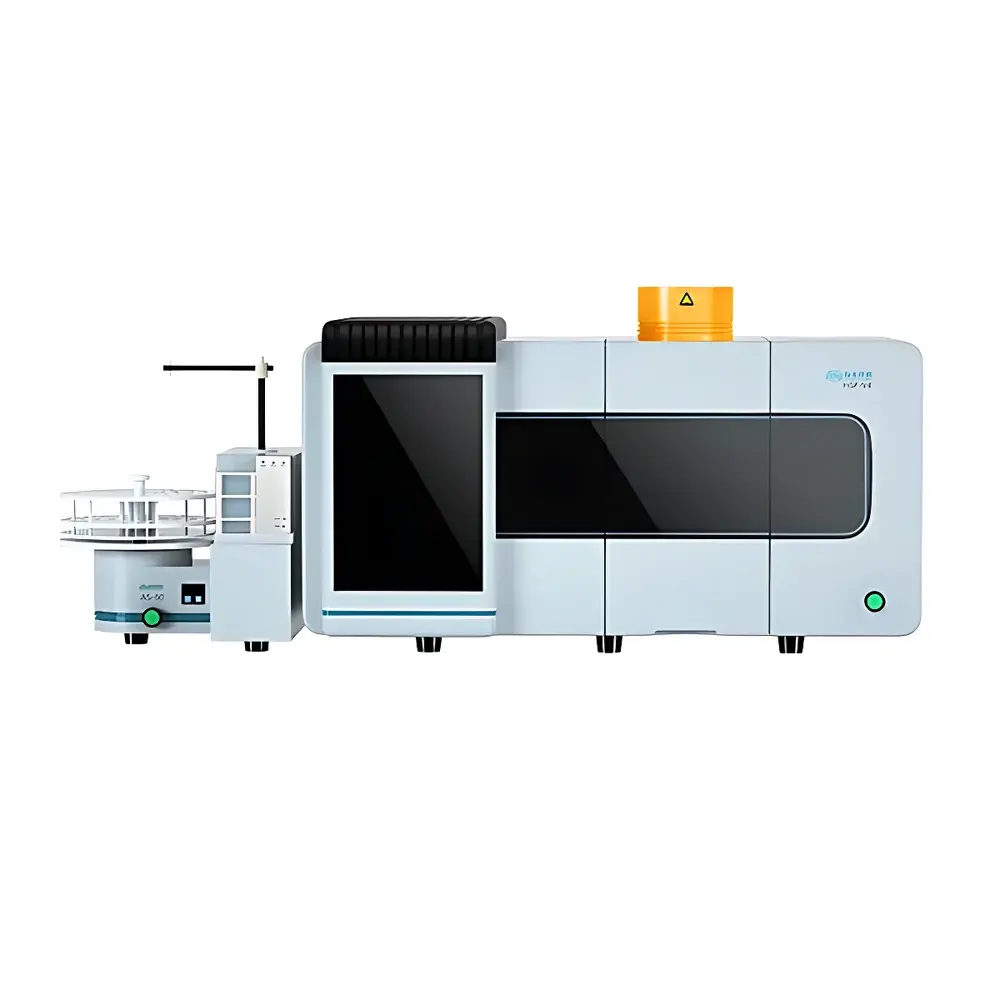
Haiguang HGF-V4 Atomic Fluorescence Spectrometer
| Brand | Haiguang Instrument |
|---|---|
| Origin | Beijing, China |
| Model | HGF-V4 |
| Instrument Type | Multi-channel Atomic Fluorescence Spectrometer |
| Sample Introduction | Dual Sequential Injection Pump |
| Waste Disposal | Gravity-driven (Static) Drainage |
| Sample Introduction Mode | Vapor Generation / Hydride Generation |
| Gas Flow Control | Mass Flow Controllers (MFCs) |
| Detectable Elements | As, Se, Pb, Bi, Sb, Te, Sn, Hg, Cd, Ge, Zn, Au |
| Relative Standard Deviation (RSD) | < 0.6% |
| Linear Dynamic Range | > 3 orders of magnitude |
| Detection Limits (As, Se, Pb, Bi, Sb, Te, Sn) | < 0.01 µg/L |
| PMT Wavelength Range | 160–320 nm |
| Atomizer Temperature Control Range | 50–450 °C |
Overview
The Haiguang HGF-V4 Atomic Fluorescence Spectrometer is a fourth-generation multi-channel AFS system engineered for high-precision, routine elemental analysis of hydride-forming elements in complex environmental, food, clinical, and geological matrices. Based on the principle of atomic fluorescence spectroscopy—where analyte atoms, generated in situ via hydride/vapor generation and atomized in a quartz cell under controlled thermal conditions, are excited by a line-source lamp (e.g., hollow cathode or electrodeless discharge lamp) and emit characteristic fluorescence at specific wavelengths—the HGF-V4 delivers exceptional sensitivity, long-term stability, and operational robustness. Its design addresses critical limitations of legacy AFS platforms, including memory effects, mercury carryover, lamp drift, and manual intervention in gas flow or cleaning protocols. The instrument is purpose-built for laboratories requiring compliance with international regulatory methods—including US EPA, ISO, and Chinese national standards (e.g., GB, HJ, SL)—and supports GLP/GMP-aligned workflows through audit-trail-capable software and hardware-level diagnostics.
Key Features
- Multi-channel, multi-lamp auto-positioning optical system: Eliminates manual lamp alignment; enables rapid sequential or simultaneous multi-element analysis without recalibration.
- Low-stray-light optical architecture: Incorporates internally blackened threaded optics, asymmetric apertures, and proprietary anti-reflective coatings to maximize signal-to-noise ratio (SNR), especially critical for ultra-trace Hg and As detection.
- 3D-integrated microfluidic flow path: Minimizes dead volume and surface adsorption; significantly reduces Hg memory effect and cross-contamination between runs.
- Microliter-scale sequential injection manifold: Fully maintenance-free—no peristaltic pump tubing wear, no valve degradation. Automates sample introduction, reagent mixing, reaction, separation, and post-run cleaning.
- Triple-gas digital mass flow control: Independent regulation of carrier gas, auxiliary gas, and shielding gas (all at milliliter-per-minute precision) ensures reproducible atomization environment and inter-run stability.
- Three-stage vapor–liquid separator with self-overflow water-cooling: Designed for high-organic-content samples (e.g., digested biological tissues, wastewater sludge); suppresses foam formation, provides continuous moisture removal, and enables passive waste drainage without vacuum pumps.
- Dual-zone thermally regulated quartz atomizer: Separate temperature control for carrier gas inlet and flame zone maintains optimal atomization efficiency across wide concentration ranges and matrix types.
- Million-cycle ignition system: Solid-state electronic ignition eliminates consumable ignition filaments—removing a major source of downtime and calibration drift in flame-based AFS.
- Hg lamp intensity stabilization module: Real-time photometric feedback corrects for spectral output drift during extended operation, ensuring consistent Hg quantification over multi-hour sequences.
- Integrated hardware diagnostics suite: Monitors liquid leakage, MFC output deviation, ignition current waveform, and atomizer chamber video feed—feeding alerts directly into the control software.
- LAN + Wi-Fi dual-network connectivity: Enables remote instrument status monitoring, method deployment, and data retrieval without local workstation dependency.
Sample Compatibility & Compliance
The HGF-V4 is validated for aqueous, acid-digested, and microwave-assisted extracts from diverse sample types—including drinking water, soil, sediment, urine, blood, food composites, cosmetics, and industrial effluents. It meets performance criteria specified in multiple internationally recognized standard methods: GB 5009.11–2014 (total/inorganic As in food), GB 5009.17–2021 (total/organic Hg), HJ 694–2014 (As, Hg, Se, Bi, Sb in water), HJ 1133–2020 (particulate-phase As, Se, Bi, Sb in ambient air), and ISO 17892-6 (geotechnical investigation—trace element analysis in soils). All hardware and firmware components comply with IEC 61326-1 (EMC for laboratory equipment) and IEC 61010-1 (safety requirements). Software supports 21 CFR Part 11-compliant user authentication, electronic signatures, and full audit trail logging for regulated environments.
Software & Data Management
The HGF-V4 operates with Haiguang’s next-generation AFS Control Suite—a Windows-based application supporting fully automated sequence execution, real-time QC charting (Levey-Jennings, Shewhart), method validation reporting (linearity, LOD/LOQ, recovery, RSD), and customizable report templates aligned with CNAS, CMA, and FDA expectations. Data files are stored in encrypted SQLite format with immutable timestamps and operator metadata. The software integrates seamlessly with LIMS via ASTM E1384-compliant export protocols and supports scheduled backup to network drives or cloud repositories. All instrument actions—including lamp warm-up, gas purging, atomizer preheating, measurement, rinse cycles, and shutdown—are programmable and logged with millisecond resolution.
Applications
The HGF-V4 serves as a primary analytical platform in environmental monitoring labs for compliance testing of As, Hg, and Sb in groundwater and industrial discharges; in food safety centers for screening rice, seafood, and infant formula for inorganic arsenic and methylmercury precursors; in public health institutes for biomonitoring of urinary Sb (GBZ/T 302–2018) and blood Pb (GBZ/T 316.3–2018); and in geological survey laboratories for quantifying trace metalloids in ore leachates and rock digests (GB/T 22105–2008). Its low detection limits and high matrix tolerance also support research applications in nanotoxicology (metal speciation in colloidal suspensions), pharmaceutical excipient purity testing, and forensic toxicology.
FAQ
What hydride-forming elements can the HGF-V4 quantify with certified detection limits?
The instrument achieves sub-10 ng/L detection limits for As, Se, Pb, Bi, Sb, and Te using standard hydride generation protocols. For Hg, Cd, Ge, Zn, and Au, detection limits are method-dependent and typically range from 0.005–0.05 µg/L under optimized cold-vapor or transition-metal-assisted conditions.
Is the HGF-V4 compatible with existing laboratory information management systems (LIMS)?
Yes—data export conforms to ASTM E1384 and ASTM E2500 standards. Raw and processed results, QC metrics, and audit logs can be transmitted via secure FTP, ODBC, or REST API interfaces.
Does the system require external cooling water or compressed air?
No. The three-stage gas–liquid separator uses passive water recirculation with integrated Peltier cooling; all gas flows are supplied by internal pressure-regulated cylinders or lab-grade nitrogen/argon sources.
How is calibration verification performed between sample batches?
The software supports bracketing calibration standards, continuing calibration verification (CCV), and ongoing precision checks (OPA) with configurable pass/fail thresholds. All calibrations are traceable to NIST SRMs or equivalent certified reference materials.
Can the HGF-V4 be operated unattended overnight?
Yes—fully automated sequences including standby mode, startup, calibration, sample analysis, cleaning, and shutdown are programmable. Hardware sensors trigger emergency stop and alert notifications if anomalies (e.g., leak, flame-out, temperature excursion) are detected.






