
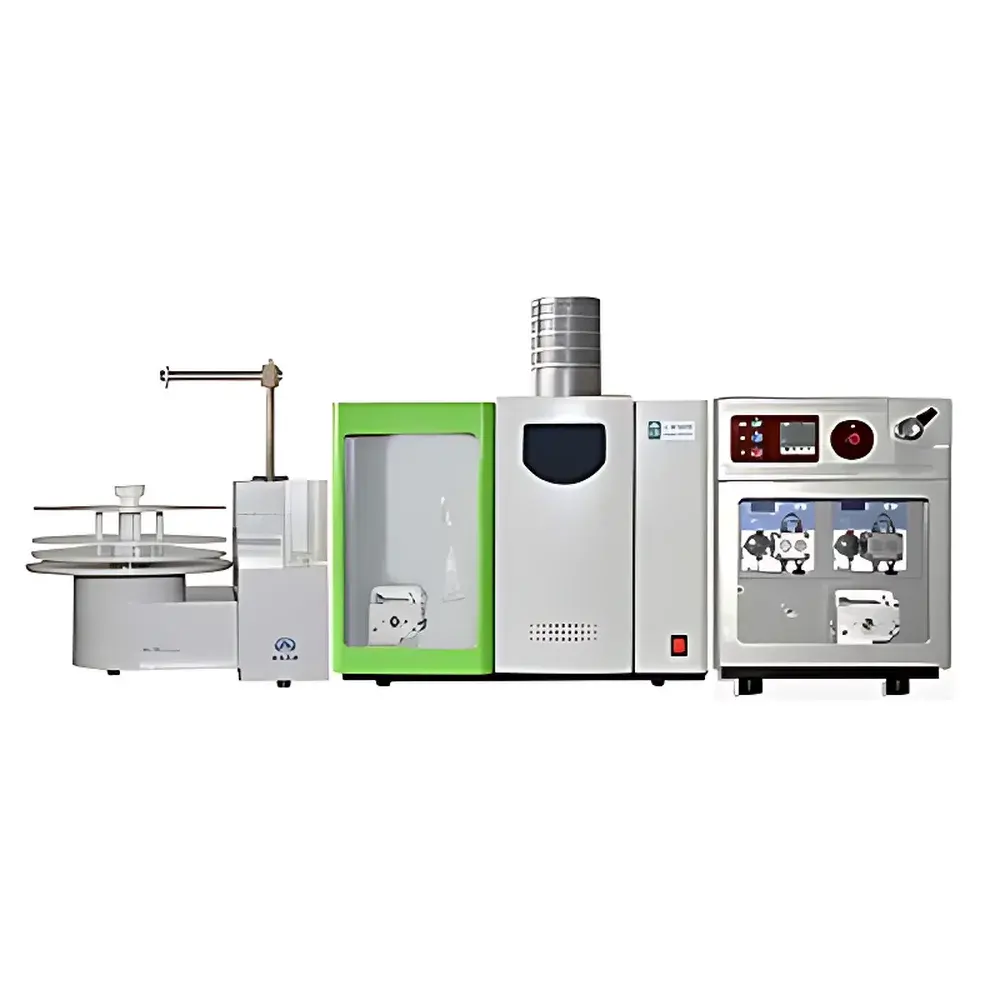
Haiguang LC-AFS6000 Liquid Chromatography–Atomic Fluorescence Spectrometer
| Brand | Haiguang Instrument |
|---|---|
| Origin | Beijing, China |
| Model | LC-AFS6000 |
| Instrument Type | LC–AFS Hyphenated System |
| Sample Introduction | Peristaltic Pump & Syringe Pump (Dual Mode) |
| Detectable Elements (Total Analysis) | As, Se, Pb, Bi, Sb, Te, Sn, Hg, Cd, Zn, Ge, Au |
| Detectable Elements (Speciation) | As, Hg, Se, Sb (and associated species, e.g., As(III), As(V), MMA, DMA, iAs, MeHg, EtHg, SeCys, SeMet) |
| Patented Gas–Liquid Separation | ZL 201820830427.8 |
| Patented LC–AFS Switching Module | ZL 201420280550.9 |
| Software Platform | Windows 7/8/XP Compatible |
| Data Export | Native Excel (.xlsx) Integration |
| Automation Interface | Standard RS-232/USB for LC Autosampler Coupling |
| Flame Monitoring | Integrated Argon–Hydrogen Flame Viewing Window |
| Electrical Architecture | Segregated High/Low Voltage Design with Modular PCB Layout |
| Compliance Support | ASTM D5762, ISO 17294-2, USP <232>/<233>, EPA Method 1638, GB/T 22105.1–2008 |
Overview
The Haiguang LC-AFS6000 is a fully integrated liquid chromatography–atomic fluorescence spectrometry (LC–AFS) hyphenated system engineered for high-sensitivity, speciation-resolved elemental analysis in environmental, food safety, pharmaceutical, and geological laboratories. It combines reversed-phase or ion-exchange HPLC separation with hydride generation atomic fluorescence detection (HG-AFS), enabling quantitative determination of both total element concentrations and individual chemical species—such as inorganic arsenic (AsIII/AsV), methylmercury (MeHg), selenomethionine (SeMet), and antimony species—within a single platform. The instrument operates on the principle of selective post-column hydride/cold vapor generation followed by atomization in an argon–hydrogen flame and measurement of element-specific atomic fluorescence at characteristic wavelengths (e.g., 193.7 nm for As, 196.0 nm for Hg). Its dual-mode architecture supports seamless switching between total elemental analysis and chromatographic speciation without hardware reconfiguration.
Key Features
- Dual-function design: Simultaneous support for total elemental quantification and chromatographic speciation—eliminating need for separate instrumentation.
- Intelligent coded hollow cathode lamps with automatic recognition, lifetime monitoring, and optimized pulsed constant-current drive for enhanced signal stability and lamp longevity.
- Shielded low-temperature quartz furnace atomizer minimizes fluorescence quenching and gas-phase interferences, improving atomization efficiency and signal-to-noise ratio.
- Patented membrane-based two-stage gas–liquid separation system (ZL 201820830427.8) eliminates manual liquid handling—no reagent addition or waste drainage required during operation.
- Modular argon gas management with array-type manifold and intelligent flow regulation reduces argon consumption by up to 40% versus conventional systems.
- Real-time argon–hydrogen flame observation window enables visual verification of flame ignition, stability, and geometry—critical for method validation and troubleshooting.
- Self-diagnostic firmware performs automated system checks at startup, including pressure verification, pump status, lamp output, and detector baseline assessment—with audible/visual fault alerts.
- Hybrid sample introduction: configurable peristaltic pump (10-roller, 6-channel) for routine total analysis and precision syringe pump (corrosion-resistant, integrated with autosampler interface) for speciation workflows.
Sample Compatibility & Compliance
The LC-AFS6000 accommodates aqueous extracts, digested biological tissues, filtered environmental waters, and food leachates across pH 1–9. It complies with regulatory frameworks governing elemental impurities and speciation testing—including USP / for elemental impurities in pharmaceuticals, EPA Method 1638 for mercury speciation in water and tissue, ASTM D5762 for total and speciated arsenic in coal, and ISO 17294-2 for multi-element analysis in wastewater. Its data integrity architecture supports audit trails, user-level access control, and electronic signature capability aligned with FDA 21 CFR Part 11 requirements when deployed under validated laboratory information management systems (LIMS).
Software & Data Management
The proprietary Haiguang AFS Control Suite provides unified control of LC gradient programming, UV photolysis parameters (wavelength, power, residence time), HG reaction conditions, and AFS acquisition settings. Speciation mode includes synchronized timing for column elution, post-column UV digestion (254 nm, adjustable dwell time), and real-time peak alignment algorithms to ensure retention time reproducibility (<0.02 min RSD over 50 injections). All measurement data are timestamped, stored in structured binary format (.afsd), and exportable directly to Microsoft Excel with embedded metadata (sample ID, calibration curve, integration parameters, QC flags). Network-enabled deployment allows centralized data archiving and remote instrument monitoring via secure TCP/IP protocols.
Applications
- Regulatory testing of inorganic arsenic in rice and infant cereals per EU Commission Regulation (EU) No 2023/915.
- Mercury speciation in fish tissue and sediment samples to assess bioaccumulation risk (MeHg vs. inorganic Hg).
- Monitoring selenium species (selenocysteine, selenomethionine) in dietary supplements and fortified foods.
- Speciation of antimony in drinking water and PET packaging leachates to distinguish toxic Sb(III) from less harmful Sb(V).
- Total elemental screening of geological samples (soils, ores) for As, Pb, Cd, Hg, and Bi at sub-ng/g levels.
- QC/QA in clinical labs analyzing urinary arsenic metabolites for occupational exposure assessment.
FAQ
Can the LC-AFS6000 perform both total and speciation analysis without hardware modification?
Yes—the patented LC–AFS switching module (ZL 201420280550.9) enables software-controlled routing between total analysis and speciation flow paths, preserving column integrity and minimizing cross-contamination.
What autosamplers are compatible with the system?
It natively supports Haiguang’s 183-position polar-coordinate autosampler (with wash station) and 130-position XYZ robotic carousel; third-party LC autosamplers may be integrated via TTL/RS-232 trigger signals.
Is UV photolysis mandatory for all speciation analyses?
No—the system features a dual-path flow selector allowing direct bypass of the UV reactor for species stable under ambient conditions (e.g., AsB, SeCys), while enabling on-demand photolysis for labile compounds (e.g., MeHg, DMA).
How does the system handle carryover in high-concentration speciation runs?
It employs segmented carrier stream isolation, post-injection rinse cycles with 10% HNO3, and programmable column backflush—achieving <0.05% carryover for 100 ng/mL MeHg standards.
Does the software support GLP-compliant reporting?
Yes—reports include full audit trail logs, analyst ID, instrument calibration history, raw chromatograms with integration markers, and uncertainty estimation per ISO/IEC 17025:2017 Annex A.3 guidelines.





