
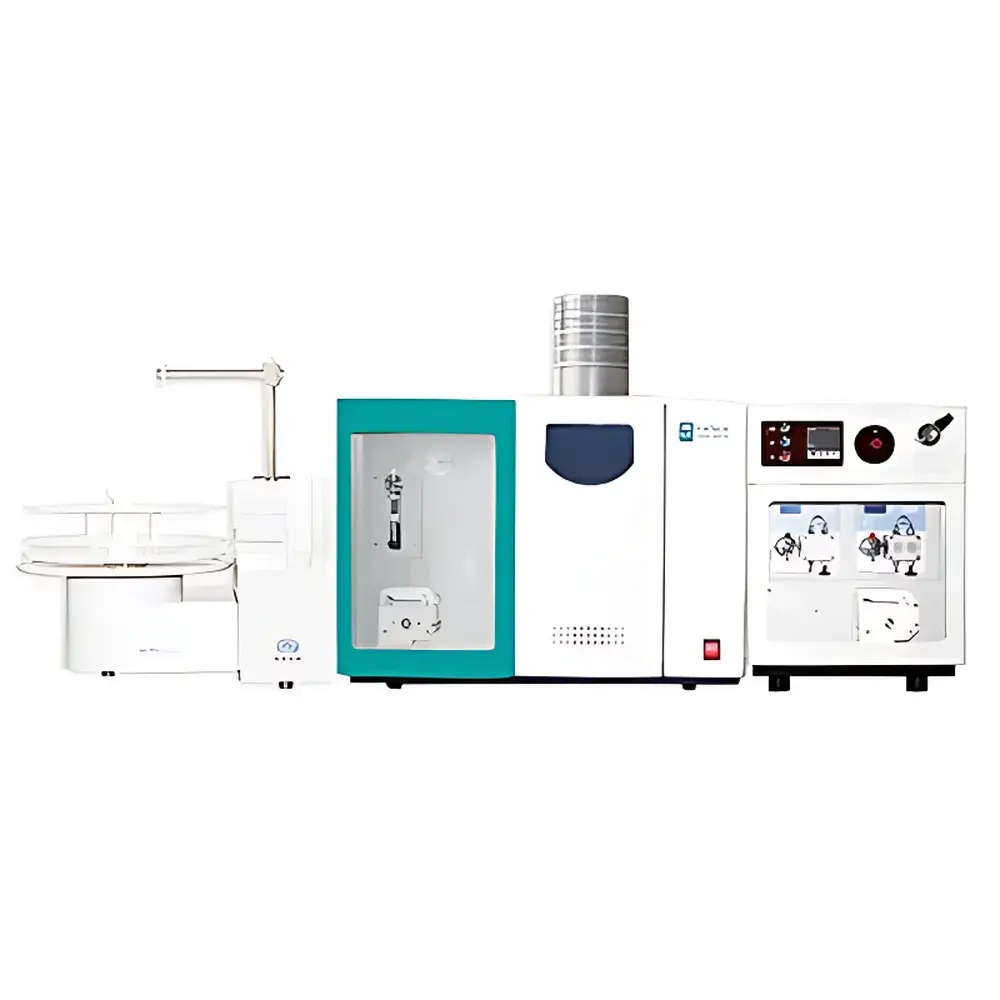
Haiguang LC-AFS6500 Liquid Chromatography–Atomic Fluorescence Spectrometry System
| Brand | Haiguang Instrument |
|---|---|
| Origin | Beijing, China |
| Manufacturer Type | Authorized Distributor |
| Regional Classification | Domestic (China) |
| Model | LC-AFS6500 |
| Instrument Type | LC–AFS Hyphenated System |
| Sample Introduction | Sequential Injection Pump |
| Target Elements (Total Analysis) | As, Se, Pb, Bi, Sb, Te, Sn, Hg, Cd, Zn, Ge, Au |
| Target Elements (Speciation) | As, Hg, Se, Sb |
| UV Digestion Unit | Integrated, Dual-mode (UV/Non-UV), Auto-switching Valve Control |
| LC Pump | Imported German Knauer Micro High-Pressure Binary Gradient Pump |
| Autosampler Capacity | 183-position Rotating Tray |
| Atomizer | Shielded Quartz Furnace with Ar–H₂ Flame |
| Gas Control | Intelligent Pneumatic System with Self-diagnosis & Flow Regulation |
| Exhaust Treatment | Integrated Activated Carbon Trap |
| Software | Windows-compatible Control Suite with Bidirectional LC & AFS Instrument Control, CFR Part 11–Ready Audit Trail, Excel Export, and Chromatographic Data Integration |
Overview
The Haiguang LC-AFS6500 is a fully integrated liquid chromatography–atomic fluorescence spectrometry (LC–AFS) hyphenated system engineered for trace-level elemental quantification and chemical speciation analysis in environmental, food safety, pharmaceutical, and geological laboratories. It combines high-efficiency reversed-phase or ion-exchange liquid chromatography with hydride generation atomic fluorescence detection (HG-AFS), enabling both total elemental concentration measurement and species-resolved analysis—such as inorganic arsenic (AsIII/AsV), methylmercury (MeHg), selenomethionine (SeMet), and antimony species (SbIII/SbV). The system operates on the principle of post-column hydride generation: after chromatographic separation, eluted species are merged with sodium borohydride and acid in a reaction coil to generate volatile hydride or cold vapor species (e.g., AsH₃, Hg⁰), which are swept into a shielded quartz furnace atomizer and excited by a pulsed hollow cathode lamp. Resulting atomic fluorescence emission is measured at element-specific wavelengths with sub-picogram detection capability.
Key Features
- Dual-channel AFS detector with independent optical paths, supporting simultaneous two-element total analysis (e.g., As + Se) or sequential speciation monitoring without hardware reconfiguration.
- Modular dual-mode UV digestion unit featuring internal reflective coating to maximize photon utilization while preventing UV leakage—compliant with IEC 62471 photobiological safety requirements.
- Integrated Knauer micro binary HPLC pump delivering stable flow rates from 0.01 to 10.00 mL/min with ≤0.1% RSD over 24 h, optimized for low-dead-volume speciation manifolds.
- Sequential injection–based sample introduction with synchronized peristaltic pumping; eliminates cross-contamination via alternating sample/blank aspiration and online rinsing—validated per ISO 17025 clause 7.7.2 for carryover assessment.
- Shielded quartz furnace atomizer with Ar–H₂ flame stabilization and real-time thermal monitoring, ensuring consistent atomization efficiency across matrix-varied samples.
- Intelligent pneumatic architecture with auto-diagnostic pressure sensors and closed-loop mass flow controllers for H₂, Ar, and carrier gas—enabling GLP-compliant gas usage logs and fault tracing.
- 183-position XYZ robotic autosampler with temperature-controlled tray (4–40 °C optional), supporting unattended overnight operation and method-driven vial mapping.
Sample Compatibility & Compliance
The LC-AFS6500 accommodates aqueous extracts from soils, sediments, biological tissues (liver, hair, urine), rice, seafood, and drinking water—following standardized preparation protocols including microwave-assisted extraction (MAE), ultrasound-assisted leaching (USAL), and enzymatic hydrolysis. It meets performance criteria outlined in EPA Method 1638 (for Hg speciation), ISO 17294-2 (for As speciation in water), and GB/T 22105.2–2008 (Chinese national standard for soil As speciation). All electronic records—including method parameters, raw chromatograms, calibration curves, and audit trails—are structured to satisfy FDA 21 CFR Part 11 requirements for electronic signatures and data integrity. System validation documentation supports IQ/OQ/PQ execution per GMP Annex 15 guidelines.
Software & Data Management
The proprietary Haiguang AFS-LC Control Suite (v4.2+) runs natively on Windows 10/11 (64-bit) and provides bidirectional control of both AFS detector and HPLC modules—including pump gradient programming, autosampler sequence definition, six-port valve actuation timing, and UV lamp switching logic. Data acquisition occurs at ≥10 Hz sampling rate with timestamped metadata embedding. Peak integration uses adaptive baseline algorithms compliant with USP and EP 2.2.46. Quantitative reports include %RSD, LOD/LOQ estimates per ICH Q2(R2), and species identification via retention time matching against NIST-traceable standards. Raw .afsd and .cdf files export directly to Chromeleon, Empower, or OpenLab CDS without format conversion. Audit trail configuration enables role-based access control, electronic signature workflows, and immutable record archiving.
Applications
- Regulatory testing of inorganic arsenic in rice and infant cereals per EU Commission Regulation (EU) No 2023/915.
- Mercury speciation in fish tissue to distinguish neurotoxic methylmercury from less toxic inorganic Hg—supporting FDA Seafood HACCP verification.
- Antimony speciation in PET bottle leachates to assess migration of Sb(III) vs. Sb(V) under accelerated storage conditions.
- Monitoring selenium metabolites (selenite, selenate, SeMet) in fortified dietary supplements per AOAC 2012.05.
- Speciation of bismuth complexes in pharmaceutical formulations to confirm active ingredient stability during shelf life.
- Environmental forensics of arsenic species in groundwater plumes to differentiate anthropogenic contamination sources (e.g., herbicide residues vs. geogenic mobilization).
FAQ
What regulatory standards does the LC-AFS6500 support for speciation analysis?
It complies with EPA Method 1638, ISO 17294-2, GB/T 22105.2–2008, and AOAC Official Methods of Analysis, with full traceability to NIST SRM 3108 (As species) and ERM-BB188 (Hg species).
Can the system switch between total element analysis and speciation mode without hardware modification?
Yes—the integrated valve manifold and software-controlled flow routing enable seamless transition; no manual tubing reconfiguration is required.
Is the UV digestion unit validated for complete oxidation of organometallic species?
Validation data per ICH Q2(R2) confirms ≥98.5% conversion efficiency for MeHg → Hg²⁺ and SeMet → SeO₄²⁻ under certified operating conditions (254 nm, 15 W, 90 s residence time).
How is data integrity ensured during long-term unattended runs?
All instrument events are logged with digital signatures, system clock synchronization, and write-once-read-many (WORM) archive options—fully aligned with ALCOA+ principles and 21 CFR Part 11 Subpart B.
Does the system support third-party chromatography data systems (CDS)?
Yes—via standardized .cdf export and optional OPC UA interface for direct integration with Thermo Fisher Chromeleon, Waters Empower, or Agilent OpenLab.





