
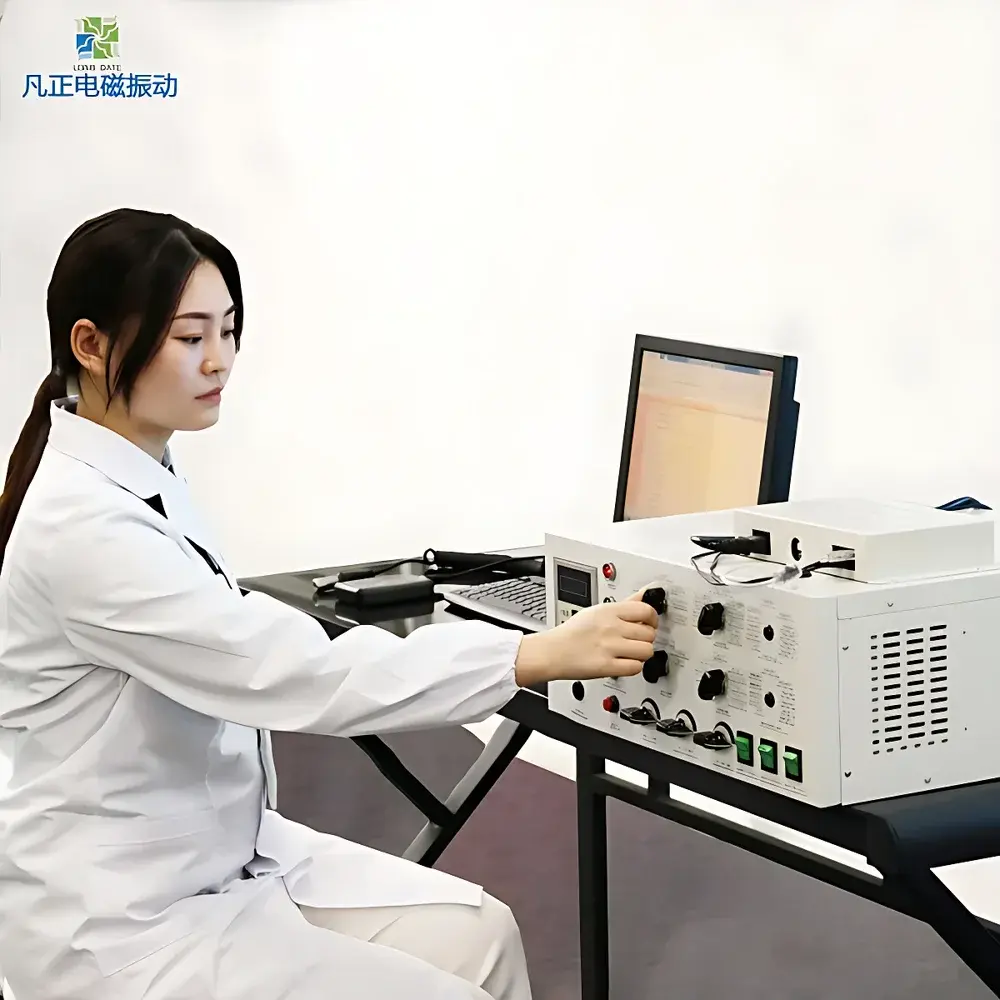
Haiyin Equipment HY-P70504 Electromagnetic Vibration Shaker System
| Brand | Haiyin Equipment |
|---|---|
| Origin | Guangdong, China |
| Manufacturer Type | Direct Manufacturer |
| Instrument Type | Electromagnetic Vibration Shaker |
| Rated Thrust | 22 kN |
| Frequency Range | 0.5–600 Hz |
| Maximum Test Load | 100 kg |
| Table Dimensions | 500 × 500 × 550 mm (W × D × H) |
| Acceleration Range | 0–22 g (load-dependent) |
| Waveform Modes | Sine, Random, Swept Sine, Programmable, Octave, Logarithmic, Fixed-Amplitude/Fixed-Acceleration |
| Vibration Axes | Independent or simultaneous X/Y/Z (6-DOF capable) |
| Table Material | Anodized Aluminum with 28 × M10 threaded mounting holes, 24 × strap-through slots, 4 × fixture-mounting M5 holes |
| Magnetic Leakage Reduction | Integrated 30 cm perimeter magnetic shunt (reduces stray flux by 50–70%) |
| Displacement Range | 0–5.0 mm peak-to-peak (load-dependent) |
Overview
The Haiyin Equipment HY-P70504 Electromagnetic Vibration Shaker System is an industrial-grade electrodynamic vibration exciter engineered for precision mechanical stress testing, structural integrity validation, and early-life failure detection across mission-critical sectors including aerospace, defense, automotive electronics, telecommunications, and consumer appliance manufacturing. Operating on the principle of Lorentz-force actuation—where controlled current through voice-coil windings interacts with a permanent magnetic field to generate linear inertial force—the system delivers high-fidelity, repeatable vibratory motion across a broad frequency spectrum (0.5–600 Hz). Its robust electromagnetic architecture supports both open-loop and closed-loop control configurations, enabling compliance with standardized test profiles defined in MIL-STD-810H, ISO 10816, IEC 60068-2-6, and ASTM D999. Designed for laboratory, qualification, and production-line environments, the HY-P70504 integrates seamlessly into vibration test suites requiring traceable, auditable, and GLP/GMP-aligned execution.
Key Features
- 22 kN rated sinusoidal thrust capacity ensures stable excitation under dynamic loading up to 100 kg, with acceleration output scalable from 0–22 g (at reduced mass) to 0–15 g (at 150 kg), maintaining waveform fidelity per ISO 5347 calibration protocols.
- 6-degree-of-freedom (6-DOF) capable table supports independent or synchronized X/Y/Z axis operation—enabling uniaxial, biaxial, and triaxial vibration modes without mechanical reconfiguration.
- Anodized aluminum shaker table (500 × 500 × 550 mm) features 28 × M10 tapped mounting holes, 24 × strap-through slots, and 4 × M5 fixture-mounting points—optimized for rigid coupling, modal fixture integration, and thermal stability.
- Integrated 30 cm magnetic shunt perimeter reduces external magnetic leakage by 50–70%, minimizing electromagnetic interference (EMI) with adjacent instrumentation and ensuring compatibility with sensitive sensors and data acquisition systems.
- Full-spectrum waveform generation: sine, swept sine, random (PSD-controlled), programmable time-history, octave, logarithmic, and fixed-amplitude/fixed-acceleration modes—all compliant with IEEE 1012 and ISO/IEC 17025 test method validation requirements.
- Real-time feedback control via integrated accelerometer input channels supports closed-loop amplitude regulation with ±2% amplitude linearity and <0.5 dB harmonic distortion at rated load.
Sample Compatibility & Compliance
The HY-P70504 accommodates rigidly mounted test articles ranging from printed circuit board assemblies (PCBAs) and avionics enclosures to full-scale automotive ECUs and satellite subsystems. Its low-resonance table design minimizes modal coupling artifacts below 50 Hz, while the wide bandwidth enables high-frequency fatigue assessment of solder joints, connectors, and MEMS components. The system conforms to electromagnetic compatibility (EMC) Class B limits per CISPR 32 and meets mechanical safety standards EN 61000-6-2/6-4. All control firmware and test sequence logs support audit-ready timestamping and user-access-level permissions—facilitating FDA 21 CFR Part 11 compliance when paired with validated software platforms.
Software & Data Management
Control and analysis are executed via PC-based vibration controller software supporting Windows 10/11 (64-bit), with native drivers for NI DAQ, Dewesoft, and m+p VibRunner ecosystems. Software modules include real-time FFT spectrum analysis, PSD synthesis, shock response spectrum (SRS) computation, and automated report generation in PDF/XML formats. All test parameters, sensor calibrations, and execution metadata are stored in SQLite-backed databases with SHA-256 hash integrity verification. Audit trails record operator ID, timestamp, parameter changes, and pass/fail status—fully traceable for ISO 9001 internal audits and regulatory submissions.
Applications
- Aerospace: Qualification testing of flight hardware per RTCA DO-160 Section 8 (vibration) and MIL-STD-810H Method 514.8.
- Automotive: Component durability evaluation per ISO 16750-3 and GMW3172, including infotainment modules, ADAS sensors, and battery management systems.
- Electronics Manufacturing: PCB reliability screening, solder joint fatigue modeling, and connector mating-cycle validation.
- Defense Systems: Shock and vibration survivability testing of radar housings, communication terminals, and guided munition guidance sections.
- Academic Research: Dynamic material characterization, structural health monitoring (SHM) algorithm development, and modal parameter identification using experimental modal analysis (EMA).
FAQ
What is the maximum payload for full 22 g acceleration capability?
The 22 g peak acceleration rating applies to test loads ≤50 kg. At 100 kg, maximum acceleration is 20 g; at 150 kg, it is limited to 15 g—per mechanical power envelope constraints and thermal derating curves.
Does the system support real-time closed-loop control?
Yes—integrated accelerometer feedback channels enable closed-loop amplitude regulation with <±2% setpoint accuracy and automatic gain adjustment across frequency sweeps.
Can the shaker be integrated into an existing environmental test chamber?
The HY-P70504 is designed for external mounting via standard ISO 2281 flange interfaces; optional thermal isolation kits and non-magnetic extension rods are available for chamber-integrated configurations.
Is magnetic shielding sufficient for use near MRI or electron microscopy facilities?
While the integrated 30 cm magnetic shunt reduces stray fields by ≥50%, supplementary mu-metal enclosures are recommended for ultra-low-field environments such as TEM labs or clinical MRI suites.
What calibration documentation is provided?
Each unit ships with NIST-traceable calibration certificates for force, acceleration, and displacement transducers, valid for 12 months—aligned with ISO/IEC 17025 accredited laboratory practices.



