
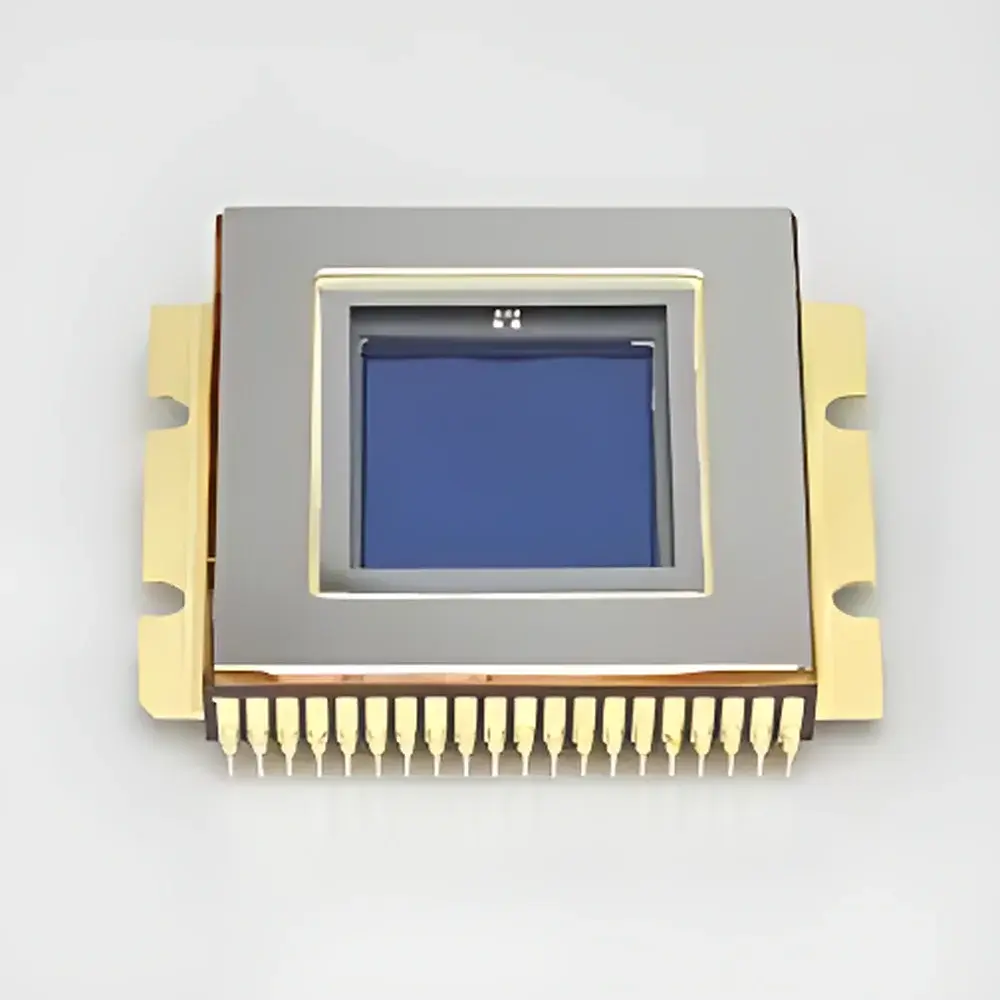
Hamamatsu Back-Illuminated CCD Area Image Sensor S12071
| Brand | Hamamatsu |
|---|---|
| Origin | Japan |
| Manufacturer Type | Original Equipment Manufacturer (OEM) |
| Product Category | Imported |
| Model | S12071 |
| Pricing Tier | Entry-Level to Mid-Range Industrial OEM Module |
Overview
The Hamamatsu S12071 is a high-performance, back-illuminated silicon CCD area image sensor engineered for demanding spectroscopic and low-light scientific imaging applications. Its fully depleted, back-thinned architecture enables quantum efficiency exceeding 60% across the deep ultraviolet (165 nm) through near-infrared (1100 nm), with peak responsivity in the UV–VIS range (200–600 nm). Unlike front-illuminated CCDs, the S12071 eliminates absorption losses from gate structures, delivering superior photon collection efficiency—especially critical for weak-signal detection in monochromator-based spectrometers, Raman systems, and vacuum UV (VUV) instrumentation. The sensor integrates single-stage thermoelectric (TE) cooling to stabilize dark current at ≤100 e⁻/pixel/s (typ. at 25 °C ambient), enabling integration times up to several seconds without significant thermal noise accumulation. Its hermetically sealed metal package with fused silica (quartz) window ensures compatibility with UHV environments and resistance to UV-induced degradation.
Key Features
- Back-illuminated architecture for enhanced QE in UV (165 nm) and broadband spectral response (165–1100 nm)
- 1024 × 1024 active pixel array with 24 µm × 24 µm pixel pitch and 24.576 mm × 24.576 mm optical format
- Single-stage TE cooling system maintaining stable sensor temperature under continuous operation
- Anti-blooming (anti-smear) functionality to suppress charge overflow during overexposure—essential for high-dynamic-range spectral line profiling
- Dual readout port configuration: Port A optimized for low-noise operation (≤1 MHz clock rate); Port B supporting higher-speed acquisition (≤10 MHz), enabling frame rates up to 1.5 fps (typ.)
- Low dark current performance (≤100 e⁻/pixel/s at 25 °C ambient) and high full-well capacity (>100 ke⁻ per pixel)
- Hermetic metal housing with quartz entrance window—compatible with ozone-generating UV sources and cleanroom handling protocols
Sample Compatibility & Compliance
The S12071 is designed for integration into OEM spectroscopic platforms requiring trace-level sensitivity and spectral fidelity. Its quartz window transmits down to 165 nm, making it suitable for synchrotron beamlines, plasma diagnostics, and UV fluorescence lifetime systems. The sensor complies with RoHS Directive 2011/65/EU and meets IEC 61340-5-1 ESD immunity standards for handling in electrostatic-sensitive device (ESD) workspaces. While not certified as a standalone medical or industrial safety device, its electrical and thermal specifications align with common design requirements for ISO/IEC 17025-accredited calibration laboratories when integrated into validated instrument architectures. No intrinsic radiation hardness certification is provided; users requiring space- or reactor-grade tolerance must perform independent qualification per MIL-STD-883 or ESA ECSS-Q-ST-60-15C.
Software & Data Management
The S12071 is supplied as a bare sensor die or with optional C12081-series evaluation boards—compact, USB 2.0–enabled driver modules featuring FPGA-based timing control, programmable gain/offset, and on-board ADC (16-bit). These boards support standard Windows/Linux drivers and are compatible with third-party SDKs including Hamamatsu’s own DCAM-SDK and open-source frameworks such as libdc1394 and Spinnaker (via custom HAL layer). All firmware supports non-volatile register configuration storage, hardware-triggered acquisition, and synchronized multi-sensor operation. Audit-trail-capable metadata embedding (timestamp, exposure, temperature, gain setting) is supported for GLP/GMP-aligned workflows when used with compliant host software. Raw frame data is output in IEEE 754-compliant 16-bit linear format, facilitating direct import into MATLAB, Python (NumPy/SciPy), or Igor Pro for spectral deconvolution and calibration modeling.
Applications
- High-resolution monochromator and spectrograph focal plane arrays (e.g., Czerny–Turner, Echelle)
- UV-Vis-NIR absorbance and reflectance spectrophotometers requiring sub-0.1% photometric repeatability
- Raman spectroscopy systems where UV excitation (e.g., 244 nm, 266 nm) demands high QE below 300 nm
- Plasma emission monitoring in semiconductor process tools (OES—Optical Emission Spectroscopy)
- Astronomical instrumentation for ground-based UV calibrations and laboratory astrophysics simulators
- Time-resolved luminescence setups using gated integration, leveraging anti-blooming for pulse-height discrimination
FAQ
Is the S12071 suitable for vacuum ultraviolet (VUV) applications below 200 nm?
Yes—the fused silica window transmits down to 165 nm, and the back-illuminated structure avoids organic passivation layers that degrade under VUV exposure. For optimal performance below 185 nm, purging with nitrogen or operating under vacuum is recommended.
Can the sensor be operated without the C12081 driver board?
Yes—it is available as a bare die or ceramic-packaged module for custom PCB integration. However, precise clock sequencing, bias voltage regulation, and TE-cooler drive circuitry must be implemented per Hamamatsu’s Application Note AP-001.
What is the maximum recommended integration time under TE cooling?
At stabilized sensor temperature (~−10 °C), integration times of 5–10 seconds yield <5% dark signal contribution for most spectroscopic averaging routines; longer exposures require dark-frame subtraction.
Does Hamamatsu provide NIST-traceable spectral responsivity calibration data?
Calibration certificates (including QE curves and pixel uniformity maps) are available upon request as part of Hamamatsu’s OEM Calibration Service (HCS-CCD), traceable to NIST SRM 2030 and PTB reference standards.
Is the S12071 compatible with cryogenic cooling stages?
No—the integrated single-stage TE cooler is rated for ΔT ≈ 45 K below ambient. Mounting to external cryocoolers may cause mechanical stress fracture; alternative sensors (e.g., S11155 series) are recommended for LN₂ or closed-cycle operation.






