
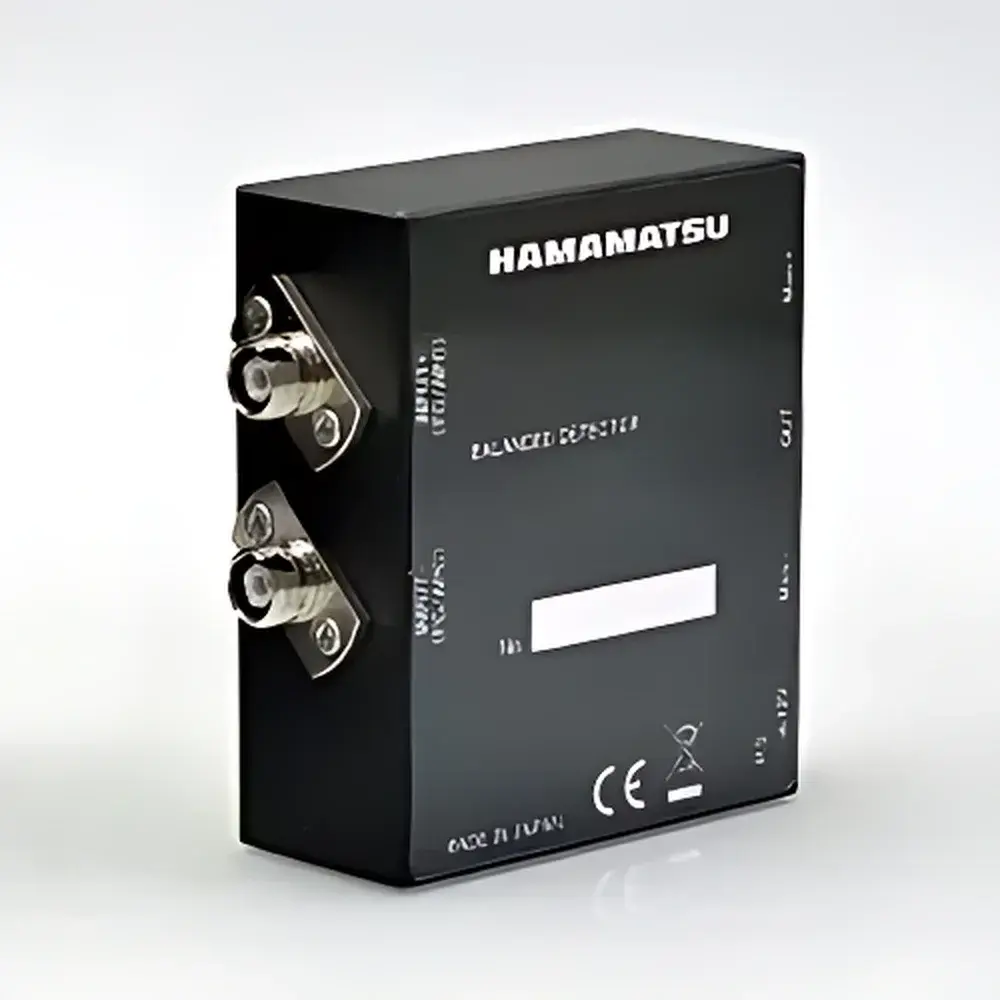
Hamamatsu Balanced Detector C12668-01
| Brand | Hamamatsu |
|---|---|
| Origin | Japan |
| Manufacturer Type | Original Equipment Manufacturer (OEM) |
| Import Status | Imported |
| Model | C12668-01 |
| Frequency Response | 20 MHz (−3 dB) |
| Common-Mode Rejection Ratio (CMRR) | 35 dB (typ.) |
| Optical Input | FC/APC connector (single-mode fiber compatible) |
| Electrical Output | SMA female connector |
| Operating Wavelength Range | Optimized for ~1060 nm (OCT applications) |
| Package Dimensions | Compact housing (see mechanical drawing per datasheet) |
Overview
The Hamamatsu Balanced Detector C12668-01 is a high-stability, differential photoreceiver module engineered specifically for low-noise optical coherence tomography (OCT) systems operating in the 1060 nm spectral window. It implements a true balanced detection architecture based on two matched, low-capacitance silicon PIN photodiodes mounted monolithically within a thermally stable, hermetically sealed package. The photodiodes are reverse-biased and connected in series opposition—enabling common-mode rejection of intensity noise, laser relative intensity noise (RIN), and environmental fluctuations that affect both signal and reference arms identically. Unlike single-ended detection, this configuration converts only the *differential photocurrent*—arising from minute path-length or phase differences between interferometric arms—into a usable voltage output via an integrated transimpedance amplifier (TIA). This principle underpins high-sensitivity depth-resolved imaging in ophthalmic and dermatological OCT platforms where shot-noise-limited performance is critical.
Key Features
- Dual-channel balanced photodiode architecture with intrinsic matching (<±1% responsivity deviation) for optimal common-mode suppression
- Integrated low-noise TIA with fixed gain optimized for OCT interferometric signal dynamics (typical transimpedance: 10⁴ V/A)
- Patented internal optical layout minimizing Fresnel reflections at diode surfaces and fiber-to-detector interfaces—reducing ghost signals and baseline drift
- FC/APC input interface ensures >60 dB return loss with standard single-mode fiber pigtails (SMF-28e+ or equivalent), preserving polarization extinction ratio in polarization-sensitive OCT configurations
- 20 MHz small-signal bandwidth (−3 dB) supports A-scan rates up to 100 kHz in swept-source OCT systems without phase distortion
- Compact metal housing (42 × 32 × 14 mm) with SMA output facilitates integration into space-constrained optical benches and clinical OEM subsystems
- Operates with ±15 V DC supply; no external biasing or calibration required—designed for plug-and-play deployment in regulated medical device environments
Sample Compatibility & Compliance
The C12668-01 is compatible with standard single-mode optical fibers compliant with IEC 60793-2-50 (category B1.1/B1.3). Its spectral responsivity peak (1060 ± 30 nm) aligns with industry-standard OCT light sources including swept lasers (e.g., Axsun, Insight Photonic Solutions) and superluminescent diodes (SLDs). The detector meets RoHS Directive 2011/65/EU and conforms to IEC 61326-1:2013 for electromagnetic compatibility in laboratory and clinical instrumentation. While not itself a medical device, it is routinely embedded in Class IIa/IIb OCT systems certified under ISO 13485:2016 and FDA 21 CFR Part 820. Traceable calibration data (responsivity, NEP, CMRR) is provided per Hamamatsu’s internal QA protocol, supporting GLP-compliant validation workflows.
Software & Data Management
As a hardware-level analog signal conditioning module, the C12668-01 requires no firmware or driver software. Its analog output (0–5 V or ±5 V, depending on configuration) interfaces directly with digitizers meeting PCI Express, PXIe, or USB 3.0 standards (e.g., National Instruments PXIe-5171R, Spectrum M4i.4450-x8). When integrated into FDA-cleared OCT platforms, the detector’s output falls within the scope of 21 CFR Part 11 audit trail requirements—requiring system-level timestamping, user access control, and electronic signature implementation upstream in the acquisition software stack. Hamamatsu provides detailed electrical interface schematics and noise spectral density curves (in V/√Hz) to support signal chain modeling in MATLAB or Python-based reconstruction pipelines.
Applications
- Ophthalmic anterior and posterior segment OCT (retinal layer segmentation, corneal pachymetry)
- Dermatological OCT for non-invasive skin lesion assessment and Mohs surgery guidance
- Endoscopic OCT probes requiring miniaturized, low-thermal-drift detection heads
- Research-grade Fourier-domain and swept-source interferometers demanding high CMRR and reflection immunity
- Low-coherence interferometry setups for MEMS/NEMS displacement metrology (sub-nm resolution achievable with lock-in post-processing)
FAQ
What is the maximum optical input power per channel before saturation?
The detector is rated for ≤1 mW average optical power per photodiode at 1060 nm to maintain linearity and avoid thermal drift.
Can the C12668-01 be used with polarization-maintaining (PM) fiber inputs?
Yes—when coupled using a PM fiber with FC/APC termination and proper alignment of the slow axis, the module preserves polarization fidelity; however, CMRR may degrade by ≤3 dB if polarization extinction ratio falls below 20 dB.
Is temperature stabilization required for clinical operation?
No active TEC is integrated; the module operates stably across 15–35 °C ambient, with responsivity drift <0.02%/°C over this range—within acceptable limits for FDA-submitted OCT system specifications.
Does Hamamatsu provide NIST-traceable calibration certificates?
Calibration reports include factory-measured responsivity (A/W), NEP (W/√Hz), and CMRR at 1 MHz and 10 MHz; NIST traceability is available upon request as a value-added service (lead time: 4 weeks).




